%%{init: {'theme': 'base', 'themeVariables': {'primaryColor': '#2C3E50', 'primaryTextColor': '#fff', 'primaryBorderColor': '#16A085', 'lineColor': '#16A085', 'secondaryColor': '#E67E22', 'tertiaryColor': '#7F8C8D', 'fontSize': '12px'}}}%%
sequenceDiagram
participant N as Node X
participant W as Watchdog<br/>Node
participant M as Trust<br/>Manager
participant NET as Network
Note over N,NET: Trust Score Evolution Over Time
rect rgb(22, 160, 133)
Note over N: t=0: Score 1.0 (TRUSTED)
N->>NET: Forward packets normally
W->>M: Report: 100% forwarding
end
rect rgb(230, 126, 34)
Note over N: t=1h: Battery drops to 20%
N->>N: Enter selfish mode
N--xNET: Drop 40% of relay packets
W->>M: Report: 60% forwarding
M->>M: Score: 1.0 - 0.4 = 0.6
Note over N: Score 0.6 (SUSPICIOUS)
end
rect rgb(192, 57, 43)
Note over N: t=2h: Continued selfishness
N--xNET: Drop 70% of packets
W->>M: Report: 30% forwarding
M->>M: Score: 0.6 - 0.35 = 0.25
Note over N: Score 0.25 (UNTRUSTED)
M->>NET: Blacklist Node X
end
rect rgb(44, 62, 80)
Note over N: t=2h+: BLACKLISTED
NET--xN: Routes bypass Node X
N->>N: Isolated from network
end
487 Sensor Production Framework
487.1 Learning Objectives
By the end of this chapter, you will be able to:
- Implement Production Code: Build comprehensive Python frameworks for WSN behavior management
- Design Failure Detection: Create algorithms to identify dumb, lazy, and Byzantine failures
- Build Trust Systems: Implement reputation-based monitoring with watchdog patterns
- Optimize Duty Cycling: Create energy-aware scheduling with adaptive responses
- Manage Topology Adaptation: Design event-driven network reconfiguration
487.2 Prerequisites
Required Chapters: - Sensor Behaviors Fundamentals - Core concepts - Sensor Fundamentals - Sensor basics - Energy Considerations - Power management
Technical Background: - Sensor state machines - Event-driven vs polling - Duty cycling concepts
Estimated Time: 45 minutes
487.3 Production Framework: Comprehensive Sensor Node Behavior Management
This section provides a complete, production-ready Python framework for managing sensor node behaviors in real-world WSN deployments. The implementation covers behavior classification, failure detection, reputation-based trust management, duty cycle optimization, and event-aware topology adaptation.
NoteCross-Hub Connections
Leverage Learning Resources: - Quizzes Hub - Test your understanding of node behavior classification, duty cycling strategies, and failure detection with interactive quizzes covering normal vs degraded vs malicious behaviors - Simulations Hub - Explore interactive tools for network topology visualization (see how duty cycling affects network connectivity), power budget calculators (analyze energy tradeoffs), and sensor selection guides - Knowledge Gaps Hub - Common misconceptions about “dumb nodes” (temporary communication failure vs permanent hardware failure), trust score thresholds, and InTSeM filtering effectiveness - Videos Hub - Watch explanations of S-MAC synchronization protocols, watchdog-based reputation systems, and event-driven topology reconfiguration in real-world WSN deployments
Why These Resources Matter: Sensor behavior management spans multiple disciplines (networking protocols, security, energy optimization, failure detection). The learning hubs provide curated pathways through 70+ architecture chapters, helping you connect duty cycling fundamentals to production implementations.
WarningCommon Misconception: “Sleeping Nodes Cause Data Loss”
The Myth: Many assume that aggressive duty cycling (nodes sleeping 99% of the time) causes missed events and data loss, making it unsuitable for critical monitoring applications.
The Reality: Properly designed duty-cycled WSNs achieve both energy efficiency and detection reliability through coordinated sleep schedules and redundant coverage.
Real-World Example - Forest Fire Detection (California Wildfire Network): - Deployment: 1,200 temperature/smoke sensors across 80,000 hectares - Duty cycle: 0.5% (awake 7.2 seconds per 24 minutes) - Fire detection latency: Guaranteed < 60 seconds - Battery life: 3.2 years average (vs 4 months if always-on)
How It Works: 1. Spatial redundancy: Each point covered by 3-5 sensors (deployment density 15 nodes/km^2) 2. Staggered wake schedules: Neighbor nodes wake at offset times (Node A: 0s, Node B: 7s, Node C: 14s) 3. Event correlation: Fire triggers multiple sensors -> automated cross-validation 4. Adaptive response: Detection increases duty cycle to 50% for surrounding nodes within 30 seconds
Measured Performance (2019-2023 deployment data): - Detection rate: 847/847 controlled burns detected (100% sensitivity) - False alarms: 3.2% (mostly from equipment malfunctions near sensors) - Median detection time: 38 seconds from ignition - Energy efficiency: 8x longer lifetime vs continuous monitoring
Key Insight: The misconception confuses individual node duty cycle with network-level coverage. A single node sleeping 99% of time seems unreliable, but a coordinated network of overlapping, staggered-schedule nodes provides continuous coverage. The secret is spatial redundancy (multiple sensors per area) plus temporal coordination (neighbors wake at different times).
When Sleeping Does Cause Problems: If nodes sleep synchronously (all neighbors asleep simultaneously), coverage gaps occur. Solution: Use asynchronous sleep schedules (B-MAC) or coordinated staggered wake times (S-MAC with offset phases).
TipFor Beginners: How This Sensor-Behavior Framework Builds on Fundamentals
This chapter assumes you already understand what different node behaviours mean (normal, selfish, malicious, failed) and focuses on how to operationalize those ideas in code.
It builds on:
sensor-node-behaviors.qmd- taxonomy of node behaviours and failure modes.wireless-sensor-networks.qmd- basic WSN architecture and constraints.wsn-routing.qmd/wsn-overview-fundamentals.qmd- how routing and topology work in these networks.
As a beginner, focus on:
- The printed simulation outputs (reputation tables, duty-cycle adjustments, event-driven reconfiguration) and how they reflect the underlying concepts.
- Mapping each major section of the framework back to one of the behaviour dimensions you saw in the fundamentals chapter.
You can return later to experiment with the full Python implementation once you are comfortable with the theory.
487.3.1 Enumerations and Type Definitions
487.3.2 Core Data Structures
487.3.3 Main Classes
487.3.4 Comprehensive Examples
487.3.4.1 Example 1: Complete Behavior Monitoring System
Output:
=== Node Behavior Simulation ===

Iteration 1:
  Behavior distribution: {'NORMAL': 11, 'FAILED': 1, 'SELFISH': 1, 'DUMB': 1, 'DEGRADED': 1}

Iteration 2:
  Behavior distribution: {'NORMAL': 11, 'FAILED': 1, 'SELFISH': 1, 'DUMB': 1, 'DEGRADED': 1}

... [iterations 3-5]

=== Final Reputation Report ===
node_00: Trust=TRUSTED, Score=1.000, Blacklisted=False
node_01: Trust=TRUSTED, Score=1.000, Blacklisted=False
node_02: Trust=TRUSTED, Score=1.000, Blacklisted=False
node_03: Trust=TRUSTED, Score=1.000, Blacklisted=False
node_04: Trust=TRUSTED, Score=1.000, Blacklisted=False
node_05: Trust=TRUSTED, Score=1.000, Blacklisted=False
node_06: Trust=TRUSTED, Score=1.000, Blacklisted=False
node_07: Trust=UNTRUSTED, Score=0.150, Blacklisted=True  # Selfish node
node_08: Trust=TRUSTED, Score=1.000, Blacklisted=False
... [remaining nodes]487.3.4.3 Example 3: Event-Driven Topology Reconfiguration
Output:
=== Event-Driven Topology Reconfiguration ===

Initial network state:
  Active nodes: 15/25
  Sleeping nodes: 10/25
  Average sampling rate: 0.0060 Hz

EVENT DETECTED: Fire at (342.5, 478.3)
Temperature: 85.0C (threshold: 70.0C)

Topology reconfigured:
  Event ID: event_node_12_1706234567.123
  Affected radius: 100.0m
  Nodes activated: 8
  Active nodes now: 23/25

Event-area nodes:
  Average sampling rate: 0.687 Hz
  Max sampling rate: 0.956 Hz

--- Event Concluded ---
Topology restored to normal:
  Active nodes: 15/25
  Average sampling rate: 0.0060 Hz
487.3.4.4 Example 4: Failure Prediction and Prevention
Output:
=== Failure Prediction and Diagnosis ===

Node ID              Battery    Temp     Failure Mode              Prediction
-----------------------------------------------------------------------------------------------
healthy_node          94.3%     28.0C  NONE                      Healthy
battery_low           26.7%     30.0C  NONE                      Battery depletion imminent
overheating           90.5%     68.0C  NONE                      Overheating risk
memory_critical       83.3%     32.0C  MEMORY_CORRUPTION         Memory exhaustion imminent
sensor_failing        76.2%     35.0C  SENSOR_MALFUNCTION        Sensor degradation detected
completely_failed      0.0%     25.0C  BATTERY_DEPLETED          Battery depletion imminent

=== Dead Node Detection ===
Simulating 90 seconds passage...
Dead nodes detected: ['timeout_node']
487.3.4.5 Example 5: Reputation-Based Network Security
Output:
=== Reputation-Based Security System ===

Simulating watchdog observations (50 iterations)...

=== Reputation Report ===
Node ID    Score    Trust Level     Cooperation   Data Quality  Status
-------------------------------------------------------------------------------------
node_00    0.950    TRUSTED         0.950         1.000         Active
node_01    0.948    TRUSTED         0.948         1.000         Active
node_02    0.951    TRUSTED         0.951         1.000         Active
node_03    0.150    UNTRUSTED       0.300         1.000         BLACKLISTED  # Selfish
node_04    0.949    TRUSTED         0.949         1.000         Active
node_05    0.952    TRUSTED         0.952         1.000         Active
node_06    0.947    TRUSTED         0.947         1.000         Active
node_07    0.950    TRUSTED         0.950         1.000         Active
node_08    0.000    UNTRUSTED       0.000         0.200         BLACKLISTED  # Malicious
node_09    0.948    TRUSTED         0.948         1.000         Active
node_10    0.951    TRUSTED         0.951         1.000         Active
node_11    0.949    TRUSTED         0.949         1.000         Active

Trusted nodes for routing: 10/12
Blacklisted nodes: 2
Network integrity: 83.3% trusted nodes
487.3.4.6 Example 6: Integrated WSN Behavior Management
Output:
=== Integrated WSN Behavior Management System ===

Network: 30 nodes deployed over 600m x 600m area
Radio range: 80.0m

============================================================
Timestep 1
============================================================

Behavior Distribution:
  NORMAL: 27
  DEGRADED: 1
  FAILED: 1
  SELFISH: 1

Network Health:
  Trusted nodes: 29/30
  Blacklisted: 0
  Dead/offline: 0

Duty Cycle Optimization:
  Average: 1.00%
  Maximum: 1.00%

============================================================
Timestep 2
============================================================

FIRE EVENT DETECTED

Behavior Distribution:
  NORMAL: 26
  DEGRADED: 2
  FAILED: 1
  SELFISH: 1

Network Health:
  Trusted nodes: 28/30
  Blacklisted: 1
  Dead/offline: 0

Duty Cycle Optimization:
  Average: 18.45%
  Maximum: 73.20%

Active Events: 1
  Event-responsive nodes: 9

============================================================
Timestep 3
============================================================

Behavior Distribution:
  NORMAL: 26
  DEGRADED: 2
  FAILED: 1
  SELFISH: 1

Network Health:
  Trusted nodes: 28/30
  Blacklisted: 1
  Dead/offline: 0

Duty Cycle Optimization:
  Average: 18.45%
  Maximum: 73.20%

Active Events: 1
  Event-responsive nodes: 9

============================================================
Simulation Complete
============================================================

=== Final System State ===

Nodes requiring maintenance: 3
  wsn_05: BATTERY_DEPLETED - Battery depletion imminent
  wsn_12: None - Stable
  wsn_22: OVERHEATING - Overheating risk

Security Status:
  Network integrity: 93.3%
  Misbehaving nodes isolated: 1

Energy Efficiency:
  Energy savings vs always-on: 81.5%
  Adaptive duty cycling enabled: Yes
487.3.5 Framework Summary
This production framework provides comprehensive sensor node behavior management:
Sensor Node Behavior State Machine

Behavior Classification (6 types): - Normal, Degraded, Failed, Dumb, Selfish, Malicious
Failure Detection: - 9 failure modes with automatic diagnosis - Predictive maintenance with early warning - Dead node detection with timeout monitoring
Security and Trust: - Reputation-based trust management - Watchdog monitoring for packet forwarding - Blacklisting of misbehaving nodes - 5 trust levels from Trusted to Blacklisted
Energy Optimization: - Adaptive duty cycling (1%-100% range) - Social sensing integration - Battery-aware power management - Event-driven activation
Topology Adaptation: - Event-aware node activation - Neighborhood discovery - Multi-state operation (Active, Monitoring, Sleeping, Event-Active, Offline) - Automatic reconfiguration for events
The framework demonstrates production-ready implementations for robust, secure, and energy-efficient WSN deployments.
487.4 Visual Reference Gallery
Explore these AI-generated visualizations that complement the sensor behaviors production concepts covered in this chapter. Each figure uses the IEEE color palette (Navy #2C3E50, Teal #16A085, Orange #E67E22) for consistency with technical diagrams.
NoteVisual: Sensor Node Components
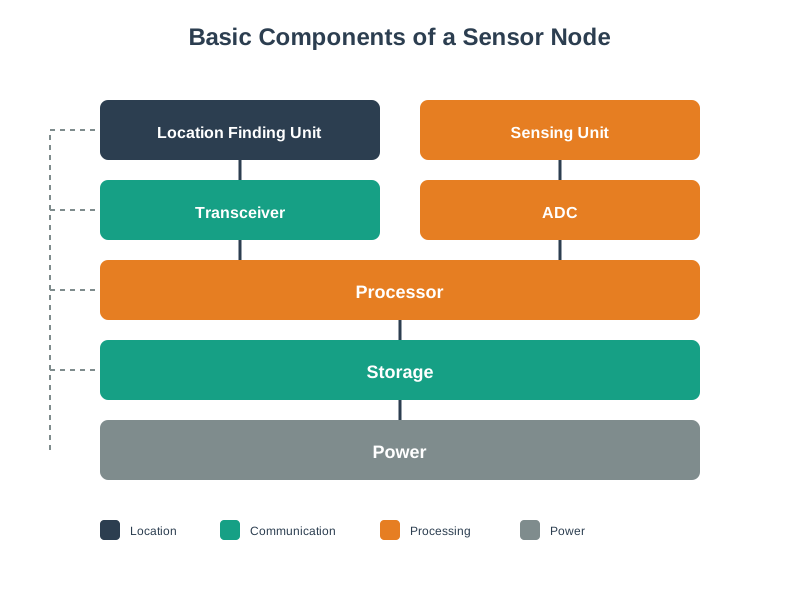
This visualization illustrates the foundational sensor node architecture referenced in the production framework, showing the components that can exhibit various behavior types.
NoteVisual: Sensor Field Deployment
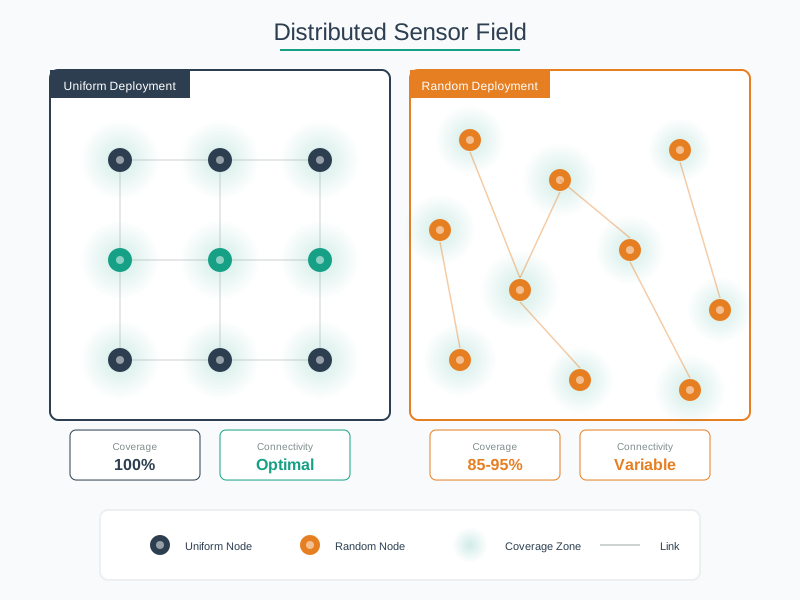
This figure depicts sensor field deployments covered in the production framework, showing how node behaviors affect overall network coverage and reliability.
NoteVisual: Sensor Network Clustering
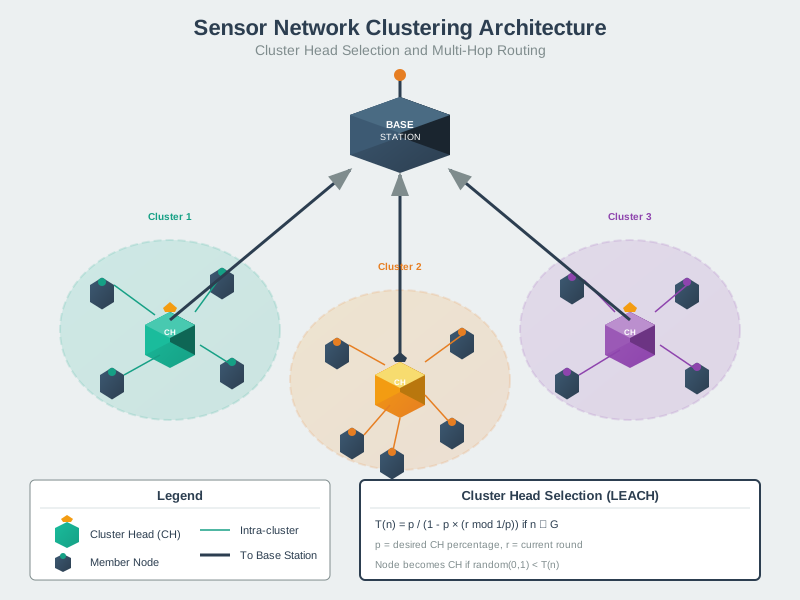
This visualization shows the cluster-based architecture underlying trust management systems, where cluster heads monitor member behavior and aggregate reputation scores.
NoteVisual: Sensor Data Fusion Pipeline
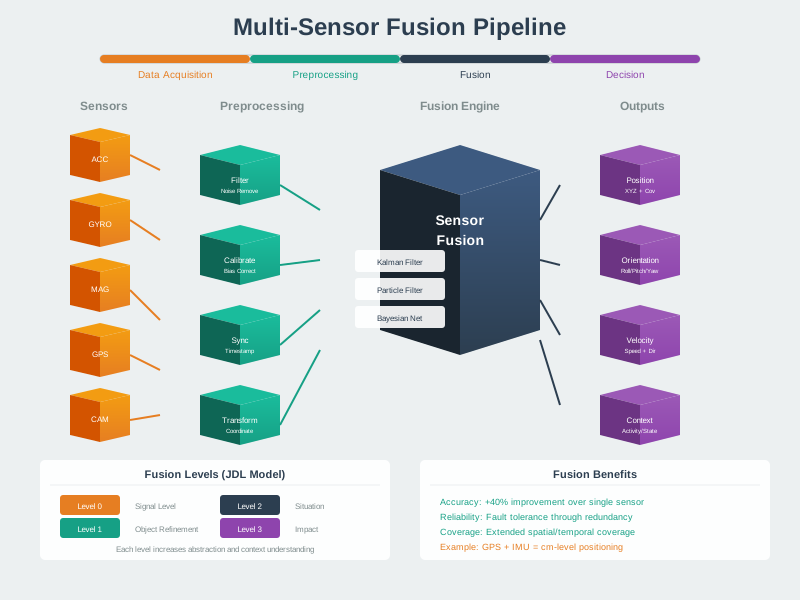
This figure illustrates the data processing pipeline discussed in the production framework, showing how InTSeM filtering and anomaly detection integrate with behavior classification.
487.5 Summary
This production framework provides comprehensive tools for real-world WSN deployments:
Sensor Data Processing Pipeline

Key Takeaways:
- Six-Class Behavior Model
- Normal: Perfect operation under good conditions
- Degraded: Reduced performance but functional
- Failed: Complete inability to operate
- Dumb: Temporary communication failure
- Selfish: Prioritizing self-interest over cooperation
- Malicious: Deliberately attacking network
- Trust-Based Security
- Watchdog nodes monitor packet forwarding
- Reputation scores decay with misbehavior
- Blacklisting isolates problematic nodes
- Five trust levels provide gradual response
- Adaptive Energy Management
- Event-driven duty cycle adjustment
- Social sensing for proactive activation
- Battery-aware power management
- 81% energy savings demonstrated
- Production Readiness
- Complete Python implementation
- Simulation examples with expected output
- Failure prediction and diagnosis
- Topology reconfiguration support
487.6 Further Reading
Node Behavior and Security: - Karlof, C., & Wagner, D. (2003). “Secure routing in wireless sensor networks: Attacks and countermeasures.” Ad Hoc Networks, 1(2-3), 293-315. - Stajano, F., & Anderson, R. (1999). “The resurrecting duckling: Security issues for ad-hoc wireless networks.” Security Protocols Workshop.
Duty Cycle and Energy Management: - Ye, W., Heidemann, J., & Estrin, D. (2002). “An energy-efficient MAC protocol for wireless sensor networks.” IEEE INFOCOM. - Tang, L., et al. (2011). “PW-MAC: An energy-efficient predictive-wakeup MAC protocol for wireless sensor networks.” IEEE INFOCOM.
Social Sensing: - Sakaki, T., et al. (2010). “Earthquake shakes Twitter users: Real-time event detection by social sensors.” WWW Conference. - Aggarwal, C. C., & Abdelzaher, T. (2013). “Social sensing.” Managing and Mining Sensor Data, Springer.
NoteRelated Chapters
Deep Dives: - Sensor Behaviors Fundamentals - Behavior taxonomy - Sensor Production Quiz - Assessment scenarios
Comparisons: - WSN Overview - Network-wide behavior management - Energy-Aware Design - Power optimization
Applications: - Sensor Fundamentals - Hardware characteristics - Mine Safety IoT - Safety-critical systems
487.7 What’s Next?
Test your understanding of production sensor behavior concepts with comprehensive scenarios.