%%{init: {'theme': 'base', 'themeVariables': { 'primaryColor': '#2C3E50', 'primaryTextColor': '#fff', 'primaryBorderColor': '#16A085', 'lineColor': '#16A085', 'secondaryColor': '#E67E22', 'tertiaryColor': '#ecf0f1'}}}%%
flowchart LR
    subgraph Devices["Non-IP Devices"]
        M[Modbus Sensor]
        Z[Zigbee Light]
        B[BACnet HVAC]
    end

    subgraph Gateway["IoT Gateway Functions"]
        PT[Protocol<br/>Translation]
        DB[Data<br/>Buffering]
        SF[Security<br/>Functions]
    end

    subgraph Cloud["Cloud Services"]
        MQTT[MQTT Broker]
        API[REST API]
    end

    M -->|RS-485| PT
    Z -->|Zigbee| PT
    B -->|BACnet| PT

    PT --> DB
    DB --> SF
    SF -->|MQTT/HTTP| MQTT
    SF --> API

    style M fill:#7F8C8D,stroke:#2C3E50,color:#fff
    style Z fill:#7F8C8D,stroke:#2C3E50,color:#fff
    style B fill:#7F8C8D,stroke:#2C3E50,color:#fff
    style PT fill:#2C3E50,stroke:#16A085,color:#fff
    style DB fill:#16A085,stroke:#2C3E50,color:#fff
    style SF fill:#E67E22,stroke:#2C3E50,color:#fff
    style MQTT fill:#16A085,stroke:#2C3E50,color:#fff
    style API fill:#16A085,stroke:#2C3E50,color:#fff
1332 Edge Data Acquisition: Power Management and Gateways
1332.1 Learning Objectives
By the end of this chapter, you will be able to:
- Calculate Power Budgets: Compute battery life for IoT devices based on duty cycling and transmission patterns
- Design Duty Cycling Strategies: Optimize active, transmit, and sleep cycles for maximum battery longevity
- Understand Gateway Functions: Explain how gateways enable non-IP devices to participate in IoT networks
- Implement Store-and-Forward: Design reliable data pipelines that survive network outages
1332.2 Prerequisites
Before diving into this chapter, you should be familiar with:
- Edge Data Acquisition: Architecture: Understanding device categories and connectivity paths
- Edge Data Acquisition: Sampling and Compression: Data reduction techniques for bandwidth optimization
- Basic electrical concepts: Familiarity with current, voltage, and power calculations
1332.3 Power Management and Duty Cycling
Battery life is the primary constraint for most edge IoT devices. Understanding power consumption patterns is essential for designing practical systems.
1332.3.1 Power States
Most IoT microcontrollers support multiple power states:
| State | ESP32 Current | Activity |
|---|---|---|
| Active | 80-240 mA | CPU + Wi-Fi active |
| Light Sleep | 0.8 mA | CPU paused, Wi-Fi off |
| Deep Sleep | 10 uA | Only RTC active |
| Hibernation | 2.5 uA | Only wake timer |
1332.3.2 Duty Cycling Formula
Average current consumption with duty cycling:
\[I_{avg} = \frac{t_{active} \times I_{active} + t_{tx} \times I_{tx} + t_{sleep} \times I_{sleep}}{t_{total}}\]
Where:
- \(t_{active}\) = time in active mode (sensing, processing)
- \(t_{tx}\) = time transmitting
- \(t_{sleep}\) = time in sleep mode
- \(I_{active}\), \(I_{tx}\), \(I_{sleep}\) = current draw in each mode
Battery life calculation:
\[Life_{hours} = \frac{Battery_{mAh}}{I_{avg}}\]
1332.3.3 Example Calculation
Scenario: ESP32 with 2500 mAh battery
| Mode | Duration (per hour) | Current | Energy Contribution |
|---|---|---|---|
| Active | 30 seconds | 80 mA | 0.667 mAh |
| Transmit | 10 seconds | 120 mA | 0.333 mAh |
| Deep Sleep | 3560 seconds | 0.01 mA | 0.010 mAh |
Average current: (30x80 + 10x120 + 3560x0.01) / 3600 = 0.55 mA
Battery life: 2500 mAh / 0.55 mA = 4,545 hours = 189 days
1332.3.4 Optimized Design
Reduce active to 5 seconds, transmit to 2 seconds:
| Mode | Duration (per hour) | Current | Energy Contribution |
|---|---|---|---|
| Active | 5 seconds | 80 mA | 0.111 mAh |
| Transmit | 2 seconds | 120 mA | 0.067 mAh |
| Deep Sleep | 3593 seconds | 0.01 mA | 0.010 mAh |
Average current: 0.19 mAh/hour = 0.11 mA
Battery life: 2500 mAh / 0.11 mA = 22,727 hours = 2.6 years
Improvement factor: 4.9x (from 6 months to 2.5+ years)
1332.4 Knowledge Check: Battery Life
1332.5 Gateway Functions for Non-IP Devices
Gateways serve as critical bridges between non-IP devices and the internet. Key functions include:
1332.5.1 Protocol Translation
- Convert sensor-specific protocols (Modbus, BACnet, Zigbee) to IP protocols
- Translate between MQTT, CoAP, and HTTP as needed
- Handle message format conversion (binary to JSON)
1332.5.2 Data Buffering
- Store data during network outages
- Batch multiple sensor readings for efficient transmission
- Implement store-and-forward for intermittent connectivity
1332.5.3 Security Functions
- Encrypt data before transmission to cloud
- Authenticate devices and manage credentials
- Filter and validate incoming commands
1332.6 Handling Missing Data
WarningCommon Pitfall: Missing Data Deletion
The mistake: Deleting rows with missing sensor values instead of using appropriate imputation or flagging strategies, losing valuable contextual information.
Symptoms:
- Dataset shrinks dramatically after preprocessing (e.g., 1M rows becomes 200K)
- Model accuracy drops when deployed despite good validation scores
- Time gaps in data break time-series analysis (autocorrelation, windowing)
- Critical events during sensor outages are completely missed
Why it happens: Beginners apply pandas dropna() liberally. In IoT, sensors fail intermittently due to battery depletion, network issues, or environmental factors. Deleting these rows removes entire time windows, including valid data from other sensors.
The fix: Use context-appropriate imputation strategies:
# For slow-changing values (temperature): forward-fill
df['temp'] = df['temp'].fillna(method='ffill', limit=60)  # Max 60 missing samples

# For periodic values: interpolation
df['humidity'] = df['humidity'].interpolate(method='time')

# For event-driven sensors: mark as "no event" vs "missing"
df['motion_event'] = df['motion'].fillna(0)  # No motion detected
df['motion_missing'] = df['motion'].isna()    # Track sensor status

# For critical analysis: flag and include in model
df['has_missing'] = df.isna().any(axis=1) # Create feature for missingnessPrevention: Track missing data rates per sensor as a health metric. Implement automated alerts when missingness exceeds 5%. Use “missing” as an informative feature rather than discarding it.
TipUnderstanding Missing Data Handling
Core Concept: Missing data in IoT streams is not just a nuisance to remove - it carries information about sensor health, network reliability, and environmental conditions that should inform your analysis strategy.
Why It Matters: IoT sensors fail differently than traditional data sources. A temperature sensor might return NULL during battery depletion, while a motion sensor returns 0 (no motion) when working perfectly. Blindly dropping rows with missing values discards valid readings from other sensors in the same time window and creates gaps that break time-series analysis. Worse, the pattern of missingness often reveals systematic problems - sensors failing every night suggest power issues, while random gaps suggest network congestion.
Key Takeaway: Never use dropna() without first analyzing WHY data is missing. For slow-changing values (temperature), forward-fill with a time limit. For event-driven sensors (motion), distinguish “no event” from “sensor offline” using a separate missing flag column. Always track missingness rate as a sensor health metric - a sudden increase from 1% to 10% missing readings often predicts complete sensor failure within days.
1332.7 Knowledge Check: Gateway Functions
1332.8 Visual Reference Gallery
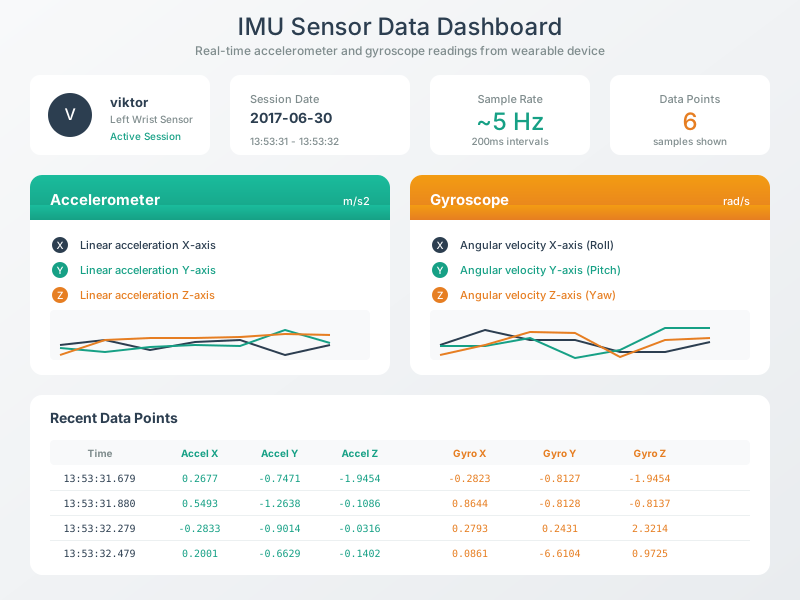
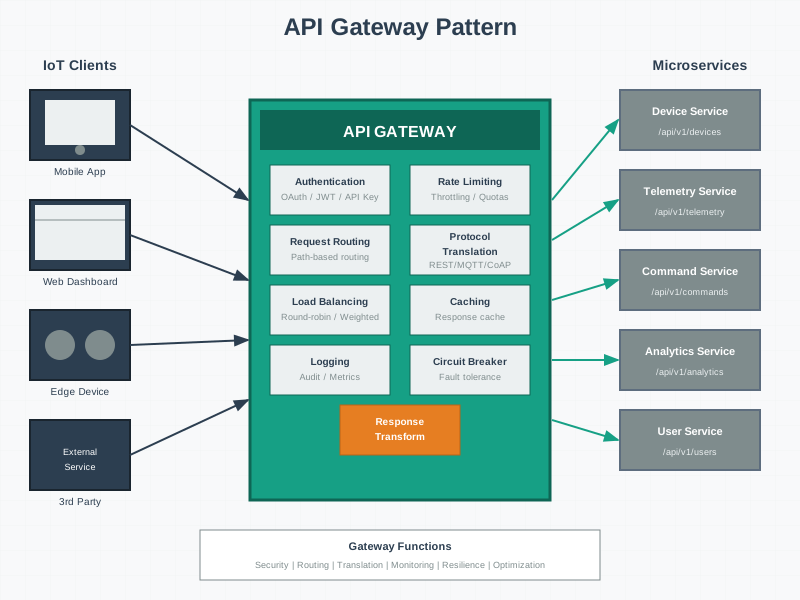
NoteAI-Generated Data Acquisition Diagrams
These AI-generated SVG diagrams provide alternative visual perspectives on edge data acquisition concepts covered in this chapter.


1332.9 Practice Exercises
NoteExercise 1: Power Budget Analysis and Battery Life Optimization
Objective: Calculate battery life for IoT devices with different duty cycling strategies and optimize for maximum longevity.
Tasks:
- Select a target device (ESP32 or nRF52): identify power consumption in each state (active: 80-240 mA, light sleep: 0.8 mA, deep sleep: 10 uA)
- Design baseline duty cycle: active 30s/hour (sensing + processing), transmit 10s/hour (Wi-Fi/BLE), sleep remainder
- Calculate average current and battery life with 2500 mAh battery using the formula
- Optimize duty cycle: reduce active to 5s/hour, transmit to 2s/hour; recalculate battery life improvement
Expected Outcome: Baseline design yields ~6 months battery life, optimized design achieves 2-3 years (4-5x improvement). Understand that transmission dominates power budget. Learn to batch transmissions and maximize sleep time.
NoteExercise 2: Gateway Store-and-Forward Implementation
Objective: Build a reliable gateway that buffers data during connectivity outages and implements intelligent synchronization.
Tasks:
- Set up edge gateway (Raspberry Pi) with local storage (SQLite database or time-series DB)
- Implement data pipeline: sensors to gateway (buffer to DB) to cloud (MQTT or HTTP POST)
- Add connectivity monitoring: ping cloud endpoint every 10s; if unreachable, set offline flag
- Simulate 15-minute outage: disconnect network, accumulate 900 sensor samples (1 sample/sec); reconnect and verify all data syncs with correct timestamps
Expected Outcome: Zero data loss during outage with proper temporal ordering after sync. Measure sync latency: 900 records should upload in <10 seconds. Understand buffer sizing: 1 GB storage handles ~10 million sensor readings at 100 bytes each = days of outages.
1332.10 Summary
Power management and gateway functions are critical for practical edge IoT deployments:
- Duty cycling: Maximize sleep time and batch transmissions - TX current dominates power budget
- Battery life: Optimized duty cycling extends battery life from months to years (4-5x improvement typical)
- Gateway functions: Protocol translation, store-and-forward buffering, and security are essential for non-IP device integration
- Missing data: Treat as information, not noise - use appropriate imputation and track as a health metric
1332.11 What’s Next
Continue to Multi-Sensor Data Fusion to learn techniques for combining data from multiple sensors to improve accuracy and reliability.
NoteRelated Chapters & Resources
Edge Computing:
- Edge Compute Patterns - Processing patterns and optimization
- Edge Fog Computing - Architecture overview
Sensing Context:
- Sensor Fundamentals - Data sources and sensor types
- Multi-Sensor Data Fusion - Combining data from multiple sources
Storage & Cloud:
- Data Storage and Databases - Storage options and database design
- Data in the Cloud - Cloud integration and platforms
Reviews & Practice:
- Edge Topic Review - Comprehensive review of edge computing
- Edge Comprehensive Review - Complete edge concepts review
- Edge Quiz Bank - Test your edge computing knowledge
Learning Hubs:
- Quiz Navigator - Data acquisition quizzes and interactive challenges
1332.12 Additional Resources
- AWS IoT Greengrass Documentation - Edge runtime for local compute and data caching
- Azure IoT Edge - Cloud intelligence deployed locally
- ESP-IDF Power Management - ESP32 power optimization