%% fig-cap: "Electromagnetic wave properties showing the inverse relationship between frequency and wavelength"
%% fig-alt: "Diagram illustrating electromagnetic wave characteristics with frequency measured in Hertz (cycles per second), wavelength measured in meters (distance between peaks), and the speed of light equation c = f × λ showing higher frequency corresponds to shorter wavelength and higher energy"
%%{init: {'theme': 'base', 'themeVariables': { 'primaryColor': '#2C3E50', 'primaryTextColor': '#2C3E50', 'primaryBorderColor': '#16A085', 'lineColor': '#16A085', 'secondaryColor': '#E67E22', 'tertiaryColor': '#ECF0F1', 'noteTextColor': '#2C3E50', 'noteBkgColor': '#ECF0F1'}}}%%
graph LR
    A["Electromagnetic Wave"] --> B["Frequency (f)<br/>Cycles per second<br/>Unit: Hertz (Hz)"]
    A --> C["Wavelength (λ)<br/>Distance between peaks<br/>Unit: meters (m)"]
    A --> D["Energy (E)<br/>Wave energy<br/>E = h × f"]

    B --> E["Higher Frequency<br/>2.4 GHz, 5 GHz<br/>More cycles/sec"]
    B --> F["Lower Frequency<br/>868 MHz, 433 MHz<br/>Fewer cycles/sec"]

    E --> G["Shorter Wavelength<br/>12.5 cm at 2.4 GHz<br/>Higher Energy"]
    F --> H["Longer Wavelength<br/>34.5 cm at 868 MHz<br/>Lower Energy"]

    style A fill:#2C3E50,stroke:#16A085,stroke-width:3px,color:#fff
    style E fill:#E67E22,stroke:#16A085,stroke-width:2px
    style F fill:#16A085,stroke:#2C3E50,stroke-width:2px,color:#fff
    style G fill:#E67E22,stroke:#16A085,stroke-width:2px
    style H fill:#16A085,stroke:#2C3E50,stroke-width:2px,color:#fff
803 Electromagnetic Waves and the Spectrum
803.1 Introduction
This chapter explores the fundamental physics of electromagnetic waves and the electromagnetic spectrum that enables wireless communication. Understanding these concepts is essential for making informed decisions about wireless technology selection in IoT applications.
NoteLearning Objectives
By the end of this chapter, you will be able to:
- Understand how electromagnetic waves enable wireless communication
- Compute wavelength from frequency and explain the frequency–wavelength–energy relationships
- Identify the electromagnetic spectrum regions and their characteristics
- Recognize where IoT technologies operate within the radio frequency spectrum
803.2 Prerequisites
Before diving into this chapter, you should be familiar with:
- Networking Basics for IoT: Understanding basic networking concepts provides context for wireless technologies
- Basic physics and mathematics: Familiarity with wave properties, frequency, and wavelength calculations
803.3 Fundamentals of Wireless Communication
TipCross-Hub Connections: Explore Related Resources
Knowledge Gaps Hub: - Common Misconceptions - Clarify confusion about “5 GHz is always faster” and “higher frequency = better range”
Videos Hub: - Video Resources - Watch visual explanations of electromagnetic waves, frequency spectrum, and wireless propagation
Simulations Hub: - Interactive Tools - Try RF spectrum analyzers and link budget calculators
Quizzes Hub: - Self-Assessment Quizzes - Test your understanding of frequency bands and wireless fundamentals
WarningCommon Misconception: “Higher Frequency Always Means Better Performance”
The Myth: Many IoT developers believe that higher frequencies (5 GHz, mmWave) always provide superior performance and should be preferred over lower frequencies (2.4 GHz, sub-GHz).
The Reality: Frequency selection involves fundamental physics trade-offs:
Real-World Data: - Range Comparison: A 915 MHz LoRa signal achieves 15 km rural range with 20 dBm TX power, while 5 GHz Wi-Fi achieves only 100-150 m outdoors with the same power—a 100× range difference - Penetration Loss: 2.4 GHz Wi-Fi experiences ~5 dB wall loss, 5 GHz Wi-Fi experiences ~7-10 dB wall loss, while 915 MHz sub-GHz experiences only ~2-3 dB wall loss—3-5× better building penetration at lower frequencies - Free Space Path Loss at 100m: - 433 MHz: ~55 dB path loss - 915 MHz: ~62 dB path loss - 2.4 GHz: ~72 dB path loss (10 dB worse than sub-GHz) - 5 GHz: ~78 dB path loss (16 dB worse than sub-GHz) - 28 GHz (5G mmWave): ~93 dB path loss (38 dB worse than sub-GHz)
Why This Matters: - Smart Agriculture: A farmer choosing 5 GHz Wi-Fi for field sensors would need 100+ access points, while 915 MHz LoRa covers the same area with 2-3 gateways—50× cost reduction - Smart Buildings: Elevators and concrete stairwells create “dead zones” for 5 GHz signals but 2.4 GHz and sub-GHz signals penetrate through, ensuring continuous coverage - Battery Life: Path loss directly impacts battery life—a device compensating for 16 dB higher path loss (5 GHz vs sub-GHz) must transmit at 40× higher power, draining batteries 40× faster
Correct Approach: Match frequency to use case requirements: - High data rate, short range, indoor: 5 GHz Wi-Fi (video streaming, AR/VR) - Moderate data rate, moderate range, mixed indoor/outdoor: 2.4 GHz (smart home, industrial monitoring) - Low data rate, long range, deep indoor penetration: Sub-GHz (smart meters, agriculture, parking sensors)
Higher frequency enables higher bandwidth but at the cost of range and penetration—there’s no universal “best” frequency, only the best match for your specific IoT application constraints.
NoteRelated Chapters
Wireless Technology Families: - Wi-Fi Fundamentals and Standards - 802.11 WLAN for local area networking - Bluetooth Fundamentals - BLE and Classic Bluetooth for personal area networks - LPWAN Fundamentals - Long-range, low-power wide-area networks - Cellular IoT Fundamentals - LTE-M, NB-IoT, and 5G IoT - RFID Fundamentals and Standards - Short-range identification - NFC Fundamentals - Near-field communication for tap experiences
Specific Protocols: - Zigbee Fundamentals and Architecture - Mesh networking at 2.4 GHz - LoRaWAN Overview - Sub-GHz long-range IoT - Thread Fundamentals - IPv6-based mesh for smart homes
Spectrum and Regulations: - Mobile Wireless Fundamentals - Deeper dive into wireless communications - Mobile Wireless Comprehensive Review - Complete wireless technology coverage
Network Design: - Wireless Network Design - Practical deployment considerations - Topologies Fundamentals - Network topology patterns
Foundational Concepts: - Networking Basics - Core networking principles - Physical Layer - Physical transmission fundamentals
Learning: - Videos Hub - Wireless technology video tutorials - Simulations Hub - Interactive spectrum demonstrations
803.3.1 Electromagnetic Waves
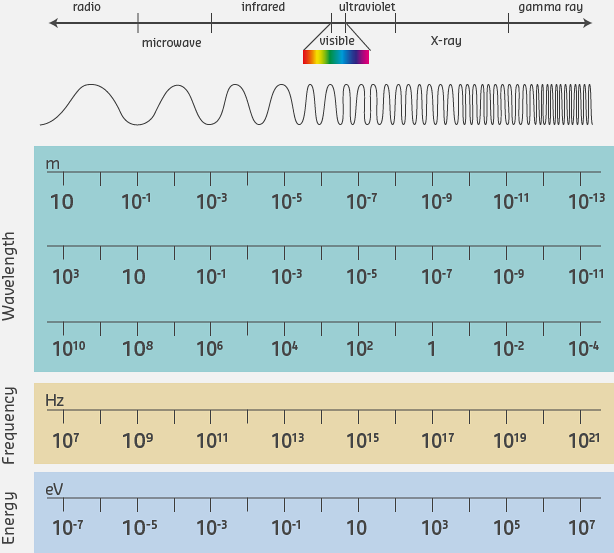
Wireless technologies use electromagnetic waves to carry information between devices. Unlike sound waves or water waves, electromagnetic waves (also called electromagnetic radiation) travel through space-time—they don’t need a medium like water or air to propagate. This property makes them ideal for wireless communication across various distances and environments.
Electromagnetic waves carry electromagnetic radiant energy and exhibit properties of both waves and particles. For wireless communication, we focus on their wave properties:
- Frequency (f): The number of wave cycles per second, measured in Hertz (Hz)
- Wavelength (λ): The physical distance between wave peaks, measured in meters
- Energy (E): The energy carried by the wave, related to frequency
803.3.2 The Wave-Energy Relationship
The fundamental relationships governing electromagnetic waves are:
\[ c = f \times \lambda \]
Where: - \(c\) = speed of light (approximately \(3 \times 10^8\) m/s) - \(f\) = frequency in Hertz (Hz) - \(\lambda\) = wavelength in meters (m)
This means: - Higher frequency → Shorter wavelength → Higher energy - Lower frequency → Longer wavelength → Lower energy
The energy of electromagnetic radiation is given by:
\[ E = h \times f \]
Where: - \(E\) = energy in Joules - \(h\) = Planck’s constant (\(6.626 \times 10^{-34}\) J·s) - \(f\) = frequency in Hz
803.4 The Electromagnetic Spectrum
803.4.1 Spectrum Overview
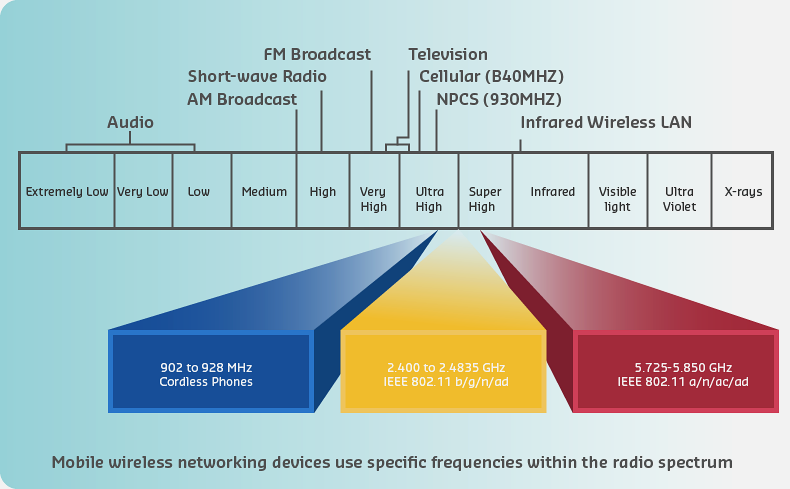
The electromagnetic spectrum encompasses all types of electromagnetic radiation, from radio waves to gamma rays. Visible light is just a small portion of this spectrum. The different regions are distinguished by their frequency and wavelength characteristics.
%% fig-cap: "Electromagnetic spectrum regions showing frequency and wavelength ranges"
%% fig-alt: "Complete electromagnetic spectrum from radio waves (lowest frequency, longest wavelength) through microwave, infrared, visible light, ultraviolet, X-rays, to gamma rays (highest frequency, shortest wavelength), with IoT wireless technologies operating in the radio and microwave regions"
%%{init: {'theme': 'base', 'themeVariables': { 'primaryColor': '#2C3E50', 'primaryTextColor': '#2C3E50', 'primaryBorderColor': '#16A085', 'lineColor': '#16A085', 'secondaryColor': '#E67E22', 'tertiaryColor': '#ECF0F1'}}}%%
graph LR
    A["Electromagnetic<br/>Spectrum"] --> B["Radio Waves<br/>3 kHz - 300 GHz<br/>IoT operates here"]
    A --> C["Microwave<br/>300 MHz - 300 GHz<br/>Wi-Fi, Cellular"]
    A --> D["Infrared<br/>300 GHz - 430 THz"]
    A --> E["Visible Light<br/>430-770 THz"]
    A --> F["Ultraviolet<br/>770 THz - 30 PHz"]
    A --> G["X-Rays<br/>30 PHz - 30 EHz"]
    A --> H["Gamma Rays<br/>> 30 EHz"]

    B --> I["Increasing Frequency →"]
    H --> I
    I --> J["← Decreasing Wavelength"]

    style A fill:#2C3E50,stroke:#16A085,stroke-width:3px,color:#fff
    style B fill:#16A085,stroke:#2C3E50,stroke-width:3px,color:#fff
    style C fill:#16A085,stroke:#2C3E50,stroke-width:2px,color:#fff
    style I fill:#E67E22,stroke:#16A085,stroke-width:2px
    style J fill:#E67E22,stroke:#16A085,stroke-width:2px
803.4.2 Radio Frequency Spectrum for IoT
Radio waves occupy the portion of the electromagnetic spectrum with the longest wavelength and the lowest frequency. This makes them ideal for wireless communication because:
- Long-range propagation: Lower frequencies travel farther
- Building penetration: Longer wavelengths pass through obstacles better
- Lower power requirements: Less energy needed for transmission
- Well-understood technology: Mature standards and components
%% fig-cap: "Radio frequency bands used for IoT applications"
%% fig-alt: "Radio spectrum allocation showing different frequency bands for IoT: sub-GHz bands (433/868/915 MHz) for long-range LPWAN, 2.4 GHz ISM band for Wi-Fi/Bluetooth/Zigbee, and 5 GHz band for high-speed Wi-Fi, with characteristics of range vs bandwidth trade-offs"
%%{init: {'theme': 'base', 'themeVariables': { 'primaryColor': '#2C3E50', 'primaryTextColor': '#2C3E50', 'primaryBorderColor': '#16A085', 'lineColor': '#16A085', 'secondaryColor': '#E67E22', 'tertiaryColor': '#ECF0F1'}}}%%
graph TB
    A["Radio Frequency<br/>Spectrum for IoT"] --> B["Sub-GHz Bands<br/>433, 868, 915 MHz"]
    A --> C["2.4 GHz ISM Band<br/>2.4 - 2.483 GHz"]
    A --> D["5 GHz Band<br/>5.15 - 5.875 GHz"]

    B --> B1["✓ Long Range 10+ km<br/>✓ Excellent Penetration<br/>✓ Low Power<br/>✗ Low Bandwidth"]
    C --> C1["✓ Global Availability<br/>✓ Balanced Range/Speed<br/>✗ Crowded Spectrum<br/>✗ Interference"]
    D --> D1["✓ High Bandwidth<br/>✓ Less Interference<br/>✗ Short Range<br/>✗ Poor Penetration"]

    B --> B2["LoRa, Sigfox<br/>NB-IoT, Z-Wave"]
    C --> C2["Wi-Fi, Bluetooth<br/>Zigbee, Thread"]
    D --> D2["Wi-Fi 5/6<br/>High-speed only"]

    style A fill:#2C3E50,stroke:#16A085,stroke-width:3px,color:#fff
    style B fill:#16A085,stroke:#2C3E50,stroke-width:2px,color:#fff
    style C fill:#E67E22,stroke:#16A085,stroke-width:2px
    style D fill:#E67E22,stroke:#16A085,stroke-width:2px
TipAlternative View: Frequency Band Selection Decision Tree
This variant helps you choose the right frequency band for your IoT application:
%%{init: {'theme': 'base', 'themeVariables': {'primaryColor': '#2C3E50', 'primaryTextColor': '#fff', 'primaryBorderColor': '#16A085', 'lineColor': '#16A085', 'secondaryColor': '#E67E22', 'tertiaryColor': '#7F8C8D'}}}%%
flowchart TD
    START["IoT Application"] --> Q1{"Range<br/>requirement?"}

    Q1 -->|"> 1 km"| SUB["Sub-GHz<br/>433/868/915 MHz<br/>LoRa, Sigfox"]
    Q1 -->|"< 100 m"| Q2{"Data rate<br/>needed?"}

    Q2 -->|"> 10 Mbps"| WIFI5["5 GHz Wi-Fi<br/>Video, streaming"]
    Q2 -->|"< 1 Mbps"| Q3{"Wall<br/>penetration?"}

    Q3 -->|"Critical"| WIFI24["2.4 GHz<br/>Wi-Fi, BLE, Zigbee"]
    Q3 -->|"Not critical"| WIFI5

    style START fill:#2C3E50,stroke:#16A085,color:#fff
    style Q1 fill:#E67E22,stroke:#2C3E50,color:#fff
    style Q2 fill:#E67E22,stroke:#2C3E50,color:#fff
    style Q3 fill:#E67E22,stroke:#2C3E50,color:#fff
    style SUB fill:#16A085,stroke:#2C3E50,color:#fff
    style WIFI24 fill:#16A085,stroke:#2C3E50,color:#fff
    style WIFI5 fill:#16A085,stroke:#2C3E50,color:#fff
The key trade-off: lower frequencies offer better range and penetration, higher frequencies offer more bandwidth.
803.5 Summary
This chapter covered the fundamental physics of electromagnetic waves and the electromagnetic spectrum:
Key Concepts: - Electromagnetic waves travel through space-time carrying electromagnetic radiant energy - Frequency, wavelength, and energy are interrelated: higher frequency means shorter wavelength and higher energy - The fundamental wave equation: \(c = f \times \lambda\) - The energy equation: \(E = h \times f\)
The Electromagnetic Spectrum: - Spans from radio waves (longest wavelength, lowest frequency) to gamma rays (shortest wavelength, highest frequency) - IoT primarily uses radio waves (3 kHz - 300 GHz) - Radio frequencies offer optimal balance of range, penetration, and power efficiency
Frequency Band Trade-offs: - Sub-GHz: Long range, excellent penetration, low bandwidth - 2.4 GHz: Balanced performance, global availability, crowded - 5 GHz: High bandwidth, short range, poor penetration
803.6 What’s Next
Continue your wireless fundamentals journey with these chapters:
- IoT Wireless Frequency Bands: Detailed exploration of 2.4 GHz, 5 GHz, and sub-GHz bands
- Spectrum Licensing and Propagation: Licensed vs unlicensed spectrum, regional variations, and path loss
- Design Considerations and Labs: Practical frequency selection frameworks and hands-on labs
- Knowledge Checks and Assessments: Test your understanding with scenario-based questions
803.7 References
Books: - “Wireless Communications: Principles and Practice” by Theodore S. Rappaport - “RF and Microwave Wireless Systems” by Kai Chang
Standards: - ITU Radio Regulations: International spectrum allocation - IEEE 802 Standards: Wireless LAN/PAN protocols