%%{init: {'theme': 'base', 'themeVariables': { 'primaryColor': '#2C3E50', 'primaryTextColor': '#fff', 'primaryBorderColor': '#16A085', 'lineColor': '#16A085', 'secondaryColor': '#E67E22', 'tertiaryColor': '#fff', 'noteTextColor': '#2C3E50', 'noteBkgColor': '#fff', 'textColor': '#2C3E50', 'fontSize': '14px'}}}%%
graph LR
    E[Exchange] -->|route| Q1[Main Queue]
    Q1 -->|consume| C[Consumer]
    C -.->|NACK requeue=false| Q1
    Q1 -->|failed messages| DLX[Dead Letter<br/>Exchange]
    DLX -->|route| DLQ[Dead Letter<br/>Queue]
    DLQ -->|manual investigation| A[Admin]

    style E fill:#E67E22,stroke:#16A085,stroke-width:2px,color:#fff
    style Q1 fill:#16A085,stroke:#2C3E50,stroke-width:2px,color:#fff
    style C fill:#2C3E50,stroke:#16A085,stroke-width:2px,color:#fff
    style DLX fill:#E67E22,stroke:#2C3E50,stroke-width:2px,color:#fff
    style DLQ fill:#7F8C8D,stroke:#2C3E50,stroke-width:2px,color:#fff
    style A fill:#2C3E50,stroke:#16A085,stroke-width:2px,color:#fff
1244 AMQP Features and Frame Types
1244.1 Learning Objectives
By the end of this chapter, you will be able to:
- Apply AMQP Security: Configure SASL authentication, TLS encryption, and access control lists
- Leverage Interoperability: Understand AMQP’s open standard benefits and multi-language support
- Debug AMQP Connections: Use protocol-level frame knowledge to troubleshoot messaging issues
- Analyze Frame Types: Examine AMQP 1.0 frame lifecycle from connection to message transfer
1244.2 Prerequisites
Before diving into this chapter, you should be familiar with:
- AMQP Core Architecture: Exchanges, queues, bindings, and the producer-broker-consumer model
- AMQP Messages and Delivery: Message structure and delivery guarantees
- Networking Basics: TCP connections, TLS, and authentication concepts
NoteRelated Chapters
Deep Dives: - AMQP Core Architecture - Exchanges, queues, and bindings - AMQP Messages and Delivery - Message structure and guarantees - AMQP Implementations and Labs - Hands-on broker setup
Security: - IoT Security Fundamentals - Security concepts - Transport Layer Security - TLS/SSL details
Related Protocols: - MQTT Security - MQTT authentication and encryption - CoAP Security - DTLS for CoAP
TipFor Beginners: AMQP Frames
Think of AMQP frames like envelopes for different types of communication:
- OPEN frame: “Hello, I want to connect” (like knocking on a door)
- BEGIN frame: “Let’s start a conversation” (opening a communication channel)
- ATTACH frame: “I want to send/receive messages” (establishing message link)
- TRANSFER frame: “Here’s a message” (actual data delivery)
- CLOSE frame: “Goodbye” (ending the connection)
Key terms:
| Term | Simple Explanation |
|---|---|
| Frame | Packet of data in AMQP protocol |
| Session | Logical channel within a connection |
| Link | Producer or consumer endpoint within a session |
| Flow Control | Managing how fast messages are sent |
| SASL | Authentication mechanism (username/password, certificates) |
1244.3 AMQP Routing Patterns
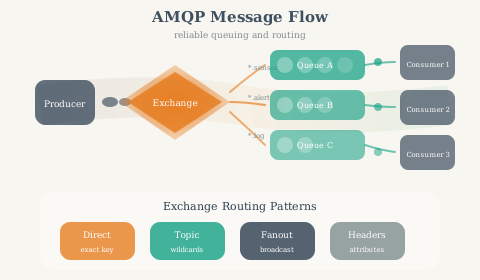
AMQP supports multiple routing patterns to address different messaging scenarios.
1244.3.1 Supported Patterns
1. Direct Routing (Point-to-Point):
- One producer, one consumer
- Messages go to specific queue
- Use case: Task assignment, direct commands
2. Publish-Subscribe (One-to-Many):
- One producer, multiple consumers
- Each consumer gets a copy
- Use case: Notifications, announcements
3. Topic-Based Routing (Pattern Matching):
- Route based on hierarchical patterns
- Wildcards for flexible subscriptions
- Use case: IoT sensor data distribution
4. Request-Reply (RPC Pattern):
- Producer sends request with reply-to queue
- Consumer processes and sends response
- Use case: Synchronous operations over async infrastructure
1244.4 Reliability Features
AMQP provides enterprise-grade reliability mechanisms.
1244.4.1 Persistent Messages
Messages can be configured to survive broker restarts.
Configuration:
delivery_mode=2: Message written to disk- Durable queues: Queue definition persists
- Durable exchanges: Exchange definition persists
Trade-offs:
| Mode | Persistence | Performance | Use Case |
|---|---|---|---|
| Transient | Memory only | High throughput | Telemetry, logs |
| Persistent | Disk + memory | Lower throughput | Critical data, orders |
1244.4.2 Dead Letter Handling
Failed messages are captured for investigation rather than lost.
Benefits:
- Prevents message loss on processing failures
- Enables debugging of problematic messages
- Supports retry workflows (move back to main queue after fix)
1244.5 Security
AMQP provides comprehensive security features for enterprise deployments.
1244.5.1 Authentication
AMQP supports multiple authentication mechanisms via SASL (Simple Authentication and Security Layer).
Supported mechanisms:
| Mechanism | Description | Use Case |
|---|---|---|
| PLAIN | Username/password | Development, simple deployments |
| EXTERNAL | X.509 certificates | Production, mutual TLS |
| ANONYMOUS | No authentication | Public read-only access |
| SCRAM-SHA-256 | Challenge-response | Secure password auth |
Example (RabbitMQ with username/password):
credentials = pika.PlainCredentials('app_user', 'secure_password')
parameters = pika.ConnectionParameters(
    host='broker.example.com',
    credentials=credentials,
    virtual_host='/production'
)
connection = pika.BlockingConnection(parameters)
1244.5.2 Encryption
AMQP supports TLS/SSL for transport security.
Configuration:
import ssl

ssl_context = ssl.create_default_context()
ssl_context.load_cert_chain(
    certfile='/path/to/client.crt',
    keyfile='/path/to/client.key'
)
ssl_context.load_verify_locations('/path/to/ca.crt')

parameters = pika.ConnectionParameters(
    host='broker.example.com',
    port=5671,  # AMQPS port
    credentials=credentials,
    ssl_options=pika.SSLOptions(ssl_context)
)
Best practices:
- Use TLS 1.2 or higher
- Require client certificates in production
- Rotate certificates regularly
- Use strong cipher suites
1244.6 Interoperability
AMQP is an open standard with broad ecosystem support.
1244.6.1 Open Standard Benefits
Multiple broker implementations:
| Broker | Organization | Strengths |
|---|---|---|
| RabbitMQ | VMware | Most popular, extensive plugins |
| Apache Qpid | Apache | AMQP 1.0 focus, Java ecosystem |
| Azure Service Bus | Microsoft | Cloud-native, enterprise integration |
| Amazon MQ | AWS | Managed RabbitMQ/ActiveMQ |
| Solace | Solace | High performance, IoT focus |
Protocol-level interoperability:
- Clients and brokers from different vendors work together
- No vendor lock-in
- Consistent behavior across implementations
1244.6.2 Language Support
AMQP has client libraries for all major programming languages:
| Language | Popular Libraries |
|---|---|
| Python | pika, aio-pika, kombu |
| Java | RabbitMQ Java, Apache Qpid JMS |
| JavaScript | amqplib, rhea |
| C# | RabbitMQ .NET |
| Go | streadway/amqp, Azure AMQP |
| Rust | lapin, amiquip |
| Ruby | bunny, march_hare |
Consistent API patterns:
# Python (pika)
channel.basic_publish(exchange='orders', routing_key='new', body=data)

# JavaScript (amqplib)
channel.publish('orders', 'new', Buffer.from(data))

# Java (RabbitMQ)
channel.basicPublish("orders", "new", null, data.getBytes())
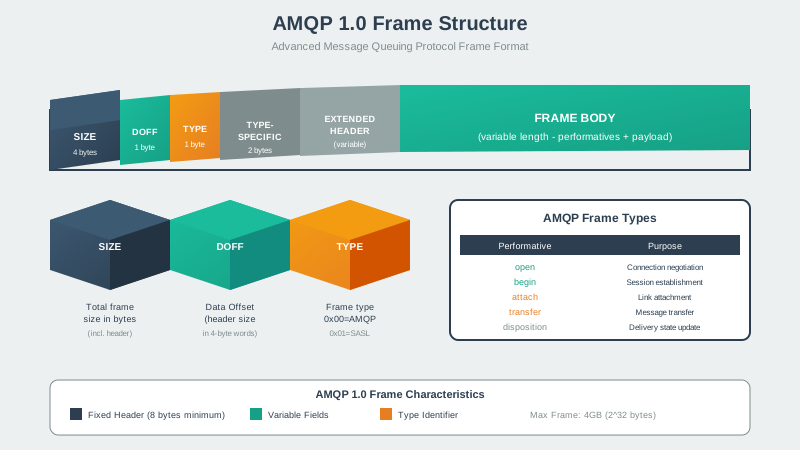
1244.7 AMQP 1.0 Frame Types
AMQP 1.0 uses nine frame types for protocol operation, providing a clear lifecycle from connection to message transfer.
1244.7.1 Frame Lifecycle
%%{init: {'theme': 'base', 'themeVariables': { 'primaryColor': '#2C3E50', 'primaryTextColor': '#fff', 'primaryBorderColor': '#16A085', 'lineColor': '#16A085', 'secondaryColor': '#E67E22', 'tertiaryColor': '#fff', 'noteTextColor': '#2C3E50', 'noteBkgColor': '#fff', 'textColor': '#2C3E50', 'fontSize': '13px'}}}%%
sequenceDiagram
    participant C as Client
    participant B as Broker

    C->>B: 1. OPEN (connection)
    B->>C: OPEN (confirm)
    C->>B: 2. BEGIN (session)
    B->>C: BEGIN (confirm)
    C->>B: 3. ATTACH (link)
    B->>C: ATTACH (confirm)
    C->>B: 4. FLOW (credits)
    loop Message Transfer
        C->>B: 5. TRANSFER (message)
        B->>C: 6. DISPOSITION (ACK)
    end
    C->>B: 7. DETACH (close link)
    C->>B: 8. END (close session)
    C->>B: 9. CLOSE (close connection)
1244.7.2 Frame Descriptions
| # | Frame | Direction | Purpose |
|---|---|---|---|
| 1 | OPEN | Bidirectional | Establish connection, negotiate capabilities |
| 2 | BEGIN | Bidirectional | Create session (logical channel) |
| 3 | ATTACH | Bidirectional | Create link (producer or consumer endpoint) |
| 4 | FLOW | Bidirectional | Manage credits (flow control) |
| 5 | TRANSFER | Sender→Receiver | Send message data |
| 6 | DISPOSITION | Bidirectional | Acknowledge/settle transfers |
| 7 | DETACH | Bidirectional | Close link |
| 8 | END | Bidirectional | Close session |
| 9 | CLOSE | Bidirectional | Terminate connection |
1244.7.3 Connection Layer (OPEN/CLOSE)
OPEN frame fields:
OPEN {
    container_id: "client-app-001"    # Unique identifier
    hostname: "broker.example.com"     # Virtual host
    max_frame_size: 65536              # Max frame size in bytes
    channel_max: 32767                 # Max channels
    idle_time_out: 120000              # Heartbeat interval (ms)
}
Purpose:
- Negotiate connection parameters
- Exchange capabilities
- Establish heartbeat interval
1244.7.4 Session Layer (BEGIN/END)
Sessions provide logical channels within a connection.
BEGIN frame fields:
BEGIN {
    remote_channel: null               # For new session
    next_outgoing_id: 0                # Transfer sequence number
    incoming_window: 1000              # Flow control window
    outgoing_window: 1000              # Flow control window
}
Purpose:
- Multiplex multiple message streams
- Provide ordering guarantees within session
- Enable flow control per session
1244.7.5 Link Layer (ATTACH/DETACH)
Links represent producer or consumer endpoints.
ATTACH frame fields:
ATTACH {
    name: "sensor-producer-link"       # Unique link name
    role: sender                       # sender or receiver
    source: { address: null }          # For sender: null
    target: { address: "sensor_queue" }# Destination queue
    snd_settle_mode: settled           # Delivery mode
}
Purpose:
- Create message endpoints (sender or receiver)
- Define delivery semantics
- Specify source/target addresses
1244.7.6 Transfer and Disposition
TRANSFER frame:
TRANSFER {
    handle: 0                          # Link handle
    delivery_id: 42                    # Unique delivery ID
    delivery_tag: <binary>             # Application correlation
    message_format: 0                  # Standard AMQP message
    settled: false                     # Requires acknowledgment
    more: false                        # Last fragment

    # Followed by message payload
}
DISPOSITION frame (acknowledgment):
DISPOSITION {
    role: receiver                     # Who is settling
    first: 42                          # First delivery ID
    last: 42                           # Last delivery ID
    settled: true                      # Final state
    state: accepted                    # accepted/rejected/released
}
1244.7.7 Flow Control (FLOW)
Flow frames manage credit-based flow control.
FLOW frame fields:
FLOW {
    next_incoming_id: 100              # Expected transfer ID
    incoming_window: 500               # Available receive capacity
    next_outgoing_id: 50               # Next transfer to send
    outgoing_window: 500               # Send capacity
    handle: 0                          # Link handle (optional)
    link_credit: 100                   # Messages consumer can accept
}
Credit-based flow control:
- Consumer grants credits to producer
- Producer can only send messages up to available credits
- Prevents consumer overload
- Enables backpressure signaling
1244.8 Visual Reference Gallery
NoteAMQP Architecture Diagrams
These visual references provide alternative perspectives on AMQP architecture and frame concepts.

1244.9 Knowledge Check
Test your understanding of AMQP features and frame types.
1244.10 Summary
This chapter covered advanced AMQP features and protocol frames:
- Routing Patterns: Applied direct, publish-subscribe, topic-based, and request-reply patterns for different messaging scenarios
- Reliability Features: Configured persistent messages, durable queues, and dead letter handling for enterprise-grade reliability
- Security Mechanisms: Implemented SASL authentication, TLS encryption, and access control lists
- Interoperability: Leveraged AMQP’s open standard benefits with multi-vendor broker support and language bindings
- Frame Types: Analyzed AMQP 1.0’s nine frame types (OPEN, BEGIN, ATTACH, FLOW, TRANSFER, DISPOSITION, DETACH, END, CLOSE) for protocol-level understanding
- Flow Control: Applied credit-based flow control to prevent consumer overload
1244.11 What’s Next
The next chapter AMQP vs MQTT and Use Cases compares AMQP and MQTT protocols, examining their strengths for battery-powered IoT devices, enterprise integration patterns, and hybrid architectures.