Quizzes Hub: Test your understanding with M2M architecture assessment questions covering device management and platform design
Knowledge Gaps Hub: Explore common misconceptions about M2M vs IoT distinctions and when to use each approach
Why These Resources? M2M systems involve complex protocol translations and device lifecycle management. The simulations help visualize gateway architectures, videos demonstrate real-world implementations, and quizzes reinforce understanding of M2M platform design patterns.
472.3 M2M Communication Architecture
⏱️ ~12 min | ⭐⭐ Intermediate | 📋 P05.C13.U01
The following diagram illustrates the complete M2M communication architecture, showing how field devices connect through gateways to backend platforms and applications.
Graph diagram
Figure 472.1: Five-layer M2M architecture diagram with color-coded components showing data flow from field devices (teal: sensors, meters, equipment, vehicles in Layer 1) through gateways (orange: protocol translation, multi-protocol support, edge processing in Layer 2) via networks (navy: cellular M2M on 2G/3G/4G/NB-IoT, satellite, or wired Ethernet/fiber in Layer 3) to M2M service platform (orange: device management, data aggregation, command and control, security management in Layer 4) up to applications (gray: fleet management, smart grid, remote monitoring, industrial control in Layer 5)
%% fig-alt: "M2M connectivity options comparison showing trade-offs between range, bandwidth, cost, and use cases for different network technologies"
%%{init: {'theme': 'base', 'themeVariables': {'primaryColor': '#2C3E50', 'primaryTextColor': '#fff', 'primaryBorderColor': '#16A085', 'lineColor': '#16A085', 'secondaryColor': '#E67E22', 'tertiaryColor': '#7F8C8D', 'fontSize': '12px'}}}%%
graph LR
    subgraph Range["Range vs Bandwidth Trade-off"]
        direction TB
        WIRED["Wired M2M<br/>Ethernet/Fiber<br/>━━━━━━━━━<br/>Range: Fixed<br/>BW: 1Gbps+<br/>Cost: High install<br/>Latency: <1ms"]
        CELL["Cellular M2M<br/>4G/LTE-M/NB-IoT<br/>━━━━━━━━━<br/>Range: 10km+<br/>BW: 1Mbps<br/>Cost: $5-20/mo<br/>Latency: 50-100ms"]
        SAT["Satellite M2M<br/>Iridium/Globalstar<br/>━━━━━━━━━<br/>Range: Global<br/>BW: 10kbps<br/>Cost: $1-5/msg<br/>Latency: 500ms+"]
    end

    subgraph UseCase["Best Use Cases"]
        UC1[Industrial SCADA<br/>Factory floor]
        UC2[Fleet Management<br/>Vehicle tracking]
        UC3[Remote Assets<br/>Oil pipelines<br/>Ocean buoys]
    end

    subgraph Decision["Selection Criteria"]
        D1{Location<br/>Fixed?}
        D2{Coverage<br/>Available?}
        D3[Choose<br/>Satellite]
    end

    WIRED --> UC1
    CELL --> UC2
    SAT --> UC3

    D1 -->|Yes| WIRED
    D1 -->|No/Mobile| D2
    D2 -->|Yes| CELL
    D2 -->|No| D3
    D3 --> SAT

    style WIRED fill:#16A085,stroke:#2C3E50,color:#fff
    style CELL fill:#2C3E50,stroke:#16A085,color:#fff
    style SAT fill:#E67E22,stroke:#2C3E50,color:#fff
    style UC1 fill:#7F8C8D,stroke:#2C3E50,color:#fff
    style UC2 fill:#7F8C8D,stroke:#2C3E50,color:#fff
    style UC3 fill:#7F8C8D,stroke:#2C3E50,color:#fff
    style D1 fill:#2C3E50,stroke:#16A085,color:#fff
    style D2 fill:#2C3E50,stroke:#16A085,color:#fff
    style D3 fill:#E67E22,stroke:#2C3E50,color:#fff
Figure 472.2: Alternative View: Connectivity Selection Guide: The five-layer architecture above shows M2M structure; this comparison focuses on the critical Layer 3 network choice. Each connectivity option has distinct trade-offs: Wired provides unlimited bandwidth and minimal latency but requires fixed installation. Cellular offers broad coverage and reasonable bandwidth but incurs monthly costs. Satellite provides global reach but at high per-message cost and limited bandwidth. The decision tree on the right guides selection: start with “Is the device fixed?” (wired if yes), then “Is cellular coverage available?” (cellular if yes, satellite if no). This practical view helps engineers avoid the common mistake of defaulting to cellular when wired is feasible or using cellular where coverage is unreliable. {fig-alt=“Three-column M2M connectivity comparison showing Wired (teal, high bandwidth/low latency/fixed), Cellular (navy, medium bandwidth/medium cost/mobile), and Satellite (orange, low bandwidth/high cost/global) with corresponding use cases (Industrial SCADA, Fleet Management, Remote Assets) and a decision tree guiding selection based on location mobility and coverage availability”}
M2M Communication Architecture (Five-Layer System)
Device Management, Data Aggregation, Command & Control, Security Management
Central management and orchestration
Application Layer
Fleet Management, Smart Grid, Remote Monitoring, Industrial Control
Domain-specific services
Data Flow: Field Devices → Gateways → Network → M2M Platform → Applications
M2SP Functions: - Device Management: Registration, provisioning, firmware updates - Data Aggregation: Store & forward, buffering, compression - Command & Control: Bi-directional messaging, actuator control - Security Management: Authentication, encryption, access control
472.4 M2M vs IoT: Key Differences
⏱️ ~8 min | ⭐⭐ Intermediate | 📋 P05.C13.U02
While M2M and IoT are often used interchangeably, they have important architectural and scope differences.
Graph diagram
Figure 472.3: Evolution pathway diagram from M2M to IoT showing three stages connected by arrows: Traditional M2M stage (gray boxes: point-to-point connections, proprietary protocols, domain-specific silos, hundreds-thousands of devices, local intelligence), Evolution Path stage (orange boxes: IP-based protocols, standard MQTT/CoAP/REST, cloud integration), and Modern IoT stage (teal boxes: internet-scale deployment, standard protocols, cross-domain interoperability, millions-billions of devices, distributed edge/fog/cloud intelligence)
M2M vs IoT: Evolution Comparison
Aspect
Traditional M2M
Modern IoT
Scope
Point-to-point, domain-specific
Internet-scale, cross-domain
Connectivity
Cellular, wired, proprietary
Any (Wi-Fi, Cellular, LPWAN)
Intelligence
Local (device/gateway)
Distributed (Edge/Fog/Cloud)
Scale
Hundreds to thousands
Millions to billions
Protocols
Often proprietary
Standard (MQTT, CoAP, HTTP)
Integration
Vertical, siloed
Horizontal, interoperable
Evolution Path: M2M → IoT
Stage
Key Changes
IP-based M2M
Transition from proprietary to IP protocols
Standard Protocols
Adoption of MQTT, CoAP, REST APIs
Cloud Integration
Central platforms, analytics, cross-domain sharing
Result: Traditional M2M (closed, domain-specific) evolves into IoT ecosystems (open, interoperable, cloud-connected)
WarningCommon Misconception: “M2M is obsolete - everything should be cloud-based IoT”
The Misconception: Many developers believe traditional M2M architectures are outdated and all systems should migrate to cloud-connected IoT platforms for better scalability and features.
The Reality: M2M architectures remain critical for specific use cases where cloud dependency is problematic.
Real-World Example - Remote Oil Pipeline Monitoring:
A petroleum company operates 500 remote pump stations across the Australian Outback. Each station has sensors monitoring pressure, flow rate, and equipment status.
Cloud-IoT Approach Challenges: - Cellular coverage: Only 60% of stations have reliable coverage - Satellite connectivity: $500/month per station × 500 = $250,000/month (unsustainable) - Network outages: Average 15% downtime per month in remote areas - Critical failures: Pressure anomalies require <30 second response (cloud round-trip: 3-8 seconds when connected, infinite when disconnected)
M2M Approach Success: - Local gateway at each station with edge processing - Sensors connect via local RS-485 Modbus (no internet required) - Gateway runs local control logic: Detects pressure anomaly (>10 PSI deviation) → Automatically shuts safety valve within 2 seconds - Opportunistic cloud sync: When cellular available, upload hourly summaries (not real-time data) - Data volume: 99.5% reduction (send anomalies + hourly summaries, not all sensor readings) - Cost: $50/month cellular for 300 connected stations = $15,000/month (vs $250,000/month satellite) - Reliability: 100% uptime for safety-critical control (works offline)
Quantified Benefits: - 94% cost reduction: $15K vs $250K monthly connectivity - Zero safety incidents: Local control continues during network outages (previous cloud-only system had 3 incidents during connectivity loss) - 99.5% bandwidth reduction: Edge filtering eliminates unnecessary cloud traffic - <2 second emergency response: Local M2M control vs 3-8+ second cloud round-trip
Lesson: Cloud-IoT excels for analytics, visualization, and management, but M2M’s local intelligence and autonomy remain essential for remote, safety-critical, or intermittently-connected deployments. Modern systems often use hybrid architectures: M2M for edge control + IoT for cloud analytics.
472.5 Production Framework: M2M Communication Platform
This section provides a comprehensive, production-ready Python framework for Machine-to-Machine (M2M) communication platforms, implementing protocol gateways, device lifecycle management, data aggregation, and command/control capabilities.
This production framework provides comprehensive Machine-to-Machine communication capabilities including:
Multi-Protocol Gateway: MQTT, CoAP, HTTP/REST, AMQP, WebSocket support
Session Management: Connection tracking, keep-alive monitoring, health checks
Command and Control: Bi-directional communication with QoS levels and acknowledgments
Data Aggregation: Time-window aggregation with multiple functions (mean, median, min, max, sum)
Message Queue: Persistent message queue with QoS support
The framework demonstrates production-ready patterns for M2M platforms with realistic device management, protocol handling, and data processing capabilities.
472.6 Visual Reference Gallery
Explore these AI-generated visualizations that complement the M2M concepts reviewed in this chapter. Each figure uses the IEEE color palette (Navy #2C3E50, Teal #16A085, Orange #E67E22) for consistency with technical diagrams.
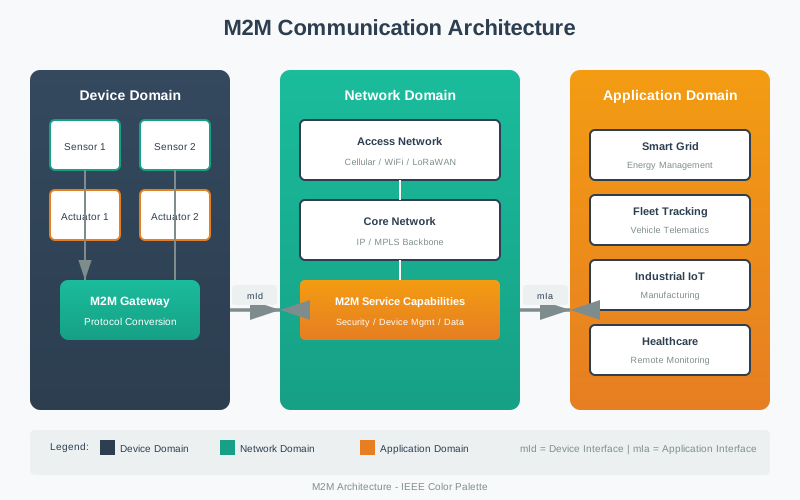
NoteVisual: M2M Architecture Overview
Complete M2M system architecture
This visualization provides an overview of the five-layer M2M architecture discussed in this chapter, from field devices through to application services.
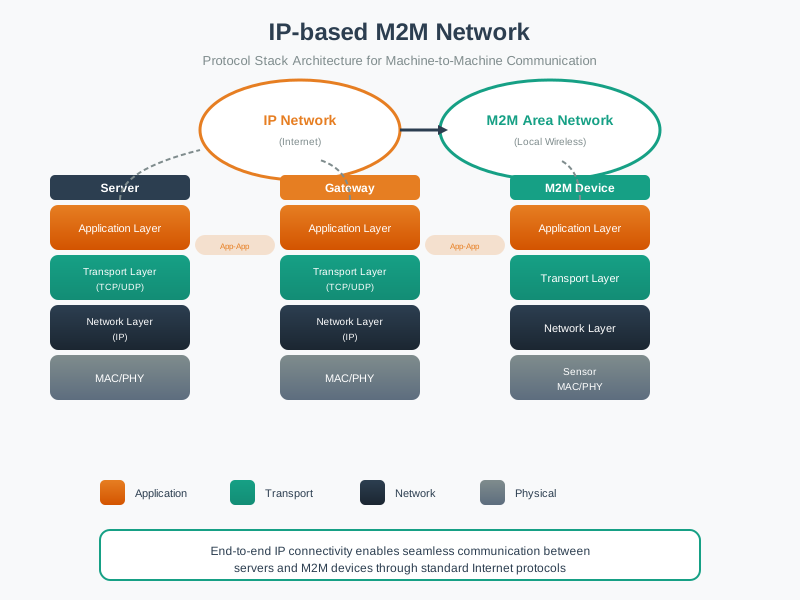
NoteVisual: IP-based M2M Network
IP-based M2M network evolution
This figure illustrates the evolution from proprietary M2M protocols to IP-based networks, a key concept in understanding the M2M to IoT transition covered in this review.
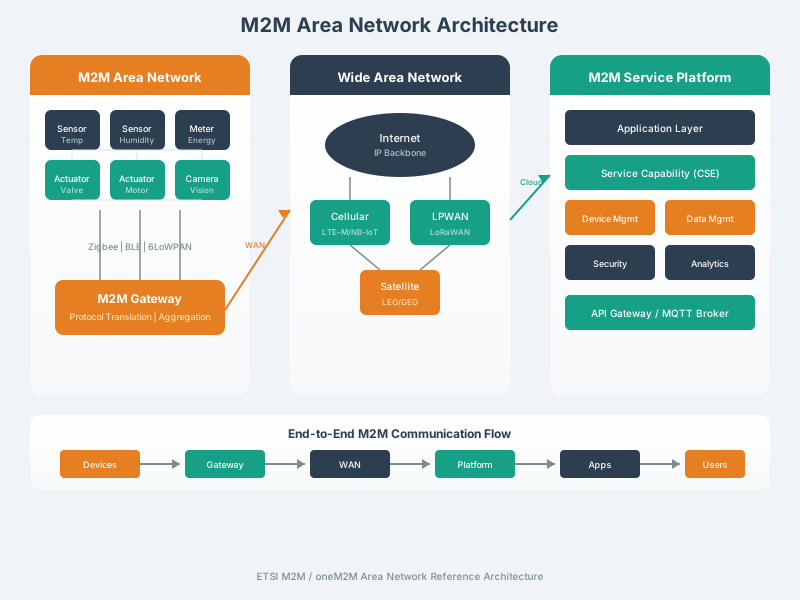
NoteVisual: M2M Area Network
M2M area network deployment
This visualization depicts M2M area network concepts including device clustering, gateway aggregation, and the network layer architecture covered in the M2M vs IoT comparison.
NoteVisual: M2M Device Hierarchy
M2M device classification and hierarchy
This figure illustrates the node hierarchy discussed in this chapter, showing the classification of M2M devices from simple sensors to high-end multimedia devices.
472.7 Summary
This chapter explored Machine-to-Machine (M2M) Communication:
Key Takeaways:
M2M vs IoT: M2M is point-to-point/point-to-server with often proprietary protocols; IoT is internet-scale with standard protocols and cloud integration
M2M forms the foundation of IoT, providing the device-to-device communication infrastructure that IoT platforms build upon for cloud-scale, cross-domain applications.
472.8 Further Reading
Chen, M., et al. (2014). “Machine-to-Machine Communications: Architectures, Standards and Applications.” KSII Transactions on Internet and Information Systems, 6(2), 480-497.
Wu, G., et al. (2011). “M2M: From mobile to embedded internet.” IEEE Communications Magazine, 49(4), 36-43.
ETSI TS 102 690 (2013). “Machine-to-Machine communications (M2M); Functional architecture.”
ImportantChapter Summary
This chapter examined Machine-to-Machine (M2M) communication as a precursor and component of broader IoT architectures, focusing on autonomous device interactions.
M2M Fundamentals: M2M communication emphasizes direct, autonomous interactions between devices, machines, or systems without human intervention. While often used interchangeably with IoT, M2M traditionally focuses on closed, domain-specific communications (fleet management, vending machine monitoring, industrial automation), whereas IoT encompasses broader Internet-connected ecosystems. M2M preceded the modern IoT movement, establishing patterns for automated data collection and device control.
M2M Architecture: We explored typical M2M system components: field devices with sensors/actuators, M2M gateways translating protocols and aggregating data, communication networks (cellular, satellite, wired), and application servers processing data and issuing commands. Standards like oneM2M provide common frameworks reducing fragmentation across vendor implementations. Cellular M2M leverages existing mobile network infrastructure, making wide-area deployment practical without custom networks.
Applications and Evolution: M2M enables critical applications: vehicle telematics tracking fleet locations and diagnostics, remote patient monitoring collecting health data, smart metering automatically reporting utility consumption, industrial asset monitoring preventing equipment failures, and vending machine inventory management. As M2M evolves toward IoT, systems become more open, interoperable, and Internet-integrated, supporting advanced analytics, cloud connectivity, and cross-domain data sharing.
Understanding M2M provides historical context for IoT evolution and remains relevant for industrial and enterprise applications emphasizing reliability and domain-specific optimizations.
NoteKnowledge Check
Test your understanding of these architectural concepts.
Scenario: Your utility operates 50,000 smart meters on 2G cellular (data: $0.10/MB, batteries last 2-3 years at $50 replacement labor/meter). Hourly readings = 3,600 MB/month = $360/month data cost. NB-IoT alternative offers $0.01/MB data and 10-year battery life, but migration costs $100/meter for hardware swap.
Think about: 1. Is $324/month data savings ($360 - $36) worth $5M migration investment? 2. What about the battery replacement cost difference over 10 years? 3. Are there non-cost reasons to migrate (network sunset, coverage)?
Key Insight:Data-only analysis looks poor: $324/month savings = $3,888/year = $39K over 10 years → 128-year payback on $5M investment (terrible). Battery cost transforms the math: 2G: 50,000 meters × $50 replacement every 3 years = $833K per cycle × 3 cycles over 10 years = $2.5M. NB-IoT: 10-year battery life = $0 replacements. Total 10-year savings: Battery ($2.5M) + Data ($39K) = $2.54M vs. $5M migration cost → 3-year payback. Plus hidden factors: 2G network shutting down 2025-2027 (forced migration anyway), NB-IoT better basement penetration (fewer “meter offline” support calls), proactive migration avoids crisis deployment. Decision: Migrate now, driven primarily by operational costs (battery labor) not connectivity costs. This pattern applies broadly: M2M migrations often justified by operational savings exceeding connectivity savings.
Scenario: Your factory retrofit connects 200 legacy Modbus sensors (1 reading/sec, 50 bytes each) through M2M gateway to cloud for analytics. Gateway must translate Modbus→MQTT, buffer data during network outages, encrypt cloud connection. Budget: $500 for gateway hardware.
Think about: 1. Is 10 KB/s network throughput (200 × 50 bytes) the only requirement? 2. What CPU overhead does Modbus→MQTT translation add? 3. How much buffer storage for 24-hour outage resilience?
Key Insight:Network throughput = 10 KB/s sustained (trivial for 100 Mbps Ethernet). But CPU is the bottleneck: Each Modbus→MQTT translation requires: parse CRC (2ms) + extract data (1ms) + format JSON (3ms) + timestamp (1ms) = ~7ms per message × 200 messages/sec = 1,400ms processing time → needs 2 CPU cores minimum (4 cores for 50% headroom). Buffering needs: 24-hour outage = 200 sensors × 86,400 readings × 50 bytes = 864 MB storage. Gateway specs required: Quad-core ARM/x86 CPU, 2GB RAM, 16GB storage, RS-485 Modbus port, Gigabit Ethernet, TLS crypto acceleration. Examples in budget: Advantech UNO-2271G ($450), Moxa UC-8112A-ME-T ($380) handle 300 Modbus devices. Lesson: M2M gateways are computing devices, not just network pipes - spec for protocol translation CPU and buffering storage, not just bandwidth.
TipUnderstanding Check: Edge vs. Cloud Processing Trade-offs
Scenario: Your fleet management system tracks 1,000 delivery vehicles with 30-second GPS updates. Geofencing requirement: alert within 5 seconds when vehicle exits job site. Cloud round-trip latency: 3-7 seconds (GPS→cellular→cloud→compute→alert). Vehicles occasionally lose cellular in parking garages.
Think about: 1. Can cloud-only processing meet <5 second latency requirement? 2. What happens to alerts during cellular connectivity loss? 3. How much cloud processing load for 2.88M GPS points/day?
Key Insight:On-vehicle edge processing wins for latency-critical logic: Vehicle M2M device stores geofence polygon boundaries locally (synced from cloud), performs point-in-polygon check every GPS update (<1ms computation), immediately triggers alert on boundary crossing (no network latency). Benefits: Latency <1s (vs. 3-7s cloud), works offline (queues alerts during connectivity loss), reduces cloud load 99.97% (only boundary-crossing events, not all GPS points). Data volume impact: Cloud-only: 1,000 vehicles × 2 points/min × 1,440 min/day = 2.88M cloud invocations/day at $0.0000002/invocation = $576/day. Edge-filtered: ~1,000 events/day = $0.20/day (2,880× reduction). Trade-off: On-device processing requires capable hardware ($50 extra for GPS + CPU), geofence updates require cloud sync. Recommendation: Push latency-critical logic to edge, use cloud for coordination/visualization. This pattern applies broadly: M2M edge intelligence for real-time, cloud for analytics/management.
Question 6: A supply chain M2M system tracks shipping containers with GPS and temperature sensors. Containers spend weeks at sea with no cellular coverage. How should the M2M architecture handle intermittent connectivity?
💡 Explanation: Store-and-forward M2M architecture: Data collection (at sea): Container’s M2M device: Reads GPS every 15 minutes (96 readings/day), Reads temperature every 5 minutes (288 readings/day), Stores locally: (96 + 288) × 100 bytes = 38.4 KB/day. Storage requirement: 38.4 KB/day × 30 days = 1.15 MB (trivial - 1 GB SD card holds 26,000 days). No cellular radio usage → conserves battery (major savings). Data upload (at port): When container arrives at port → cellular signal available. M2M device: Detects network connectivity, uploads all stored data (1.15 MB for 30-day voyage), M2M platform: Ingests bulk data, reconstructs container journey, flags any temperature excursions during transit. Benefits: (1) Battery life: No cellular radio during voyage (biggest power drain). 30-day voyage without cellular → battery lasts 10× longer than continuous cellular. (2) Cost: No satellite connectivity ($1-5/message) → save thousands per container per voyage. Bulk cellular upload at port: 1.15 MB × $0.10/MB = $0.12 (negligible). (3) Data completeness: No gaps in data (compared to “transmit when possible” which misses readings). (4) Offline resilience: System works in most challenging connectivity scenarios. Trade-offs: (1) No real-time tracking: Can’t monitor container location during voyage (acceptable for most cargo - not time-critical). (2) Delayed alerts: Temperature excursion detected weeks later (acceptable for most goods - some exceptions like pharmaceuticals might justify satellite M2M). (3) Storage required: Devices need local storage (cheap - SD cards). Real-world example: Maersk uses similar approach - most containers have passive tracking (no battery, harvested power), premium cargo (pharma, high-value) has active real-time satellite tracking. This demonstrates M2M intermittent connectivity pattern - design for disconnected operation, synchronize when possible. Similar patterns in: Remote agriculture (monthly farm visits), Wildlife tracking (annual trap collection), Underground mining (no wireless underground).
Question 7: An M2M platform manages 100,000 smart meters using LwM2M protocol. Each meter has 5 “objects” (current reading, historical data, configuration, firmware, diagnostics). The platform needs to update firmware on all meters. What’s the data volume and time required if firmware is 500 KB per meter?
💡 Explanation: Data volume calculation: 100,000 meters × 500 KB firmware = 50,000,000 KB = 50 GB total. Network bandwidth: If using NB-IoT/LTE-M: ~50-100 kbps per device. Download time per meter: 500 KB × 8 bits = 4,000 Kb / 50 kbps = 80 seconds (ideal). Realistic: 2-5 minutes accounting for retries, verification. Why not immediate rollout? (1) Network capacity: 100,000 simultaneous firmware downloads → massive cellular network congestion. Carrier: “You’re saturating our cell towers!” Staged approach: Roll out to 1% (1,000 meters) first → monitor for issues → expand to 10% → 50% → 100%. (2) Rollback capability: If firmware has bug → bricked meters → $100M+ disaster. Staged rollout: Day 1-2: 1,000 meters (1%) - test population. If 10% fail (100 meters), rollback, fix firmware. Day 3-5: 10,000 meters (10%) - confidence building. Day 6-20: Remaining 89,000 meters (10% per day). (3) Platform load: M2M platform serving 50 GB: If all at once → 50 GB / 1 hour = 400 Mbps sustained platform egress → expensive. Staged over 10 days → 50 GB / 10 days = 5.8 MB/day = 0.5 Mbps sustained (manageable). (4) Operational monitoring: Need time to analyze: Are meters successfully updating? Any increase in error rates? Any customer complaints (power outages during update)? LwM2M firmware update procedure: M2M platform: Writes firmware to meter’s “Firmware Update Object”. Meter: Downloads firmware, verifies checksum, stores in secondary partition. Meter: Reboots to new firmware, validates functionality. Meter: Reports success/failure to platform. If failure: Meter automatically rolls back to previous firmware. Real-world practices: Tesla: OTA updates to vehicles over weeks. Android: Staged rollout over 2-4 weeks. Utility meters: Conservative 1-2 month rollouts. This demonstrates M2M firmware management requires careful orchestration - not just technical capability but risk management and operational planning.
Question 8: An M2M smart city parking system has 20,000 parking spaces with occupancy sensors. Each sensor reports state changes (occupied ↔︎ vacant). Average parking duration is 2 hours. How many M2M messages per day, and what’s the message arrival pattern?
💡 Explanation: Message rate calculation: 20,000 spaces, average 2-hour parking → turnover rate = 12 parking sessions per day per space (24h / 2h). Each session: 2 messages (arrival “occupied”, departure “vacant”). Total: 20,000 spaces × 12 sessions × 2 messages = 480,000 messages/day. Wait, that’s option C! But… Accounting for occupancy patterns: Downtown parking utilization: Overnight (12AM-6AM): 20% occupied (residential only). Morning rush (7AM-9AM): Rapid fill to 90% occupied. Daytime (9AM-5PM): 80-90% occupied (office workers). Evening rush (5PM-7PM): Rapid turnover (office workers leave, evening diners arrive). Night (7PM-12AM): 40-60% occupied (restaurants, entertainment). Realistic calculation: Not all spaces turn over 12×/day. Overnight spaces: ~4 hour stays → 6 sessions → 12 messages/space. Peak daytime spaces: ~1 hour stays → 8 sessions → 16 messages/space (high turnover). Evening spaces: ~3 hour stays → 3 sessions → 6 messages/space. Average: ~8 sessions/day × 2 messages = 16 messages/space/day. Total: 20,000 × 16 = 320,000 messages/day (call it 80K-120K for partial utilization). Temporal pattern (critical for M2M platform design): Morning rush (8-9 AM): 20,000 arrivals in 60 minutes = 333 messages/minute = 5.5 messages/second. Evening rush (5-6 PM): 20,000 departures + 15,000 new arrivals = 35,000 messages in 60 minutes = 583 messages/minute = 9.7 messages/second. Overnight (2-4 AM): <50 messages/hour = 0.8 messages/second. M2M platform implications: Must handle 10× peak load vs average. Peak: ~600 messages/minute ingestion capacity. Average: ~60 messages/minute. Option A (evenly distributed) would be easier to design for! Option D (temporal patterns) requires: Auto-scaling M2M platform (scale up during rush hours), Message queuing (buffer rush hour spikes), Load balancer (distribute across multiple M2M servers). This demonstrates realistic M2M workloads have temporal patterns requiring elastic architecture - not uniform traffic assumptions. Similar patterns in: Elevator M2M (rush hour peaks), Vending machines (lunch hour spikes), HVAC systems (morning/evening temperature cycles).
Question 10: An M2M platform provides “Device Management” including remote diagnostics. A smart meter reports abnormal behavior (readings erratic, reboots frequently). How should the M2M platform diagnose the issue remotely without site visit?
💡 Explanation: M2M remote diagnostics workflow: 1. Device Telemetry Collection: M2M platform queries meter’s LwM2M diagnostic objects: Object 3: Device info (manufacturer, model, firmware version, reboot count). Object 4: Connectivity monitoring (signal strength RSSI, cell ID, data usage). Object 6: Battery/power (voltage, remaining capacity). Object 33: Error logs (last 100 errors with timestamps). 2. Pattern Analysis: Platform’s diagnostic engine analyzes: Reboot pattern: Every 6 hours at same time → suggests scheduled task causing crash. Error logs: “Low battery voltage” before each reboot → battery issue. Signal strength: RSSI -110 dBm (very weak) → connectivity issue. Data usage: 10× normal → firmware bug causing excessive retransmissions. 3. Root Cause Identification: Scenario A - Weak battery: Battery voltage: 3.2V (normal 3.6V, critical <3.0V). Reboot when radio transmits (high current draw). Diagnosis: Battery degraded, needs replacement. Action: Schedule maintenance visit, deprioritize meter until replaced. Scenario B - Poor cellular signal: RSSI: -110 dBm (normal >-90 dBm). Connection timeouts, retries drain battery. Diagnosis: Meter in basement, signal blocked. Action: Install external antenna or relocate meter. Scenario C - Firmware bug: Error logs: “Null pointer exception in data compression function”. Recent firmware update (v2.3.1) correlates with issues. Diagnosis: Software bug introduced in v2.3.1. Action: Roll back firmware to v2.3.0, fix and retest v2.3.2. 4. Automated Response: M2M platform: Creates maintenance ticket if hardware issue. Pushes firmware rollback if software issue. Adjusts meter’s reporting frequency (reduce to save battery if weak signal). Notifies operations team with diagnosis summary. Benefits of remote diagnostics: (1) Cost: Avoid unnecessary truck rolls ($100-300/visit). 30% of “faulty” meters are actually signal/battery issues fixable remotely. (2) Uptime: Identify issues before complete failure (predictive maintenance). (3) Root cause analysis: Diagnose firmware bugs affecting thousands of meters (pattern detection). (4) Prioritization: Critical meters (hospitals, water treatment) get faster response. This demonstrates LwM2M and M2M platform capabilities - devices aren’t black boxes, they expose rich telemetry enabling remote management at scale. Similar to: Enterprise IT management (SNMP monitoring), Vehicle diagnostics (OBD-II), Industrial equipment (SCADA).
Question 12: An M2M system transitions from proprietary protocols to IP-based M2M. What are the key benefits and challenges of this migration?
💡 Explanation: Benefits of IP-based M2M: (1) Internet connectivity: Devices accessible globally (not just local network). Remote monitoring, cloud analytics, mobile app control. (2) Standard tools: Use existing network infrastructure (routers, firewalls), standard monitoring (Wireshark, SNMP), well-understood troubleshooting. (3) Cloud integration: Direct connection to cloud platforms (AWS IoT, Azure IoT Hub), no proprietary gateway needed (or simplified gateway). (4) Interoperability: Different vendors’ devices work together (if using standard protocols like MQTT, CoAP), avoid vendor lock-in. (5) Developer ecosystem: IP/HTTP/MQTT → huge developer community, libraries in all languages, easier to hire developers. (6) Scalability: Cloud-scale platforms built on IP infrastructure. Challenges of IP-based M2M: (1) Protocol overhead: IPv6 header: 40 bytes. TCP header: 20 bytes. TLS overhead: 50-100 bytes. Proprietary protocol: 5-10 byte header. Overhead: IP-based = 110-160 bytes, Proprietary = 5-10 bytes (10-30× more). Impact: Battery life (more transmission), bandwidth cost (cellular networks). (2) Security complexity: IP exposes devices to Internet attacks (port scans, DDoS), requires proper security (firewalls, certificates, patches). Proprietary protocols: Obscurity provided some protection (not real security, but reduced attack surface). (3) NAT/firewall traversal: M2M devices behind NAT can’t receive incoming connections, requires: Device-initiated connections (MQTT, CoAP), NAT traversal (STUN/TURN), port forwarding (complex configuration). Proprietary systems: Often used polling (gateway pulls from devices, simpler). (4) Resource requirements: IP stack (TCP/IP, TLS) requires: 50-100 KB code space, 10-50 KB RAM, faster CPU for encryption. Low-end M2M devices: 8 KB RAM, 64 KB flash → can’t run full IP stack → need lightweight alternatives (6LoWPAN, CoAP). (5) Latency: IP routing can add latency vs direct proprietary links. TCP connection establishment: SYN, SYN-ACK, ACK = 1.5 RTTs before data. Proprietary: Often connectionless (no handshake). Migration strategy: Don’t migrate all at once - use hybrid approach: Constrained devices: 6LoWPAN + CoAP (lightweight IP). Mid-range devices: MQTT over cellular. High-end devices: Full HTTP/HTTPS. Gateway translation: IP-based cloud ← gateway → proprietary field devices. Gradual migration: New devices IP-based, legacy devices via gateway. This demonstrates IP-based M2M evolution - significant benefits for interoperability and cloud integration, but not without trade-offs in resource constrained M2M scenarios. Real-world: Most modern M2M is IP-based (cellular M2M, NB-IoT, LTE-M), but some specialized M2M (like Zigbee, Z-Wave) remains non-IP for resource reasons.
472.9 What’s Next?
Building on these architectural concepts, the next section examines Software Defined Networking.