946 IEEE 802.15.4: Topic Review
946.1 Learning Objectives
By the end of this review, you will be able to:
- Summarize 802.15.4 Features: Recall key specifications including data rates, range, and power
- Compare Frequency Bands: Understand 2.4 GHz, 868 MHz, and 915 MHz trade-offs
- Distinguish Network Types: Compare beacon-enabled vs non-beacon operation modes
- Evaluate Device Types: Understand FFD vs RFD capabilities and use cases
- Apply Security Features: Implement AES-128 encryption and authentication
- Connect to Higher Layers: Understand how Zigbee, Thread, and 6LoWPAN build on 802.15.4
946.2 Prerequisites
Required Chapters:
- 802.15.4 Fundamentals - Core standard
- 802.15.4 Comprehensive Review - Full review
- Zigbee Overview - Upper layer
Deep Dives:
- 802.15.4 Fundamentals - Complete introduction
- 802.15.4 Comprehensive Review - Detailed specification
- 802.15.4 Quiz Bank - Practice questions
Higher-Layer Protocols:
- Zigbee Fundamentals and Architecture - Mesh networking
- Thread Fundamentals and Roles - IPv6 mesh
- 6LoWPAN Fundamentals and Architecture - IPv6 compression
Comparisons:
- Bluetooth Comprehensive Review - BLE comparison
- LPWAN Comparison and Review - Long-range protocols
Architecture:
- Wireless Sensor Networks - WSN context
- Network Design and Simulation - Design tools
Learning:
- Quizzes Hub - All 802.15.4 quizzes
- Simulations Hub - Interactive calculators
This Quick Review Covers:
| Topic | Key Points |
|---|---|
| PHY Layer | Frequency bands, data rates |
| MAC Layer | CSMA/CA, frame types |
| Addressing | Short vs extended |
| Security | AES-128 encryption |
Estimated Time: 20 minutes (index) + 60 minutes (detailed chapters)
946.3 Review Chapters
This topic review has been organized into focused chapters for better learning:
| Chapter | Topics Covered | Time |
|---|---|---|
| Protocol Stack and Specifications | Stack architecture, frequency bands, channel planning, 802.15.4 variants | 15 min |
| Frame Structure and Security | MAC frames, addressing modes, security levels, AES-128 | 15 min |
| Device Types and Network Operations | FFD vs RFD, beacon modes, superframe structure, CSMA-CA | 15 min |
| Higher-Layer Protocols and Performance | Zigbee, Thread, 6LoWPAN, throughput, latency, battery life | 15 min |
Learning Resources:
- Quizzes Hub - 802.15.4 quiz bank with 50+ questions
- Simulations Hub - Range calculator, power budget tool
- Videos Hub - Protocol operation animations
- Knowledge Map - 802.15.4’s place in IoT networking
Self-Assessment:
- Test understanding with 802.15.4 Quiz Bank
- Compare with Bluetooth Comprehensive Review
- Explore applications in Wireless Sensor Networks
Misconception 1: “802.15.4 data rate = application throughput”
Reality: PHY rate (250 kbps) includes ALL overhead. Actual application throughput is 40-80 kbps (68-84% overhead from MAC headers, CSMA-CA backoffs, ACKs, inter-frame spacing).
Quantified Impact: Sending 1000 bytes of application data at 250 kbps PHY:
- Theoretical time: 32 ms (1000 bytes x 8 bits / 250,000 bps)
- Actual time: 160-200 ms (5-6x longer due to overhead)
- Throughput efficiency: 16-32% of PHY rate
Misconception 2: “FFDs consume more power than RFDs”
Reality: Power consumption depends on duty cycle, not device type. An FFD end device with 0.1% duty cycle can match RFD battery life (5-7 years on CR2032).
Quantified Impact: Battery life comparison (CR2032, 220 mAh):
- FFD coordinator (100% RX): 11 hours
- FFD end device (0.1% duty): 5-7 years (identical to RFD)
- RFD sensor (0.1% duty): 5-7 years
- Key factor: Duty cycle (0.1% vs 100% = 1000x difference)
Misconception 3: “802.15.4 channels don’t overlap with Wi-Fi”
Reality: 2.4 GHz 802.15.4 channels significantly overlap with Wi-Fi. Only channels 15, 20, 25, 26 minimize overlap with Wi-Fi channels 1, 6, 11.
Quantified Impact: Channel overlap analysis:
- 802.15.4 channel 11 (2405 MHz): 100% overlap with Wi-Fi channel 1
- 802.15.4 channel 18 (2440 MHz): 100% overlap with Wi-Fi channel 6
- 802.15.4 channel 25 (2475 MHz): <10% overlap with Wi-Fi channel 11
- Packet loss increase: 20-60% on overlapped channels in dense Wi-Fi environments
Misconception 4: “Beacon-enabled mode always saves power”
Reality: Non-beacon mode often consumes less power for infrequent, event-driven traffic. Beacons waste energy for devices that transmit rarely.
Quantified Impact: Power comparison for sensor transmitting once per hour:
- Non-beacon: Transmit only when needed (0.003% duty cycle)
- Beacon (BO=8): Listen to beacons every 3.93s (0.64% duty cycle)
- Power difference: Beacon mode uses 213x more energy (640 uA vs 3 uA average)
- Battery life: Non-beacon = 8 years, Beacon = 1.4 years (same device)
What is this chapter? Topic-based review of IEEE 802.15.4 standard concepts, organized into focused learning modules.
When to use:
- After studying 802.15.4 fundamentals
- When reviewing specific topics
- Before assessments
Recommended Learning Path:
- Read the Key Takeaways below for overview
- Work through each focused chapter in order
- Test with Quiz Bank
Prerequisites:
- 802.15.4 Fundamentals
- Understanding of wireless networking basics
947 IEEE 802.15.4: Comprehensive Review
947.1 Chapter Summary
IEEE 802.15.4 is the foundational standard for low-rate wireless personal area networks in IoT:
Core Features:
- Low Power: < 1% duty cycle, years on battery
- Low Data Rate: 20-250 kbps (sufficient for sensors/actuators)
- Low Cost: Minimal hardware requirements (especially RFDs)
- Short to Medium Range: 10-75m typical, up to 1000m best case
- Reliable: DSSS modulation, CSMA/CA, ACK mechanism
Frequency Bands:
- 2.4 GHz: 16 channels, 250 kbps, worldwide
- 868 MHz: 1 channel, 20 kbps, Europe
- 915 MHz: 10 channels, 40 kbps, Americas
Network Types:
- Non-Beacon: Asynchronous, unslotted CSMA/CA, lower power for infrequent TX
- Beacon-Enabled: Synchronized, superframe structure, GTS for time-critical data
Device Types:
- FFD (Full Function Device): Can be coordinator, router, or device; talks to all
- RFD (Reduced Function Device): End device only; talks to FFD only; minimal resources
Variants for Specialized Applications:
- 802.15.4a: UWB for precise positioning
- 802.15.4e: Industrial automation with deterministic latency (TSCH)
- 802.15.4g: Smart grid with long range (2-5 km)
Frame Types:
- Beacon: Synchronization and network management
- Data: Application payload (0-102 bytes)
- ACK: Delivery confirmation
- MAC Command: Network operations (join, leave, etc.)
Higher-Layer Protocols Built on 802.15.4:
- Zigbee: Home/building automation, mature ecosystem
- Thread: IP-based mesh (Google, Apple, Amazon supported)
- 6LoWPAN: IPv6 compression for constrained devices
- WirelessHART: Industrial process automation
- Wi-SUN: Smart grid utility networks
Best Use Cases:
- Home and building automation
- Industrial wireless sensor networks
- Smart metering and utilities
- Healthcare monitoring
- Asset tracking
- Interactive devices and remote controls
Limitations:
- Low data rate (not for video/audio)
- Limited range without mesh
- Frame overhead significant for small payloads
- 2.4 GHz crowded spectrum
Design Decisions:
- Beacon vs Non-Beacon: Event-driven -> Non-beacon; Time-critical -> Beacon
- FFD vs RFD: Infrastructure/routers -> FFD; Sensors/actuators -> RFD
- Variant Selection: Standard range -> 802.15.4-2003; Long range -> 802.15.4g; Deterministic -> 802.15.4e
- Addressing: Small networks -> Short addresses; Global -> Extended addresses
IEEE 802.15.4 has become the de facto standard for low-power IoT connectivity, serving as the foundation for numerous higher-layer protocols and enabling billions of connected devices worldwide.
947.2 Visual Reference Gallery
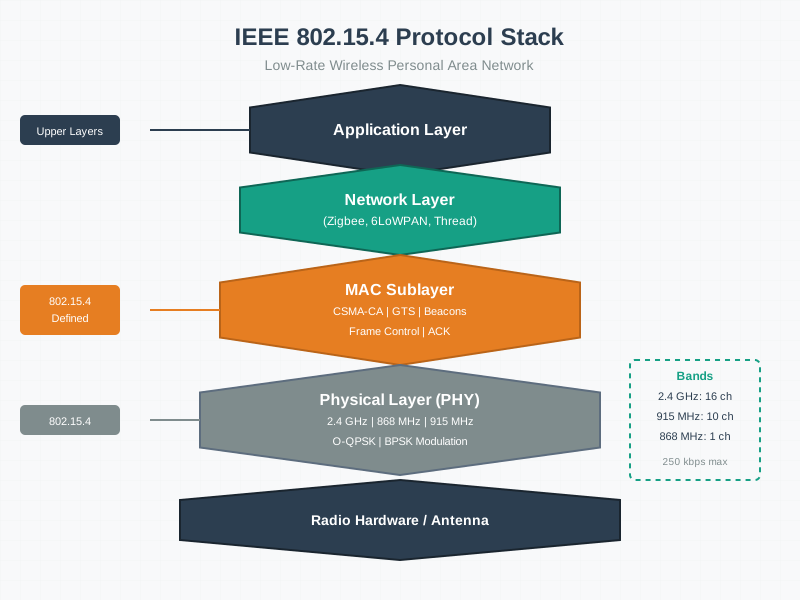
IEEE 802.15.4 defines the lower two layers of the protocol stack, enabling higher-layer protocols like Zigbee, Thread, and 6LoWPAN.
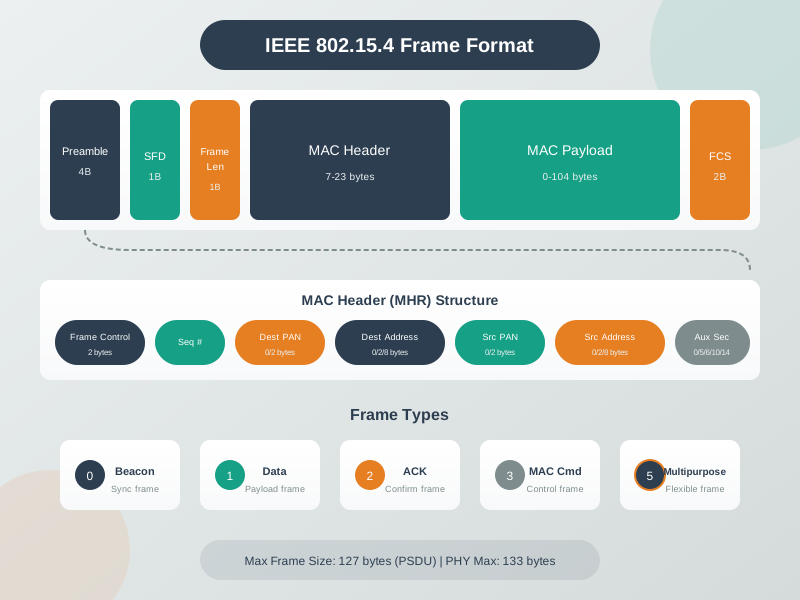
The flexible frame format supports various addressing modes and optional security, with overhead ranging from 6 to 25 bytes.
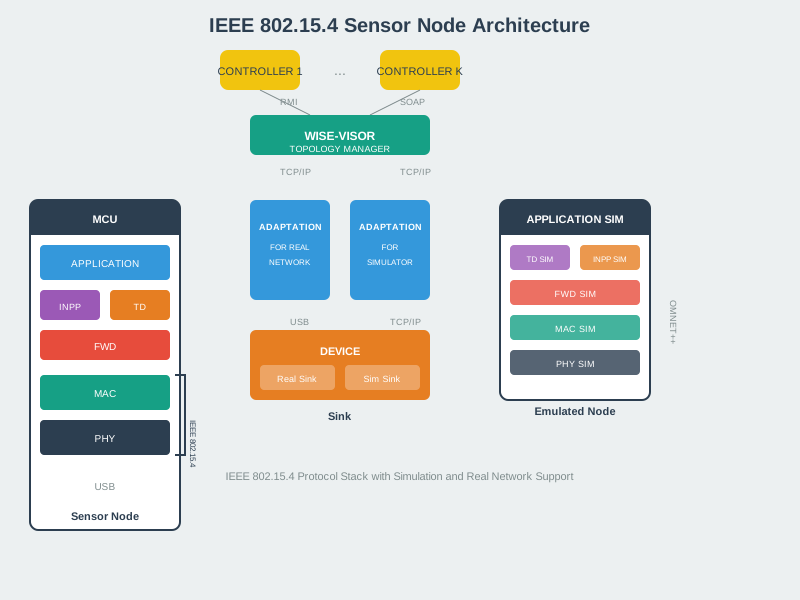
Sensor nodes built on 802.15.4 achieve 5-7 year battery life through ultra-low duty cycle operation.
947.3 Summary
- Low-Power Design: Duty cycles under 1% enable battery-powered sensors to operate for years on coin cells through efficient sleep scheduling
- Frequency Band Flexibility: Supports 2.4 GHz (worldwide), 868 MHz (Europe), and 915 MHz (Americas) with appropriate data rate trade-offs
- Network Topologies: Star, peer-to-peer, and cluster-tree topologies serve different IoT deployment scenarios, from simple sensor networks to complex mesh deployments
- Device Roles: FFDs can serve as coordinators, routers, or end devices, while RFDs are optimized for ultra-low-cost, battery-powered sensing applications
- Addressing Flexibility: Both 64-bit extended (globally unique) and 16-bit short (network-local) addressing modes minimize overhead while maintaining scalability
- Security Features: AES-128 encryption with CCM mode provides confidentiality, integrity, and replay attack protection at the link layer
- Higher-Layer Protocols: Serves as foundation for Zigbee, Thread, 6LoWPAN, WirelessHART, and Wi-SUN, demonstrating versatility across IoT applications
- Frame Efficiency: MAC overhead ranges from 6-25 bytes depending on addressing mode, impacting payload capacity significantly
- CSMA-CA Mechanism: Collision avoidance with configurable backoff parameters balances latency and reliability
- Real-World Performance: Application throughput typically 40-80 kbps (68-84% overhead), latency 10-500 ms depending on network conditions
947.4 Knowledge Check
947.5 Extended Practice Questions
For additional practice questions covering all 802.15.4 topics, see:
- 802.15.4 Quiz Bank - 50+ questions organized by topic
- Addressing Quiz - Focus on addressing modes
- Power and Performance Quiz - Energy and throughput
- Devices and Security Quiz - FFD/RFD and security