Analyze real-world digital twin deployments across manufacturing, healthcare, and smart cities
Understand twin lifecycle management phases and ongoing maintenance requirements
Evaluate measurable business outcomes from digital twin implementations
Recognize architectural patterns that enable multi-benefit optimization
Apply lessons learned from successful deployments to your own projects
506.2 Twin Lifecycle Management
Digital twins are delivering measurable value across industries. Before examining specific cases, understanding the twin lifecycle is essential for successful deployment.
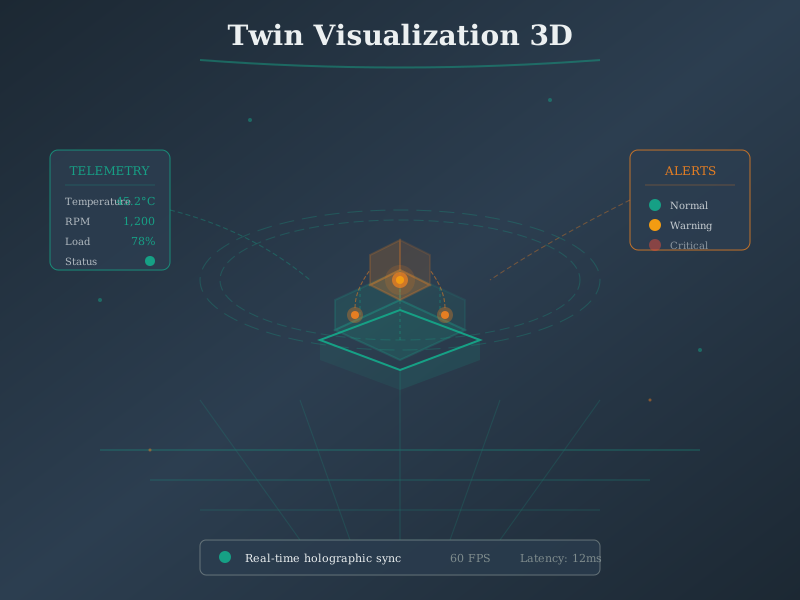
Twin 3D Visualization
Figure 506.1: Digital twin 3D visualization interface showing real-time equipment status and predictive analytics overlays.
TipUnderstanding Twin Lifecycle
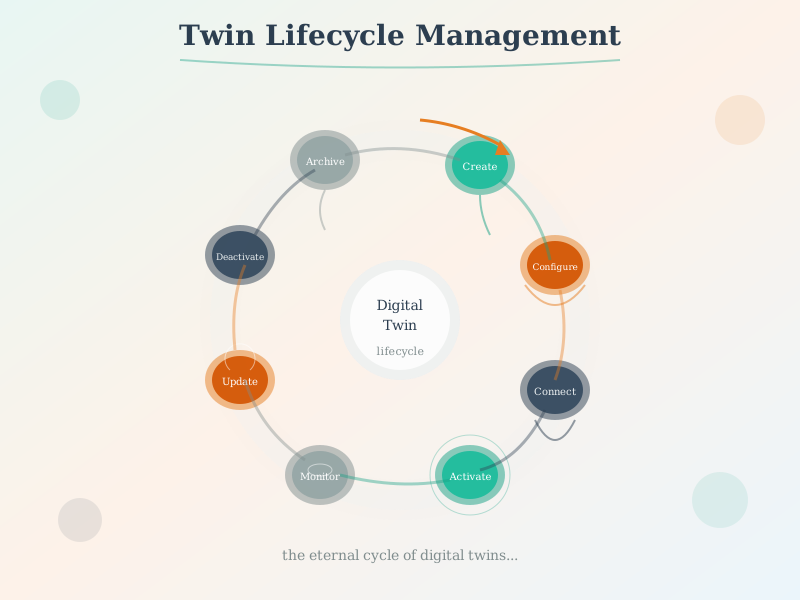
Core Concept: A digital twin’s lifecycle parallels its physical counterpart through five phases: design (modeling before physical exists), commissioning (initial calibration), operation (continuous synchronization), evolution (model updates as physical changes), and retirement (archiving for future reference).
Why It Matters: Unlike static documentation that becomes outdated, digital twins must evolve with their physical counterparts. When a machine is upgraded, its twin needs recalibration. When operating conditions change seasonally, prediction models need retraining. Organizations that treat twins as one-time implementations discover their predictions degrade over time. Critically, retired twins remain valuable: historical twin data from decommissioned equipment helps diagnose similar issues in newer systems and trains next-generation models.
Key Takeaway: Budget for ongoing twin maintenance at 15-20% of initial implementation cost annually; the twin is a living system that requires feeding with calibration data and model updates, not a one-time deliverable.
Show code
{const container =document.getElementById('kc-twin-24');if (container &&typeof InlineKnowledgeCheck !=='undefined') { container.innerHTML=''; container.appendChild(InlineKnowledgeCheck.create({question:"A digital twin for a manufacturing robot has been running for 2 years. Recently, maintenance replaced the robot's servo motors with a newer model. The twin's predictive maintenance alerts have become unreliable - predicting failures that do not happen and missing actual issues. What is the most likely cause?",options: [ {text:"The new motors are defective and producing erratic sensor readings",correct:false,feedback:"While possible, the scenario describes systematic prediction errors (both false positives and false negatives), not random sensor noise. This pattern suggests a model calibration issue."}, {text:"The twin's ML models were trained on the old motor's behavior patterns and need recalibration for the new motor's different vibration and temperature signatures",correct:true,feedback:"Correct! This is a twin lifecycle management issue. When physical components change, the digital twin's models become miscalibrated. The new motors have different 'normal' vibration patterns, different temperature profiles, and different failure signatures. The twin needs retraining on data from the new motors - this is the 'evolution' phase of twin lifecycle."}, {text:"The cloud platform has a software bug introduced in a recent update",correct:false,feedback:"Platform bugs would affect all twins, not just this robot. The correlation with motor replacement points to a model calibration issue, not a platform bug."}, {text:"Predictive maintenance twins cannot be used on new equipment",correct:false,feedback:"Predictive twins work on new equipment, but models must be trained on that equipment's specific behavior. The issue is that THIS twin's models were trained on OLD equipment."} ],difficulty:"hard",topic:"digital-twins" })); }}
Twin Lifecycle Management
Figure 506.2: Digital twin lifecycle management showing the evolution of twins alongside their physical counterparts.
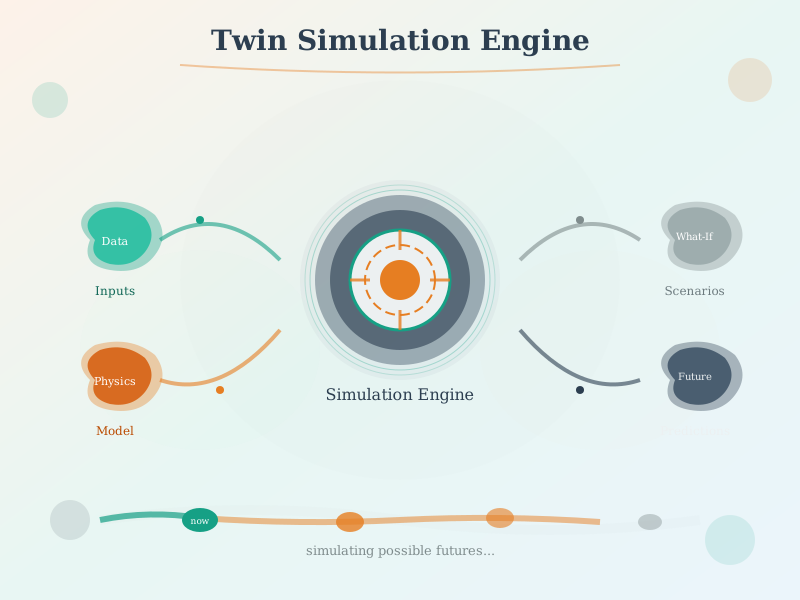
Twin Simulation Engine
Figure 506.3: Digital twin simulation engine enabling what-if scenario testing and predictive analysis.
506.3 Manufacturing: General Electric Aviation
Scale: Over 1.2 million digital twins deployed across aviation, power, and healthcare equipment.
Implementation:
Jet engines monitored with 5,000+ sensors per unit
Digital twins predict component failures 2-3 weeks in advance
Real-time optimization of fuel efficiency during flight
Results:
$1.5 billion in cumulative savings through predictive maintenance
1% fuel efficiency improvement (massive savings at scale)
20% reduction in unplanned downtime
Architecture Insight: GE uses edge computing on aircraft to process high-frequency vibration data locally, sending only anomalies and aggregates to cloud twins for long-term analysis.
Show code
{const container =document.getElementById('kc-twin-8');if (container &&typeof InlineKnowledgeCheck !=='undefined') { container.innerHTML=''; container.appendChild(InlineKnowledgeCheck.create({question:"GE's jet engine digital twins use 5,000+ sensors per engine and predict component failures 2-3 weeks in advance. The key architectural decision that enables this is:",options: [ {text:"Streaming all 5,000 sensor readings in real-time to cloud for centralized processing",correct:false,feedback:"Streaming 5,000 high-frequency sensors from an aircraft in flight would overwhelm satellite bandwidth and incur massive data costs. The actual architecture uses edge computing on the aircraft."}, {text:"Edge computing on the aircraft for local processing, sending only anomalies and aggregates to cloud twins",correct:true,feedback:"Correct! GE processes high-frequency vibration data locally on the aircraft using edge computing. Only anomalies, trends, and aggregated metrics are sent to cloud twins for long-term analysis. This reduces bandwidth by 99% while preserving predictive capability."}, {text:"Storing all sensor data locally and uploading when the aircraft lands",correct:false,feedback:"Waiting until landing would delay critical alerts by hours. The hybrid approach sends important findings in real-time while buffering raw data for later detailed analysis."}, {text:"Using lower-resolution sensors to reduce data volume",correct:false,feedback:"High-resolution sensors are essential for detecting subtle vibration patterns that indicate bearing wear or blade damage. Data reduction through edge processing is the solution, not lower sensor quality."} ],difficulty:"hard",topic:"digital-twins" })); }}
506.4 Smart Buildings: Microsoft Campus
Scale: 125+ buildings, 30,000+ sensors, covering 17 million square feet.
Implementation:
Azure Digital Twins modeling entire campus
HVAC, lighting, occupancy, air quality monitoring
ML models predict space utilization and optimize energy
Results:
25% energy consumption reduction
$1.2 million annual energy cost savings
35% improvement in space utilization efficiency
Real-time COVID-19 density monitoring and alerts
Architecture Insight: Hierarchical twin structure (Campus → Building → Floor → Room → Equipment) enables both building-specific and campus-wide optimization.
Show code
{const container =document.getElementById('kc-twin-16');if (container &&typeof InlineKnowledgeCheck !=='undefined') { container.innerHTML=''; container.appendChild(InlineKnowledgeCheck.create({question:"Microsoft's campus digital twin covers 125 buildings with 30,000 sensors. They report 25% energy reduction AND 35% improvement in space utilization. A facilities manager asks: 'How can twins achieve multiple benefits simultaneously?' What is the key architectural feature that enables this?",options: [ {text:"Using separate digital twin instances for energy and space optimization",correct:false,feedback:"Separate twins would create data silos. The power comes from unified data enabling cross-domain insights - occupancy data informs both space planning AND HVAC scheduling."}, {text:"A hierarchical twin structure (Campus -> Building -> Floor -> Room -> Equipment) that enables both building-specific and campus-wide optimization from a single data model",correct:true,feedback:"Correct! The hierarchical structure allows the same occupancy sensor data to inform multiple use cases: room-level occupancy optimizes local HVAC, floor-level aggregates enable hot-desking policies, building-level totals guide energy purchasing, and campus-wide views optimize space allocation across buildings. One data model, multiple optimization targets."}, {text:"Running machine learning models that automatically discover optimization opportunities",correct:false,feedback:"ML models are important but they operate on the twin's data. The architectural enabler is the hierarchical structure that aggregates data appropriately for different use cases."}, {text:"Installing more sensors per square foot than typical deployments",correct:false,feedback:"Sensor density helps data quality but does not explain multi-benefit optimization. The architecture that relates sensors to spaces at multiple hierarchy levels is the key enabler."} ],difficulty:"hard",topic:"digital-twins" })); }}
506.5 Healthcare: Siemens Healthineers
Application: Patient-specific digital twins for cardiovascular treatment planning.
Implementation:
Medical imaging creates geometric twin of patient’s heart
Blood flow simulation using computational fluid dynamics
Treatment options tested virtually before procedures
Results:
40% reduction in diagnosis time for complex cases
30% fewer complications in valve replacement surgeries
Personalized treatment plans improving outcomes
Architecture Insight: Combines static anatomical data (CT/MRI scans) with dynamic physiological data (heart rate, blood pressure) for comprehensive patient twins.
Show code
{const container =document.getElementById('kc-twin-17');if (container &&typeof InlineKnowledgeCheck !=='undefined') { container.innerHTML=''; container.appendChild(InlineKnowledgeCheck.create({question:"Siemens Healthineers creates patient-specific digital twins for cardiovascular treatment planning. Unlike industrial twins that monitor equipment continuously, these medical twins combine static anatomical data (CT/MRI scans) with dynamic physiological data (heart rate, blood pressure). What type of digital twin is this?",options: [ {text:"A monitoring twin focused on real-time patient vital signs",correct:false,feedback:"Monitoring twins track ongoing state but do not predict treatment outcomes. The Siemens twin is used for treatment planning - testing virtual procedures before performing them on the patient."}, {text:"A simulation twin that uses patient-specific geometry to predict treatment outcomes before procedures are performed",correct:true,feedback:"Correct! This is a simulation twin - it combines patient-specific anatomical data (geometry from imaging) with physiological parameters to simulate blood flow, predict outcomes of different treatment options, and optimize the procedure before touching the patient. The '40% reduction in diagnosis time' and '30% fewer complications' come from virtual testing, not just monitoring."}, {text:"A process twin modeling the surgical workflow",correct:false,feedback:"Process twins model operational workflows, not patient physiology. The Siemens twin models the patient's cardiovascular system to simulate treatment options."}, {text:"A component twin of the heart as a single organ",correct:false,feedback:"While focused on the heart, this twin goes beyond component-level monitoring. It simulates system behavior (blood flow, valve function) to predict treatment outcomes - a simulation use case, not just component health."} ],difficulty:"medium",topic:"digital-twins" })); }}
506.6 Smart Cities: Singapore Virtual Singapore
Scale: Entire nation, 720 square kilometers, detailed to individual trees.
Implementation:
3D city model with semantic information
Integration of climate, population, traffic, utility data
Simulation platform for urban planning scenarios
Results:
Tested 50+ urban planning scenarios before implementation
Optimized emergency response routes reducing time by 18%
Predicted and prevented flooding in 12 vulnerable areas
Enabled pandemic response planning and crowd management
Architecture Insight: Multi-fidelity approach—high detail for active planning areas, lower detail for context, with ability to zoom in as needed.
506.7 Cross-Industry Patterns
Analyzing these four deployments reveals common patterns for successful digital twin implementations:
506.7.1 Pattern 1: Edge-Cloud Hybrid Processing
GE Aviation demonstrates the necessity of edge computing for high-frequency sensor data. Key principles:
Process high-frequency data locally at the edge
Send anomalies and aggregates to cloud for long-term analysis
Maintain local autonomy for safety-critical decisions
Reduce bandwidth costs while preserving analytical capability
506.7.2 Pattern 2: Hierarchical Data Models
Microsoft Campus shows how hierarchical structures enable multi-domain optimization:
Single data model serves multiple use cases
Aggregation at different levels enables different insights
Avoids data silos that limit cross-functional optimization
Scales from individual equipment to enterprise-wide views
506.7.3 Pattern 3: Simulation Before Intervention
Siemens Healthcare exemplifies the “test before touch” philosophy:
Virtual testing reduces real-world risk
Multiple scenarios can be evaluated quickly
Optimization happens before physical changes
Applicable to surgery planning, manufacturing changes, and urban development
Now that you have seen real-world implementations and their business impact, the next chapter provides detailed worked examples showing how to design and implement digital twin systems for specific scenarios.