%%{init: {'theme': 'base', 'themeVariables': {'primaryColor': '#2C3E50', 'primaryTextColor': '#fff', 'primaryBorderColor': '#16A085', 'lineColor': '#E67E22', 'secondaryColor': '#16A085', 'tertiaryColor': '#7F8C8D'}}}%%
graph TB
subgraph Header["Protocol Message Overhead (20-byte payload)"]
direction LR
H1["Lower Overhead"]
H2["→"]
H3["Higher Overhead"]
end
subgraph Minimal["Minimal Overhead"]
COAP_OH["CoAP:<br/>4-byte header<br/>24 bytes total<br/>83% efficiency"]
MQTT_OH["MQTT (QoS 0):<br/>2-byte header + topic<br/>~30 bytes total<br/>67% efficiency"]
end
subgraph Moderate["Moderate Overhead"]
MQTT_Q1["MQTT (QoS 1):<br/>~35 bytes total<br/>57% efficiency<br/>+ ACK message"]
AMQP_OH["AMQP:<br/>8-byte header + framing<br/>~50 bytes total<br/>40% efficiency"]
end
subgraph Heavy["Heavy Overhead"]
HTTP_OH["HTTP:<br/>~200+ bytes headers<br/>~220 bytes total<br/>9% efficiency"]
XMPP_OH["XMPP:<br/>~280+ bytes XML<br/>~300 bytes total<br/>7% efficiency"]
end
subgraph Impact["Battery/Bandwidth Impact"]
I1["Low power sensors:<br/>Use CoAP or MQTT QoS 0<br/>Minimize TX time"]
I2["Reliable delivery:<br/>MQTT QoS 1/2 or AMQP<br/>Accept overhead"]
I3["Web integration:<br/>HTTP at gateway<br/>Not on sensors"]
end
Minimal --> Impact
Moderate --> Impact
Heavy --> Impact
style Header fill:#f9f9f9,stroke:#2C3E50
style Minimal fill:#16A085,color:#fff
style Moderate fill:#E67E22,color:#fff
style Heavy fill:#c0392b,color:#fff
style Impact fill:#7F8C8D,color:#fff
style COAP_OH fill:#d4efdf,color:#2C3E50
style MQTT_OH fill:#d4efdf,color:#2C3E50
style MQTT_Q1 fill:#fdebd0,color:#2C3E50
style AMQP_OH fill:#fdebd0,color:#2C3E50
style HTTP_OH fill:#fadbd8,color:#2C3E50
style XMPP_OH fill:#fadbd8,color:#2C3E50
style I1 fill:#e8e8e8,color:#2C3E50
style I2 fill:#e8e8e8,color:#2C3E50
style I3 fill:#e8e8e8,color:#2C3E50
1176 CoAP vs MQTT: Detailed Protocol Comparison
1176.1 Learning Objectives
By the end of this chapter, you will be able to:
- Compare Architecture Models: Differentiate between CoAP’s request-response and MQTT’s publish-subscribe patterns
- Evaluate Transport Trade-offs: Analyze UDP vs TCP implications for IoT deployments
- Assess QoS Options: Compare reliability mechanisms in both protocols
- Calculate Protocol Overhead: Understand header sizes and efficiency implications
- Select Protocols: Make informed decisions based on specific requirements
1176.2 Prerequisites
Before diving into this chapter, you should be familiar with:
- Application Protocols Overview: Basic understanding of MQTT and CoAP roles in IoT
- Transport Fundamentals: TCP vs UDP characteristics
1176.3 CoAP vs MQTT: Detailed Comparison
Choosing between CoAP and MQTT is not always straightforward. Both protocols excel in different scenarios. Here’s a comprehensive comparison:
1176.3.1 Architecture and Communication Model
| Aspect | CoAP | MQTT |
|---|---|---|
| Pattern | Request-Response (client-server) | Publish-Subscribe (broker-based) |
| Communication | One-to-One | Many-to-Many |
| Coupling | Tight (direct connection) | Loose (decoupled via broker) |
| Discovery | Built-in resource discovery | Topic-based addressing |
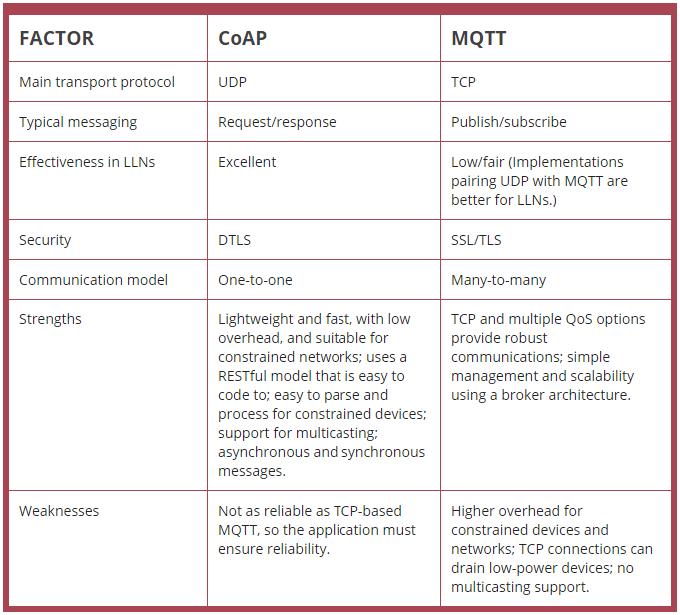
Table: Detailed CoAP vs MQTT Comparison
| FACTOR | CoAP | MQTT |
|---|---|---|
| Main transport protocol | UDP | TCP |
| Typical messaging | Request/response | Publish/subscribe |
| Effectiveness in LLNs | Excellent | Low/fair (Implementations pairing UDP with MQTT are better for LLNs.) |
| Security | DTLS | SSL/TLS |
| Communication model | One-to-one | Many-to-many |
| Strengths | Lightweight and fast, with low overhead, and suitable for constrained networks; uses a RESTful model that is easy to code to; easy to parse and process for constrained devices; support for multicasting; asynchronous and synchronous messages. | TCP and multiple QoS options provide robust communications; simple management and scalability using a broker architecture. |
| Weaknesses | Not as reliable as TCP-based MQTT, so the application must ensure reliability. | Higher overhead for constrained devices and networks; TCP connections can drain low-power devices; no multicasting support. |
1176.3.2 Network and Transport
| Aspect | CoAP | MQTT |
|---|---|---|
| Transport | UDP (User Datagram Protocol) | TCP (Transmission Control Protocol) |
| Reliability | Optional confirmable messages | TCP ensures delivery |
| Overhead | Very low (4-byte header) | Low (2-byte header + TCP) |
| Connection | Connectionless | Persistent connection |
| Latency | Lower (no handshake) | Slightly higher (TCP handshake) |
1176.3.3 Quality of Service and Reliability
| Aspect | CoAP | MQTT |
|---|---|---|
| Message Types | CON (confirmable), NON (non-confirmable) | QoS 0, 1, 2 |
| Acknowledgment | Optional ACK messages | Depends on QoS level |
| Retransmission | Application handles it | QoS 1&2 handle automatically |
| Duplicate Detection | Message IDs | Packet identifiers |
1176.3.4 Security
| Aspect | CoAP | MQTT |
|---|---|---|
| Security Layer | DTLS (Datagram TLS) | TLS/SSL |
| Authentication | Pre-shared keys, certificates | Username/password, certificates |
| Encryption | Yes (with DTLS) | Yes (with TLS) |
| Overhead | DTLS adds overhead to UDP | TLS integrated with TCP |
1176.3.5 Resource Usage
| Aspect | CoAP | MQTT |
|---|---|---|
| Memory Footprint | Minimal | Small |
| Power Consumption | Very low (UDP, sleep modes) | Low (keep-alive messages) |
| Battery Life | Excellent | Very good |
| Bandwidth | Very efficient | Efficient |
1176.3.6 Design Philosophy
| Aspect | CoAP | MQTT |
|---|---|---|
| Inspired By | HTTP (RESTful) | MQTT for SCADA |
| Paradigm | Resource-oriented | Message-oriented |
| Standards Body | IETF (RFC 7252) | OASIS (ISO/IEC 20922) |
| Target | Constrained nodes | Telemetry and messaging |
1176.4 Protocol Selection Framework
TipTradeoff: HTTP vs MQTT vs CoAP
Decision context: When selecting an application protocol for IoT communication
| Factor | HTTP | MQTT | CoAP |
|---|---|---|---|
| Battery impact | High (connection overhead) | Medium (persistent TCP) | Low (connectionless UDP) |
| Bandwidth | High (verbose headers) | Low (2-byte header) | Very low (4-byte header) |
| Latency | Medium-High (TCP + headers) | Low (persistent connection) | Lowest (UDP, no handshake) |
| Reliability | TCP guaranteed | QoS 0/1/2 options | Optional CON/NON |
| Complexity | Simple (universal) | Moderate (broker required) | Low (direct communication) |
| Pattern | Request-Response | Publish-Subscribe | Request-Response + Observe |
| Ecosystem | Universal | Strong IoT | Growing |
Choose HTTP when:
- Integrating with existing web infrastructure and REST APIs
- Building mobile/web apps that communicate with gateways or cloud
- Debugging and development simplicity is priority
- Bandwidth and battery constraints are not critical (Wi-Fi/Ethernet devices)
Choose MQTT when:
- Many devices need to publish to or subscribe from a central system
- Event-driven architecture with multiple consumers per message
- Devices have intermittent connectivity (store-and-forward via broker)
- Smart home, telemetry dashboards, industrial monitoring
Choose CoAP when:
- Constrained devices with limited RAM/flash (8-bit MCUs)
- Battery-powered sensors on LPWAN (6LoWPAN, Thread)
- Direct device-to-device or device-to-gateway communication
- RESTful semantics needed on constrained networks
Default recommendation: MQTT for cloud/broker-based IoT systems, CoAP for constrained edge networks, HTTP only when interfacing with web systems or during prototyping
WarningTradeoff: Broker-Based (MQTT) vs Direct Communication (CoAP/HTTP)
Option A: Use a broker-based architecture where all messages flow through a central MQTT broker Option B: Use direct device-to-device or device-to-server communication with CoAP or HTTP
Decision Factors:
| Factor | Broker-Based (MQTT) | Direct (CoAP/HTTP) |
|---|---|---|
| Coupling | Loose (devices don’t know each other) | Tight (must know endpoint addresses) |
| Discovery | Topic-based (subscribe to patterns) | Requires discovery protocol |
| Fan-out | Built-in (1 publish to N subscribers) | Must implement multi-cast or repeat |
| Single point of failure | Broker is critical | Distributed, no central point |
| Latency | +1 hop through broker | Direct path, minimal latency |
| Offline handling | Broker stores messages | Client must retry |
| Scalability | Scales horizontally with broker cluster | Scales naturally (peer-to-peer) |
| Infrastructure | Requires broker deployment/management | Simpler deployment |
Choose Broker-Based (MQTT) when:
- Multiple consumers need the same data (dashboards, logging, analytics)
- Devices should not know about each other (decoupled architecture)
- Message persistence is needed for offline devices
- Topic-based routing simplifies message organization
- Enterprise-scale deployments with centralized management
Choose Direct Communication (CoAP/HTTP) when:
- Latency-critical control loops require minimal hops
- Simple point-to-point communication between known endpoints
- Broker infrastructure is impractical (resource-constrained networks, isolated sites)
- RESTful semantics and HTTP-style resources are natural fit
- Avoiding single points of failure is priority
Default recommendation: Broker-based (MQTT) for telemetry collection and event distribution; direct communication (CoAP) for device control and local sensor networks
1176.5 Knowledge Check
Test your understanding of protocol comparison concepts.
1176.6 Hybrid Architecture Example
TipCase Study: Smart HVAC System Protocol Design
Requirements: - 500 temperature sensors per building - Real-time alerts for anomalies - Historical data queries - Mobile app control
Solution - Hybrid approach:
# 1. MQTT for telemetry (sensors → cloud)
Topic: buildings/bldg1/floor3/zone-a/temp42/reading
Payload (CBOR): {t:23.5, h:45, ts:1642259400}
QoS: 0 (frequent updates, loss acceptable)

# 2. CoAP for control (app → actuators)
PUT coap://hvac.local/v1/zones/zone-a/setpoint
Payload: {"target":22.0}
Type: CON (confirmable - critical command)

# 3. HTTP REST for historical queries (app → cloud)
GET https://api.example.com/v1/sensors/temp42/history?start=2025-01-01
Response (JSON): [{"timestamp":"2025-01-01T00:00:00Z","value":23.5}...]
Why this works: - MQTT handles high-volume telemetry efficiently - CoAP provides low-latency local control - HTTP enables rich queries from mobile apps - Each protocol optimized for its use case
1176.7 Protocol Overhead Comparison (Visual)
1176.8 Summary Table: Quick Reference
| Criterion | CoAP | MQTT |
|---|---|---|
| Best Use Case | Direct device queries | Event distribution |
| Communication | Request-Response | Publish-Subscribe |
| Transport | UDP (lightweight) | TCP (reliable) |
| Power | Ultra-low | Low |
| Reliability | Optional | Built-in (QoS) |
| Scalability | Good | Excellent |
| Complexity | Low | Medium |
| Browser Support | Limited | Good (WebSockets) |
| Setup | No broker needed | Requires broker |
| Latency | Low | Medium |
| Data Type | Sensor data | Events/telemetry |
1176.9 Key Takeaways
NoteSummary
Core Concepts: - CoAP uses UDP with request-response pattern; MQTT uses TCP with publish-subscribe - CoAP has 4-byte minimum header; MQTT has 2-byte minimum header (plus TCP overhead) - CoAP offers optional reliability (CON/NON); MQTT provides QoS 0/1/2 levels - Both protocols target constrained environments but with different design philosophies
Practical Applications: - Use CoAP for battery sensors, direct device control, and constrained networks - Use MQTT for telemetry dashboards, event-driven systems, and cloud integration - Hybrid architectures combine both protocols for optimal efficiency
Design Considerations: - Evaluate latency requirements, power constraints, and communication patterns - Consider broker infrastructure costs for MQTT vs direct communication for CoAP - Factor in existing ecosystem and tooling support for your platform
1176.10 What’s Next?
Continue to HTTP and Modern Protocols for IoT for a deep dive into HTTP/2, HTTP/3, and common pitfalls when using traditional web protocols in IoT environments.