%%{init: {'theme': 'base', 'themeVariables': {'primaryColor': '#E8F4F8', 'primaryTextColor': '#2C3E50', 'primaryBorderColor': '#16A085', 'lineColor': '#16A085', 'secondaryColor': '#FFF5E6', 'tertiaryColor': '#F0F0F0', 'noteTextColor': '#2C3E50', 'noteBkgColor': '#FFF5E6', 'textColor': '#2C3E50', 'fontSize': '14px'}}}%%
graph TB
    subgraph ISO["📋 ISO STANDARDS"]
        ISO14443["ISO 14443<br/>HF Proximity Cards<br/>13.56 MHz, <10 cm"]
        ISO15693["ISO 15693<br/>HF Vicinity Cards<br/>13.56 MHz, <1 m"]
        ISO18000["ISO 18000<br/>Air Interface<br/>All frequencies"]

        ISO14443 --> TypeA["Type A: MIFARE<br/>Payments, Access"]
        ISO14443 --> TypeB["Type B: Passports<br/>eID, Government"]

        ISO15693 --> Library["Library Books<br/>Item Tracking"]

        ISO18000 --> Part6["Part 6: UHF<br/>860-960 MHz"]
        ISO18000 --> Part7["Part 7: Active<br/>433 MHz"]
    end

    subgraph EPC["🏭 EPC STANDARDS"]
        Gen2["EPC Gen2<br/>UHF 860-960 MHz"]
        Gen2Specs["• 640 Kbps data rate<br/>• Anti-collision: Q-algorithm<br/>• 96/128-bit EPC<br/>• Global supply chain"]

        Gen2 --> Gen2Specs
        Gen2 --> Apps["Applications:<br/>• Retail (Walmart)<br/>• Logistics<br/>• Manufacturing"]
    end

    subgraph NFC["📱 NFC STANDARDS"]
        NFCForum["NFC Forum<br/>ISO 14443 + extras"]
        NFCTypes["Type 1-5 Tags<br/>NDEF format"]

        NFCForum --> NFCTypes
        NFCTypes --> NFCApps["• Mobile payments<br/>• Pairing devices<br/>• Smart posters"]
    end

    ISO14443 -.->|"Basis for"| NFCForum

    style ISO fill:#E8F4F8,stroke:#16A085,stroke-width:3px
    style EPC fill:#FFF5E6,stroke:#E67E22,stroke-width:3px
    style NFC fill:#F8E8E8,stroke:#2C3E50,stroke-width:3px

    style ISO14443 fill:#E8F4F8,stroke:#16A085,stroke-width:2px
    style ISO15693 fill:#E8F4F8,stroke:#16A085,stroke-width:2px
    style ISO18000 fill:#E8F4F8,stroke:#16A085,stroke-width:2px
    style Gen2 fill:#FFF5E6,stroke:#E67E22,stroke-width:2px
    style NFCForum fill:#F8E8E8,stroke:#2C3E50,stroke-width:2px
863 RFID Standards and Summary
863.1 RFID Standards
863.1.1 ISO Standards
ISO 14443 (HF - Proximity cards): - Type A: MIFARE (NXP) - Type B: Used in passports - Range: <10 cm - Use: Payment cards, access control
ISO 15693 (HF - Vicinity cards): - Range: Up to 1m - Use: Library books, item tracking
ISO 18000 (All frequencies): - Part 6: UHF (860-960 MHz) - Part 7: Active tags (433 MHz)
Question: Contactless payment cards (tap-to-pay) and many NFC phone interactions are based primarily on which standard?
💡 Explanation: C. NFC builds on HF proximity communication defined in ISO 14443 (Type A/B). ISO 15693 is HF but designed for longer-range “vicinity” tags (e.g., libraries), and EPC Gen2/ISO 18000-6C is UHF for supply chain.
863.1.2 EPC Gen2 (UHF Standard)
EPCglobal Gen2 is the dominant UHF RFID standard:
- Developed by GS1
- Used globally for supply chain
- Fast reading (640 Kbps)
- Anti-collision algorithm
- 96-bit or 128-bit EPC (Electronic Product Code)
863.2 Worked Examples
NoteWorked Example: UHF RFID Tag Selection for Retail Apparel Tracking
Scenario: A clothing retailer is deploying RFID to track 50,000 garments across 20 stores. Tags will be attached to fabric care labels. The system must support anti-theft detection at store exits and inventory counting with handheld readers.
Given:
- Garment types: Cotton shirts, polyester jackets, denim jeans
- Environment: Store floor (no metal shelving), typical retail with fluorescent lighting
- Reader: Handheld UHF reader (Zebra MC3330R), 1W EIRP output
- Required read range: 2-3 meters for inventory, 1-2 meters for exit gates
- Tag options:
- Avery Dennison AD-229r7: UHF inlay, 96-bit EPC, sensitivity -20 dBm, $0.08/tag
- Smartrac DogBone: UHF inlay, 128-bit EPC, sensitivity -22 dBm, $0.12/tag
- Alien Squiggle: UHF inlay, 96-bit EPC, sensitivity -18 dBm, $0.07/tag
Steps:
Calculate theoretical read range using Friis equation:
Range = (λ/4π) × √(Pt × Gt × Gr / Pth)

Where:
- λ = c/f = 3×10⁸ / 915×10⁶ = 0.328 m (wavelength at 915 MHz)
- Pt = 1 W = 30 dBm (reader transmit power)
- Gt = 6 dBi (typical handheld antenna gain)
- Gr = 2 dBi (typical dipole tag antenna gain)
- Pth = tag sensitivity threshold
Compare tag sensitivities:
- AD-229r7 (-20 dBm = 10 μW): Range ≈ 5.2 m theoretical
- DogBone (-22 dBm = 6.3 μW): Range ≈ 6.5 m theoretical
- Squiggle (-18 dBm = 15.8 μW): Range ≈ 4.1 m theoretical
Apply real-world derating factors:
- Multipath fading in store: -3 dB (50% range reduction)
- Tag on fabric (absorption): -2 dB (37% reduction)
- Non-optimal tag orientation: -3 dB average
- Practical range ≈ 40-50% of theoretical
Calculate practical ranges:
- AD-229r7: 5.2 m × 0.45 = 2.3 m practical
- DogBone: 6.5 m × 0.45 = 2.9 m practical
- Squiggle: 4.1 m × 0.45 = 1.8 m practical
Cost analysis for 50,000 tags:
- Squiggle: 50,000 × $0.07 = $3,500
- AD-229r7: 50,000 × $0.08 = $4,000
- DogBone: 50,000 × $0.12 = $6,000
Result: Select AD-229r7 tags. They provide 2.3m practical range (exceeds 2-3m requirement with margin), 96-bit EPC is sufficient for 50,000 items, and cost is $4,000 (saves $2,000 vs DogBone). The Squiggle is too short-range at 1.8m.
Key Insight: Tag sensitivity (in dBm) is the most critical specification for range. Every 3 dB improvement in sensitivity doubles the read range. Always apply 50-60% derating to theoretical Friis calculations for real-world retail environments with fabric and multipath interference.
NoteWorked Example: Anti-Collision Performance for Warehouse Pallet Scanning
Scenario: A warehouse uses RFID portal readers at dock doors to scan pallets containing 200 cartons each. Each carton has one UHF RFID tag. The forklift passes through at 5 mph (2.2 m/s) and the read zone is 2 meters wide. The warehouse needs 99%+ read rate to avoid manual reconciliation.
Given:
- Tags per pallet: 200 UHF EPC Gen2 tags
- Forklift speed: 2.2 m/s (5 mph)
- Read zone width: 2 meters
- Portal reader: 4-antenna configuration, 4W EIRP per antenna
- EPC Gen2 anti-collision: Q-algorithm with adaptive slot selection
- Tag response time: 44 μs (EPC Gen2 standard)
- Query-to-response round trip: ~2 ms including reader processing
Steps:
Calculate available read time:
Time in zone = Distance / Speed
Time = 2 m / 2.2 m/s = 0.91 seconds (910 ms available)
Calculate theoretical inventory cycles:
Cycle time per slot = Query + Response + Processing
Cycle time ≈ 2 ms per slot

With Q=7 (128 slots per round):
Round time = 128 slots × 2 ms = 256 ms per round

Rounds available = 910 ms / 256 ms = 3.5 rounds
Model anti-collision with 200 tags and Q=7:
- Expected collisions per round: Tags randomly select from 128 slots
- Collision probability when 200 tags select from 128 slots ≈ 40%
- First round reads: ~120 unique tags (60%)
- Second round reads: ~48 more tags (60% of 80 remaining)
- Third round reads: ~19 more tags
- After 3 rounds: ~187 tags read (93.5%)
Optimize Q value for 200 tags:
- Optimal Q = ceil(log₂(Tags)) = ceil(log₂(200)) = 8
- With Q=8 (256 slots): Collision rate drops to ~20%
- First round: ~160 tags (80%)
- Second round: ~32 more tags (80% of 40)
- Third round: ~6 more tags
- After 3 rounds: ~198 tags (99%)
Calculate required read rate for 99.5% target:
- Need 199/200 tags read per pallet
- Solution: Add 4th antenna pass or slow forklift to 4 mph
- At 4 mph: 1.14 seconds in zone = 4.5 rounds = 99.7% read rate
Result: With Q=8 and 4-antenna portal, achieve 99% read rate at 5 mph. For 99.5%+ target, either slow forklift to 4 mph or add redundant portal read. Expected throughput: 350 pallets/hour at 5 mph with single portal.
Key Insight: The EPC Gen2 Q-algorithm is critical for dense tag environments. Setting Q too low causes collisions (tags interfere), while Q too high wastes time on empty slots. Optimal Q ≈ log₂(expected tags). Always calculate dwell time in read zone when designing portal systems for moving assets.
863.3 Visual Reference Gallery
NoteRFID Visualizations
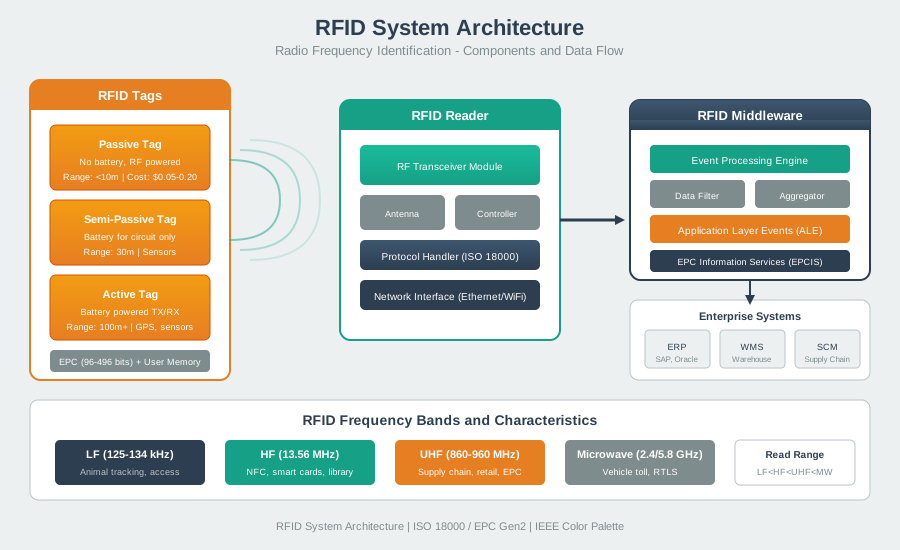
The following AI-generated diagrams provide additional perspectives on RFID technology.
863.3.1 RFID Architecture
863.4 Summary
This chapter covered RFID fundamentals and standards:
- RFID System Components: Tags (passive, active, semi-passive) and readers work together using radio frequency for automatic identification
- Frequency Bands: LF (125 kHz) for metal/water tolerance, HF (13.56 MHz) for proximity/NFC, UHF (860-960 MHz) for long-range tracking
- Tag Types: Passive tags are battery-free and powered by the reader; battery-assisted tags add sensing/logging; active tags include a battery/transmitter for longer range but require battery lifecycle planning
- Standards: ISO 14443 (HF proximity cards), ISO 15693 (HF vicinity cards), and EPC Gen2 (UHF supply chain) ensure interoperability
- Anti-Collision Protocols: Enable simultaneous reading of hundreds of tags per second for warehouse and retail applications
- Range Calculation: Friis equation determines theoretical range based on reader power, antenna gain, tag sensitivity, and environmental factors
NoteRelated Chapters & Resources
RFID Deep Dives: - RFID Security - Security and privacy concerns - RFID Applications - Practical implementations - RFID Comprehensive Review - Complete reference
Related Technologies: - NFC Fundamentals - NFC uses RFID technology - Barcode/QR Alternatives - Identification sensors
Architecture: - WSN Overview - Sensor network context - IoT Reference Models - Where RFID fits
Privacy: - Introduction to Privacy - RFID privacy implications
Learning Hubs: - Quiz Navigator - RFID quizzes
NoteOriginal Source Figure (Alternative View)
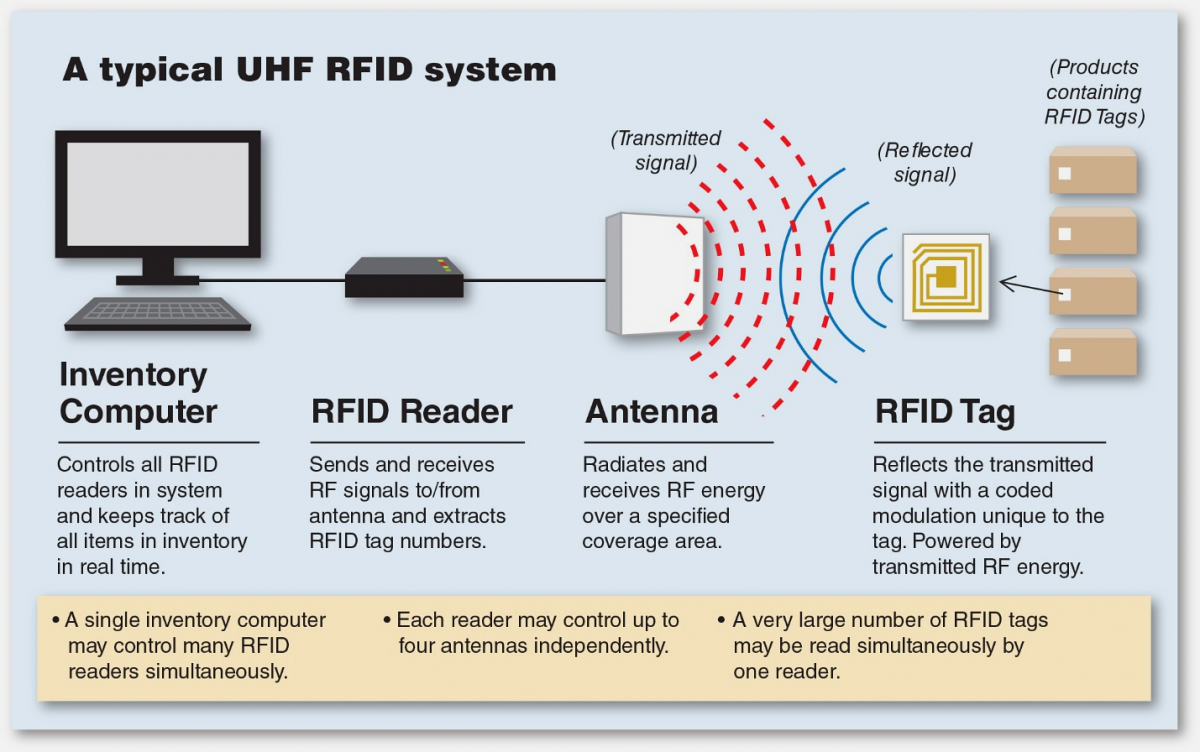
This figure from the CP IoT System Design Guide provides an alternative visual perspective on RFID concepts covered in this chapter.
RFID Working Principle - Reader and Tag Communication:
Source: CP IoT System Design Guide, Chapter 4 - Short-Range Protocols
863.5 What’s Next
The next chapter explores RFID Hands-on and Applications, covering practical implementations with Arduino and ESP32 platforms for access control and inventory systems.