%%{init: {'theme': 'base', 'themeVariables': { 'primaryColor': '#2C3E50', 'primaryTextColor': '#fff', 'primaryBorderColor': '#16A085', 'lineColor': '#E67E22', 'secondaryColor': '#16A085', 'tertiaryColor': '#E8F6F3', 'clusterBkg': '#E8F6F3', 'clusterBorder': '#16A085', 'fontSize': '12px'}}}%%
graph TB
subgraph CoAP["CoAP Architecture"]
Sensor1["IoT Sensor<br/>(Client)"]
Gateway1["Gateway/Server"]
Sensor1 -->|"GET /temp<br/>(4-byte header)"| Gateway1
Gateway1 -->|"2.05 Content<br/>temp=23°C"| Sensor1
end
subgraph MQTT["MQTT Architecture"]
Sensor2["IoT Sensor<br/>(Publisher)"]
Broker["MQTT Broker"]
App["Dashboard App<br/>(Subscriber)"]
Sensor2 -->|"PUBLISH<br/>topic: sensors/temp"| Broker
Broker -->|"PUBLISH<br/>temp=23°C"| App
end
CoAP -.->|vs| MQTT
Note1["CoAP: Request-Response<br/>UDP, 4-byte header<br/>Constrained devices"]
Note2["MQTT: Publish-Subscribe<br/>TCP, 2-byte header + topic<br/>Scalable, reliable"]
Note1 -.-> CoAP
Note2 -.-> MQTT
style Sensor1 fill:#2C3E50,stroke:#16A085,color:#fff
style Gateway1 fill:#16A085,stroke:#2C3E50,color:#fff
style Sensor2 fill:#2C3E50,stroke:#16A085,color:#fff
style Broker fill:#E67E22,stroke:#2C3E50,color:#fff
style App fill:#16A085,stroke:#2C3E50,color:#fff
669 IoT Protocols Lab: CoAP vs MQTT
669.1 Learning Objectives
By the end of this chapter, you will be able to:
- Compare CoAP and MQTT architectures: Understand request-response vs publish-subscribe patterns
- Evaluate protocol overhead: Calculate header sizes and efficiency for each protocol
- Select appropriate protocols: Choose CoAP or MQTT based on device constraints and use cases
- Understand transport layer differences: Recognize when UDP (CoAP) vs TCP (MQTT) is appropriate
- Apply QoS levels: Match reliability requirements to MQTT QoS or CoAP confirmable messages
TipFor Beginners: What You’ll Learn
What is this chapter? Deep comparison of the two most popular IoT application protocols: CoAP and MQTT.
Why it matters: - Wrong protocol choice wastes battery life or misses reliability requirements - CoAP excels for constrained devices with direct communication - MQTT excels for scalable telemetry with broker-based distribution
Prerequisites: - IoT Protocols Lab: IPv6 and 6LoWPAN - IoT Protocols Fundamentals
669.2 Application Layer Protocols
Traditional application protocols (HTTP, XMPP) are resource-demanding and not suitable for constrained IoT devices.
669.2.1 Why Not Use HTTP?
HTTP (Hypertext Transfer Protocol):
Overhead:
HTTP GET Request (minimum):
GET / HTTP/1.1\r\n
Host: example.com\r\n
\r\n

Size: ~40 bytes (just headers, no data)

HTTP Response:
HTTP/1.1 200 OK\r\n
Content-Type: application/json\r\n
Content-Length: 10\r\n
\r\n
{"temp":25}

Size: ~70 bytes headers + 10 bytes data = 80 bytes
Total exchange: ~120 bytes
Issues for IoT: - Verbose: Text-based, human-readable (wasteful for M2M) - TCP-based: Connection overhead - Stateful: Requires connection management - No pub/sub: Request-response only
When HTTP is OK: - Gateways: IoT gateway to cloud (mains-powered, reliable network) - RESTful APIs: Cloud services - Infrequent: Configuration, firmware updates
669.2.2 IoT-Specific Application Protocols
The two most popular IoT application protocols: 1. CoAP (Constrained Application Protocol) 2. MQTT (Message Queue Telemetry Transport)
669.3 CoAP vs MQTT Comparison
{fig-alt=“Comparison of CoAP and MQTT architectures showing CoAP’s request-response pattern between sensor and gateway using UDP with 4-byte headers versus MQTT’s publish-subscribe pattern with broker mediating between sensor publisher and dashboard subscriber using TCP”}
669.3.1 Detailed Comparison
| Aspect | CoAP | MQTT |
|---|---|---|
| Model | Request-Response (1-to-1) | Publish-Subscribe (many-to-many) |
| Transport | UDP (connectionless) | TCP (connection-oriented) |
| Messaging | RESTful (GET, POST, PUT, DELETE) | Pub/Sub topics |
| Overhead | Low (4-byte header) | Medium (2-byte fixed + variable) |
| Reliability | Optional (Confirmable messages) | QoS levels (0, 1, 2) |
| Power | Very low (UDP, no broker connection) | Higher (TCP, always connected) |
| Real-Time | Excellent (UDP, no broker hop) | Good (broker adds latency) |
| Scalability | Moderate (P2P connections) | Excellent (broker decouples) |
| Discovery | Built-in (Resource Discovery) | None (app-level) |
| Security | DTLS | TLS (MQTTS) |
| Multicast | Yes (UDP multicast) | No (TCP point-to-point) |
| Message Size | Small (UDP constraints) | Flexible (TCP streaming) |
| Complexity | Lower (simple devices) | Higher (broker required) |
| Best For | Constrained devices, real-time | Data collection, dashboards |
669.3.2 CoAP (Constrained Application Protocol)
NoteCoAP Characteristics
RESTful Design: - Mirrors HTTP (GET, POST, PUT, DELETE) - URI-based resources (coap://example.com/sensor/temp) - Content types (JSON, CBOR, XML)
Built for UDP: - Connectionless (low overhead) - Optional reliability (Confirmable vs Non-Confirmable) - Multicast support (discover devices)
Lightweight: - 4-byte header (vs 40+ HTTP) - Binary protocol (efficient parsing) - Small code footprint (~10 KB)
Features: - Resource discovery: /.well-known/core - Observe: Subscribe to resource changes - Block transfer: Large data in chunks
Use Cases: - Sensor readings (temperature, humidity) - Actuator control (lights, locks) - Device configuration - Resource-constrained networks
CoAP Message Example:
GET /sensor/temp
Host: fe80::1234

CoAP Header (4 bytes):
- Version, Type, Token Length, Code: 4 bytes
- Message ID: included

Total: ~20 bytes (including URI path)

vs HTTP: ~40 bytes minimum
669.3.3 MQTT (Message Queue Telemetry Transport)
NoteMQTT Characteristics
Publish-Subscribe: - Producers (sensors) publish to topics - Consumers (apps) subscribe to topics - Broker decouples publishers and subscribers
Designed for Telemetry: - Many sensors → Few subscribers - Persistent connections (TCP) - Quality of Service (QoS) levels
Lightweight (for TCP): - 2-byte fixed header + variable header - Binary protocol - Compact topic names
QoS Levels: - QoS 0: At most once (fire and forget) - QoS 1: At least once (acknowledged) - QoS 2: Exactly once (guaranteed)
Features: - Retained messages: Last value available to new subscribers - Last Will and Testament: Notify on disconnect - Clean session: Persistent vs ephemeral
Use Cases: - Telemetry collection (many sensors → cloud) - Dashboard updates (real-time monitoring) - Command distribution (cloud → devices) - Mobile apps (unreliable networks)
MQTT Topic Example:
Publishers:
- Sensor 1: Publish to "home/bedroom/temperature"
- Sensor 2: Publish to "home/kitchen/temperature"

Subscribers:
- Dashboard: Subscribe to "home/+/temperature" (all rooms)
- Logger: Subscribe to "home/#" (all topics under home)

Broker: Routes messages from publishers to subscribers
669.3.4 CoAP vs MQTT: When to Use
ImportantSelection Guide
Use CoAP when: - Constrained devices: Limited RAM/CPU (< 32 KB RAM) - Real-time: Low latency critical - Multicast: Need to address multiple devices simultaneously - Power-constrained: Battery-powered sensors - Direct M2M: Machine-to-machine without broker - RESTful: Web-style API desired - Example: Temperature sensor reporting to gateway
Use MQTT when: - Scalability: Many publishers, many subscribers - Reliable network: TCP acceptable (Wi-Fi, Ethernet, cellular) - Guaranteed delivery: QoS critical - Decoupling: Publishers/subscribers don’t know each other - Dashboard/monitoring: Real-time data visualization - Cloud integration: MQTT brokers widely supported - Example: Factory sensors → cloud → monitoring dashboard
Consider Hybrid: - CoAP for sensor → gateway (constrained network) - MQTT for gateway → cloud (reliable network)
669.4 Visual Reference Gallery
NoteVisual: CoAP vs MQTT Protocol Comparison
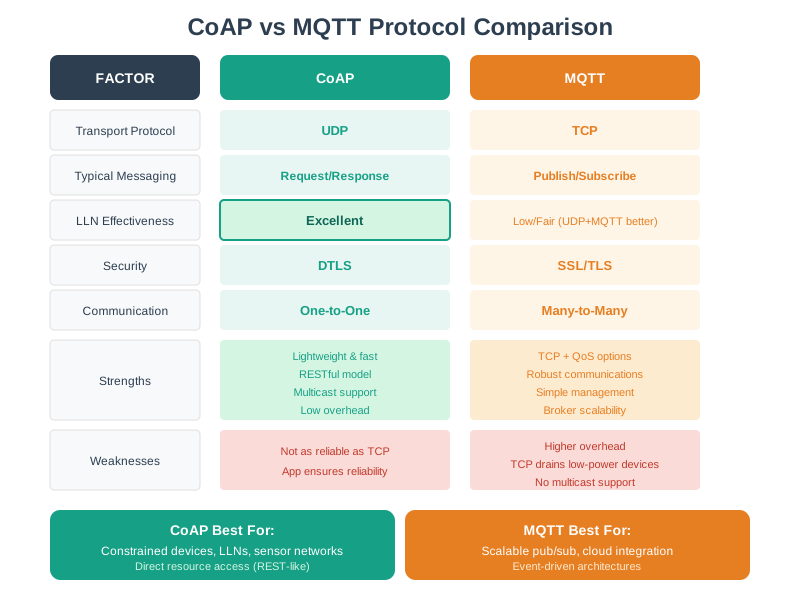
Understanding the fundamental differences between CoAP (RESTful, UDP-based) and MQTT (pub-sub, TCP-based) helps select the optimal protocol for specific IoT application requirements.
NoteVisual: IoT Protocol Stack Layers
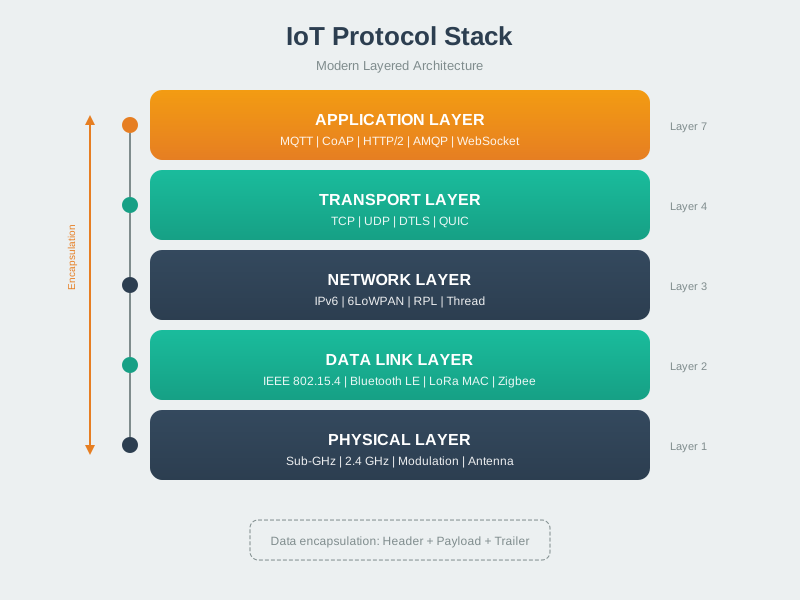
The IoT protocol stack visualization shows how different protocols interoperate across network layers, from application-level messaging to physical wireless transmission.
669.5 Knowledge Check
669.6 Summary
This chapter compared the two dominant IoT application layer protocols:
- HTTP is too verbose for IoT with 40+ byte headers and TCP connection overhead, making it unsuitable for constrained devices
- CoAP provides RESTful semantics over UDP with a 4-byte header, multicast support, and optional reliability via confirmable messages
- MQTT enables scalable pub/sub telemetry with broker decoupling, QoS levels (0/1/2), and features like retained messages and Last Will
- Choose CoAP for constrained devices requiring low latency, multicast, or direct M2M communication with minimal power consumption
- Choose MQTT for scalable data collection where many publishers feed dashboards and cloud services through a central broker
- Hybrid architectures work well: CoAP from sensors to gateway, MQTT from gateway to cloud
669.7 What’s Next
With CoAP and MQTT characteristics understood, learn to systematically select protocols for your IoT projects:
- IoT Protocols Lab: Selection Framework: Apply a decision tree for protocol selection based on power, range, and data patterns
- IoT Protocols Lab: Python Implementations: Build Python tools for protocol analysis, battery life calculation, and automated selection
- CoAP Fundamentals and Architecture: Deep dive into CoAP mechanics
- MQTT: Fundamentals: Comprehensive MQTT protocol coverage