716 RPL DODAG Message Flow and Exchange
716.1 Learning Objectives
After completing this chapter, you will be able to:
- Understand the complete message exchange during DODAG formation
- Identify the four core RPL control message types (DIO, DIS, DAO, DAO-ACK)
- Trace message flows through a concrete network example
- Analyze RANK calculations using ETX link quality metrics
716.2 RPL Control Messages Overview
RPL builds the DODAG through control messages:

{fig-alt=“RPL control messages overview showing DIO (advertise DODAG), DIS (request info), DAO (advertise reachability), DAO-ACK (acknowledgment), and DODAG construction flow from ROOT sending DIO through node joining to DAO advertisement”}
716.3 Step-by-Step DODAG Construction
{fig-alt=“DODAG construction sequence diagram showing 5 steps: ROOT initiates with DIO, nodes receive and join calculating RANK, nodes propagate DIO, upward routes established via parent pointers, downward routes built via DAO messages”}
716.4 Message Flow: Complete Sequence Diagram
This enhanced sequence diagram shows the complete message exchange during DODAG formation, including timing and RANK calculation:
{fig-alt=“Complete DODAG formation sequence diagram showing temporal progression from t=0s initialization through 7 steps: root DIO broadcast, first-hop join with RANK calculation, ripple expansion via DIS/DIO, DAO messages flowing upward to build downward routes, DAO-ACK confirmations, and final steady state with operational network, illustrating message types, RANK values at each hop, and timing for 50-node network convergence”}
Key insights from message flow: 1. RANK increases hop-by-hop: 0 -> 256 -> 456 -> 636 (based on link quality, not just hop count) 2. DIO flows downward (away from root), DAO flows upward (toward root) 3. DIS accelerates discovery (Node C doesn’t wait for periodic DIO from B) 4. DAO aggregation: Node B’s DAO to A includes both B and C reachability 5. Convergence: 30 seconds typical for small network, up to 120s for large/deep networks
716.5 Enhanced Message Flow: Detailed DODAG Building Sequence
This section provides an in-depth walkthrough of exactly what happens during DODAG formation, with specific message contents, timing details, and node state changes. Understanding this level of detail is crucial for troubleshooting and optimizing RPL networks.
716.5.1 Message Types and Their Roles
Before diving into the sequence, let’s understand the four core RPL control messages:
{fig-alt=“RPL control message types diagram showing four core message types: DIO for advertising DODAG information with RANK and configuration, DIS for requesting DODAG information to speed joining, DAO for advertising node reachability to build downward routes, and DAO-ACK for confirming route installation, with each message type showing its primary purpose and information carried”}
Message Direction Summary: - DIO: Flows downward (away from root) -> Builds DODAG topology - DIS: Sent to neighbors -> Requests DIOs to accelerate joining - DAO: Flows upward (toward root) -> Builds downward routing tables - DAO-ACK: Flows downward (from root/parents) -> Confirms DAO received
716.5.2 Detailed Step-by-Step Message Exchange
Let’s walk through a concrete example with specific node addresses, message contents, and timing. This example shows a 12-node smart building network forming its DODAG.
Network Setup: - Root: Border router (BR) at address fd00::1, connected to Internet - Nodes: 11 sensor nodes (addresses fd00::2 through fd00::c) - Topology: 4-layer hierarchy (root + 3 layers of sensors) - Radio: IEEE 802.15.4, range ~30m per hop - Objective Function: ETX (Expected Transmission Count)
{fig-alt=“Detailed RPL DODAG formation message exchange sequence showing complete protocol interaction between border router root node and three sensor nodes with specific IPv6 addresses, including exact message contents with DODAG ID, RANK calculations based on ETX link quality metrics, parent selection logic comparing multiple potential parents, DAO message aggregation as nodes forward reachability information upward, and DAO-ACK confirmations flowing back down to establish bidirectional routing”}
Key Observations from Detailed Exchange:
Parent Selection is Metric-Based: Node C receives DIOs from both Node A (RANK 307) and Node B (RANK 384), but chooses Node A because the total path cost (parent RANK + link ETX) is lower (589 vs 896)
DAO Aggregation: When Node C sends its DAO to Node A, Node A aggregates both its own reachability (fd00::2) and Node C’s reachability (fd00::4) into a single DAO forwarded to the root
Bidirectional Confirmation: DAO-ACK messages flow back down the same path, confirming each hop that the route was successfully installed
Timing Dependencies: Each step depends on the previous completing:
- DIOs must arrive before nodes can calculate RANK
- RANK must be calculated before nodes send DAO
- DAO must arrive before DAO-ACK can be sent
Trickle Timer Behavior: After initial formation (~30s), DIO interval increases from 10s -> 30s -> 1min -> 10min to minimize overhead once topology is stable
716.6 Understanding RANK Calculation in Formation
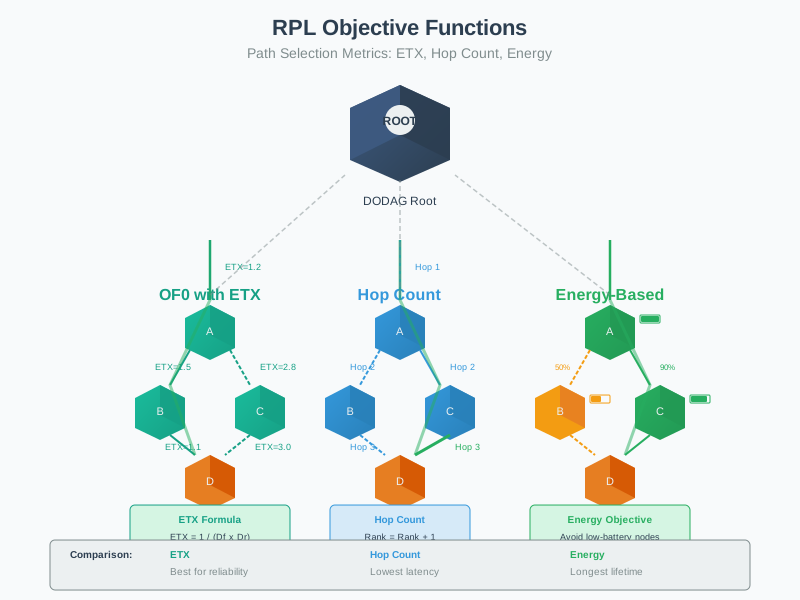
As the DODAG forms, each node calculates its RANK based on the Objective Function (OF):
Example with ETX (Expected Transmission Count) metric:
Root: RANK = 0

First-hop node (good link, ETX = 1.2):
RANK = 0 + (ETX x 256) = 0 + 307 = 300

Second-hop node (good link from first-hop, ETX = 1.1):
RANK = 300 + (1.1 x 256) = 300 + 282 = 582

Leaf node (poor link from second-hop, ETX = 2.5):
RANK = 582 + (2.5 x 256) = 582 + 640 = 1222
RANK increases as you move away from root. Nodes always forward upward to lower RANK (toward root), preventing loops. The rate of increase depends on link quality—poor links cause larger RANK jumps, discouraging routes through unreliable paths.
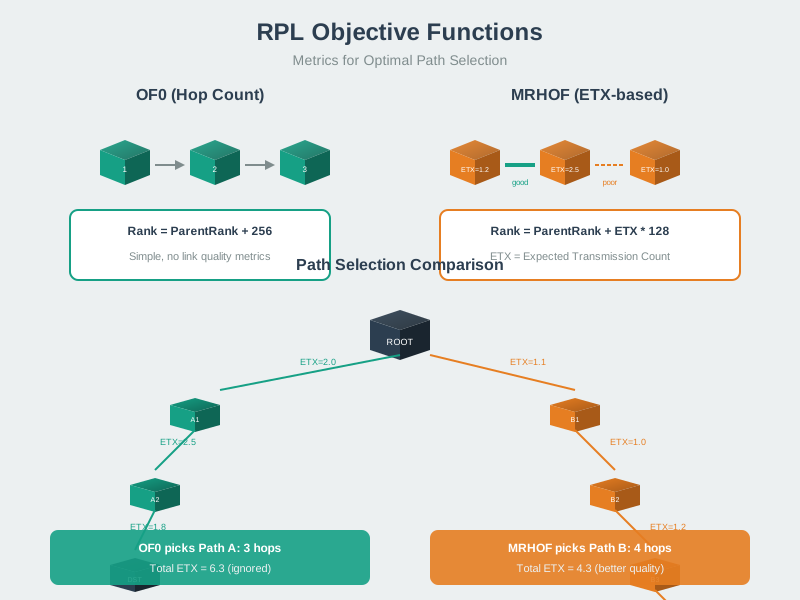
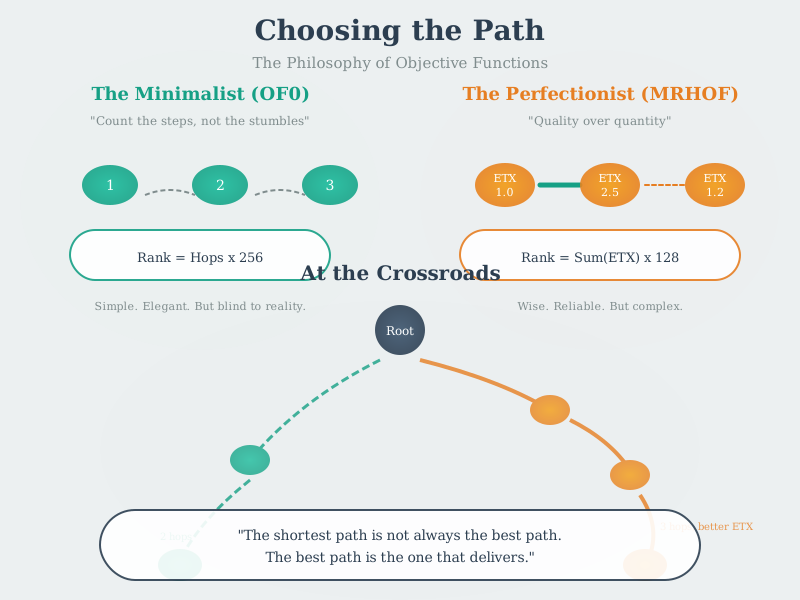
Objective Functions: - OF0 (RFC 6552): Hop count or ETX (simple, widely supported) - MRHOF (RFC 6719): Minimum Rank with Hysteresis (avoids parent flapping) - Custom OFs: Energy-aware, latency-optimized, security-enhanced (application-specific)
716.7 Detailed Construction Steps
Root node (border router/gateway): 1. Creates DODAG: Assigns unique DODAG ID 2. Sets RANK = 0: Root has minimum RANK 3. Broadcasts DIO: Sends DODAG Information Object (multicast)
DIO Contents: - DODAG ID (IPv6 address) - RANK (0 for root) - Objective function (routing metric) - DODAG configuration (timers, etc.)
716.8 Step 2: Nodes Receive DIO and Join
Node receives DIO: 1. Decision: Join this DODAG or wait for others? - Compare DODAG rank, objective function - May receive DIOs from multiple DODAGs 2. Calculate RANK: RANK = parent_RANK + increase 3. Select parent: Choose sender of DIO (if acceptable) 4. Update state: Store DODAG ID, parent, RANK
Multiple DIO Sources: - Node may hear DIOs from multiple neighbors - Chooses best parent (lowest RANK, best link quality) - May maintain backup parents (loop-free)
716.9 Step 3: Nodes Propagate DIO
After joining DODAG: 1. Node becomes part of DODAG 2. Sends own DIO: Advertises DODAG to neighbors 3. DIO contents: Own RANK, DODAG ID, etc. 4. Trickle timer: Controls DIO frequency (adaptive)
Trickle Algorithm: - Stable network: Send DIOs infrequently (minutes) - Network changes: Send DIOs frequently (seconds) - Reduces overhead while maintaining responsiveness
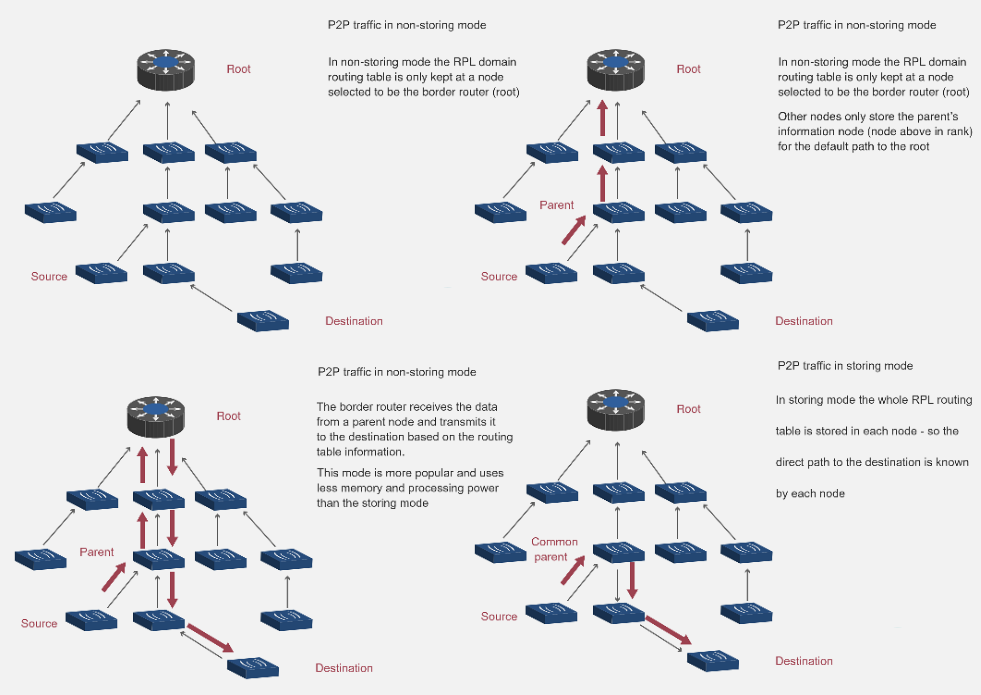
Upward routes (towards root) established automatically: - Each node knows its parent (from DIO selection) - Default route: Send to parent (towards root) - No routing table needed for upward routes (just parent pointer)
Example:
Node 3 -> Node 1 -> Root
(N3 knows parent is N1, N1 knows parent is Root)Downward routes (from root to nodes) require DAO messages:
- Node sends DAO to parent:
- “I am reachable via you”
- Includes node’s address and prefixes
- Parent updates routing table:
- “Node X is reachable via this child”
- Parent propagates DAO towards root:
- Aggregates reachability information
- Root knows all nodes:
- Complete routing table for downward routes
DAO-ACK (optional): - Parent confirms DAO receipt - Reliability for critical networks
716.10 Summary
This chapter covered the detailed message flow during DODAG construction:
- Four Control Messages: DIO (topology), DIS (solicitation), DAO (reachability), DAO-ACK (confirmation)
- Message Directions: DIO flows downward, DAO flows upward, DIS to neighbors
- RANK Calculation: Based on objective function (ETX, hop count, energy)
- Parent Selection: Nodes choose parents with lowest cumulative path cost
- DAO Aggregation: Intermediate nodes combine reachability from multiple children
- Five Construction Steps: Root init, DIO reception, DIO propagation, upward routes, downward routes
716.11 What’s Next
Continue learning about DODAG construction details:
- RPL DODAG Visual Guide: Step-by-step visual progression
- RPL DODAG Worked Example: Complete 10-node network calculation
- RPL Trickle Algorithm: Energy-efficient maintenance mechanism
- RPL DODAG Construction Overview: Return to overview