%% fig-alt: "Trickle algorithm flowchart showing interval-based operation with suppression mechanism and exponential backoff for network code dissemination"
%%{init: {'theme': 'base', 'themeVariables': {'primaryColor': '#2C3E50', 'primaryTextColor': '#fff', 'primaryBorderColor': '#16A085', 'lineColor': '#16A085', 'secondaryColor': '#E67E22', 'tertiaryColor': '#ECF0F1', 'fontSize': '16px'}}}%%
graph TD
    subgraph "Trickle Algorithm Operation"
        START["Initialize:<br/>τ = τ_min<br/>c = 0"]

        INTERVAL["Interval τ begins:<br/>Pick random t ∈ [0,τ]<br/>Reset counter c = 0"]

        LISTEN["Listen for<br/>metadata from<br/>neighbors"]

        COUNT{"Hear same<br/>version?"}

        INC["Increment c<br/>(consistency counter)"]

        TRANS_TIME{"Time = t?"}

        SUPPRESS{"c ≥ k?"}

        TRANSMIT["Transmit<br/>metadata"]
        SKIP["Suppress<br/>transmission"]

        END_INT{"Interval end?"}

        CONSIST{"Network<br/>consistent?"}

        DOUBLE["Double interval:<br/>τ = min(2τ, τ_max)"]
        RESET["Reset interval:<br/>τ = τ_min"]
    end

    START --> INTERVAL
    INTERVAL --> LISTEN

    LISTEN --> COUNT

    COUNT -->|"Yes"| INC
    COUNT -->|"Different version"| RESET
    INC --> LISTEN

    LISTEN --> TRANS_TIME

    TRANS_TIME -->|"Yes"| SUPPRESS
    TRANS_TIME -->|"No"| LISTEN

    SUPPRESS -->|"Yes (c≥k)"| SKIP
    SUPPRESS -->|"No (c<k)"| TRANSMIT

    SKIP --> END_INT
    TRANSMIT --> END_INT

    END_INT -->|"Continue"| LISTEN
    END_INT -->|"End of τ"| CONSIST

    CONSIST -->|"Yes"| DOUBLE
    CONSIST -->|"No (heard different)"| RESET

    DOUBLE --> INTERVAL
    RESET --> INTERVAL

    style START fill:#2C3E50,stroke:#16A085,stroke-width:3px,color:#fff
    style INTERVAL fill:#E67E22,stroke:#2C3E50,stroke-width:3px,color:#fff
    style LISTEN fill:#16A085,stroke:#2C3E50,stroke-width:2px,color:#fff
    style COUNT fill:#3498DB,stroke:#2C3E50,stroke-width:2px,color:#fff
    style INC fill:#16A085,stroke:#2C3E50,stroke-width:2px,color:#fff
    style TRANS_TIME fill:#3498DB,stroke:#2C3E50,stroke-width:2px,color:#fff
    style SUPPRESS fill:#3498DB,stroke:#2C3E50,stroke-width:2px,color:#fff
    style TRANSMIT fill:#D5F4E6,stroke:#16A085,stroke-width:3px
    style SKIP fill:#95A5A6,stroke:#2C3E50,stroke-width:2px,color:#fff
    style END_INT fill:#3498DB,stroke:#2C3E50,stroke-width:2px,color:#fff
    style CONSIST fill:#3498DB,stroke:#2C3E50,stroke-width:2px,color:#fff
    style DOUBLE fill:#F9E79F,stroke:#F39C12,stroke-width:2px
    style RESET fill:#FADBD8,stroke:#E74C3C,stroke-width:2px
441 Trickle Algorithm for Network Reprogramming
441.1 Learning Objectives
By the end of this chapter, you will be able to:
- Configure Trickle Algorithm: Implement efficient dissemination protocols for network updates
- Understand Polite Gossip: Explain how suppression reduces overhead during stable periods
- Implement Exponential Backoff: Configure interval doubling for energy-efficient maintenance
- Detect Inconsistency: Handle new code versions through rapid interval reset
441.2 Prerequisites
Before diving into this chapter, you should be familiar with:
- WSN Routing Challenges: Understanding energy constraints in sensor networks
- Link Quality Routing: How unreliable links affect protocol design
- Wireless Sensor Networks: WSN architecture and deployment scenarios
441.3 Introduction
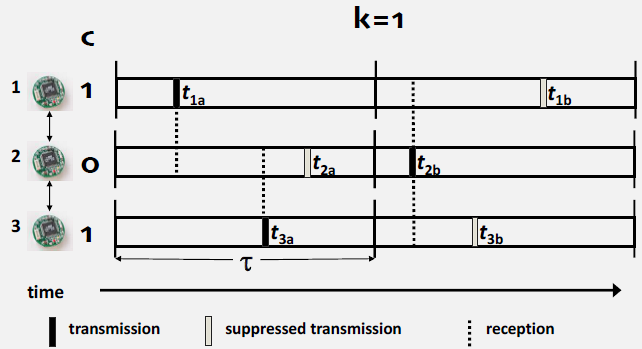
Trickle is a “polite gossip” algorithm for efficiently propagating code updates through a sensor network with minimal overhead.
441.4 The Problem: Network Reprogramming
441.4.1 Challenges
WSNs may operate for years, but requirements change: - Bug fixes needed in deployed code - New features required - Configuration updates - Security patches
Physical access challenges: - Thousands of nodes in remote locations - Infeasible to visit each node - Need over-the-air programming (OTA updates)
441.4.2 Goals
| Goal | Description |
|---|---|
| Zero maintenance cost | No overhead when no updates exist |
| Rapid propagation | Fast when updates are available |
| Robust | Tolerate packet loss and node failures |
| Energy-efficient | Minimize transmissions |
441.5 Trickle Algorithm
441.5.1 Core Idea
“Broadcast your code version periodically, but stay silent if you hear others broadcasting the same version.”
This “polite gossip” approach achieves: - Near-zero overhead when network is consistent - Rapid propagation when updates appear
441.5.2 Key Mechanisms
- Suppression: If enough neighbors have same code, don’t broadcast
- Exponential back-off: Increase interval when network is consistent
- Reset on inconsistency: Detect new code, restart with short interval
441.6 Trickle Parameters
441.6.1 τ (Interval Length)
The current broadcast interval: - Starts at τ_min (e.g., 1 second) - Doubles each interval if network consistent - Capped at τ_max (e.g., 1 hour)
441.6.2 k (Suppression Threshold)
Number of consistent messages to suppress transmission: - If hear same metadata k times, suppress transmission - Typical: k = 1 or 2 - Lower k = more suppression, less overhead
441.6.3 c (Consistency Counter)
Count of same metadata heard during interval: - Reset at start of each interval - Incremented when hearing consistent message - Compared against k for suppression decision
441.6.4 t (Transmission Time)
Random time within interval to transmit: - Picked uniformly at random in [0, τ] - Randomization prevents collisions - Spread transmissions across interval
441.7 Algorithm Pseudocode
class TrickleNode:
    def __init__(self, version, tau_min=1.0, tau_max=3600.0, k=1):
        self.version = version
        self.tau_min = tau_min  # Minimum interval (1 second)
        self.tau_max = tau_max  # Maximum interval (1 hour)
        self.k = k              # Suppression threshold
        self.tau = tau_min      # Current interval
        self.c = 0              # Consistency counter
        self.t = random.uniform(0, self.tau)  # Transmission time

    def start_interval(self):
        """Begin new Trickle interval"""
        self.c = 0
        self.t = random.uniform(0, self.tau)

    def receive_metadata(self, received_version):
        """Handle received version metadata"""
        if received_version == self.version:
            # Consistent - increment counter
            self.c += 1
        elif received_version > self.version:
            # Newer version - update and reset
            self.version = received_version
            self.tau = self.tau_min
            self.start_interval()
        # Older version - ignore (sender will update)

    def transmission_time_reached(self):
        """Called when time t is reached"""
        if self.c < self.k:
            # Haven't heard enough - transmit
            self.broadcast_metadata()
        # else: suppress transmission

    def end_interval(self):
        """Called at end of interval τ"""
        # Double interval (exponential backoff)
        self.tau = min(2 * self.tau, self.tau_max)
        self.start_interval()
441.8 How Trickle Works
441.8.1 Steady State (No Updates)
When all nodes have the same version:
- Long intervals: τ grows to τ_max (e.g., 1 hour)
- High suppression: Neighbors all report same version, c ≥ k
- Near-zero overhead: Most nodes suppress their transmissions
- Result: Network-wide, perhaps 1 message per hour
441.8.2 New Update Arrives
When a node receives newer version:
- Reset interval: τ = τ_min (e.g., 1 second)
- Rapid propagation: Many nodes start broadcasting
- Wave effect: Update spreads across network in seconds
- Convergence: As nodes update, suppression kicks in
- Back to steady state: Intervals grow, overhead drops
441.8.3 Performance Example
| Scenario | 100-Node Network |
|---|---|
| Steady state overhead | ~1 message/hour total |
| Update propagation | 100% coverage in ~15 seconds |
| Energy during propagation | Brief burst, then minimal |
441.9 Trickle in Practice
441.9.1 Applications
- Code updates: Firmware, application code
- Configuration dissemination: Network parameters
- Route maintenance: RPL routing protocol uses Trickle
- Time synchronization: Distribute time reference
441.9.2 Protocol Integration
RPL (Routing Protocol for LLNs) uses Trickle for: - DIO (DODAG Information Object) messages - Efficient route advertisement - Rapid recovery from topology changes
441.9.3 Tuning Guidelines
| Parameter | Conservative | Aggressive |
|---|---|---|
| τ_min | 1-4 seconds | 100-500 ms |
| τ_max | 1-2 hours | 10-30 minutes |
| k | 2-3 | 1 |
- Conservative: Lower energy, slower propagation
- Aggressive: Faster propagation, higher energy
441.10 Knowledge Check
441.11 Summary
Trickle provides an elegant solution for network-wide dissemination:
| Feature | Benefit |
|---|---|
| Polite gossip | Suppress when consistent, broadcast when needed |
| Exponential backoff | Minimal overhead during steady state |
| Rapid reset | Fast propagation when updates arrive |
| Self-stabilizing | Automatically converges to consistency |
Key insight: Trickle adapts its overhead to network state - near-zero cost when stable, high activity when needed.
441.12 What’s Next?
Now that you understand the core WSN routing protocols, the next chapter provides Hands-On Labs where you can experiment with routing protocol implementations.
Continue to WSN Routing Labs and Games →
NoteRelated Chapters
- WSN Routing Fundamentals - Overview of WSN routing challenges and classification
- WSN Routing: Directed Diffusion - Data-centric routing with interests and gradients
- WSN Routing: Data Aggregation - In-network data processing techniques
- WSN Routing: Link Quality - RSSI, WMEWMA, and MIN-T metrics
- WSN Routing: Labs and Games - Hands-on practice and interactive simulations
Protocol References: - RPL Operation - RPL uses Trickle - 6LoWPAN - Adaptation layer