%%{init: {'theme': 'base', 'themeVariables': {'primaryColor': '#2C3E50', 'primaryTextColor': '#fff', 'primaryBorderColor': '#16A085', 'lineColor': '#16A085', 'secondaryColor': '#E67E22', 'tertiaryColor': '#7F8C8D', 'background': '#ffffff', 'mainBkg': '#2C3E50', 'secondBkg': '#16A085', 'tertiaryBkg': '#E67E22'}}}%%
graph TB
subgraph devices[" End Devices "]
D1[Sensor 1<br/>Class A]
D2[Sensor 2<br/>Class A]
D3[Actuator<br/>Class C]
D4[Beacon<br/>Class B]
end
subgraph gateways[" Gateways "]
GW1[Gateway 1<br/>Ethernet]
GW2[Gateway 2<br/>Wi-Fi]
GW3[Gateway 3<br/>4G]
end
subgraph backend[" Backend Infrastructure "]
NS[Network Server<br/>Deduplication<br/>MAC Commands]
AS[Application Server<br/>Data Processing]
end
D1 -.->|LoRa RF| GW1
D1 -.->|LoRa RF| GW2
D2 -.->|LoRa RF| GW2
D2 -.->|LoRa RF| GW3
D3 -.->|LoRa RF| GW1
D4 -.->|LoRa RF| GW3
GW1 -->|Packet Forwarder<br/>IP/UDP| NS
GW2 -->|Packet Forwarder<br/>IP/UDP| NS
GW3 -->|Packet Forwarder<br/>IP/UDP| NS
NS -->|Application Data| AS
AS -.->|Downlink| NS
NS -.->|MAC/App Data| GW1
NS -.->|MAC/App Data| GW2
style devices fill:#f0f0f0,stroke:#2C3E50,stroke-width:2px
style gateways fill:#f0f0f0,stroke:#16A085,stroke-width:2px
style backend fill:#f0f0f0,stroke:#E67E22,stroke-width:2px
style D1 fill:#2C3E50,stroke:#16A085,color:#fff
style D2 fill:#2C3E50,stroke:#16A085,color:#fff
style D3 fill:#2C3E50,stroke:#16A085,color:#fff
style D4 fill:#2C3E50,stroke:#16A085,color:#fff
style GW1 fill:#16A085,stroke:#2C3E50,color:#fff
style GW2 fill:#16A085,stroke:#2C3E50,color:#fff
style GW3 fill:#16A085,stroke:#2C3E50,color:#fff
style NS fill:#E67E22,stroke:#2C3E50,color:#fff
style AS fill:#E67E22,stroke:#2C3E50,color:#fff
1068 LPWAN Architectures
1068.1 Learning Objectives
By the end of this chapter, you will be able to:
- Design LoRaWAN Networks: Plan star-of-stars topologies with gateways and network servers
- Configure Sigfox Deployments: Understand operator-managed networks and callback mechanisms
- Compare LPWAN Topologies: Analyze architectural differences between LoRaWAN, Sigfox, and NB-IoT
- Implement Device Classes: Select appropriate LoRaWAN device classes (A/B/C) for application needs
- Plan Backhaul Connectivity: Design gateway-to-server connections using IP networks
- Evaluate Network Scalability: Assess capacity limits and coverage requirements for LPWAN deployments
1068.2 Prerequisites
Before diving into this chapter, you should be familiar with:
- LPWAN Fundamentals: Understanding core LPWAN characteristics and technology trade-offs is essential for evaluating different architectural approaches
- Network Topologies: Knowledge of star, mesh, and hybrid topologies provides context for understanding LPWAN-specific topology choices
- LoRaWAN Overview: Familiarity with LoRaWAN basics, device classes, and protocol fundamentals is necessary for understanding detailed architectural design
- Wireless Sensor Networks: WSN architecture principles and multi-hop communication concepts help contextualize LPWAN deployment strategies
TipFor Beginners: LPWAN Network Architectures
If you’re deploying hundreds or thousands of IoT sensors across a city, campus, or farm, you face a critical design question: How should your network be structured? LPWAN architectures answer this question differently than traditional networks.
LoRaWAN: Star-of-Stars (DIY Model) Think of LoRaWAN like setting up your own cellular network. You buy gateways (like cell towers) and place them strategically. Sensors send data to any gateway in range—often multiple gateways receive the same transmission (redundancy!). Gateways forward everything to your network server (in the cloud), which deduplicates, decrypts, and routes to your application. You control everything: gateway placement, network configuration, data ownership.
Sigfox: Operator-Managed (Subscription Model) Sigfox is like using Verizon or AT&T for IoT. The Sigfox company operates the base stations—you just buy sensors and subscribe. Your sensors transmit; Sigfox infrastructure receives and forwards data to your server via callbacks (webhooks). Simple, but you’re dependent on Sigfox coverage and subject to their limits (140 messages/day).
NB-IoT/LTE-M: Cellular (Telco Model) Uses existing cell towers from AT&T, Vodafone, T-Mobile, etc. Sensors have SIM cards like phones. Maximum coverage (wherever cell service exists), but higher power consumption and recurring cellular data costs.
| Term | Simple Explanation |
|---|---|
| Star-of-Stars | Devices → Gateways → Network Server (LoRaWAN topology) |
| Gateway | Antenna receiving LoRa transmissions and forwarding to network server |
| Network Server | Central system managing security, routing, deduplication |
| Backhaul | Internet connection from gateway to network server (Ethernet/4G) |
| Operator-Managed | Network run by company (Sigfox)—you just subscribe |
| Private Network | You own and control all infrastructure (LoRaWAN) |
| Callbacks | Webhooks—Sigfox pushes data to your HTTP endpoint |
| Device Class | LoRaWAN A/B/C—determines power use vs downlink capability |
NoteCross-Hub Connections
Explore Related Learning Resources:
- Simulations Hub - Interactive LPWAN network planning tools and coverage calculators
- Videos Hub - Visual explanations of star-of-stars topology and gateway operation
- Quizzes Hub - Test your understanding of LoRaWAN, Sigfox, and NB-IoT architectures
- Knowledge Map - See how LPWAN architectures connect to topology, routing, and deployment strategies
Why These Matter: LPWAN architectures require understanding trade-offs between coverage, cost, and control. The simulations hub helps visualize gateway placement, while the knowledge map shows how architecture choices affect protocol selection and application design.
WarningCommon Misconception: “LPWAN = Always Long Range”
The Myth: Many assume all LPWAN technologies automatically provide 10+ km range in any environment.
The Reality: Range is highly deployment-specific:
- LoRaWAN Urban Reality: Typical urban range is 2-5 km, not 15 km
- Buildings, interference, and antenna height drastically reduce theoretical range
- Gateway at ground level: ~500m-1km effective coverage
- Gateway on rooftop: 3-5 km typical, 10 km possible with clear line-of-sight
- Sigfox Base Station Density: Operator claims “40 km range” refer to rural open field conditions
- Urban deployments: Base stations every 2-5 km for reliability
- Indoor penetration: Signals attenuate 20-30 dB through buildings
- NB-IoT Coverage Limitations: Uses cellular towers, but indoor coverage can be poor
- NB-IoT has 20 dB better penetration than LTE-M, but still struggles in basements
- ~164 dB link budget (NB-IoT) vs ~146 dB (LTE-M) vs ~157 dB (LoRaWAN SF12)
Key Insight: Always conduct a site survey before deploying LPWAN networks. Theoretical range calculations (Friis equation) assume free space—real deployments require accounting for: - Building penetration loss (10-30 dB) - Foliage attenuation (0.5-1 dB per tree) - Interference from other ISM band devices (Wi-Fi, Bluetooth) - Antenna gain and height (every 6 dB doubles range)
Example: A farm deployment claiming “15 km LoRaWAN range” likely uses: - Gateway on 30m tower or silo (height advantage) - High-gain directional antennas (8-12 dBi) - Rural environment with minimal interference - Line-of-sight to most sensors
Replicating this in a city with gateway on a 10m building rooftop? Expect 2-3 km maximum.
1068.3 LPWAN Technology Comparison
NoteAcademic Resource: NPTEL IoT Course (IIT) - IoT Layered Architecture
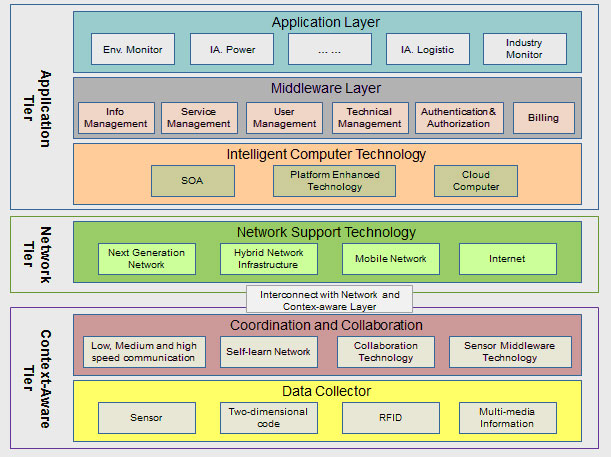
Source: NPTEL Internet of Things Course, IIT Kharagpur - This architecture shows how LPWAN technologies fit within the Network Support Technology layer, connecting the Context-Aware Tier (sensors, RFID, data collectors) to the Application Tier (middleware, cloud services, industry applications). LPWAN provides the “low, medium, and high speed communication” bridge in this layered model.
Understanding the differences between LPWAN technologies helps you choose the right solution for your deployment. This comprehensive comparison covers the three major LPWAN options:
| Feature | LoRaWAN | Sigfox | NB-IoT / LTE-M |
|---|---|---|---|
| Deployment Model | Private or operator | Operator-managed only | Telco operator (licensed) |
| Network Ownership | You own (private) or subscribe | Subscription only | Cellular subscription |
| Spectrum | Unlicensed ISM (868/915 MHz) | Unlicensed ISM (868/915 MHz) | Licensed cellular bands |
| Range | 2-15 km (urban/rural) | 10-40 km (excellent) | Cellular coverage (km) |
| Data Rate | 0.3-50 kbps (adaptive) | 100 bps (very limited) | NB-IoT: 250 kbps, LTE-M: 1 Mbps |
| Payload Size | Up to 242 bytes | 12 bytes uplink, 8 bytes downlink | Flexible (1-1000+ bytes) |
| Messages per Day | Unlimited (fair use) | 140 uplink, 4 downlink (hard limit) | Unlimited (data plan limits) |
| Latency | Seconds (Class A), ms (Class C) | Seconds to minutes | <1 second (LTE-M), seconds (NB-IoT) |
| Battery Life | 5-10 years typical | 10-15 years (ultra-low power) | 5-10 years (PSM/eDRX modes) |
| Bi-directional | Yes (Class A/B/C options) | Limited (4 downlinks/day) | Yes (full duplex) |
| Mobility Support | Limited (stationary focus) | Good (handoff between stations) | Excellent (cellular handoff) |
| Infrastructure Cost | $500-1000 per gateway | None (operator-managed) | None (cellular towers exist) |
| Device Cost | $5-20 (modules) | $5-15 (modules) | $10-30 (modules) |
| Setup Complexity | Medium (deploy gateways) | Easy (just subscribe) | Easy (SIM card) |
| Network Scalability | High (add gateways) | Limited (operator capacity) | Very high (cellular infrastructure) |
| Security | AES-128 (end-to-end) | AES-128 (operator-managed) | 3GPP cellular security |
| Geolocation | TDOA (with 3+ gateways) | RSSI-based (built-in) | Cell tower triangulation |
| Standards Body | LoRa Alliance | Sigfox (proprietary) | 3GPP (international standard) |
TipWhich LPWAN Should You Choose?
Choose LoRaWAN when: - ✅ You want to own the network (no recurring subscription fees) - ✅ You need flexible data rates and payload sizes (up to 242 bytes) - ✅ You need bidirectional communication (downlinks to devices) - ✅ You’re deploying in areas without Sigfox or cellular coverage - ✅ You need unlimited messages per day - ✅ You have budget for gateway infrastructure ($500-1000 per gateway)
Example: Farm monitoring (50-acre property, 100 soil sensors, no cell coverage) → Deploy 2 LoRaWAN gateways
Choose Sigfox when: - ✅ You want simplest deployment (no infrastructure to manage) - ✅ You have tiny payloads (≤12 bytes) and infrequent updates (≤140/day) - ✅ Sigfox coverage exists in your region (check coverage map) - ✅ You need ultra-long battery life (10-15 years) - ✅ Uplink-only communication is sufficient (or very rare downlinks)
Example: Asset tracking (shipping pallets reporting GPS every 30 min = 48 messages/day)
Choose NB-IoT / LTE-M when: - ✅ You need reliable, nationwide coverage (anywhere cell service exists) - ✅ You need higher data rates (250 kbps - 1 Mbps) for occasional firmware updates - ✅ You need low latency (<1 second for LTE-M) - ✅ Mobility support is required (asset tracking with handoff between cell towers) - ✅ You’re okay with recurring cellular data costs (similar to phone plan) - ✅ You need guaranteed QoS from telco operator SLA
Example: Smart parking meters (city-wide, need reliable uptime, firmware updates, existing AT&T/Verizon coverage)
NoteCost Comparison Example (1000 devices, 5 years)
LoRaWAN (Private Network):
Infrastructure: 10 gateways × $1000 = $10,000
Device modules: 1000 × $10 = $10,000
Network server: $100/month × 60 months = $6,000
Total 5-year cost: $26,000 ($5.20 per device/year)
Sigfox (Subscription):
Infrastructure: $0 (operator-managed)
Device modules: 1000 × $10 = $10,000
Subscription: 1000 × $10/year × 5 years = $50,000
Total 5-year cost: $60,000 ($12 per device/year)
NB-IoT (Cellular):
Infrastructure: $0 (cellular towers)
Device modules: 1000 × $20 = $20,000
Data plan: 1000 × $5/month × 60 months = $300,000
Total 5-year cost: $320,000 ($64 per device/year)
Key Insight: LoRaWAN private networks have higher upfront cost but lowest ongoing cost. Cellular has highest cost but best coverage and reliability. Sigfox is middle ground between DIY and cellular.
1068.4 LoRaWAN Star‑of‑Stars
LoRaWAN uses a star‑of‑stars topology: battery devices send LoRa frames to nearby gateways; gateways forward to a network server, which routes to application servers.
{fig-alt=“LoRaWAN star-of-stars architecture showing end devices (Classes A, B, C) communicating via LoRa RF to multiple gateways, which forward packets over IP backhaul (Ethernet, Wi-Fi, 4G) to the Network Server for deduplication and routing to Application Server. Demonstrates redundancy with devices reaching multiple gateways.”}
NoteAlternative View: Device Class Comparison
%%{init: {'theme': 'base', 'themeVariables': {'primaryColor': '#2C3E50', 'primaryTextColor': '#fff', 'primaryBorderColor': '#16A085', 'lineColor': '#16A085', 'secondaryColor': '#E67E22', 'tertiaryColor': '#7F8C8D'}}}%%
graph TB
    subgraph ClassA["Class A: Lowest Power"]
        A1["Uplink triggered by device"]
        A2["RX1: 1 sec after TX"]
        A3["RX2: 2 sec after TX"]
        A4["Sleep until next uplink"]
    end

    subgraph ClassB["Class B: Scheduled Windows"]
        B1["Beacon synchronized"]
        B2["Scheduled RX slots"]
        B3["Predictable latency"]
        B4["Medium power"]
    end

    subgraph ClassC["Class C: Always Listening"]
        C1["Continuous RX"]
        C2["Minimal latency"]
        C3["Highest power"]
        C4["For actuators"]
    end

    A1 --> A2 --> A3 --> A4
    B1 --> B2 --> B3 --> B4
    C1 --> C2 --> C3 --> C4

    style ClassA fill:#16A085,stroke:#2C3E50
    style ClassB fill:#E67E22,stroke:#2C3E50
    style ClassC fill:#2C3E50,stroke:#16A085
This diagram compares the three LoRaWAN device classes, showing how each trades off power consumption against downlink latency and receive window availability.
Key points: - Uplink frames can be received by multiple gateways; the network server de‑duplicates - Class A/B/C end device classes trade battery vs. latency - Gateways are stateless packet forwarders; backhaul via Ethernet/Wi-Fi/Cellular
1068.5 Sigfox Operator Model
Sigfox provides a fully managed network. Devices use ultra‑narrowband to operator base stations; backend routes messages to customer callbacks.
%%{init: {'theme': 'base', 'themeVariables': {'primaryColor': '#2C3E50', 'primaryTextColor': '#fff', 'primaryBorderColor': '#16A085', 'lineColor': '#16A085', 'secondaryColor': '#E67E22', 'tertiaryColor': '#7F8C8D', 'background': '#ffffff', 'mainBkg': '#2C3E50', 'secondBkg': '#16A085', 'tertiaryBkg': '#E67E22'}}}%%
graph TB
    subgraph devices[" Sigfox Devices "]
        SD1[Device 1<br/>12 bytes UL]
        SD2[Device 2<br/>8 bytes DL]
        SD3[Device 3<br/>Uplink Only]
    end

    subgraph operator[" Sigfox Operator Network "]
        BS1[Base Station 1<br/>Ultra-Narrowband]
        BS2[Base Station 2<br/>100 Hz BW]
        BS3[Base Station 3<br/>Spatial Diversity]
        BE[Sigfox Backend<br/>Message Processing<br/>Geolocation]
    end

    subgraph customer[" Customer Infrastructure "]
        CB[Callback Server<br/>HTTP/HTTPS<br/>Webhook]
        APP[Application<br/>Data Processing]
    end

    SD1 -.->|UNB 868/902 MHz| BS1
    SD1 -.->|3× Repetition| BS2
    SD2 -.->|UNB| BS2
    SD2 -.->|UNB| BS3
    SD3 -.->|UNB| BS3

    BS1 -->|Proprietary Protocol| BE
    BS2 -->|Proprietary Protocol| BE
    BS3 -->|Proprietary Protocol| BE

    BE -->|REST API/Callback<br/>JSON Payload| CB
    CB -->|Application Data| APP
    APP -.->|Downlink Request<br/>4 msgs/day max| CB
    CB -.->|API Call| BE
    BE -.->|Downlink| BS2

    style devices fill:#f0f0f0,stroke:#2C3E50,stroke-width:2px
    style operator fill:#f0f0f0,stroke:#E67E22,stroke-width:2px
    style customer fill:#f0f0f0,stroke:#16A085,stroke-width:2px
    style SD1 fill:#2C3E50,stroke:#16A085,color:#fff
    style SD2 fill:#2C3E50,stroke:#16A085,color:#fff
    style SD3 fill:#2C3E50,stroke:#16A085,color:#fff
    style BS1 fill:#E67E22,stroke:#2C3E50,color:#fff
    style BS2 fill:#E67E22,stroke:#2C3E50,color:#fff
    style BS3 fill:#E67E22,stroke:#2C3E50,color:#fff
    style BE fill:#E67E22,stroke:#2C3E50,color:#fff
    style CB fill:#16A085,stroke:#2C3E50,color:#fff
    style APP fill:#16A085,stroke:#2C3E50,color:#fff
{fig-alt=“Sigfox operator-managed architecture showing devices transmitting ultra-narrowband (UNB) messages with 3× repetition for spatial diversity to multiple base stations. Operator backend processes messages and delivers to customer callback servers via HTTP webhooks. Downlink path limited to 4 messages per day.”}
Characteristics: - Very small payloads (uplink‑focused), extremely low power - Coverage and QoS tied to operator footprint - Simple device model (no gateway to manage)
1068.6 NB‑IoT / LTE‑M Architecture
Cellular LPWAN integrates with 4G/5G core. Devices attach to eNodeB/gNodeB; data egresses via EPC/5GC to application servers.
%%{init: {'theme': 'base', 'themeVariables': {'primaryColor': '#2C3E50', 'primaryTextColor': '#fff', 'primaryBorderColor': '#16A085', 'lineColor': '#16A085', 'secondaryColor': '#E67E22', 'tertiaryColor': '#7F8C8D', 'background': '#ffffff', 'mainBkg': '#2C3E50', 'secondBkg': '#16A085', 'tertiaryBkg': '#E67E22'}}}%%
graph TB
    subgraph devices[" NB-IoT/LTE-M Devices "]
        ND1[NB-IoT Device<br/>eSIM/SIM<br/>PSM Mode]
        ND2[LTE-M Device<br/>Voice Support<br/>Mobile]
        ND3[NB-IoT Sensor<br/>eDRX Mode<br/>Stationary]
    end

    subgraph ran[" Radio Access Network "]
        ENB1[eNodeB 1<br/>4G Base Station]
        ENB2[eNodeB 2<br/>Licensed Spectrum]
        GNB[gNodeB<br/>5G Base Station]
    end

    subgraph core[" Core Network "]
        MME[MME/AMF<br/>Mobility Management]
        SGW[SGW/UPF<br/>Packet Gateway]
        HSS[HSS/UDM<br/>Subscriber DB]
    end

    subgraph external[" External Networks "]
        PDN[PDN Gateway<br/>Internet Access]
        APP[Application Server<br/>IoT Platform]
    end

    ND1 -.->|NB-IoT<br/>Licensed Band| ENB1
    ND2 -.->|LTE-M Cat-M1| ENB2
    ND2 -.->|Handoff| GNB
    ND3 -.->|NB-IoT| ENB2

    ENB1 -->|S1 Interface| MME
    ENB2 -->|S1 Interface| MME
    GNB -->|NG Interface| MME

    MME <-->|Auth/Attach| HSS
    MME -->|Bearer Setup| SGW
    SGW -->|User Plane| PDN

    PDN -->|IP Connection| APP
    APP -.->|MT Data| PDN

    style devices fill:#f0f0f0,stroke:#2C3E50,stroke-width:2px
    style ran fill:#f0f0f0,stroke:#16A085,stroke-width:2px
    style core fill:#f0f0f0,stroke:#E67E22,stroke-width:2px
    style external fill:#f0f0f0,stroke:#7F8C8D,stroke-width:2px
    style ND1 fill:#2C3E50,stroke:#16A085,color:#fff
    style ND2 fill:#2C3E50,stroke:#16A085,color:#fff
    style ND3 fill:#2C3E50,stroke:#16A085,color:#fff
    style ENB1 fill:#16A085,stroke:#2C3E50,color:#fff
    style ENB2 fill:#16A085,stroke:#2C3E50,color:#fff
    style GNB fill:#16A085,stroke:#2C3E50,color:#fff
    style MME fill:#E67E22,stroke:#2C3E50,color:#fff
    style SGW fill:#E67E22,stroke:#2C3E50,color:#fff
    style HSS fill:#E67E22,stroke:#2C3E50,color:#fff
    style PDN fill:#7F8C8D,stroke:#2C3E50,color:#fff
    style APP fill:#7F8C8D,stroke:#2C3E50,color:#fff
{fig-alt=“NB-IoT and LTE-M cellular LPWAN architecture showing devices with SIM cards attaching to licensed spectrum base stations (eNodeB/gNodeB), connecting through 4G/5G core network (MME, SGW, HSS) to reach application servers via PDN Gateway. Demonstrates PSM/eDRX power-saving modes and mobile handoff capabilities.”}
Design notes: - Licensed spectrum, mobility, and SIM/eSIM lifecycle - Power‑saving modes: PSM/eDRX for multi‑year battery life - Best for nationwide coverage and operator‑managed SLAs
1068.7 Videos
NoteLPWAN Overview
NoteRelated Chapters
Deep Dives: - LoRaWAN Overview - Core LoRaWAN architecture and fundamentals - LoRaWAN Architecture - Detailed network design and device classes - Sigfox Fundamentals - Operator-managed LPWAN alternative - LPWAN Fundamentals - Core concepts and technology comparison
Comparisons: - LPWAN Comparison - Compare LoRaWAN, Sigfox, NB-IoT architectures - NB-IoT Fundamentals - Cellular LPWAN architecture - LTE-M Fundamentals - Mobile cellular IoT alternative
Products:
Learning: - Quizzes Hub - Test your LPWAN architecture knowledge - Simulations Hub - Interactive LPWAN network tools
1068.8 Visual Reference Gallery
Explore these AI-generated architectural diagrams that visualize key LPWAN concepts covered in this chapter:
NoteVisual: LPWAN Technology Landscape
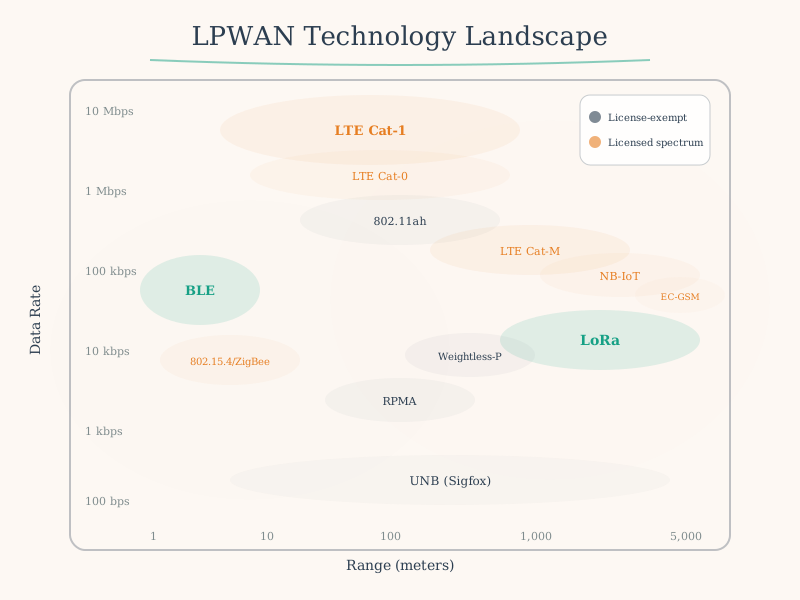
This visualization compares the three major LPWAN technologies, highlighting their positioning in terms of range (2-50 km), data rate (100 bps to 1 Mbps), and battery life (5-20 years).
NoteVisual: LPWAN Technology Comparison Matrix
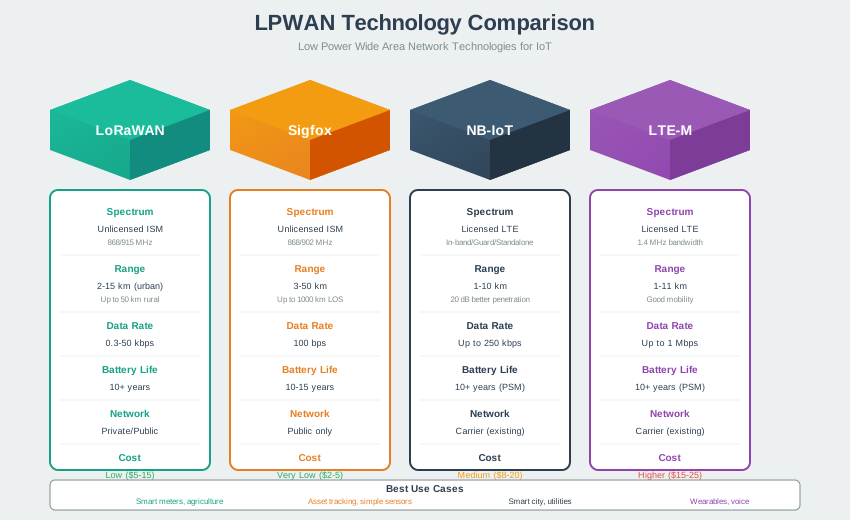
A structured comparison showing the key trade-offs between unlicensed (LoRaWAN, Sigfox) and licensed (NB-IoT) LPWAN technologies for IoT deployments.
NoteVisual: LPWAN Link Budget Analysis
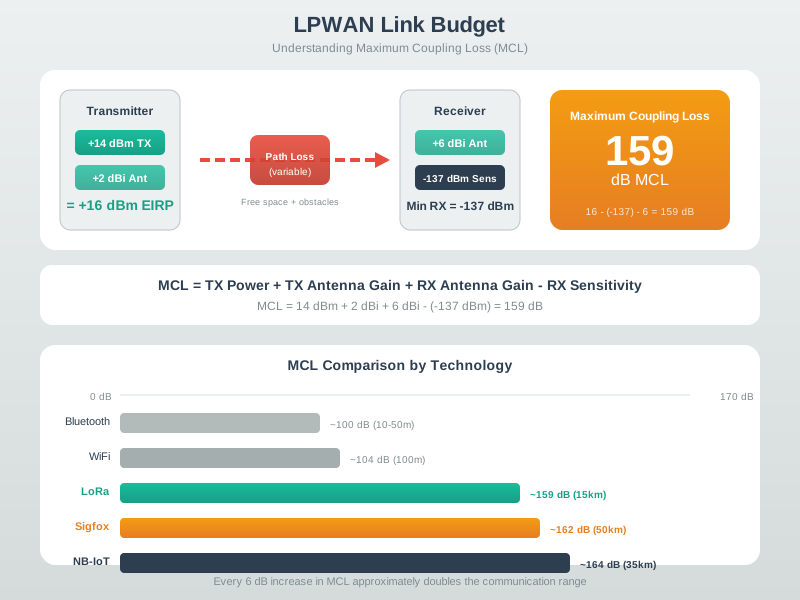
Understanding link budget is essential for LPWAN deployment planning, showing how range is achieved through a combination of transmit power, receiver sensitivity, and spreading factors.
1068.9 Summary
This chapter covered LPWAN network architectures and topologies:
- LoRaWAN Star-of-Stars: End devices communicate through stateless gateways that forward to network servers, enabling de-duplication and scalable deployments
- Device Classes: LoRaWAN Class A (lowest power), Class B (scheduled downlinks), and Class C (continuous receive) provide different latency-power trade-offs
- Sigfox Operator Model: Fully managed network with ultra-narrowband communication to operator base stations, routing messages to customer endpoints via callbacks
- Cellular LPWAN Integration: NB-IoT and LTE-M integrate with 4G/5G core networks, leveraging licensed spectrum and existing cellular infrastructure
- Backhaul Connectivity: Gateways use IP networks (Ethernet, Wi-Fi, cellular) to connect to network servers, enabling flexible deployment options
- Power-Saving Modes: Technologies like PSM (Power Saving Mode) and eDRX enable multi-year battery life in cellular LPWAN deployments
- Deployment Trade-offs: Private LoRaWAN networks offer control and no subscription costs, while operator models (Sigfox, NB-IoT) provide managed coverage with SLAs
1068.10 Knowledge Check
TipQuestion 1: LPWAN Architecture
What is the typical network topology for LPWAN technologies like LoRaWAN?
Options: - A) Mesh topology - B) Star-of-stars topology - C) Ring topology - D) Full mesh topology
NoteAnswer
Correct: B) Star-of-stars topology
LPWAN typically uses star-of-stars: end devices connect to gateways (first star), and gateways connect to a central network server (second star). This simplifies end devices and reduces their power consumption.
TipQuestion 2: LPWAN vs Cellular
What is a key architectural difference between LPWAN and traditional cellular IoT?
Options: - A) LPWAN requires SIM cards - B) LPWAN can use unlicensed spectrum - C) Cellular has longer range - D) LPWAN requires more gateways
NoteAnswer
Correct: B) LPWAN can use unlicensed spectrum
Technologies like LoRaWAN use unlicensed ISM bands, allowing private network deployment. Cellular IoT (NB-IoT, LTE-M) requires licensed spectrum and carrier agreements.
TipQuestion 3: Gateway Redundancy
In LoRaWAN, if multiple gateways receive the same uplink message, what happens?
Options: - A) Only the first gateway forwards it - B) All gateways forward it; server deduplicates - C) Gateways coordinate to choose one - D) The message is discarded as duplicate
NoteAnswer
Correct: B) All gateways forward it; server deduplicates
Multiple gateway reception improves reliability. The network server receives all copies and deduplicates, using the best signal for processing.
1068.10.1 LPWAN Technology Selection Decision Tree (Variant View)
This decision flowchart provides an alternative approach to selecting the optimal LPWAN technology based on deployment requirements, ownership model, and technical constraints:
%%{init: {'theme': 'base', 'themeVariables': {'primaryColor': '#2C3E50', 'primaryTextColor': '#fff', 'primaryBorderColor': '#16A085', 'lineColor': '#E67E22', 'secondaryColor': '#16A085', 'tertiaryColor': '#7F8C8D'}}}%%
flowchart TD
    START(["LPWAN Technology<br/>Selection"])
    Q1{"Own network<br/>infrastructure?"}
    Q2{"Global cellular<br/>coverage needed?"}
    Q3{"Bidirectional<br/>communication?"}
    Q4{"Message payload<br/>size?"}
    Q5{"Downlink<br/>requirements?"}
    Q6{"Real-time<br/>latency needed?"}

    LORAWAN["LoRaWAN<br/>Private Network"]
    LORAWAN_PUB["LoRaWAN<br/>Public Network (TTN)"]
    SIGFOX["Sigfox<br/>Operator Network"]
    NBIOT["NB-IoT<br/>Cellular IoT"]
    LTEM["LTE-M<br/>Cellular IoT"]

    LW_FEATURES["Features:<br/>• Up to 243 bytes payload<br/>• Class A/B/C device options<br/>• AES-128 encryption<br/>• No message limits<br/>• Private or public network"]
    SF_FEATURES["Features:<br/>• 12 bytes uplink payload<br/>• 140 messages/day limit<br/>• Global operator coverage<br/>• Ultra-low power<br/>• No infrastructure needed"]
    NB_FEATURES["Features:<br/>• Deep indoor penetration<br/>• 10+ year battery life<br/>• Carrier-grade reliability<br/>• Unlimited messages<br/>• Higher latency (seconds)"]
    LM_FEATURES["Features:<br/>• Voice support (VoLTE)<br/>• Mobility/handover<br/>• Lower latency (ms)<br/>• OTA firmware updates<br/>• Higher power consumption"]

    START --> Q1
    Q1 -->|"Yes"| LORAWAN
    Q1 -->|"No"| Q2
    Q2 -->|"Yes"| Q6
    Q2 -->|"No"| Q3
    Q3 -->|"Minimal/None"| Q4
    Q3 -->|"Required"| LORAWAN_PUB
    Q4 -->|"≤12 bytes"| SIGFOX
    Q4 -->|">12 bytes"| LORAWAN_PUB
    Q6 -->|"Yes (<1s)"| LTEM
    Q6 -->|"No"| Q5
    Q5 -->|"Frequent"| NBIOT
    Q5 -->|"Rare/None"| NBIOT

    LORAWAN --> LW_FEATURES
    LORAWAN_PUB --> LW_FEATURES
    SIGFOX --> SF_FEATURES
    NBIOT --> NB_FEATURES
    LTEM --> LM_FEATURES

    style START fill:#7F8C8D,color:#fff
    style Q1 fill:#2C3E50,color:#fff
    style Q2 fill:#2C3E50,color:#fff
    style Q3 fill:#2C3E50,color:#fff
    style Q4 fill:#2C3E50,color:#fff
    style Q5 fill:#2C3E50,color:#fff
    style Q6 fill:#2C3E50,color:#fff
    style LORAWAN fill:#16A085,color:#fff
    style LORAWAN_PUB fill:#16A085,color:#fff
    style SIGFOX fill:#E67E22,color:#fff
    style NBIOT fill:#3498db,color:#fff
    style LTEM fill:#9b59b6,color:#fff
    style LW_FEATURES fill:#d4efdf,color:#2C3E50
    style SF_FEATURES fill:#fdebd0,color:#2C3E50
    style NB_FEATURES fill:#d6eaf8,color:#2C3E50
    style LM_FEATURES fill:#ebdef0,color:#2C3E50
1068.10.2 LPWAN Power vs Range Trade-off (Variant View)
This scatter-plot style diagram visualizes the fundamental trade-offs between power consumption, range, and data rate across LPWAN technologies:
%%{init: {'theme': 'base', 'themeVariables': {'primaryColor': '#2C3E50', 'primaryTextColor': '#fff', 'primaryBorderColor': '#16A085', 'lineColor': '#E67E22', 'secondaryColor': '#16A085', 'tertiaryColor': '#7F8C8D'}}}%%
graph TB
    subgraph Header["LPWAN Technology Positioning"]
        direction LR
        H1["📶 Range"]
        H2["⚡ Power"]
        H3["📊 Data Rate"]
    end

    subgraph LoRa["LoRaWAN Characteristics"]
        L1["Range: 2-15 km<br/>Urban: 2-5 km<br/>Rural: 10-15 km"]
        L2["Power: 10+ year battery<br/>Class A optimized<br/>Sleep: 1 µA"]
        L3["Data Rate: 0.3-50 kbps<br/>Payload: 243 bytes<br/>Adaptive SF7-12"]
        L4["Use Case:<br/>Smart agriculture<br/>Asset tracking<br/>Building automation"]
    end

    subgraph Sig["Sigfox Characteristics"]
        S1["Range: 10-50 km<br/>Urban: 3-10 km<br/>Rural: 30-50 km"]
        S2["Power: 15+ year battery<br/>Ultra-low duty cycle<br/>Sleep: 0.5 µA"]
        S3["Data Rate: 100 bps<br/>Payload: 12 bytes UL<br/>8 bytes DL"]
        S4["Use Case:<br/>Simple sensors<br/>Utility metering<br/>Logistics tracking"]
    end

    subgraph Cell["NB-IoT/LTE-M Characteristics"]
        C1["Range: Cellular coverage<br/>Indoor: Enhanced<br/>Licensed spectrum"]
        C2["Power: 10+ year battery<br/>PSM/eDRX modes<br/>Higher peak power"]
        C3["Data Rate: 250 kbps-1 Mbps<br/>Payload: Flexible<br/>IP-based"]
        C4["Use Case:<br/>Smart meters<br/>Fleet management<br/>Healthcare wearables"]
    end

    subgraph Compare["Technology Trade-offs"]
        T1["🏆 Best Range: Sigfox"]
        T2["🏆 Best Power: Sigfox"]
        T3["🏆 Best Data Rate: LTE-M"]
        T4["🏆 Best Flexibility: LoRaWAN"]
        T5["🏆 Best Coverage: NB-IoT"]
    end

    LoRa --> Compare
    Sig --> Compare
    Cell --> Compare

    style Header fill:#f9f9f9,stroke:#2C3E50
    style LoRa fill:#16A085,color:#fff
    style Sig fill:#E67E22,color:#fff
    style Cell fill:#2C3E50,color:#fff
    style Compare fill:#7F8C8D,color:#fff
    style L1 fill:#d4efdf,color:#2C3E50
    style L2 fill:#d4efdf,color:#2C3E50
    style L3 fill:#d4efdf,color:#2C3E50
    style L4 fill:#d4efdf,color:#2C3E50
    style S1 fill:#fdebd0,color:#2C3E50
    style S2 fill:#fdebd0,color:#2C3E50
    style S3 fill:#fdebd0,color:#2C3E50
    style S4 fill:#fdebd0,color:#2C3E50
    style C1 fill:#e8e8e8,color:#2C3E50
    style C2 fill:#e8e8e8,color:#2C3E50
    style C3 fill:#e8e8e8,color:#2C3E50
    style C4 fill:#e8e8e8,color:#2C3E50
1068.11 What’s Next
Continue to LPWAN Comparison and Review for a detailed comparison of different LPWAN technologies.