329 Edge, Fog, and Cloud: Summary
329.1 Learning Objectives
By the end of this chapter, you will be able to:
- Review Key Concepts: Consolidate edge-fog-cloud architecture knowledge
- Avoid Common Pitfalls: Recognize and prevent design antipatterns
- Apply Visual References: Use diagrams and galleries for design decisions
- Plan Next Steps: Continue learning with related topics
- Previous: Edge-Fog-Cloud Advanced Topics - Worked examples
- Review Series:
- Introduction - Overview and tools
- Architecture - Layer details
- Devices and Integration - Device selection
- Advanced Topics - Misconceptions and examples
- Summary (this chapter) - Review and next steps
329.2 Prerequisites
Before diving into this chapter, you should have completed:
- Edge-Fog-Cloud Introduction: Three-tier concept
- Edge-Fog-Cloud Architecture: Layer details
- Edge-Fog-Cloud Devices and Integration: Device patterns
- Edge-Fog-Cloud Advanced Topics: Worked examples
329.3 Visual Reference Gallery
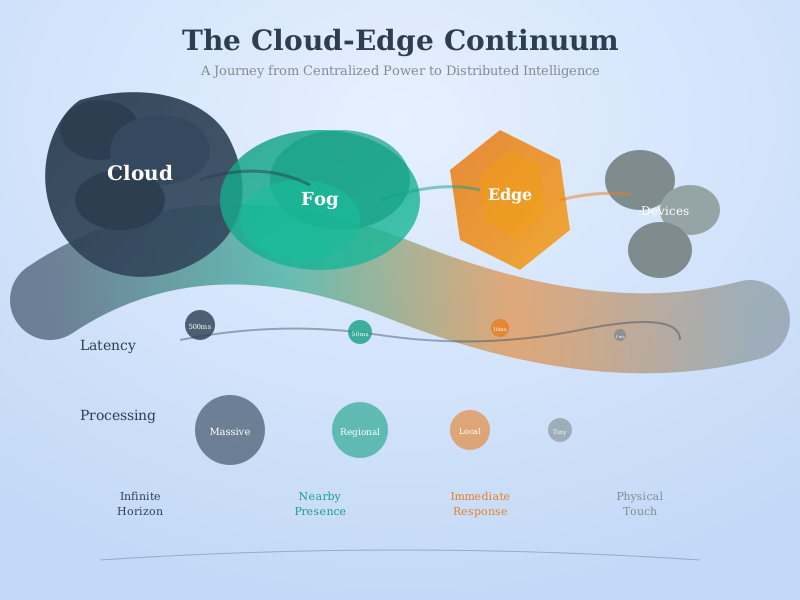
The three-tier IoT architecture showing the relationship between edge, fog, and cloud computing layers.
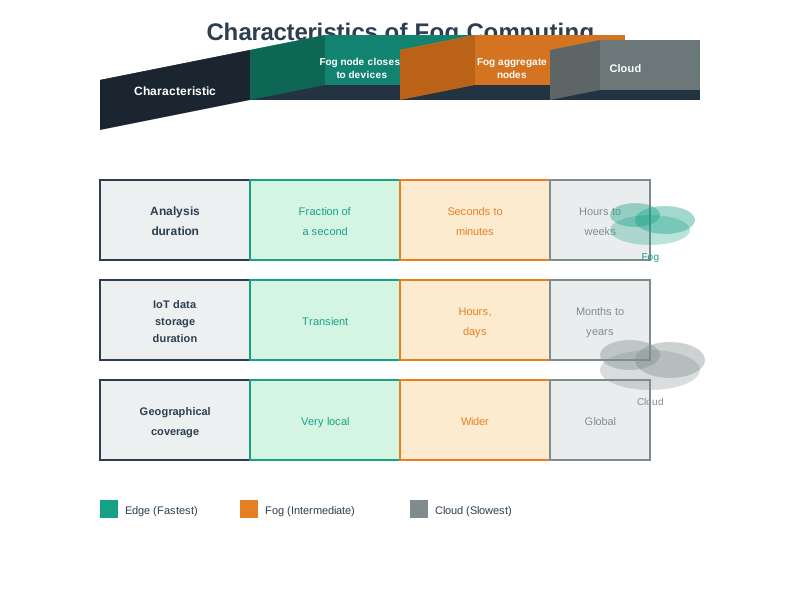
Key characteristics that distinguish fog computing from traditional cloud-centric architectures.
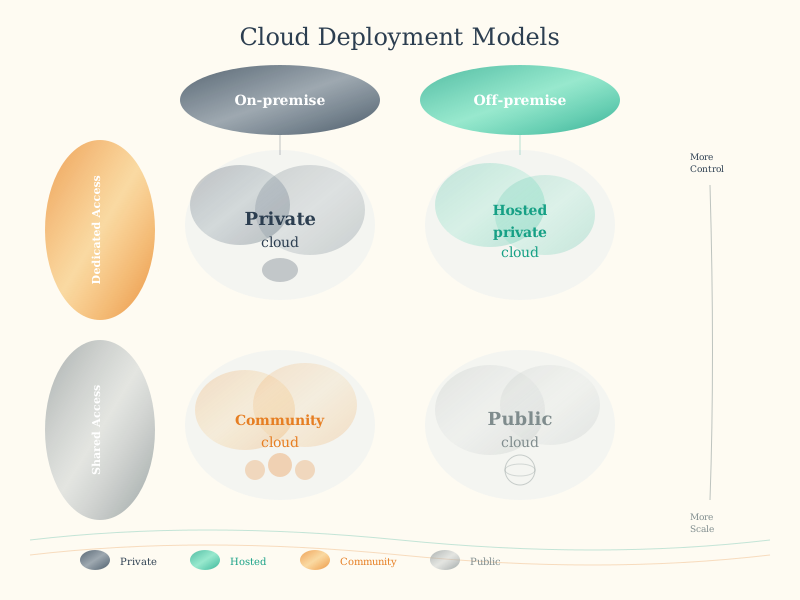
Comparison of deployment models and their suitability for different IoT application requirements.
329.4 Summary
This chapter introduced the foundational three-tier IoT architecture comprising Edge, Fog, and Cloud layers:
- Edge Nodes are physical devices (MCUs, sensors, actuators) that collect data from the environment and perform initial processing with minimal power consumption
- Fog Nodes are intermediate devices (Raspberry Pi, gateways) that aggregate data, perform protocol translation, filter information, and enable local decision-making
- Cloud Nodes are centralized data centers providing scalable compute, long-term storage, advanced analytics, and device management
- Processing Location Selection depends on latency requirements (fog for real-time), bandwidth constraints (fog reduces cloud traffic by 90-99%), and computational complexity (cloud for ML training)
- Protocol Translation bridges diverse field protocols (Zigbee, Modbus, BLE) to IP-based cloud protocols (MQTT, HTTP)
- Bidirectional Data Flow enables upstream telemetry and downstream control commands, supporting closed-loop automation
The three-tier architecture optimizes IoT deployments by placing computation at the appropriate layer based on latency, bandwidth, cost, and reliability requirements.
The Mistake: Architects send all sensor data to the cloud by default, treating fog/edge as optional optimizations to add later.
Why It Happens: Cloud computing is familiar and well-documented. Teams assume cloud is the “safe choice” since it scales elastically. They plan to add edge/fog “if latency becomes a problem.”
The Fix: Start with a requirements analysis that explicitly evaluates latency (is <100ms needed?), bandwidth cost (will transmission costs exceed $1,000/month?), and reliability (must the system function during internet outages?). Design for the most demanding requirement first. If any of these constraints exist, architect fog/edge from day one - retrofitting distributed processing into a cloud-centric design is 3-5x more expensive than building it correctly initially.
The Mistake: Teams process all sensor readings through the same pipeline regardless of urgency - either sending everything to cloud, or processing everything locally.
Why It Happens: Building separate data paths for different urgency levels requires more architecture work. Teams simplify by using one pipeline, assuming “we can optimize later.”
The Fix: Classify data into three urgency tiers from project start: (1) Safety-critical requiring <50ms response stays at edge, (2) Operational data needing <500ms goes to fog for aggregation, (3) Analytical data tolerating seconds-to-minutes latency routes to cloud. Implement tiered routing in your message broker (e.g., MQTT topic hierarchy) so critical alerts bypass fog queues while bulk telemetry gets filtered. This 10% additional design effort prevents 90% of latency complaints in production.
The following AI-generated figures provide alternative visual representations of concepts covered in this chapter. These “phantom figures” offer different artistic interpretations to help reinforce understanding.
329.4.1 Additional Figures


329.5 What’s Next
The next chapter explores Fog Computing Fundamentals in depth, covering fog node architecture, placement strategies, and implementation patterns for distributed edge processing.