98 Device Evolution: Embedded, Connected, and IoT Products
98.1 Learning Objectives
By the end of this chapter, you will be able to:
- Distinguish device categories: Classify devices as Embedded, Connected, or IoT
- Understand embedded systems: Recognize the foundational role of embedded systems in IoT
- Trace technology evolution: Appreciate how ARM Cortex-M and BLE enabled practical IoT
- Evaluate product positioning: Determine whether a product is truly “smart” or just connected
IoT Overview Series: - IoT Introduction - Getting started with IoT and the Five Verbs - IoT Requirements and Characteristics - Minimum requirements and ideal characteristics - IoT Perspectives and Definitions - Different stakeholder views on IoT - IoT History and Paradigm Shifts - Lessons from technology evolution
Technical Deep Dives: - Sensor Fundamentals - Sensors in embedded and IoT systems - Bluetooth Low Energy - BLE protocol details
98.2 Comparing Embedded, Connected, and IoT Products
The evolution from embedded systems to the Internet of Things represents a fundamental transformation in how devices interact with the world. Understanding these three distinct eras - Embedded Systems, Connected Devices, and Internet of Things - is crucial for recognizing the true innovation and value that IoT brings to modern technology.
98.2.1 The Three Eras of Device Evolution
Modern IoT devices didn’t appear overnight. They evolved through three distinct technological eras, each building on the previous generation’s capabilities while adding fundamentally new features.
Core Concept: IoT emerged from three distinct eras: Embedded Systems (1970s-1990s) with isolated, single-purpose devices; Connected Devices (1990s-2000s) adding internet connectivity for remote control; and true IoT (2010s+) adding intelligence that learns from data and makes autonomous decisions.
Why It Matters: Many marketed “smart” devices are actually just Connected (remote control) rather than IoT (intelligent). Understanding this distinction prevents overpaying for features and guides realistic project planning.
Key Takeaway: True IoT requires all three ingredients: a physical Thing + Computation + Internet connectivity + Intelligence that adapts based on data. Remove any one, and it’s not truly IoT.

98.2.2 Comprehensive Comparison: Embedded vs Connected vs IoT
The table below highlights the fundamental differences across seven key dimensions that distinguish embedded systems, connected devices, and true IoT products:
| Characteristic | Embedded Systems (1970s-1990s) | Connected Devices (1990s-2000s) | Internet of Things (2010s+) |
|---|---|---|---|
| Connectivity | None - operates in isolation | Point-to-point or proprietary protocols | Internet/Cloud via standard protocols (HTTP, MQTT, CoAP) |
| Intelligence | Fixed program in ROM/Flash | Remote updates possible, but behavior still fixed | Edge AI, machine learning, adaptive behavior based on data patterns |
| Data Flow | Local storage only (if any) | Periodic uploads to central server | Real-time bidirectional streaming with cloud analytics |
| Interoperability | Proprietary, vendor-locked | Vendor-specific APIs and protocols | Standards-based (IEEE, IETF, OCF) enabling multi-vendor ecosystems |
| Scale | Thousands per application domain | Millions deployed globally | Billions of devices worldwide (~20 billion in 2025, projected 40+ billion by 2034) |
| Decision-Making | Pre-programmed logic only | Remote commands from human operators | Autonomous decisions based on sensor fusion, ML models, and context |
| Examples | Washing machine timer, digital thermostat, microwave controller | Wi-Fi thermostat (manual control via app), connected security camera | Nest Learning Thermostat, smart factory with predictive maintenance |
98.2.3 Embedded Products (1970s-1990s)
Definition
Embedded products rely on internal (embedded) systems to perform focused tasks. They typically operate as standalone devices with limited interaction or networking capabilities. An embedded system is purpose-built for a single, specific function with minimal resources.
Key Characteristics: - Fixed functionality: Cannot adapt or learn from experience - Standalone operation: No external communication or updates - Resource-constrained: Minimal memory, processing power optimized for cost - Deterministic behavior: Same input always produces same output
Example
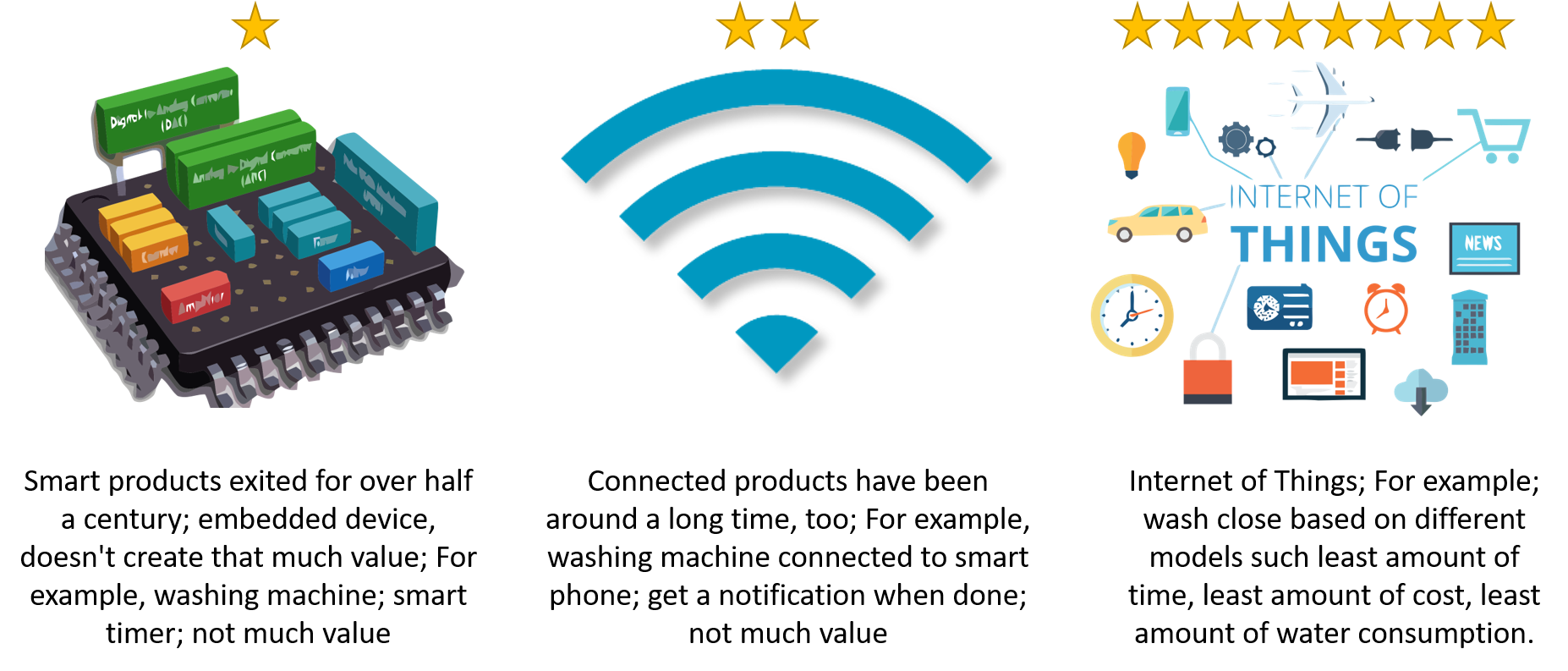
A traditional washing machine equipped with a programmable timer. Function: The timer enables scheduled operations but lacks any form of network connectivity. You set the cycle manually, and it executes the same pre-programmed sequence every time.
Value
- Benefit: Offers basic functionality and reliability for a single, specific task. Low cost, predictable behavior, no security vulnerabilities from network exposure.
- Limitation: Minimal added value because the device operates independently without external communication. Cannot be updated, monitored remotely, or optimized based on usage patterns.
98.2.4 Connected Products (1990s-2000s)
Definition
Connected products build on embedded systems by adding internet connectivity. This allows devices to communicate with users or other systems, offering features such as remote control and real-time notifications. However, they typically lack the intelligence to make autonomous decisions based on data.
Key Characteristics: - Internet-enabled: Can send/receive data over networks - Remote control: Operated via smartphone apps or web interfaces - Cloud storage: Data uploaded to centralized servers - Human-in-the-loop: Requires user commands for most actions
Example
A washing machine that sends smartphone alerts when the wash cycle is complete. Function: Provides notifications and can be controlled or monitored remotely. You can start a cycle from your phone, but you still manually select the wash settings - the machine doesn’t learn your preferences or optimize automatically.
Value
- Benefit: Improves convenience and user engagement through connectivity. Enables remote monitoring, firmware updates, and basic automation (scheduled operations).
- Limitation: Moderate impact on overall efficiency, as connectivity focuses on basic remote interactions and status updates. Still requires human decision-making for optimization - it’s a “remote control” not a “smart assistant.”
98.2.5 IoT Products (2010s-Present)
Definition
IoT products represent the most advanced stage, combining embedded technology, connectivity, and intelligent decision-making. These devices leverage data analytics, machine learning algorithms, and sensor fusion to optimize performance, adapt to user behavior, and interact autonomously with other systems.
Key Characteristics: - Autonomous intelligence: Makes decisions without human intervention - Machine learning: Learns patterns and improves over time - Sensor fusion: Combines multiple data sources for context awareness - Ecosystem integration: Communicates with other IoT devices and cloud services - Edge computing: Processes data locally for real-time responses
Example
A smart washing machine that automatically selects optimal washing cycles based on water usage, energy efficiency, and load type. Function: Uses data analysis and predefined logic to enhance resource management and user convenience. It detects fabric types via sensors, learns your usage patterns (you always wash jeans on Wednesdays), adjusts water temperature based on energy prices from the smart grid, and orders detergent automatically when running low.
Value
- Benefit: High-level impact through resource savings, time efficiency, and continuous optimization. Reduces water consumption by 30%, energy by 25%, and delivers perfectly cleaned clothes based on learned preferences. Integrates with smart home ecosystem (starts cycle when solar panels generate excess power).
- Limitation: May require more complex infrastructure, data management, and security considerations. Higher upfront cost, ongoing cloud service fees, privacy concerns about usage data, and potential security vulnerabilities if not properly secured.
98.2.6 Visual Evolution: Embedded -> Connected -> IoT
98.2.7 Why This Evolution Matters
Understanding the differences among these categories is essential for grasping the transformative potential of IoT in various industries. IoT products not only enhance functionality but also deliver smarter, more sustainable solutions.
Real-World Impact by Era:
| Era | Typical Cost | Development Time | Business Value | Customer Value |
|---|---|---|---|---|
| Embedded | $50-200 | 6-12 months | Low margins, commodity pricing | Basic functionality, reliable |
| Connected | $100-400 | 12-18 months | Premium pricing for connectivity | Convenience, remote access |
| IoT | $200-800+ | 18-36 months | Recurring revenue, ecosystem lock-in | Personalization, automation, cost savings |
Key Takeaway: The progression from Embedded -> Connected -> IoT represents not just technological advancement, but a fundamental shift in business models (one-time sale -> subscription services), value proposition (features -> outcomes), and customer relationships (transactional -> ongoing engagement).
98.3 What is an Embedded System?
An embedded system is a computer system that combines a computer processor, memory, and input/output peripheral devices to perform a dedicated function within a larger mechanical or electrical system. These systems are purpose-built and optimized for specific applications.
“An embedded system is a computerized system that is purpose-built for its application.”
- Elicia White, Making Embedded Systems (O’Reilly)
This definition has deep implications for how embedded systems are designed:
- Minimize cost / Maximize lifetime for a given expected workload
- Optimized, custom software that uses as few resources as possible
- No general-purpose bloat - every byte of code and every milliamp of power must justify its existence
Unlike desktop software where you can always throw more RAM or CPU at a problem, embedded systems force engineers to make hard trade-offs. This is why IoT firmware developers often write in C rather than Python - the efficiency gains directly translate to lower costs, longer battery life, and more reliable operation.
Key Characteristics of Embedded Systems
- Purpose-Built Functionality: Embedded systems are designed to perform a single, specialized task, making them highly efficient in operation.
- Low Power Consumption: Due to their focused functionality, embedded systems operate with minimal power requirements, allowing them to fit in small spaces and extend device longevity.
- Cost-Effective: Embedded systems are typically inexpensive, making them an economical solution for controlling devices in various applications.
- Market Dynamics: Embedded systems markets often operate within tight margins, such as in household appliances and consumer electronics.
- Optimization Requirements: Designers must optimize code and use minimal microcontroller resources to keep costs low and efficiency high.
Applications
Embedded systems are found in numerous devices and industries, including: - Home appliances (e.g., washing machines, microwaves) - Automotive systems - Medical devices - Industrial machinery
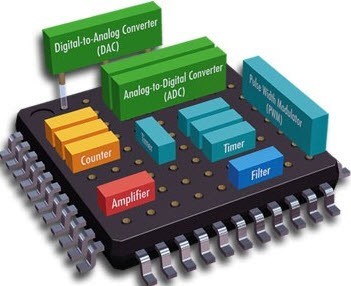
Embedded systems are fundamental to modern electronics, providing tailored solutions to a wide range of technological challenges.
98.3.1 Two Game-Changing Technologies for IoT
Two breakthrough technologies in the mid-2000s made practical IoT possible:
The ARM Cortex-M processor family revolutionized embedded computing:
- First ultra-low-power 32-bit processor designed for embedded applications
- Resources: 8-96 KB RAM, 64-512 KB code flash
- Game-changer: Sleep currents recently dropped below 1 uA - enabling devices to run for years on coin cell batteries
Before Cortex-M, designers had to choose between 8-bit processors (simple but limited) or power-hungry 32-bit chips. Cortex-M gave IoT devices full 32-bit capability with microamp power consumption.
BLE transformed wireless connectivity for IoT:
- Energy efficiency: Send a 30-byte packet once per second and last a year on a coin cell battery
- Critical adoption moment: Support was weak until Apple incorporated BLE into iBeacon (2013)
- Now universal: All major smartphones include BLE, making it the de facto standard for device-to-phone connectivity
The combination of Cortex-M processors and BLE radios enabled the first generation of truly practical consumer IoT devices - fitness trackers, beacons, smart home sensors - that could operate for years without battery replacement.
98.3.2 Historical Perspective: The Wireless Paradigm Shift
Wireless systems have evolved through four distinct paradigms, each bringing ~1000x more nodes:

| Era | Paradigm | Nodes | Technology | Direction |
|---|---|---|---|---|
| 1900 | Station-to-Station | 10^3 | Wireless telegraph | Point-to-point |
| 1920s | Station-to-People | 10^6 | AM/FM radio, TV | Broadcast |
| Present | People-to-People | 10^9 | Mobile phones | Bidirectional |
| Future | Everything-to-Everything | 10^12 | IoT | Ubiquitous mesh |
Each paradigm shift represents not just more devices, but a fundamental change in principles, technology, systems, and applications. IoT represents the ultimate paradigm: machines communicating with machines, requiring entirely new approaches to addressing, security, and data management.
98.4 Summary
In this chapter, you learned:
- Three distinct eras define device evolution: Embedded (isolated), Connected (remote control), and IoT (intelligent)
- Embedded systems are purpose-built for single functions with minimal resources
- Connected devices add internet but lack autonomous decision-making
- True IoT devices combine connectivity with machine learning and adaptive behavior
- ARM Cortex-M and BLE were the breakthrough technologies that made practical IoT possible
- Wireless paradigms have evolved from thousands to billions of nodes, with IoT targeting trillions
98.5 What’s Next?
Continue to IoT History and Paradigm Shifts to learn why established technology leaders often miss paradigm shifts and what this means for IoT today.