306 Blockchain Limitations and Real-World IoT Implementations
306.1 Learning Objectives
By the end of this chapter, you will be able to:
- Evaluate blockchain limitations for resource-constrained devices
- Calculate throughput requirements and identify scalability bottlenecks
- Analyze real-world blockchain-IoT implementations and their design decisions
- Apply worked examples to estimate transaction costs and storage requirements
- Identify appropriate IoT use cases where blockchain adds genuine value
306.2 Limitations and Challenges
While blockchain offers compelling benefits, it’s not a silver bullet. Understanding limitations is critical for realistic architecture.
The mistake: Architects design IoT systems assuming blockchain can handle the full data volume from thousands of sensors, then discover during load testing that transaction throughput is orders of magnitude below requirements.
Symptoms: - Transaction queues growing unboundedly during peak sensor activity - 10-minute to 1-hour delays between sensor reading and blockchain confirmation - Gas fees spiking to $50+ per transaction during network congestion
Why it happens: Marketing materials promote blockchain for “IoT data integrity” without mentioning throughput limits. Teams extrapolate from Visa’s 65,000 TPS to assume blockchain is similarly capable, when Ethereum actually processes ~15 TPS and Bitcoin ~7 TPS.
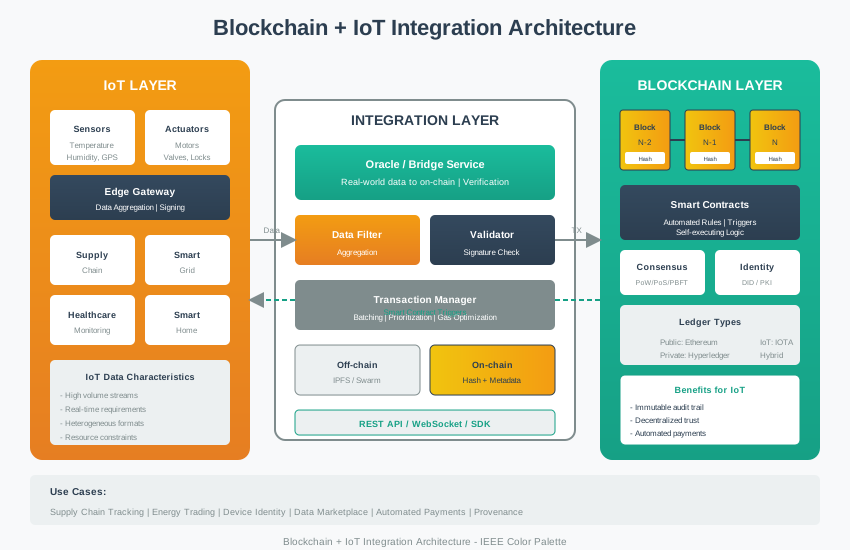
The fix: Calculate required TPS early in design: - 1,000 sensors x 1 reading/minute = 17 TPS (borderline for Ethereum) - 10,000 sensors x 1 reading/second = 10,000 TPS (requires private blockchain or off-chain design) Use hybrid on-chain/off-chain architecture: store raw data in traditional databases, anchor only cryptographic hashes or Merkle roots to blockchain for verification.
Prevention: Always perform back-of-envelope TPS calculations before selecting blockchain. Choose private blockchains (Hyperledger Fabric: 10,000+ TPS) for high-volume IoT, or use anchoring patterns that reduce on-chain transactions by 100-1000x.
The mistake: Deploying battery-powered or energy-constrained IoT devices that participate directly in Proof-of-Work blockchain consensus, rapidly draining batteries and increasing operational costs.
Symptoms: - IoT device batteries depleting in days instead of months or years - Excessive heat generation from continuous cryptographic computation - Energy bills for edge infrastructure exceeding cloud hosting costs
Why it happens: Teams conflate “lightweight IoT blockchain” marketing with actual energy requirements. Even IOTA’s Tangle requires proof-of-work per transaction. Developers assume edge devices can run blockchain nodes without understanding computational requirements.
The fix: Never run full consensus participation on battery-powered devices. Use architectural patterns: 1. Gateway delegation: Edge devices sign and send data to a gateway that handles blockchain interaction 2. Light client mode: Devices verify transactions using Simplified Payment Verification (SPV) without mining 3. Proof-of-Stake: Use PoS-based chains (Ethereum 2.0, Cardano) that require 99.95% less energy than PoW 4. Off-chain channels: Batch 1000s of transactions off-chain, settle once on-chain
Prevention: Calculate energy budget early: If a device has 1000mAh battery and blockchain operations consume 50mA, that’s 20 hours of blockchain-enabled operation vs. 6 months with standard MQTT. Design for gateway-mediated blockchain access from day one.
306.2.1 Scalability Bottleneck
The math: - 1 million IoT sensors - 1 reading per minute - Required throughput: 1 million TPS
Reality check: - Visa network: ~65,000 TPS (peak) - Ethereum: ~15 TPS - Hyperledger Fabric: ~10,000 TPS (optimized) - No blockchain today handles 1 million TPS
Solutions: - Off-chain storage with on-chain anchoring - State channels (devices transact off-chain, settle on-chain) - Sharding (partition blockchain into parallel chains) - Layer 2 solutions (Lightning Network, Polygon)
306.2.2 Resource Constraints
Full node requirements (Ethereum): - Storage: 1TB+ (growing ~1GB/day) - RAM: 8GB+ - CPU: Multi-core - Bandwidth: 10+ Mbps
Typical IoT device: - Storage: 4MB flash - RAM: 256KB - CPU: 80 MHz single-core - Bandwidth: Intermittent, low-power radio
Reality: IoT devices will never run full nodes. Architectures must embrace gateways, light clients, or trusted intermediaries.
306.2.3 Latency Mismatch
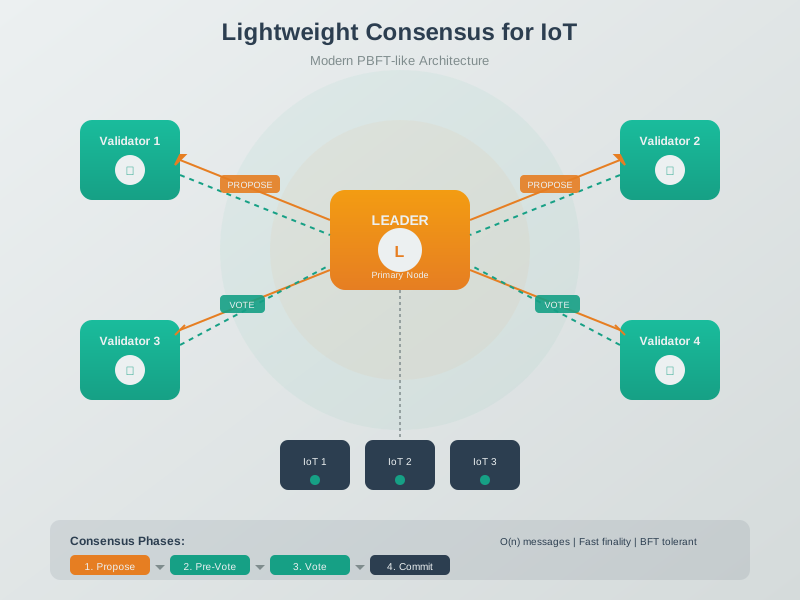
Blockchain finality times: - Bitcoin: 10 minutes (1 confirmation), 60 minutes (6 confirmations for security) - Ethereum: 15 seconds (1 confirmation), 6 minutes (25+ confirmations) - Hyperledger Fabric: <1 second (PBFT consensus)
IoT real-time requirements: - Industrial control: <10 milliseconds - Autonomous vehicles: <100 milliseconds - Healthcare monitoring: <1 second
Implication: Blockchain is unsuitable for real-time control loops. Use for: - Audit trails (post-facto verification) - Financial settlement (delayed is acceptable) - Identity management (infrequent updates)
306.2.4 Energy Consumption
Proof of Work (Bitcoin, Ethereum 1.0): - Bitcoin: ~150 TWh/year (entire country’s worth) - Incompatible with battery-powered IoT
Proof of Stake (Ethereum 2.0, Cardano): - ~99.95% less energy than PoW - Still requires always-on nodes (not suitable for edge devices)
IoT-optimized consensus (IOTA, Hedera): - Minimal energy per transaction - But sacrifice some decentralization
306.2.5 Immutability as Double-Edged Sword
Benefit: Can’t alter historical records Problem: Can’t fix mistakes or comply with “right to be forgotten” (GDPR)
Example: An IoT device mistakenly logs personally identifiable information (PII) to blockchain. Under GDPR, the individual has right to erasure. But blockchain data is immutable by design.
Workaround: - Store only hashes on-chain (PII in off-chain database that can be deleted) - Use private blockchains where consortium can agree to “fork” and exclude data - Encrypt data with keys that can be destroyed (making data unreadable, though still present)
306.3 Real-World Blockchain-IoT Implementations
306.3.1 IBM Food Trust (Hyperledger Fabric)
Problem: Food contamination outbreaks require tracing source. Traditional systems take days to weeks.
Solution: Blockchain-based supply chain where each participant logs events: - Farm: Harvest time, batch number, farm ID - Processor: Processing date, temperature logs - Distributor: Transit conditions, timestamps - Retailer: Receipt and sale
Results: - Walmart traced mangoes from farm to store in 2.2 seconds (vs 7 days previously) - Rapid contamination source identification saves lives - Over 20 major food companies participating
Technology: Hyperledger Fabric (private blockchain), IoT sensors for temperature/location, smart contracts for compliance checks.
306.3.2 Chronicled MediLedger (Ethereum-based)
Problem: Counterfeit pharmaceuticals cost $200B/year. Drug pedigree tracking is fragmented.
Solution: Blockchain ledger recording drug ownership transfers from manufacturer to pharmacy.
Components: - RFID tags on drug packaging (IoT) - Manufacturers register serial numbers on blockchain - Each transfer scanned and recorded - Pharmacists verify authenticity before dispensing
Results: Zero-knowledge proofs allow verification without revealing confidential pricing data. Compliance with DSCSA (Drug Supply Chain Security Act).
306.3.3 MOBI Vehicle Identity (Ethereum)
Problem: Car history fraud (odometer rollback, hidden accidents). Fragmented records across DMVs, insurers, service centers.
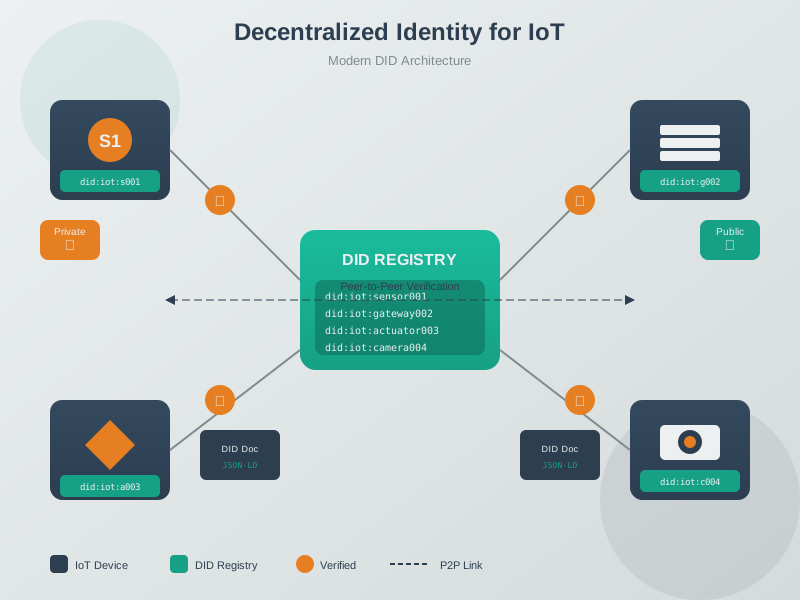
Solution: Decentralized vehicle identity (VID) on blockchain.
Participants: 30+ companies including BMW, Ford, GM, Honda, Renault, IBM, Accenture.
Vision: - Every vehicle has blockchain-based digital identity - Mileage automatically logged by vehicle IoT (GPS, OBD-II) - Accidents, maintenance, ownership transfers recorded immutably - Used car buyers verify complete history via blockchain
Current Status: Pilot projects underway; standardization in progress.
306.3.4 Helium Network (Decentralized IoT Connectivity)
Innovation: Blockchain incentivizes individuals to deploy LoRaWAN gateways.
How it works: 1. Individuals buy Helium hotspots (LoRaWAN gateways) 2. Deploy in homes/businesses, providing coverage 3. IoT devices connect through nearby hotspots 4. Hotspot owners earn cryptocurrency (HNT) for providing coverage and validating data transfers 5. Proof of Coverage consensus ensures honest network operation
Results: 900,000+ hotspots worldwide (as of 2023), creating people-powered IoT network.
306.4 Worked Examples
These worked examples demonstrate practical calculations for blockchain-IoT system design.
Scenario: A pharmaceutical company is deploying a blockchain-based cold chain monitoring system for vaccine distribution across 500 shipping containers, each with temperature sensors reporting every 5 minutes.
Given: - Number of containers: 500 - Reporting interval: 5 minutes (300 seconds) - Each sensor reading generates 1 blockchain transaction - Target blockchain: Hyperledger Fabric - Fabric throughput capacity: 3,000 TPS (typical enterprise configuration) - Transaction size: 256 bytes (sensor ID, temperature, timestamp, signature)
Steps:
- Calculate required transactions per second (TPS):
- Transactions per container per hour: 60 min / 5 min = 12 transactions/hour
- Total transactions per hour: 500 x 12 = 6,000 transactions/hour
- Required TPS: 6,000 / 3,600 seconds = 1.67 TPS
- Compare to blockchain capacity:
- Hyperledger Fabric capacity: 3,000 TPS
- Required: 1.67 TPS
- Utilization: 1.67 / 3,000 = 0.056% utilization
- Headroom available: 3,000 - 1.67 = 2,998.33 TPS spare capacity
- Calculate daily storage requirements:
- Daily transactions: 6,000 x 24 = 144,000 transactions
- Daily storage: 144,000 x 256 bytes = 36,864,000 bytes = 35.2 MB/day
- Annual storage: 35.2 x 365 = 12.85 GB/year
- Estimate transaction costs (if on Ethereum instead):
- Ethereum gas for simple storage: ~20,000 gas
- Gas price (typical): 30 gwei = 0.00000003 ETH
- Cost per transaction: 20,000 x 0.00000003 = 0.0006 ETH approx $1.50 (at $2,500/ETH)
- Daily cost: 144,000 x $1.50 = $216,000/day (prohibitive!)
- Hyperledger Fabric cost: ~$0.001/transaction = $144/day
Result: The system can easily run on Hyperledger Fabric with 0.056% capacity utilization. Using public Ethereum would cost $216,000/day vs ~$144/day on Fabric - a 1,500x cost difference.
Key Insight: Always calculate TPS requirements and cost implications before selecting a blockchain platform. For high-volume IoT applications, private blockchains like Hyperledger Fabric are typically 1,000-10,000x more cost-effective than public chains.
Scenario: A smart city is deploying 10,000 parking sensors that need to record occupancy changes and process micropayments ($0.25 per 15-minute parking session) between vehicles and parking infrastructure.
Given: - Number of parking spots: 10,000 - Average turnover: 8 vehicles per spot per day - Peak hour: 25% of daily transactions occur in 1 hour - Transaction types: Occupancy update + payment - Payment amount: $0.25 per session - Maximum acceptable latency: 30 seconds - Available platforms: Ethereum, Hyperledger Fabric, IOTA Tangle
Steps:
Calculate daily transaction volume:
- Daily parking sessions: 10,000 spots x 8 turnovers = 80,000 sessions
- Transactions per session: 2 (occupancy start + payment at end)
- Total daily transactions: 80,000 x 2 = 160,000 transactions/day
Calculate peak TPS requirement:
- Peak hour transactions: 160,000 x 0.25 = 40,000 transactions
- Peak TPS: 40,000 / 3,600 = 11.1 TPS
Evaluate platform suitability:
Platform TPS Capacity Latency Cost/TX Daily Cost Verdict Ethereum 15 TPS 15s - 10min $1.50 $240,000 Too expensive Hyperledger Fabric 3,000 TPS 1-3s $0.001 $160 Viable but not ideal IOTA Tangle 1,000+ TPS 5-10s $0.00 $0 Best fit Verify micropayment economics:
- Parking revenue per session: $0.25
- Ethereum fee: $1.50 (600% of revenue - impossible)
- Fabric fee: $0.002 (0.8% of revenue - acceptable)
- IOTA fee: $0.00 (0% of revenue - optimal)
Check latency requirements:
- Ethereum: 15 seconds to 10 minutes (6 confirmations) - borderline
- Hyperledger Fabric: 1-3 seconds - acceptable
- IOTA Tangle: 5-10 seconds - acceptable
Result: Select IOTA Tangle for this deployment. It provides feeless transactions (critical for $0.25 micropayments), sufficient throughput (11.1 TPS << 1,000+ capacity), and acceptable latency (<30 seconds).
Key Insight: For IoT micropayments, transaction fees often exceed the payment value on traditional blockchains. IOTA’s feeless model or Layer 2 solutions are essential for sub-dollar transactions. The rule of thumb: if transaction_fee > 5% of payment_value, the platform is not economically viable.
306.5 Visual Reference Gallery
306.6 What’s Next?
You’ve learned about blockchain limitations and seen how real companies are successfully deploying blockchain-IoT solutions. Continue your journey:
Blockchain Interactive Lab: Build a working blockchain on ESP32 to experience hash chains, mining, and tamper detection firsthand.
Blockchain Fundamentals for IoT: Review the basics of blockchain types and selection criteria.
Smart Contracts and Architectural Patterns: Deep dive into smart contract design and gateway-based architectures.