%%{init: {'theme': 'base', 'themeVariables': {'primaryColor': '#2C3E50', 'primaryTextColor': '#fff', 'primaryBorderColor': '#16A085', 'lineColor': '#16A085', 'secondaryColor': '#E67E22', 'tertiaryColor': '#7F8C8D', 'clusterBkg': '#f9f9f9', 'clusterBorder': '#2C3E50', 'edgeLabelBackground':'#ffffff'}}}%%
graph TB
    subgraph Centralized["Centralized IoT Architecture"]
        CS[Central Server]
        D1[Device 1]
        D2[Device 2]
        D3[Device 3]
        D4[Device 4]
        D5[Device 5]

        D1 --> CS
        D2 --> CS
        D3 --> CS
        D4 --> CS
        D5 --> CS

        style CS fill:#E67E22,stroke:#2C3E50,stroke-width:3px
        style D1 fill:#7F8C8D,stroke:#2C3E50
        style D2 fill:#7F8C8D,stroke:#2C3E50
        style D3 fill:#7F8C8D,stroke:#2C3E50
        style D4 fill:#7F8C8D,stroke:#2C3E50
        style D5 fill:#7F8C8D,stroke:#2C3E50
    end

    subgraph Decentralized["Decentralized Blockchain Architecture"]
        N1[Node 1<br/>+ Ledger]
        N2[Node 2<br/>+ Ledger]
        N3[Node 3<br/>+ Ledger]
        N4[Node 4<br/>+ Ledger]
        N5[Node 5<br/>+ Ledger]

        N1 --- N2
        N1 --- N3
        N2 --- N3
        N2 --- N4
        N3 --- N4
        N3 --- N5
        N4 --- N5
        N5 --- N1

        style N1 fill:#16A085,stroke:#2C3E50,stroke-width:2px
        style N2 fill:#16A085,stroke:#2C3E50,stroke-width:2px
        style N3 fill:#16A085,stroke:#2C3E50,stroke-width:2px
        style N4 fill:#16A085,stroke:#2C3E50,stroke-width:2px
        style N5 fill:#16A085,stroke:#2C3E50,stroke-width:2px
    end

    style Centralized fill:#fff,stroke:#2C3E50,stroke-width:2px
    style Decentralized fill:#fff,stroke:#2C3E50,stroke-width:2px
304 Blockchain Fundamentals for IoT
304.1 Learning Objectives
By the end of this chapter, you will be able to:
- Explain why decentralization and immutability matter for IoT trust models
- Differentiate between blockchain types (public, private, consortium) and their IoT suitability
- Identify the trust problems blockchain solves in multi-party IoT ecosystems
- Evaluate tradeoffs between public, private, and IoT-optimized distributed ledgers
304.2 Introduction
How do you trust data from 10,000 sensors owned by different companies? Who verifies that the temperature reading from a pharmaceutical shipment was accurate and unaltered? When an autonomous vehicle reports an accident, how can insurers trust the vehicle’s logs weren’t tampered with?
Traditional IoT architectures rely on centralized authorities to validate data, manage identities, and enforce agreements. But this creates single points of failure, trust bottlenecks, and opportunities for manipulation. Blockchain and distributed ledger technology (DLT) offer an alternative: immutable, decentralized trust where no single party controls the record of truth.
Blockchain provides a shared, tamper-proof ledger where IoT devices can record transactions, trigger automated agreements through smart contracts, and establish trust without intermediaries. However, integrating blockchain with resource-constrained IoT devices presents unique challenges in scalability, latency, and energy consumption that require careful architectural consideration.
WarningCommon Misconception: Blockchain Solves All IoT Security Problems
Myth: “Adding blockchain to my IoT system automatically makes it secure and solves all trust issues.”
Reality: Blockchain provides data immutability and decentralized consensus, but does NOT solve:
- Device security: If an attacker compromises an IoT sensor and controls its private key, they can sign and submit fraudulent data that will be permanently recorded on the blockchain as “valid.”
- Input validation: Blockchain follows “garbage in, garbage out”–if a faulty or malicious sensor reports incorrect temperature readings, the blockchain will faithfully record those false readings forever.
- Real-time threats: Blockchain has finality delays (seconds to minutes). It cannot prevent active attacks like man-in-the-middle or jamming.
- Privacy: Public blockchains expose all transaction data. Private blockchains still require careful access control design.
Key insight: Blockchain is a trust layer for multi-party systems, not a replacement for device security, encryption, access control, or input validation. You still need secure boot, attestation, encrypted communication, and anomaly detection–blockchain complements these, not replaces them.
TipFor Beginners: What is Blockchain?
Imagine a shared notebook that everyone in a group has an identical copy of. When someone writes a new entry, everyone’s notebook automatically updates to include it. Once an entry is written, it cannot be erased or changed–ever. If someone tries to alter their copy, everyone else’s notebooks will show the discrepancy, and the fake entry is rejected.
That’s essentially what blockchain is: a shared, unchangeable record of transactions or events. Each “block” contains a batch of transactions, and these blocks are “chained” together using cryptography. The chain is maintained by many computers (nodes) that all agree on what the correct version is.
For IoT, this means sensor readings, device actions, or equipment status can be recorded in a way that no single company or person can manipulate the historical record–creating trust through mathematics and distribution rather than relying on a central authority.
TipFor Kids: Meet the Sensor Squad!
Blockchain is like a magical notebook where EVERYONE has an exact copy, and once you write something, it can NEVER be erased or changed - not even by the sneakiest person!
304.2.1 The Sensor Squad Adventure: The Unbreakable Truth Notebook
The Sensor Squad had a big problem at the Smart Farm. Farmer Fred claimed his tomatoes were grown at exactly the perfect temperature. But Sneaky Sam said, “How do we KNOW that’s true? What if someone changed the records?”
This was a serious problem! The tomatoes were being sold to a fancy restaurant, and they needed PROOF that the temperature readings were real and hadn’t been changed.
Sammy the Temperature Sensor had an idea. “What if EVERYONE kept a copy of my temperature readings? Not just one notebook, but MANY notebooks - and they all have to match!”
Here’s how the Sensor Squad set up their “blockchain” system:
Step 1: Everyone Gets a Notebook
Sammy, Lila the LED, Max the Microcontroller, Bella the Battery, AND Farmer Fred all got identical notebooks. Whenever Sammy recorded a temperature, ALL of them wrote it down at the same time.
Step 2: Chain the Pages Together
After each page was filled, the Squad did something clever. They used a special code (called a “hash”) that connected each page to the previous one. It was like putting a secret stamp on each page that said “this page comes after THAT page.”
Step 3: The Cheater Test
Sneaky Sam tried to cheat! He snuck into Farmer Fred’s barn and changed one number in Fred’s notebook: “25 degrees” became “20 degrees.”
But when the Squad compared notebooks, FOUR of them said “25 degrees” and only ONE said “20 degrees.” The different one was obviously wrong! Plus, because Sneaky Sam changed that page, the secret stamp didn’t match anymore.
“CAUGHT!” shouted the Squad. “The blockchain ALWAYS knows when someone tries to cheat!”
Step 4: The Restaurant Gets the Truth
Now the fancy restaurant could trust the temperature records because: - Not just ONE person kept the records - EVERYONE did - Changing one notebook wouldn’t work - you’d have to change ALL of them at exactly the same time (impossible!) - The chain of secret stamps would reveal any tampering
“It’s like having a hundred witnesses instead of just one,” explained Max. “Even if one witness lies, all the others tell the truth!”
The Lesson:
Farmer Fred smiled. “Blockchain helps when you need EVERYONE to trust the same truth, especially when you don’t know each other well. It’s perfect for important things like food safety, medicine tracking, and making sure IoT sensors are telling the real story!”
304.2.2 Key Words for Kids
| Word | What It Means |
|---|---|
| Blockchain | A special system where many people keep identical copies of the same information, so no one can cheat or lie |
| Block | One page of records - like one day’s worth of sensor readings bundled together |
| Chain | How the pages connect - each page has a secret code linking it to the page before it |
| Hash | A special code or fingerprint that changes completely if even ONE tiny thing is different |
| Decentralized | Not controlled by any single person - everyone shares the responsibility equally |
304.2.3 Try This at Home!
The Unbreakable Truth Game!
Play this with 3-5 friends or family members to see how blockchain works:
What you need: - Small notebooks or paper for each person - A timer
The Game:
- One person is the “Sensor” and announces events: “9:00 AM - Temperature is 22 degrees!”
- EVERYONE writes this down in their notebook at the same time
- After 5 events, one person secretly tries to change ONE thing in their notebook
- Everyone compares notebooks - can you find the cheater?
The Blockchain Version (harder to cheat!):
After each event, everyone writes the FIRST LETTER of each word from the previous event at the top of the new page. For example: - Event 1: “Temperature is 22” - Event 2 starts with: “T-I-2-2” then the new event
If someone changes Event 1, their letters for Event 2 won’t match everyone else’s!
What you’ll learn: - When everyone keeps records, it’s MUCH harder to cheat - Connecting events together (like a chain) makes tampering obvious - Trust works better when NO ONE person controls all the information
NoteKey Takeaway
In one sentence: Blockchain provides immutable, decentralized trust for multi-party IoT ecosystems, but cannot solve device-level security or meet real-time latency requirements.
Remember this rule: Only use blockchain when multiple parties need shared data without trusting each other AND require an immutable audit trail; otherwise, a traditional database is simpler, faster, and cheaper.
304.3 Why Blockchain for IoT?
304.3.1 The Trust Problem in IoT Ecosystems
IoT deployments increasingly involve multiple stakeholders with competing interests:
- Multi-party ownership: A smart city has sensors owned by utilities, government, and private companies
- Data integrity questions: Who guarantees a pollution sensor reading is accurate and unaltered?
- Audit trail requirements: Regulatory compliance demands provable history (FDA for medical devices, NHTSA for autonomous vehicles)
- Automated transactions: M2M payments, resource sharing, and automated contracts need verifiable execution
Traditional solutions rely on trusted third parties (cloud providers, certification authorities), but these introduce:
- Single points of failure: Server outages affect all dependent IoT systems
- Trust bottlenecks: Central authority must validate every transaction
- Manipulation risks: Database administrators can alter historical records
- Vendor lock-in: Dependence on proprietary platforms
304.3.2 What Blockchain Provides
Blockchain addresses these challenges through four fundamental properties:
Immutability: Once recorded, data cannot be altered without detection. Cryptographic hashing and chain structure make tampering computationally infeasible.
Decentralization: No single entity controls the ledger. Consensus mechanisms ensure agreement across distributed nodes without central authority.
Transparency: All authorized parties see the same record of truth. Public blockchains are fully open; private blockchains offer permissioned transparency.
Smart Contracts: Self-executing code that automatically enforces agreements when conditions are met, enabling trustless automation.
304.3.3 Value Propositions for IoT
Blockchain adds genuine value in IoT scenarios requiring:
- Multi-organizational trust: Supply chains with manufacturers, shippers, retailers, regulators
- Auditability: Provable compliance history for regulated industries
- Micropayments: M2M transactions where traditional payment rails are too expensive
- Device identity: Self-sovereign identity for billions of IoT devices
- Data marketplaces: Monetizing sensor data while maintaining ownership
304.4 Blockchain Types for IoT
Not all blockchains are suitable for IoT. Understanding the spectrum from fully public to fully private is critical for architectural decisions.
304.4.1 Public Blockchains
Examples: Bitcoin, Ethereum, Cardano
Characteristics: - Fully decentralized: Anyone can run a node, validate transactions, participate in consensus - Permissionless: No gatekeepers for reading or writing data - High security: Massive computational power protects against attacks (Bitcoin: ~300 exahashes/second) - Low throughput: 7-15 transactions per second (Bitcoin: 7 TPS, Ethereum: 15 TPS) - High latency: 10 minutes to 1 hour for transaction finality - Energy intensive: Proof of Work consumes gigawatts (Bitcoin: ~150 TWh/year)
IoT Suitability: Generally poor for high-frequency sensor data. Useful only for: - Recording critical milestones (device manufacturing, ownership transfers) - Anchoring hashes of off-chain IoT data for verification - Public identity registries for IoT devices
304.4.2 Private (Permissioned) Blockchains
Examples: Hyperledger Fabric, R3 Corda, Quorum
Characteristics: - Controlled access: Only authorized nodes participate - Higher throughput: 1,000-10,000+ TPS depending on configuration - Lower latency: Sub-second to few-second finality - Energy efficient: Use consensus mechanisms like PBFT, Raft instead of Proof of Work - Privacy controls: Channel-based isolation, encrypted ledger state - Governance: Consortium defines rules, membership, smart contract approval
IoT Suitability: Good for enterprise IoT where: - Known participants (supply chain partners, utility companies) - Performance matters (frequent sensor updates) - Privacy required (confidential business data) - Regulatory compliance needed (GDPR, HIPAA)
304.4.3 IoT-Optimized Distributed Ledgers
IOTA (Tangle - Directed Acyclic Graph): - No blockchain: Uses DAG (Tangle) structure instead of linear chain - Feeless: No transaction costs, enabling micropayments - Scalable: Parallelized validation; throughput increases with activity - Lightweight: Designed for resource-constrained devices - Controversy: Centralized “coordinator” (being phased out), security questions
Hedera Hashgraph: - Asynchronous Byzantine Fault Tolerance: Fast, fair, provably secure consensus - High throughput: 10,000+ TPS - Governed: Controlled by council of enterprises (Google, IBM, Boeing)
IoT Suitability: Best for machine-to-machine ecosystems requiring: - High-frequency microtransactions - Low computational overhead - Predictable costs
304.4.4 Comparison Table
Intermediate Level
| Characteristic | Public Blockchain | Private Blockchain | IOTA/DAG |
|---|---|---|---|
| Throughput (TPS) | 7-15 | 1,000-10,000+ | 1,000+ (scales with load) |
| Latency | 10 min - 1 hr | <1 sec - few sec | <10 sec |
| Energy per TX | ~1,000 kWh (Bitcoin) | <0.01 kWh | ~0.001 kWh |
| Transaction Cost | $1-50 | $0.001-0.01 | $0 (feeless) |
| Decentralization | High | Low-Medium | Medium (improving) |
| Node Requirements | 1TB+ storage, high CPU | 100GB+, moderate CPU | <10GB, low CPU |
| IoT Suitability | Low (anchoring only) | High (enterprise) | High (M2M) |
%%{init: {'theme': 'base', 'themeVariables': {'primaryColor': '#2C3E50', 'primaryTextColor': '#fff', 'primaryBorderColor': '#16A085', 'lineColor': '#16A085', 'secondaryColor': '#E67E22', 'tertiaryColor': '#7F8C8D', 'fontSize': '14px'}}}%%
graph LR
    subgraph Public["Public Blockchain<br/>(Bitcoin/Ethereum)"]
        PubPro["Pros: High Security<br/>Fully Decentralized<br/>Censorship-Resistant"]
        PubCon["Cons: Slow (7-15 TPS)<br/>Expensive ($1-50/tx)<br/>High Energy"]
    end

    subgraph Private["Private Blockchain<br/>(Hyperledger Fabric)"]
        PrivPro["Pros: Fast (10K TPS)<br/>Low Cost ($0.001/tx)<br/>Privacy Controls"]
        PrivCon["Cons: Lower Decentralization<br/>Requires Governance<br/>Permissioned Access"]
    end

    subgraph DAG["IoT-Optimized DAG<br/>(IOTA)"]
        DAGPro["Pros: Feeless ($0/tx)<br/>Scalable (1K+ TPS)<br/>Lightweight"]
        DAGCon["Cons: Less Proven<br/>Coordinator (being removed)<br/>Smaller Ecosystem"]
    end

    UseCase1[Supply Chain<br/>Multi-Company Trust] -.->|Best Fit| Private
    UseCase2[M2M Micropayments<br/>Smart City] -.->|Best Fit| DAG
    UseCase3[Device Identity Registry<br/>Global Public Record] -.->|Best Fit| Public

    style Public fill:#2C3E50,stroke:#16A085,color:#fff,stroke-width:2px
    style Private fill:#16A085,stroke:#2C3E50,color:#fff,stroke-width:2px
    style DAG fill:#E67E22,stroke:#2C3E50,color:#fff,stroke-width:2px
    style UseCase1 fill:#7F8C8D,stroke:#2C3E50
    style UseCase2 fill:#7F8C8D,stroke:#2C3E50
    style UseCase3 fill:#7F8C8D,stroke:#2C3E50
TipTradeoff: Public Blockchain vs Private Blockchain
Decision context: When adding blockchain to an IoT system, you must choose between fully decentralized public networks and controlled private/consortium networks.
| Factor | Public Blockchain | Private Blockchain |
|---|---|---|
| Power | High (Proof of Work mining) | Low (efficient consensus like PBFT) |
| Cost | $1-50 per transaction (gas fees) | $0.001-0.01 per transaction |
| Complexity | Simple to join (permissionless) | Requires consortium governance setup |
| Latency | 10 min - 1 hour finality | Sub-second to few seconds finality |
Choose Public Blockchain when: - Global, censorship-resistant verification is required (device identity registry) - No trusted consortium exists to govern a private network - Transaction frequency is low (once per device lifetime) - Maximum decentralization and transparency are paramount
Choose Private Blockchain when: - Known participants need shared trust (supply chain partners) - High transaction throughput is required (>100 TPS) - Confidential business data must remain private - Regulatory compliance requires access controls (GDPR, HIPAA)
Default recommendation: Use Private Blockchain (Hyperledger Fabric) for enterprise IoT unless you specifically need global public verification or have no consortium to manage the network.
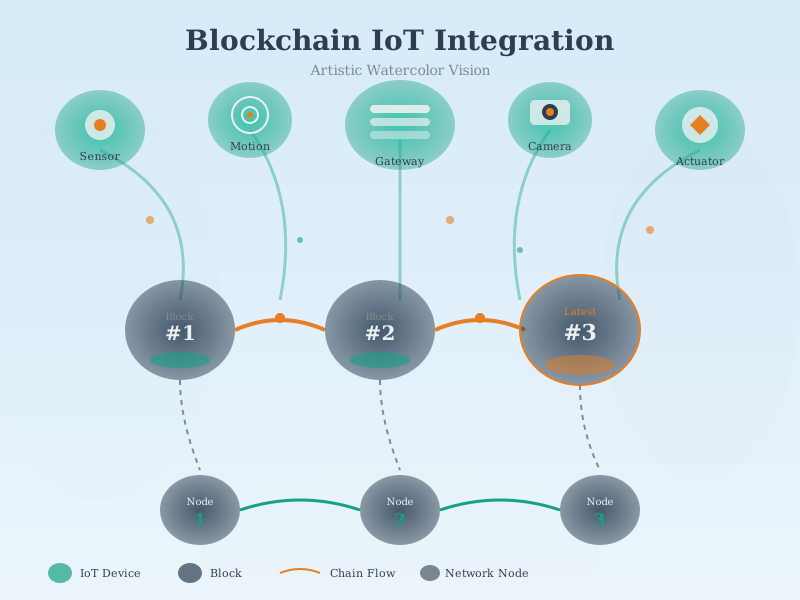
Real-World IoT Blockchain Selection Decision:
Scenario 1: Global Supply Chain (Walmart Food Trust) - Requirement: 20 companies (farms, processors, distributors, retailers) need shared trust - Data volume: 10,000 products tracked, 100 events per product per day = 1M events/day - Choice: Hyperledger Fabric (Private Blockchain) - Why: Known participants (consortium), needs privacy (confidential pricing), fast (1K TPS sufficient), low cost (<$0.01/tx vs. Ethereum $50/tx = $50M/day savings!)
Scenario 2: Smart City Parking (IOTA Use Case) - Requirement: 50,000 parking spots, drivers pay per minute via car digital wallet - Data volume: 5,000 cars x 60 payments/hour = 300K TPS (peak) - Choice: IOTA Tangle (DAG) - Why: Feeless (transaction costs would exceed parking fees otherwise), scalable, micropayments ($0.05/5-min), M2M (no human intervention)
Scenario 3: Device Manufacturing Certificates (Public Blockchain) - Requirement: 1 billion IoT devices need globally verifiable authenticity certificates - Data volume: 1B devices manufactured over 10 years = 100M/year = 3 TPS average - Choice: Ethereum (Public Blockchain) - Why: Needs global trust (anyone can verify), low transaction frequency (once per device lifetime), worth high cost ($10 certificate fee acceptable for $100 device)
NoteAlternative View: Blockchain Decision Tree for IoT Architects
This variant presents blockchain selection as a step-by-step decision process, helping architects choose the right technology based on their specific requirements.
%%{init: {'theme': 'base', 'themeVariables': {'primaryColor': '#2C3E50', 'primaryTextColor': '#fff', 'primaryBorderColor': '#16A085', 'lineColor': '#16A085', 'secondaryColor': '#E67E22', 'tertiaryColor': '#7F8C8D', 'fontSize': '14px'}}}%%
flowchart TB
    Start([IoT Blockchain<br/>Decision]) --> Q1{Multiple parties<br/>who don't fully<br/>trust each other?}

    Q1 -->|No| NoBC["No Blockchain Needed<br/>───────────<br/>Use centralized database<br/>or cloud platform<br/>───────────<br/>Simpler, faster, cheaper"]

    Q1 -->|Yes| Q2{Need immutable<br/>audit trail?}

    Q2 -->|No| NoBC

    Q2 -->|Yes| Q3{Transaction<br/>frequency?}

    Q3 -->|">1000/sec"| Q4{Need<br/>micropayments?}

    Q3 -->|"<100/sec"| Q5{Publicly<br/>verifiable?}

    Q4 -->|Yes| IOTA["IOTA/DAG<br/>───────────<br/>Feeless transactions<br/>M2M micropayments<br/>Scalable with load"]

    Q4 -->|No| Private["Private Blockchain<br/>───────────<br/>Hyperledger Fabric<br/>High throughput<br/>Privacy controls"]

    Q5 -->|Yes| Public["Public Blockchain<br/>───────────<br/>Ethereum, Bitcoin<br/>Global verification<br/>Highest trust"]

    Q5 -->|No| Private

    style NoBC fill:#7F8C8D,stroke:#2C3E50,color:#fff
    style IOTA fill:#E67E22,stroke:#2C3E50,color:#fff
    style Private fill:#16A085,stroke:#2C3E50,color:#fff
    style Public fill:#2C3E50,stroke:#16A085,color:#fff
NoteAlternative View: Hybrid On-Chain/Off-Chain Architecture
This variant shows how practical IoT-blockchain systems store only essential data on-chain while keeping bulk sensor data off-chain, addressing the scalability challenge.
%%{init: {'theme': 'base', 'themeVariables': {'primaryColor': '#2C3E50', 'primaryTextColor': '#fff', 'primaryBorderColor': '#16A085', 'lineColor': '#16A085', 'secondaryColor': '#E67E22', 'tertiaryColor': '#7F8C8D', 'fontSize': '12px'}}}%%
flowchart TB
    subgraph Sensors["IoT Layer (100,000 devices)"]
        S1["Temperature<br/>Sensors"]
        S2["Location<br/>Trackers"]
        S3["Quality<br/>Cameras"]
    end

    subgraph OffChain["Off-Chain Storage (99.9% of data)"]
        Cloud["Cloud Storage<br/>AWS S3 / IPFS<br/>───────────<br/>• Raw sensor readings<br/>• Video feeds<br/>• High-frequency data<br/>• Cost: $0.02/GB/month"]
    end

    subgraph OnChain["On-Chain (0.1% of data)"]
        BC["Blockchain<br/>───────────<br/>• Content hashes (SHA-256)<br/>• Critical events<br/>• State changes<br/>• Smart contract triggers<br/>───────────<br/>Cost: $0.001/transaction"]
    end

    subgraph Verify["Verification Process"]
        V1["Anyone can:<br/>1. Download data from S3<br/>2. Calculate SHA-256 hash<br/>3. Compare with on-chain hash<br/>4. Prove data unchanged"]
    end

    S1 --> Cloud
    S2 --> Cloud
    S3 --> Cloud
    Cloud -->|"Hash every<br/>1000 readings"| BC
    Cloud -->|"Critical events<br/>only"| BC
    BC --> Verify
    Cloud --> Verify

    style Sensors fill:#2C3E50,stroke:#16A085,color:#fff
    style OffChain fill:#7F8C8D,stroke:#16A085,color:#fff
    style OnChain fill:#16A085,stroke:#2C3E50,color:#fff
    style Verify fill:#E67E22,stroke:#2C3E50,color:#fff
304.5 What’s Next?
You’ve learned the fundamentals of blockchain technology and how different blockchain types suit different IoT scenarios. Continue your journey:
Smart Contracts for IoT: Learn how self-executing code automates IoT agreements and explore architectural patterns for integrating blockchain with resource-constrained devices.
Blockchain Limitations and Real-World Implementations: Understand scalability challenges, worked examples, and how companies like Walmart and Helium are deploying blockchain-IoT solutions.
Blockchain Interactive Lab: Build a working blockchain on ESP32 to experience hash chains, mining, and tamper detection firsthand.