%%{init: {'theme': 'base', 'themeVariables': { 'primaryColor': '#2C3E50', 'primaryTextColor': '#fff', 'primaryBorderColor': '#16A085', 'lineColor': '#16A085', 'secondaryColor': '#E67E22', 'tertiaryColor': '#7F8C8D'}}}%%
graph TB
    subgraph Characteristics["LPWAN Key Characteristics"]
        C1[Low Power<br/>5-10 year battery life<br/>Sleep current: 1-5 uA]
        C2[Long Range<br/>Urban: 2-15 km<br/>Rural: 40+ km]
        C3[Low Data Rate<br/>100 bps - 50 kbps<br/>Small payloads]
        C4[Low Cost<br/>Simple devices<br/>$5-20 per module]
        C5[Massive Scale<br/>10,000+ devices<br/>per base station]
    end

    subgraph Technologies["Major LPWAN Technologies"]
        T1[LoRaWAN<br/>CSS modulation<br/>Private/Public]
        T2[Sigfox<br/>UNB 100 bps<br/>Operator only]
        T3[NB-IoT<br/>LTE-based<br/>Cellular carriers]
        T4[LTE-M<br/>Mobile support<br/>Voice capable]
    end

    Characteristics --> Technologies

    style Characteristics fill:#2C3E50,color:#fff
    style Technologies fill:#16A085,color:#fff
1059 LPWAN Overview and Core Concepts
1059.1 Learning Objectives
By the end of this chapter, you will be able to:
- Understand the defining characteristics of LPWAN technologies
- Explain how LPWAN fills the gap between short-range wireless and cellular networks
- Identify the key LPWAN protocols: LoRaWAN, Sigfox, NB-IoT, and LTE-M
- Recognize appropriate use cases for LPWAN technologies
1059.2 Introduction
Low-Power Wide-Area Network (LPWAN) technologies represent a class of wireless communication protocols specifically designed for IoT applications that require long-range connectivity with minimal power consumption. LPWAN fills the gap between short-range technologies (like Wi-Fi and Bluetooth) and traditional cellular networks, enabling battery-powered devices to communicate over distances of several kilometers while lasting years on a single battery.
1059.3 Prerequisites
Before diving into this chapter, you should be familiar with:
- Networking Basics: Understanding fundamental networking concepts including network topologies, protocols, and wireless communication principles is essential for grasping LPWAN technologies
- IoT Protocols Overview: Basic knowledge of IoT communication protocols and their use cases helps position LPWAN within the broader IoT ecosystem
- Wireless Sensor Networks: Familiarity with WSN concepts, energy constraints, and deployment challenges provides important context for LPWAN’s design goals
TipFor Beginners: What is LPWAN?
Imagine you need to monitor water meters across an entire city, or track soil moisture sensors on a 1000-acre farm, or check parking space occupancy across downtown. You face a challenge: Wi-Fi only reaches 50 meters, Bluetooth even less, and cellular drains batteries too quickly and costs too much for simple sensor data.
LPWAN (Low-Power Wide-Area Network) solves this “Goldilocks problem”—it’s the “just right” solution between short-range technologies (Wi-Fi, Bluetooth) and power-hungry cellular networks. LPWAN can send data 10+ kilometers on a single transmission while running for 10 years on a small battery.
The magic is in the trade-offs: LPWAN sends very small amounts of data (like “temperature: 22C”) very infrequently (like once per hour) over long distances. It’s perfect for sensors that report simple readings, but terrible for video streaming or web browsing. Think of it as the difference between sending postcards once a day versus video calling—different tools for different needs.
Three major LPWAN families exist: LoRaWAN (you can build your own network), Sigfox (subscription service like cellular), and NB-IoT/LTE-M (cellular carriers’ IoT networks). Each makes different trade-offs between range, power, cost, and data rates.
| Term | Simple Explanation |
|---|---|
| LPWAN | Low-Power Wide-Area Network—long range, low power, low data rate |
| Long Range | 2-15 km in cities, 40+ km in rural areas (vs Wi-Fi’s 50m) |
| Low Power | 5-10 years on coin cell battery (vs days/months for Wi-Fi) |
| Low Data Rate | 0.3-50 kbps (vs Wi-Fi’s 100+ Mbps)—good for sensor readings |
| LoRaWAN | Open standard—build your own network with gateways and devices |
| Sigfox | Subscription service—pay per device like cellular phone plan |
| NB-IoT/LTE-M | Cellular carriers’ LPWAN—uses existing cell towers |
| Base Station/Gateway | Antenna that receives LPWAN signals from many devices |
TipFor Kids: Meet the Sensor Squad!
LPWAN is like having a super-quiet whisper that can travel for miles and miles!
1059.3.1 The Sensor Squad Adventure: The Farm That Could Talk
Farmer Jenny had a BIG problem. Her farm was HUGE - so big it took an hour to drive across! She wanted to know if her plants were thirsty, but she couldn’t check thousands of plants every day. “I wish my plants could tell me when they need water,” she sighed.
Sammy the Sensor had a brilliant idea! “Let’s put tiny sensors in the ground all over the farm. But there’s a problem - Wi-Fi only reaches about as far as you can throw a ball, and the farm is much bigger than that!”
That’s when Max the Microcontroller remembered LPWAN - the super long-range whisperer. “LPWAN can send tiny messages really, REALLY far - like 10 miles! It’s like having a walkie-talkie that works across the whole town!”
Bella the Battery loved this idea most of all. “And the best part? These sensors can run on a single tiny battery for TEN YEARS! They only wake up to whisper ‘Plant #247 is thirsty!’ then go back to sleep.”
Now Farmer Jenny gets messages on her phone: “Field 3 needs water!” “Field 7 is perfect!” The Sensor Squad helped the whole farm learn to talk!
1059.3.2 Key Words for Kids
| Word | What It Means |
|---|---|
| LPWAN | Low-Power Wide-Area Network - sends tiny messages VERY far using very little battery |
| Gateway | A tall antenna (like a lighthouse) that hears messages from sensors miles away |
| Long Range | Can send messages 10+ miles - farther than you could ride your bike in an hour! |
| Low Power | Uses so little energy that one tiny battery can last for YEARS |
| Small Messages | Only sends little notes like “temp: 72” - not videos or games |
1059.3.3 Try This at Home!
The Whisper Relay Challenge:
- Stand with family members spread across your home (or yard)
- One person whispers a short message: “Temperature is 75 degrees”
- Pass the message person to person using QUIET whispers
- See how far the message can travel while staying accurate!
The LPWAN Lesson: LPWAN works like whispers - it uses very little energy (quiet voice) but can travel surprisingly far when everyone listens carefully. That’s why LPWAN sensors whisper tiny messages instead of shouting big ones - it saves their battery “voice” for years!
NoteCross-Hub Connections
Enhance your LPWAN learning with these hub resources:
Visual Learning: - Knowledge Map - See how LPWAN fits into the IoT networking landscape and its relationships with cellular, short-range wireless, and cloud architectures - Simulations Hub - Interactive LPWAN range calculator to experiment with spreading factors, payload sizes, and duty cycle constraints
Video Tutorials: - Videos Hub - Curated LPWAN technology comparisons, LoRaWAN deep dives, and real-world deployment case studies
Test Your Knowledge: - Quizzes Hub - Practice LPWAN technology selection, TCO calculations, and duty cycle compliance problems - Knowledge Gaps - Common LPWAN misconceptions about range vs data rate trade-offs and cellular vs LPWAN cost comparisons
Why use the hubs? The Knowledge Map shows LPWAN’s critical position bridging short-range IoT (Wi-Fi, Zigbee) and cellular networks (NB-IoT, LTE-M). The Simulations hub lets you calculate real-world scenarios like: “Can my LoRaWAN sensor at SF10 send 50-byte payloads every 5 minutes and stay under 1% duty cycle?” These interactive tools reinforce the theoretical concepts with hands-on exploration.
1059.4 What is LPWAN?
NoteAcademic Resource: Stanford IoT Course - Industrial IoT Network Architecture
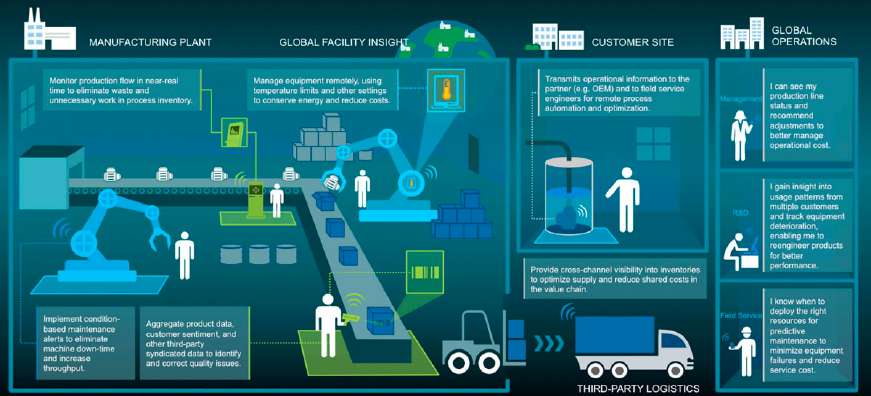
Source: Stanford University IoT Course - This diagram shows how LPWAN technologies enable industrial IoT by connecting manufacturing plants, logistics networks, and customer sites across wide geographic areas with low-power, long-range wireless communication.
LPWAN technologies are designed specifically for:
- Low power: Battery life measured in years (5-10 years typical)
- Low bit rate: Hundreds of bits per second to a few kilobits per second
- Long range: 2-15 kilometers in urban areas, 40+ kilometers in rural areas
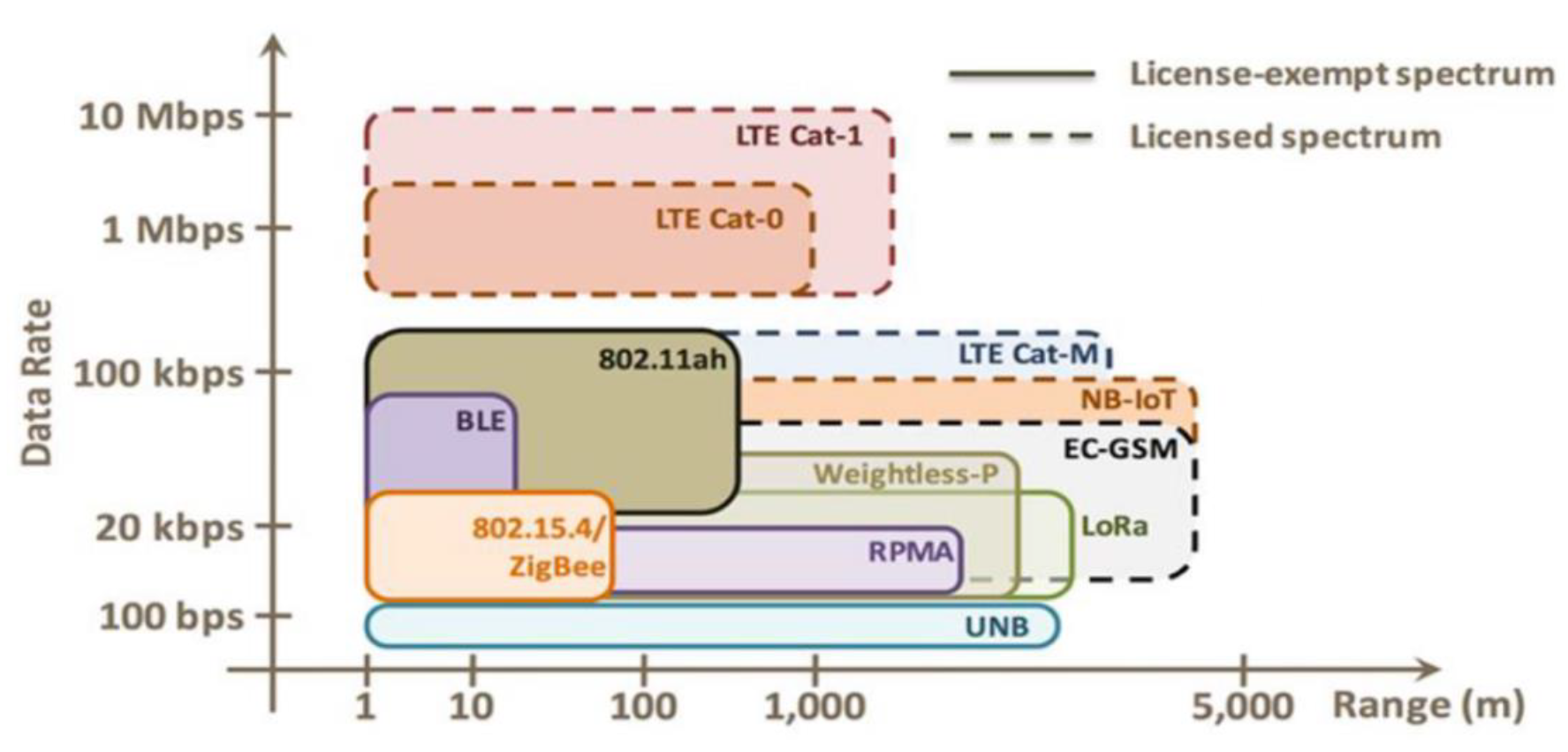
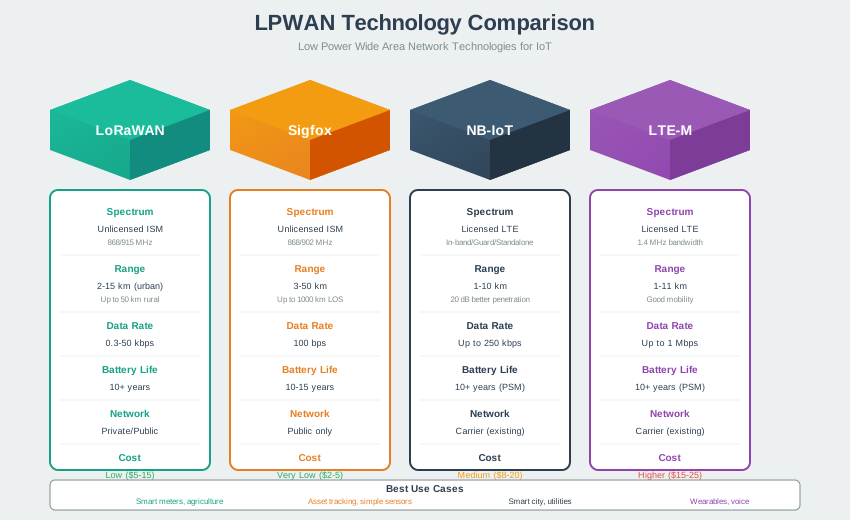
Additional LPWAN characteristics include:
- Low processing: Simple, inexpensive devices
- Massive scale: Support for tens of thousands of devices per base station
NoteAlternative View: Trade-off Triangle
%%{init: {'theme': 'base', 'themeVariables': { 'primaryColor': '#2C3E50', 'primaryTextColor': '#fff', 'primaryBorderColor': '#16A085', 'lineColor': '#16A085', 'secondaryColor': '#E67E22', 'tertiaryColor': '#7F8C8D'}}}%%
graph TD
    RANGE["Long Range"] --- CENTER((LPWAN<br/>Optimized))
    POWER["Low Power"] --- CENTER
    DATA["High Data Rate"] --- CENTER

    CENTER -.->|"Sacrificed"| DATA
    CENTER -->|"Achieved"| RANGE
    CENTER -->|"Achieved"| POWER

    Wi-Fi["Wi-Fi: High Data<br/>Short Range<br/>High Power"]
    BLE["BLE: Low Power<br/>Short Range<br/>Low Data"]
    CELL["Cellular: Long Range<br/>High Data<br/>High Power"]

    style CENTER fill:#16A085,stroke:#2C3E50,color:#fff
    style RANGE fill:#E67E22,stroke:#2C3E50,color:#fff
    style POWER fill:#E67E22,stroke:#2C3E50,color:#fff
    style DATA fill:#7F8C8D,stroke:#2C3E50,color:#fff
This diagram illustrates the LPWAN trade-off: by sacrificing high data rates, LPWAN achieves both long range AND low power - something other technologies cannot deliver simultaneously.
WarningCommon Misconception: “LPWAN is Always Cheaper Than Cellular”
The Misconception: “LPWAN networks like LoRaWAN are always more cost-effective than cellular IoT (NB-IoT/LTE-M) for any IoT deployment.”
The Reality: Cost effectiveness depends heavily on scale, deployment model, and time horizon. Small deployments (<1,000 devices) or short-term pilots often favor cellular IoT despite higher subscription costs.
Real-World Case Study: Smart Parking (200 Sensors, 3-Year Pilot)
LoRaWAN Private Network: - Gateways: 8 gateways x $1,500 = $12,000 - Sensors: 200 x $15 = $3,000 - Network server: $100/month x 36 months = $3,600 - Installation labor: $5,000 - 3-Year Total: $23,600 ($118/sensor over 3 years)
NB-IoT Cellular: - Sensors: 200 x $20 = $4,000 - Data plan: 200 x $3/month x 36 months = $21,600 - Installation labor: $2,000 (simpler, no gateways) - 3-Year Total: $27,600 ($138/sensor over 3 years)
Cost difference: Only $4,000 (17% more for cellular) over 3 years
Why This Matters:
For small-scale deployments, cellular’s $20/sensor extra cost is often justified by: - Zero infrastructure management - No gateway maintenance, firmware updates, or backhaul issues - Instant nationwide coverage - Deploy anywhere without site surveys or gateway planning - Carrier-grade reliability - 99.9% SLA with professional support vs DIY troubleshooting - Faster deployment - 1 week vs 2-3 months for gateway installation and permits - No technical debt - No in-house LPWAN expertise required
The Breakeven Point:
| Scale | 3-Year TCO Winner | Cost Difference |
|---|---|---|
| 200 devices | Cellular (marginally) | LoRaWAN only $4k cheaper (17%) |
| 1,000 devices | LoRaWAN | Saves ~$60,000 (46%) |
| 10,000 devices | LoRaWAN | Saves ~$800,000 (73%) |
| 50,000 devices | LoRaWAN | Saves ~$4.6M (83%) |
Key Insight: LoRaWAN’s cost advantage scales with device count. Gateway costs ($12k-50k) amortize across all sensors, while cellular’s per-device subscriptions compound. At 200 devices, gateway costs dominate ($12k / 200 = $60/device); at 10,000 devices, they’re negligible ($50k / 10,000 = $5/device).
Recommendation: For small deployments (<1,000 devices) or pilots, start with cellular IoT for speed and simplicity. Migrate to private LoRaWAN when scale justifies infrastructure investment (typically 1,000-2,000 devices). For 10,000+ devices over 5+ years, LoRaWAN’s savings ($500k-$5M) are undeniable.
1059.5 LPWAN Application Domains
LPWAN technologies excel in specific application scenarios:
Best Applications: - Infrequent small messages (smart metering, environmental monitoring) - Battery-powered devices requiring multi-year operation - Wide area coverage (city-wide, farmland, industrial sites) - Large scale deployments (thousands to millions of devices)
Not Suitable For: - High bandwidth applications (video, audio) - Real-time critical systems (latency can be seconds) - Frequent bidirectional communication - Continuous data streaming
Deployment Considerations: - Evaluate private vs public network based on scale and control needs - Consider regulatory duty cycle limitations in design - Plan for gateway placement and coverage requirements - Calculate total cost of ownership over device lifetime
1059.6 Videos
NoteLPWAN Overview
1059.7 Knowledge Check
NoteRelated Chapters
Deep Dives: - LPWAN Technology Comparison - Detailed technical comparison of LPWAN technologies - LPWAN Selection Guide - Decision flowcharts and selection rules - LPWAN Cost Analysis - Total cost of ownership calculations
Specific Technologies: - LoRaWAN Overview - LoRa modulation and LoRaWAN protocol architecture - LoRaWAN Architecture - Device classes, network server, and message flow - Sigfox Fundamentals - Ultra-narrowband technology and global network - NB-IoT Fundamentals - Narrowband IoT cellular technology - Cellular IoT Fundamentals - LTE-M and other cellular IoT options
Learning: - Videos Hub - LPWAN technology video tutorials - Quizzes Hub - Test your LPWAN knowledge
1059.8 Summary
This chapter introduced Low-Power Wide-Area Networks (LPWAN) and their role in IoT:
- LPWAN Characteristics: Technologies designed for long-range (2-40+ km), low-power (5-10 year battery life), and low-data-rate (hundreds of bps to few kbps) IoT applications
- Technology Positioning: LPWAN fills the gap between short-range technologies (Wi-Fi, Bluetooth) and traditional cellular networks
- Key LPWAN Protocols: LoRaWAN (private networks), Sigfox (operator service), and cellular LPWAN (NB-IoT/LTE-M) each offer different trade-offs
- Device Scale: Support for tens of thousands of devices per base station, enabling massive IoT deployments
- Application Suitability: Best for battery-powered sensors with infrequent updates in agriculture, logistics, smart cities, and environmental monitoring
1059.9 What’s Next
Now that you understand LPWAN fundamentals, explore the specific technologies:
- Next Chapter: LPWAN Technology Comparison - Deep dive into how LoRaWAN, Sigfox, NB-IoT, and LTE-M compare
- Then: LPWAN Selection Guide - Decision flowcharts for choosing the right technology
- Then: LPWAN Cost Analysis - Calculate total cost of ownership for your deployment
- Technology Deep Dives: LoRaWAN, Sigfox, NB-IoT