%% fig-alt: "Three-layer IoT architecture showing perception layer at bottom with sensors and actuators, network layer in middle with Wi-Fi/Zigbee/MQTT, and application layer at top with mobile apps and cloud services"
flowchart TB
    subgraph Application["<b>Application Layer</b><br/>User Interface & Business Logic"]
        A1["Mobile App"]
        A2["Cloud Dashboard"]
        A3["Analytics Engine"]
    end

    subgraph Network["<b>Network Layer</b><br/>Communication & Connectivity"]
        N1["Wi-Fi Router"]
        N2["Zigbee Gateway"]
        N3["MQTT Broker"]
    end

    subgraph Perception["<b>Perception Layer</b><br/>Physical Devices"]
        P1["Temperature Sensor"]
        P2["Smart Lock"]
        P3["Motion Detector"]
    end

    Perception -->|Data uplink| Network
    Network -->|Commands downlink| Perception
    Network -->|Internet| Application
    Application -->|Control| Network

    style Application fill:#16A085,color:#fff
    style Network fill:#2C3E50,color:#fff
    style Perception fill:#E67E22,color:#fff
1483 IoT Reference Architectures
1483.1 Learning Objectives
After completing this chapter, you will be able to:
- Understand the three-layer IoT architecture (Perception, Network, Application)
- Apply the five-layer architecture for enterprise IoT systems
- Use the IoT-A reference model for comprehensive system design
- Evaluate trade-offs between architectural complexity and team capabilities
- Select appropriate architecture based on system requirements
1483.2 Prerequisites
Before diving into this chapter, you should be familiar with:
- IoT Reference Models: Understanding of basic IoT architectural concepts provides the foundation for applying design models and frameworks
- Communication Networks: Knowledge of networking protocols helps you understand how the network layer fits into overall IoT design models
- Sensor Fundamentals: Familiarity with sensors and actuators is essential for understanding the perception layer in IoT design models
TipFor Beginners: What is a Design Model?
Think of a design model like a blueprint for building a house.
Before construction starts, architects create blueprints showing where walls go, how plumbing connects, and where electrical wires run. Design models for IoT are similar—they’re organized frameworks that show how all the pieces of your system fit together.
Why do we need design models?
| Without a Model | With a Model |
|---|---|
| “Let’s just start coding!” | “Here’s how sensors connect to the cloud” |
| Random architecture | Organized layers with clear responsibilities |
| Hard to scale or maintain | Easy to add features, troubleshoot issues |
| Team confusion | Everyone speaks the same language |
The three-layer model (simplest IoT architecture):
Real-world analogy:
| Layer | House Analogy | IoT Example |
|---|---|---|
| Perception | Light switches, thermostats | Temperature sensor, smart lock |
| Network | Electrical wires in walls | Wi-Fi, Zigbee, MQTT broker |
| Application | Control panel, smartphone app | Mobile app showing “72°F” |
Key insight: A design model isn’t just theory—it’s your roadmap. Without it, building IoT systems is like constructing a house by randomly stacking bricks and hoping it turns out okay.
1483.3 Introduction
Designing IoT systems requires a structured approach that addresses the unique challenges of integrating physical devices, network connectivity, data processing, and user interaction. Unlike traditional software systems, IoT designs must consider hardware constraints, real-time requirements, energy efficiency, scalability, and the physical environment.
This chapter explores established architectural models that provide systematic approaches to IoT system development. These models help architects and developers make informed decisions about system structure, component interactions, and technology choices.
1483.4 Three-Layer Architecture
The most basic IoT architecture consists of three layers:
%% fig-alt: "Three-layer IoT architecture diagram showing perception layer at bottom with sensors and actuators collecting raw data, network layer in middle with IoT gateway and network infrastructure processing and routing data, and application layer at top with cloud platform and user applications providing services. Arrows show data flowing upward from devices through network to cloud, and control commands flowing downward from applications through network to devices."
graph TB
    subgraph app[" "]
        direction LR
        cloud["Cloud Platform<br/>Data Storage & Analytics"]
        ui["User Applications<br/>Mobile & Web Apps"]
    end

    subgraph net[" "]
        direction LR
        gateway["IoT Gateway<br/>Protocol Translation"]
        router["Network Infrastructure<br/>Wi-Fi, Cellular, LPWAN"]
    end

    subgraph percep[" "]
        direction LR
        sensors["Sensors<br/>Temp, Humidity, Motion"]
        actuators["Actuators<br/>Locks, Valves, Motors"]
    end

    percep -->|Raw Data| net
    net -->|Processed Data| app
    app -->|Commands| net
    net -->|Control Signals| percep

    classDef layer1 fill:#E67E22,stroke:#2C3E50,color:#fff
    classDef layer2 fill:#2C3E50,stroke:#2C3E50,color:#fff
    classDef layer3 fill:#16A085,stroke:#2C3E50,color:#fff

    class percep layer1
    class net layer2
    class app layer3
%%{init: {'theme': 'base', 'themeVariables': {'primaryColor':'#2C3E50','primaryTextColor':'#fff','primaryBorderColor':'#16A085','lineColor':'#16A085','secondaryColor':'#E67E22','tertiaryColor':'#7F8C8D','noteBkgColor':'#FFF9C4','noteBorderColor':'#E67E22'}}}%%
sequenceDiagram
    participant Sensor as Perception Layer<br/>(Temperature Sensor)
    participant Gateway as Network Layer<br/>(IoT Gateway)
    participant Cloud as Application Layer<br/>(Cloud Platform)
    participant User as User Interface

    Note over Sensor,User: Typical IoT Data Flow Timeline

    Sensor->>Sensor: Sample temperature (25.3C)
    activate Sensor
    Sensor->>Gateway: Raw ADC value (0x3F2)
    deactivate Sensor
    Note right of Sensor: ~10ms

    activate Gateway
    Gateway->>Gateway: Convert to Celsius
    Gateway->>Gateway: Apply calibration
    Gateway->>Cloud: MQTT publish: temp=25.3C
    deactivate Gateway
    Note right of Gateway: ~100ms

    activate Cloud
    Cloud->>Cloud: Store in time-series DB
    Cloud->>Cloud: Check threshold rules
    Cloud-->>User: Update dashboard
    deactivate Cloud
    Note right of Cloud: ~500ms

    User->>Cloud: Request last 24h history
    Cloud->>User: Return temperature chart

    Note over Sensor,User: Total latency: ~600ms (typical)
1483.4.1 Perception Layer
Physical devices that sense and interact with the environment:
- Sensors, actuators, RFID tags, embedded controllers
- Responsible for data acquisition and physical control
- Constrained by power, memory, and processing capabilities
1483.4.2 Network Layer
Communication infrastructure connecting devices to applications:
- Gateways, routers, protocol translators
- Handles data transmission, protocol conversion, edge processing
- Manages connectivity across different network technologies
1483.4.3 Application Layer
Services and interfaces for users and systems:
- Cloud platforms, analytics engines, dashboards
- Provides business logic, data storage, and user interaction
- Supports high-level decision making and system management
1483.5 Five-Layer Architecture
A more detailed model adds middleware and business layers:
%% fig-alt: "Five-layer IoT architecture showing perception layer at bottom with sensors and RFID collecting data, network layer with Wi-Fi/Zigbee/LoRaWAN protocols, middleware layer processing data and managing devices, application layer with domain-specific apps for smart home and healthcare, and business layer at top with enterprise systems and business intelligence. Solid arrows show data flowing upward through sense, transport, process, and domain logic stages. Dashed arrows show control flowing downward through business rules, commands, control signals, and actions."
flowchart TB
    B["<b>Business Layer</b><br/>Enterprise Systems, BI, Decision Support"]
    A["<b>Application Layer</b><br/>Smart Home, Healthcare, Agriculture Apps"]
    M["<b>Middleware Layer</b><br/>Data Processing, Device Management, Service Orchestration"]
    N["<b>Network Layer</b><br/>Wi-Fi, Zigbee, LoRaWAN, MQTT, CoAP"]
    P["<b>Perception Layer</b><br/>Sensors, Actuators, RFID, Embedded Controllers"]

    P -->|"Sense & Actuate"| N
    N -->|"Transport & Route"| M
    M -->|"Process & Manage"| A
    A -->|"Domain Logic"| B

    B -.->|"Business Rules"| A
    A -.->|"Commands"| M
    M -.->|"Control"| N
    N -.->|"Actions"| P

    style B fill:#8E44AD,color:#fff
    style A fill:#16A085,color:#fff
    style M fill:#3498DB,color:#fff
    style N fill:#2C3E50,color:#fff
    style P fill:#E67E22,color:#fff
1483.5.1 Architecture Selection Decision Guide
This decision-oriented view helps system designers choose between three-layer and five-layer architectures based on project requirements. The choice depends on scale, integration needs, and organizational complexity rather than technical preferences alone.
%%{init: {'theme': 'base', 'themeVariables': { 'primaryColor': '#2C3E50', 'primaryTextColor': '#fff', 'primaryBorderColor': '#16A085', 'lineColor': '#16A085', 'secondaryColor': '#E67E22', 'tertiaryColor': '#7F8C8D', 'fontSize': '11px'}}}%%
flowchart TD
    START([IoT Architecture Decision]) --> Q1{Scale of<br/>deployment?}

    Q1 -->|"< 100 devices"| Q2{Enterprise<br/>integration?}
    Q1 -->|"> 100 devices"| FIVE["5-Layer Architecture<br/>Scalable, enterprise-ready"]

    Q2 -->|No| THREE["3-Layer Architecture<br/>Simple, rapid development"]
    Q2 -->|Yes| Q3{Multiple<br/>teams involved?}

    Q3 -->|No| THREE
    Q3 -->|Yes| FIVE

    THREE --> RESULT1["Best for:<br/>- Prototypes<br/>- Single-purpose systems<br/>- Small deployments<br/>- Startup MVPs"]

    FIVE --> RESULT2["Best for:<br/>- Enterprise IoT<br/>- Multi-vendor systems<br/>- Regulatory compliance<br/>- Complex integrations"]

    style START fill:#2C3E50,stroke:#16A085,color:#fff
    style THREE fill:#16A085,stroke:#2C3E50,color:#fff
    style FIVE fill:#E67E22,stroke:#2C3E50,color:#fff
    style RESULT1 fill:#E8F5E9,stroke:#16A085,color:#2C3E50
    style RESULT2 fill:#FFF3E0,stroke:#E67E22,color:#2C3E50
1483.5.2 Five-Layer Components
Business Layer: Enterprise systems, business intelligence, and decision support
Application Layer: Domain-specific applications (smart home, healthcare, agriculture)
Middleware Layer: Data processing, device management, service orchestration
Network Layer: Communication protocols and network management
Perception Layer: Physical devices and sensors
1483.6 IoT-A Reference Model
The IoT Architecture (IoT-A) reference model, developed by the European FP7 project, provides a comprehensive framework:
%% fig-alt: "IoT-A reference model diagram showing four primary architectural views arranged vertically: functional view defining services and processes, information view modeling data structures and information flow, deployment view showing hardware and software topology, and operational view managing system lifecycle. Below these views is a cross-cutting concerns layer containing security, privacy, trust, and management that applies to all views. Dashed arrows show relationships: functional view implements deployment, information view models functional view, operational view operates deployment, and cross-cutting layer applies to all views."
graph TB
    subgraph views["IoT-A Reference Model Views"]
        direction TB
        func["<b>Functional View</b><br/>Services, Processes,<br/>Capabilities"]
        info["<b>Information View</b><br/>Data Models,<br/>Information Flow"]
        deploy["<b>Deployment View</b><br/>Hardware, Software,<br/>Network Topology"]
        ops["<b>Operational View</b><br/>System Operation,<br/>Lifecycle Management"]
    end

    subgraph cross["Cross-Cutting Concerns"]
        direction LR
        sec["Security"]
        priv["Privacy"]
        trust["Trust"]
        mgmt["Management"]
    end

    func -.->|"Implements"| deploy
    info -.->|"Models"| func
    ops -.->|"Operates"| deploy

    cross -.->|"Applies to all views"| views

    style func fill:#16A085,color:#fff
    style info fill:#3498DB,color:#fff
    style deploy fill:#E67E22,color:#fff
    style ops fill:#2C3E50,color:#fff
    style cross fill:#E74C3C,color:#fff
1483.6.1 Key Aspects of IoT-A
- Functional View: What the system does (services, processes)
- Information View: What information is managed
- Deployment View: How components are deployed
- Operational View: How the system operates
- Cross-cutting concerns: Security, privacy, trust, management
1483.7 Design Model Overview
Before diving into individual frameworks, it helps to see how they relate at a glance:
%% fig-alt: "Mind map of IoT design models with central node labeled IoT Design Models branching into five major concepts: Layered Architectures branch showing 3-layer basic, 5-layer detailed, and separation of concerns; IoT-A Reference branch showing functional view, information view, deployment view, operational view, and cross-cutting concerns; Design Thinking branch showing empathize, define, ideate, prototype, and test phases; Component Patterns branch showing gateway pattern, digital twin, command pattern, observer pattern, and model-driven development; Calm Technology branch showing 8 principles including minimum attention, inform and calm, use periphery, amplify best, communicate silently, work when fails, minimum technology, and respect social norms."
mindmap
  root((IoT Design<br/>Models))
    Layered Architectures
      3-Layer Basic
      5-Layer Detailed
      Separation of Concerns
    8 Facets of Design
      UI/Visual Design
      Interaction Design
      Interusability
      Industrial Design
      Conceptual Model
      Service Design
      Productization
      Platform Design
    Calm Technology
      Minimum Attention
      Inform & Calm
      Use Periphery
      Amplify Best
      Communicate Silently
      Work When Fails
      Minimum Technology
      Respect Social Norms
    IoT-A Reference
      Functional View
      Information View
      Deployment View
      Operational View
      Cross-cutting
    Design Thinking
      Empathize
      Define
      Ideate
      Prototype
      Test
    Component Patterns
      Gateway Pattern
      Digital Twin
      Command Pattern
      Observer Pattern
      Model-Driven Dev
Use this mental map as you read:
- Start with layered architectures to understand the basic stack.
- Consider the 8 facets of IoT design to ensure you address visibility from user interface down to platform architecture.
- Apply calm technology principles to create IoT systems that inform without demanding attention—essential for user acceptance.
- Use IoT-A views when you need to reason about information, deployment, and operations across a whole system.
- Apply design thinking to keep the model grounded in real user needs.
- Implement the design using component-based patterns that make code and infrastructure maintainable.
NoteAcademic Resource: Edinburgh IoT Design - Preferred Wearable Technology Locations
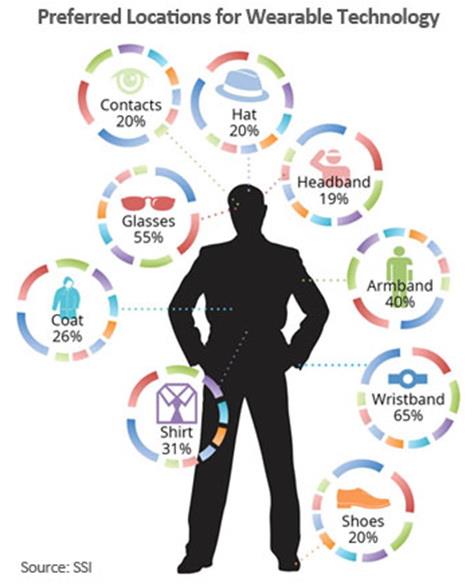
This market research data informs IoT design decisions: - Wrist dominates (65%): Design for familiar watch/band form factor - Glasses potential (55%): Smart eyewear is an emerging opportunity (despite Google Glass setback) - Smart clothing interest (31% shirt, 26% coat): E-textiles show market potential - Contact lenses low (20%): Invasive approaches face adoption barriers
Source: University of Edinburgh - Principles and Design of IoT Systems (SSI survey)
1483.8 Summary
This chapter introduced the foundational architectural models for IoT system design:
Key Takeaways:
Three-Layer Architecture: The simplest model—Perception (devices), Network (connectivity), Application (services)—sufficient for most small-to-medium IoT projects
Five-Layer Architecture: Adds Middleware and Business layers for enterprise IoT systems requiring complex device management and business intelligence
IoT-A Reference Model: Comprehensive framework with Functional, Information, Deployment, and Operational views plus cross-cutting concerns (security, privacy, trust)
Architecture Selection: Match architecture complexity to system complexity—don’t use five layers when three will suffice
Latency Awareness: Understand data flow timing through layers (typically 600ms end-to-end for simple sensor-to-dashboard flows)
1483.9 What’s Next
The next chapter explores The 8 Facets of IoT Design and Calm Technology, covering comprehensive design frameworks from user interface to platform architecture, plus principles for creating IoT systems that inform without demanding attention.
NoteRelated Chapters
Architecture Deep Dives: - The 8 Facets and Calm Technology - Design frameworks - Design Thinking for IoT - Human-centered design process - IoT Design Patterns - Gateway, Digital Twin, Command, Observer patterns
Foundation Topics: - IoT Reference Models - Detailed architecture reference - Edge Computing - Edge vs cloud processing