Analyze Real-World Monetization: Evaluate Peloton and Ring’s multi-revenue strategies
Apply Smart Data Pricing Frameworks: Design connectivity and service pricing models
Calculate Business Metrics: Compute LTV, CAC, and ROI from case study data
Extract Strategic Lessons: Apply learnings from successful IoT companies to new ventures
NoteKey Concepts
This chapter provides in-depth case studies and advanced pricing frameworks:
Peloton Case Study: Hardware + subscription model with 30-35% hardware margins, 65-70% subscription margins
Ring Case Study: Four-phase evolution from hardware to ecosystem platform
Smart Data Pricing: How to charge (usage, time, location), whom to charge (two-sided, sponsored), what to charge for (priority, transactions, services)
Phase 4 (2021-Present): Pricing optimization ($1,895 -> $1,445 bike to address demand normalization)
Strategic Insights:
Hardware as Customer Acquisition: Peloton invests $1,000+ in marketing/sales to acquire customers, recovers via hardware margin ($445) and 30-month subscription LTV ($1,320)
Subscription Compounding: Monthly recurring revenue grows from new members while existing members generate predictable cash flow (65%+ margins)
Data Monetization Opportunity: 6 billion workouts tracked (heart rate, output, cadence, leaderboard engagement) - potential for aggregated fitness insights, equipment optimization data, health insurance partnerships
Content Investment: $100M+ annual content production (live classes, on-demand library) driving subscription value and retention
Content cost scaling (instructors, production studios, music licensing)
Hardware commoditization (competitors offering $500 bikes with similar features)
This example demonstrates both the power and challenges of IoT monetization: hardware creates ecosystem lock-in, subscriptions generate recurring revenue, but unit economics must balance acquisition costs with lifetime value while adapting to market dynamics.
Show code
{const container =document.getElementById('kc-monetize-10');if (container &&typeof InlineKnowledgeCheck !=='undefined') { container.innerHTML=''; container.appendChild(InlineKnowledgeCheck.create({question:"Based on Peloton's metrics (hardware margin $445, subscription $44/month for 30 months average), calculate the approximate LTV:CAC ratio if CAC is $700. What does this tell you about their business model sustainability?",options: [ {text:"LTV = $1,765, LTV:CAC = 2.5:1 - Moderately sustainable but below ideal 3:1 target",correct:true,feedback:"Correct! LTV = Hardware margin ($445) + Subscription LTV ($44 × 30 months = $1,320) = $1,765. LTV:CAC = $1,765 / $700 = 2.52:1. This is below the 3:1 target, explaining why Peloton struggled after pandemic demand normalized - high CAC (showrooms, marketing, delivery) challenged unit economics."}, {text:"LTV = $2,765, LTV:CAC = 3.95:1 - Very healthy, sustainable business",correct:false,feedback:"Incorrect. You included full hardware price ($1,445) instead of margin ($445). LTV uses margin (profit), not revenue. Including full hardware price overstates value by ~$1,000 and misrepresents business health."}, {text:"LTV = $1,320, LTV:CAC = 1.9:1 - Unsustainable, ignoring hardware contribution",correct:false,feedback:"Partially incorrect. While subscription LTV of $1,320 alone would give 1.9:1, the hardware margin ($445) also contributes to customer value. Total LTV = $445 + $1,320 = $1,765."}, {text:"Cannot calculate without knowing subscription margin percentage",correct:false,feedback:"For this simplified analysis, we treat subscription revenue as high-margin (65-70% typical for SaaS). The question uses full subscription revenue for approximation. In detailed analysis, you'd apply margin to get ~$900-920 subscription LTV instead of $1,320."} ],difficulty:"hard",topic:"iot-monetization" })); }}
141.3 Ring Doorbell: From Hardware to Ecosystem
⏱️ ~10 min | ⭐⭐⭐ Advanced | 📋 P03.C05.U08
NoteRing’s Business Model Evolution (2013-Present)
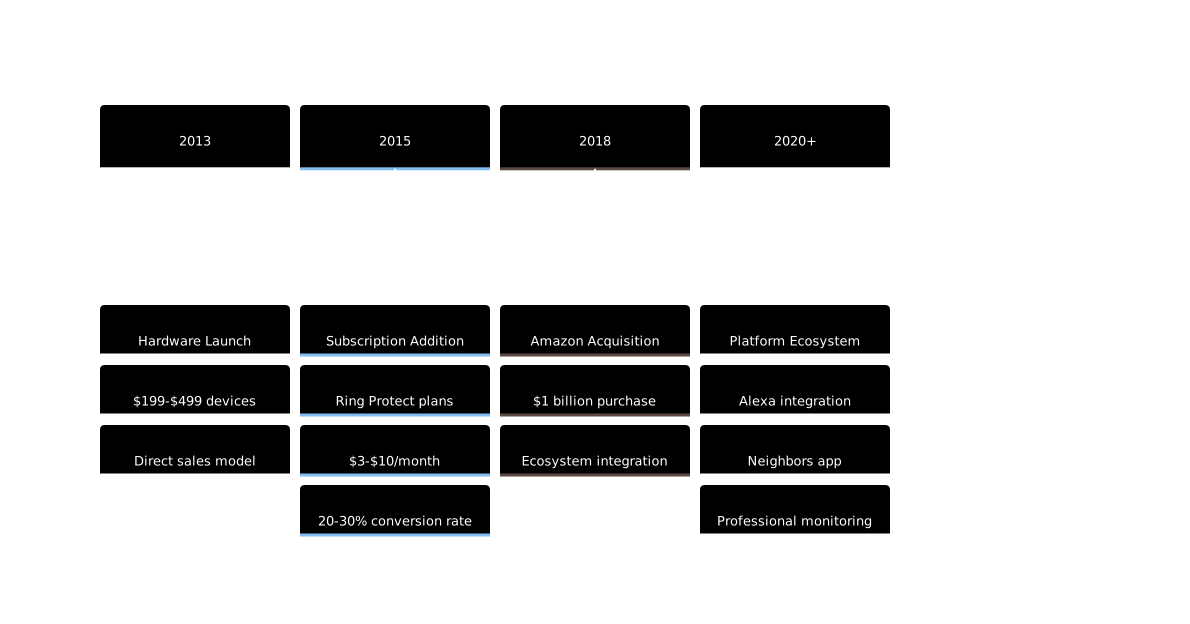
Ring demonstrates how IoT business models must evolve over time:
Mermaid diagram
Figure 141.1
141.3.1 Key Metrics
Phase
Revenue Model
Key Numbers
Hardware
One-time sales
$199-$499 per device
Subscription
Recurring revenue
$3-$10/month, 20-30% conversion
Acquisition
Exit value
$1 billion (Amazon)
Ecosystem
Platform fees
Third-party integrations
141.3.2 Lessons Learned
Hardware is the wedge, not the business: Ring’s $1B valuation came from recurring revenue potential, not hardware margins
Subscription conversion is key: 20-30% conversion to paid plans drives lifetime value
Ecosystem lock-in creates value: Integration with Alexa, Neighbors app, and professional monitoring increased switching costs
Data network effects: More users = better neighborhood security insights = more valuable platform
Phase 1: Hardware Sales (2013-2015) - Initial focus: Premium doorbell cameras ($199-$499) - Limited recurring revenue - Differentiation through innovative product design - Built foundational user base
Phase 2: Service Subscription Introduction (2015-2017) - Launched Ring Protect subscription ($3-$10/month) - Cloud video storage and advanced features - Basic functionality remained free (live view, notifications) - Conversion rate: ~20-30% of users to paid subscriptions - Created predictable recurring revenue stream
Phase 3: Ecosystem Expansion (2017-2020) - Added security cameras, alarm systems, lights - Multi-device subscriptions at discounted rates - Professional monitoring services ($10-$20/month) - Neighborhood social network (indirect value through engagement) - Increased switching costs through device integration
Phase 4: Amazon Integration (2018-present) - Integration with Alexa and Amazon Key delivery - Subsidized hardware pricing (devices as low as $59 on Prime Day) - Focus on ecosystem lock-in over hardware margins - Data value for Amazon’s broader strategy - Platform approach with third-party integrations
Strategic Success Factors:
Progressive Value Layering: Started with compelling hardware to build user base, then introduced subscriptions after establishing value
Freemium Balance: Kept free tier viable to maximize adoption while converting 20-30% to paid plans
Ecosystem Network Effects: Multi-device homes and neighborhood data created stronger value proposition
Strategic Timing: Amazon acquisition at $1B validated recurring revenue model over hardware-only approach
Customer Lock-In: Integration with Alexa, professional monitoring, and Neighbors app increased switching costs
Key Takeaways for IoT Monetization:
Hardware alone insufficient: Long-term value creation requires recurring revenue streams
Subscription conversion critical: 20-30% conversion rate demonstrates strong product-market fit
Ecosystem multiplier: Multi-device households show 3-5× higher LTV than single-device users
Platform optionality: Strategic acquirers value ecosystem potential over current revenue
Data network effects: User-generated content (neighborhood security insights) enhances platform value
Show code
{const container =document.getElementById('kc-monetize-11');if (container &&typeof InlineKnowledgeCheck !=='undefined') { container.innerHTML=''; container.appendChild(InlineKnowledgeCheck.create({question:"Ring evolved through four phases: hardware sales, subscription addition, ecosystem expansion, and Amazon integration. In which phase did Ring's valuation become primarily driven by recurring revenue potential rather than hardware sales?",options: [ {text:"Phase 1 (Hardware Launch) - Premium pricing established brand value",correct:false,feedback:"Incorrect. Hardware-only companies trade at lower multiples (1-2× revenue). Phase 1 established product-market fit but not recurring revenue valuation. Ring was a hardware company at this point."}, {text:"Phase 2 (Subscription Addition) - 20-30% conversion created predictable revenue",correct:true,feedback:"Correct! When Ring achieved 20-30% subscription conversion, investors could model predictable recurring revenue (ARR). This shifted valuation from hardware multiples (1-2×) to SaaS multiples (5-10×). The $1B Amazon acquisition was justified by subscription potential, not hardware margins."}, {text:"Phase 3 (Ecosystem Expansion) - Multi-device strategy increased switching costs",correct:false,feedback:"Phase 3 enhanced existing subscription economics but didn't fundamentally change valuation model. Recurring revenue was already established in Phase 2. Ecosystem expansion increased LTV but didn't create the subscription model."}, {text:"Phase 4 (Amazon Integration) - Platform scale enabled new monetization",correct:false,feedback:"Phase 4 is post-acquisition. Amazon paid $1B based on Phase 2-3 subscription economics. Integration enabled new opportunities but the recurring revenue valuation was established earlier."} ],difficulty:"medium",topic:"iot-monetization" })); }}
141.4 Smart Data Pricing Framework
⏱️ ~15 min | ⭐⭐⭐ Advanced | 📋 P03.C05.U09
Smart Data Pricing (SDP) is a framework for structuring IoT connectivity and service pricing based on three fundamental dimensions: how to charge, whom to charge, and what to charge for. This framework emerged from telecommunications and has direct applications to IoT monetization.
141.4.1 How to Charge: Pricing Mechanisms
Flowchart diagram
Figure 141.2
Usage-Based Pricing: Charge based on actual consumption measured in data volume (per MB), number of transactions, API calls, or device activations. This aligns cost with value delivered and ensures fairness.
Time-Based Pricing: Differential rates based on time of day, day of week, or seasonal demand patterns. Peak hours cost more, off-peak hours discounted to shape demand and optimize resource utilization.
Location-Based Pricing: Geographic zone pricing reflecting infrastructure costs, regulatory differences, or market valuations. Urban areas may have premium rates compared to rural zones.
Prepaid vs Postpaid: Prepaid requires upfront payment providing cost control and eliminating billing risk. Postpaid invoices monthly based on actual usage, offering convenience but requiring credit management.
141.4.2 Whom to Charge: Market Structures
Flowchart diagram
Figure 141.3
Two-Sided Markets: IoT platforms charge both device owners (for connectivity, management) and data consumers (for analytics, insights). Creates network effects where value increases with participants on both sides.
Toll-Free Models: Similar to 1-800 phone numbers, the receiver (service provider, application owner) pays for connectivity instead of device owner. Useful for manufacturer-managed devices where end users shouldn’t see data costs.
Zero Rating: Specific IoT services or applications don’t count against data caps. Carrier offers free data for select use cases (emergency services, health monitoring) to drive adoption or meet regulatory requirements.
Sponsored Data: Third parties (manufacturers, service providers, advertisers) pay for end-user device connectivity. Example: Car manufacturer pays cellular data costs for connected vehicles rather than charging customers monthly fees.
Show code
{const container =document.getElementById('kc-monetize-12');if (container &&typeof InlineKnowledgeCheck !=='undefined') { container.innerHTML=''; container.appendChild(InlineKnowledgeCheck.create({question:"An automotive company manufactures 500,000 connected vehicles annually. They can either: (A) charge customers $15/month for connectivity, expecting 40% opt-in rate, or (B) negotiate sponsored data with a cellular carrier at $5/device/month for 100% coverage. Which approach generates more value for the company and why?",options: [ {text:"Option A: $36M annual revenue ($15 × 200K × 12) from direct customer payments",correct:false,feedback:"Correct revenue calculation, but incomplete analysis. Option A generates $36M revenue but requires billing infrastructure, customer support for connectivity issues, and creates friction that may reduce vehicle sales or satisfaction."}, {text:"Option B: $30M annual cost but 100% connectivity enables $100M+ in services revenue",correct:true,feedback:"Correct strategic thinking! Option B costs $30M ($5 × 500K × 12) but provides 100% fleet connectivity enabling: (1) OTA updates reducing recall costs, (2) usage-based insurance partnerships, (3) predictive maintenance services, (4) enhanced customer experience differentiating vs. competitors. The indirect value far exceeds the $6M revenue difference."}, {text:"Option A: Direct monetization is always preferable to subsidized models",correct:false,feedback:"Incorrect principle. Subsidized connectivity creates platform value exceeding direct revenue. Tesla, GM OnStar, and BMW ConnectedDrive all include connectivity to enable service revenue, not as a standalone profit center."}, {text:"Hybrid: Charge $15/month but negotiate $5 sponsored rate for non-subscribers",correct:false,feedback:"Operationally complex. Managing two connectivity tiers creates technical debt, customer confusion, and billing complexity. The marginal revenue from 40% paying customers doesn't justify infrastructure costs vs. 100% sponsored model."} ],difficulty:"hard",topic:"iot-monetization" })); }}
141.4.3 What to Charge For: Value Components
Flowchart diagram
Figure 141.4
Paid Priority: Premium pricing for guaranteed Quality of Service (QoS) - lower latency, higher bandwidth, reliability SLAs. Industrial IoT, autonomous vehicles, healthcare applications pay premium for mission-critical performance.
Transaction-Based: Charge per event, API call, device message, or sensor reading. Aligns costs directly with activity levels and scales automatically with usage.
Cloud Service Pricing: Infrastructure components billed separately - CPU hours, storage GB, network bandwidth MB, database queries. Common in AWS IoT Core, Azure IoT Hub pricing models.
IoT Service Pricing: Platform features like device management, firmware updates, analytics dashboards, rule engines, and integration APIs charged as bundled subscriptions or add-on modules.
141.4.4 Real-World Carrier Examples
AT&T Sponsored Data (2014-2018): - Content providers could partner with AT&T to pay for customer data consumption - User accesses sponsored content (videos, apps) without counting against data cap - Pricing: Content provider pays $0.015 per MB for sponsored traffic - Use case: HBO sponsors streaming to drive subscriptions without user data concerns - Outcome: Limited adoption due to net neutrality concerns, program deprecated
T-Mobile Binge On and Music Freedom (2014-2017): - Zero-rated specific streaming services (Spotify, Netflix, Pandora) - Users consume unlimited music/video from selected partners without data charges - Revenue model: Free for T-Mobile customers, marketing value drives customer acquisition - Controversy: Net neutrality violations (favoring specific services), FCC investigation - Evolution: Shifted to unlimited data plans making zero-rating less relevant
Verizon Precision Pricing for IoT (2020-Present): - NB-IoT/LTE-M plans: $2-10/device/year based on data allowance - Prepaid data pools: 10,000 devices share 100 GB/month for $500 - Sponsored data for connected cars: Automakers pay $5/vehicle/month - QoS tiers: Basic ($2/device), Priority ($8/device with latency guarantees)
141.4.5 Smart Data Pricing Evolution Timeline
Year
Event
Impact on IoT Pricing
2008
First smartphone data caps
Shift from unlimited to tiered pricing ($30/2GB)
2011
AT&T introduces sponsored data
Content providers can subsidize user connectivity
2014
T-Mobile Music Freedom
Zero-rating demonstrates market demand for sponsored services
2016
NB-IoT/LTE-M launch
IoT-specific pricing: $2-5/device/year (10-100x cheaper than consumer plans)
The Smart Data Pricing framework directly applies to cellular IoT deployments. For detailed technical implementation and cost optimization strategies, see:
IoT Business Models - Foundational frameworks connecting to pricing strategies
Understanding cellular network signaling costs helps optimize IoT data plans-reducing signaling overhead by 30% through adaptive DRX can lower monthly costs from $5 to $3.50 per device at scale.
141.5 Future Monetization Research Directions
Micropayment Systems: How can blockchain and cryptocurrency enable new IoT monetization models based on machine-to-machine transactions?
Privacy-Preserving Monetization: What techniques (federated learning, differential privacy, homomorphic encryption) allow data monetization while protecting individual privacy?
AI-Driven Pricing: How can machine learning optimize dynamic pricing in real-time based on complex multi-dimensional factors?
Circular Economy Models: How can IoT enable new monetization through product-as-a-service, equipment reuse, and sustainability metrics?
Edge Computing Economics: How does edge computing shift the economics of data processing and storage, and what new monetization opportunities does it create?
Cross-Sector Data Marketplaces: What governance frameworks and technical standards are needed for secure, privacy-preserving data exchange across industries?
141.6 Visual Reference Gallery
NoteVisual: IoT Business Planning Frameworks
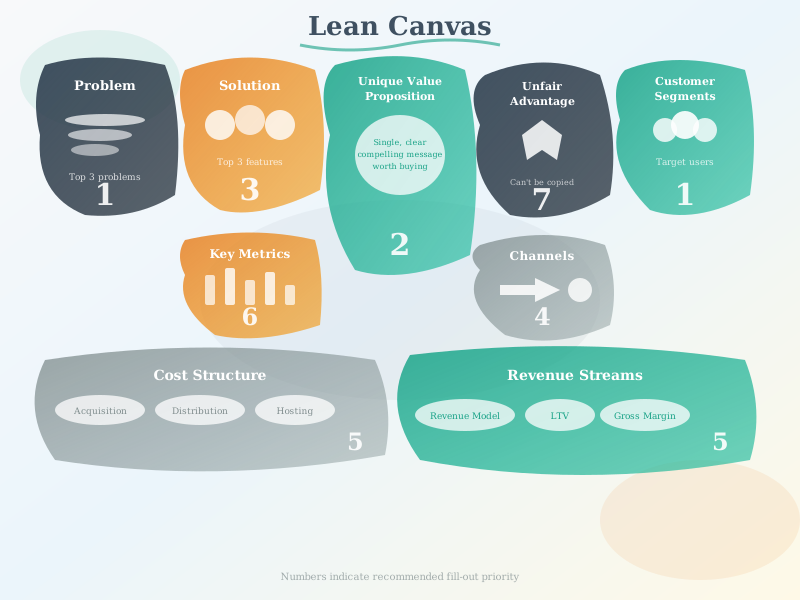
IoT Business Plans
Effective IoT monetization starts with comprehensive business planning that aligns technology capabilities with market needs and sustainable revenue models.
NoteVisual: Dynamic Pricing Systems
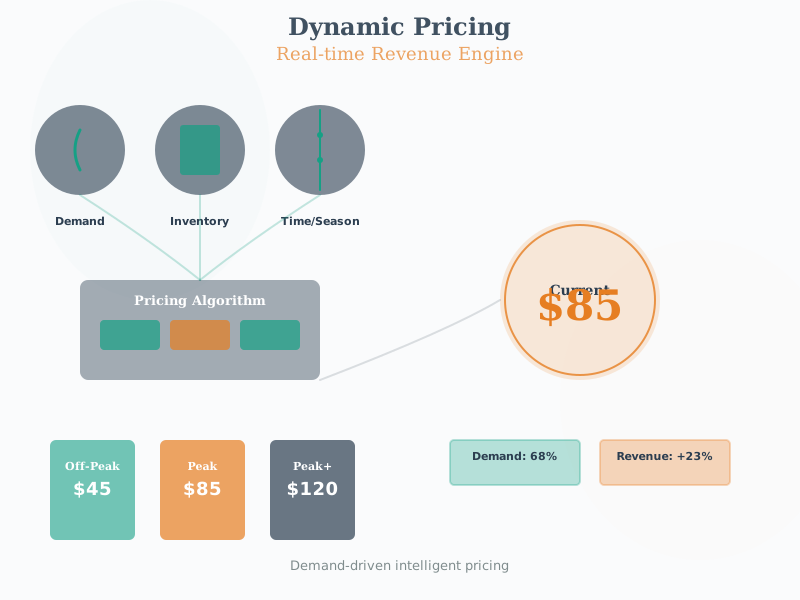
Dynamic Pricing Architecture
Dynamic pricing enables IoT platforms to optimize revenue by adjusting prices in real-time based on demand, capacity, customer segments, and competitive factors.
NoteVisual: Platform Ecosystem Economics
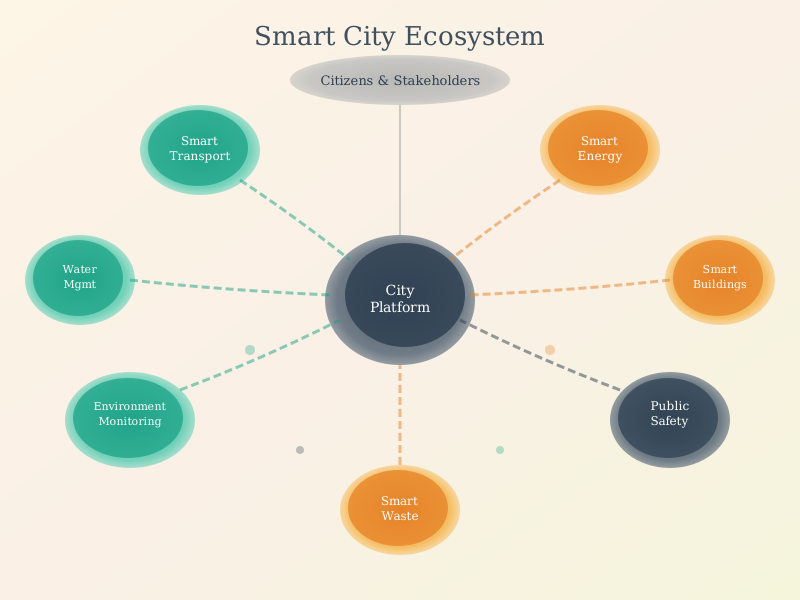
Smart City Ecosystem
IoT platforms create powerful network effects where value compounds as more device makers, developers, and users participate, enabling multiple monetization streams.
141.7 Summary
This chapter provided real-world case studies and advanced pricing frameworks:
Peloton Case Study: Dual revenue model with 30-35% hardware margins and 65-70% subscription margins; LTV:CAC of 2.8:1 challenged by high customer acquisition costs
Ring Case Study: Four-phase evolution from hardware ($199-$499) to subscriptions (20-30% conversion) to ecosystem to Amazon integration; $1B acquisition validated recurring revenue valuation
Smart Data Pricing Framework: Three dimensions of IoT pricing - how to charge (usage, time, location), whom to charge (two-sided markets, sponsored data), what to charge for (priority, transactions, services)
In one sentence: Hardware sales alone will not sustain an IoT business - recurring revenue from subscriptions, services, and data generates 5-9x higher lifetime value than one-time product sales.
Remember this rule: Your LTV:CAC ratio must exceed 3:1 to be sustainable. If you are spending $50 to acquire a customer, they must generate at least $150 in lifetime value. Subscriptions compound over time while hardware margins erode - design recurring revenue into your product from day one.
141.8 What’s Next
Having completed the Monetizing IoT series, continue to the next chapters: