%%{init: {'theme': 'base', 'themeVariables': { 'primaryColor': '#2C3E50', 'primaryTextColor': '#fff', 'primaryBorderColor': '#16A085', 'lineColor': '#16A085', 'secondaryColor': '#E67E22', 'tertiaryColor': '#ecf0f1', 'nodeBorder': '#2C3E50'}}}%%
graph LR
    Warehouse["Warehouse<br/>RFID Portal"] --> Truck["Truck<br/>RFID Tags"]
    Truck --> DistCenter["Distribution<br/>Center"]
    DistCenter --> Retail["Retail Store<br/>Smart Shelves"]

    Warehouse -.->|"Real-time Inventory"| Cloud["Cloud Database"]
    DistCenter -.->|"Tracking Updates"| Cloud
    Retail -.->|"Stock Levels"| Cloud

    style Warehouse fill:#2C3E50,stroke:#16A085,stroke-width:2px,color:#fff
    style DistCenter fill:#2C3E50,stroke:#16A085,stroke-width:2px,color:#fff
    style Retail fill:#2C3E50,stroke:#16A085,stroke-width:2px,color:#fff
    style Cloud fill:#E67E22,stroke:#2C3E50,stroke-width:2px
873 RFID Industry Applications and IoT Integration
873.1 Learning Objectives
By the end of this chapter, you will be able to:
- Identify Application Domains: Match RFID technology to supply chain, retail, healthcare, and manufacturing use cases
- Design Access Control Systems: Create RFID-based entry systems with proper security considerations
- Implement Asset Tracking: Deploy RFID for equipment, inventory, and livestock management
- Integrate with IoT Platforms: Connect RFID readers to MQTT, cloud databases, and dashboards
- Compare Technologies: Select between RFID, NFC, Bluetooth LE, and other identification technologies
- Apply Best Practices: Follow industry standards for deployment, security, and privacy
TipFor Beginners: RFID in the Real World
What is this chapter? Real-world RFID deployment scenarios across industries with integration patterns for IoT systems.
When to use: - Planning RFID deployment for business applications - Choosing between RFID and alternative technologies - Integrating RFID with existing IoT infrastructure
Key Industries Using RFID:
| Industry | Primary Application | RFID Type |
|---|---|---|
| Retail | Inventory tracking | UHF |
| Logistics | Supply chain visibility | UHF |
| Healthcare | Asset/patient tracking | HF/UHF |
| Manufacturing | Work-in-progress | HF/UHF |
| Agriculture | Livestock management | LF |
| Security | Access control | HF/NFC |
Recommended Path: 1. Complete RFID Hardware Integration 2. Study industry applications here 3. Build complete systems in RFID Labs
873.2 Prerequisites
Before diving into this chapter, you should be familiar with:
- RFID Fundamentals and Standards: Understanding frequency bands (LF, HF, UHF), tag types, and ISO standards
- RFID Hardware Integration: Basic reader wiring and programming
- Networking Basics: Knowledge of wireless protocols and data transmission
873.3 Real-World Applications
873.3.1 Supply Chain and Logistics
Benefits: - Real-time inventory visibility - Reduced manual scanning - Anti-counterfeiting - Faster processing (100+ tags/second)
Example: Walmart mandated RFID on all suppliers, reducing out-of-stock by 30%
873.3.2 Access Control
Physical Security: - Employee badges - Hotel key cards - University ID cards - Parking access
Advantages over magnetic stripe: - No physical contact (wear resistant) - Faster reads - Encrypted data - Harder to clone (when properly secured)
873.3.3 Asset Tracking
Use Cases: - Healthcare: Track medical equipment, patient wristbands - Manufacturing: Tool tracking, work-in-progress - IT: Computer and hardware inventory - Libraries: Book tracking and anti-theft
873.3.4 Animal Identification
Pet Microchips (LF 134.2 kHz): - ISO 11784/11785 standard - Unique 15-digit ID - Lifetime implant (biocompatible glass) - Read at veterinary clinics, shelters
Livestock Management: - Ear tags (UHF) - Track health, breeding, location - Regulatory compliance
873.3.5 Retail and Inventory
Smart Shelves: - RFID antennas under shelves - Real-time stock levels - Automatic reorder triggers - Theft detection
Example: Decathlon - RFID tags on ALL products - Self-checkout via RFID cart scan - 99%+ inventory accuracy
873.4 RFID vs Other Technologies
| Technology | Range | Power | Data Rate | Cost | Use Case |
|---|---|---|---|---|---|
| RFID | cm to 10m | Passive | Low-Med | Low | Inventory, access |
| NFC | <10 cm | Passive | Medium | Low | Payments, pairing |
| Bluetooth LE | 10-50m | Active | High | Med | Wearables, sensors |
| QR Codes | Visual | None | N/A | Free | Marketing, tickets |
| GPS | Global | Active | N/A | Med | Navigation, tracking |
When to Use RFID:
✅ Need: Automatic, contactless identification ✅ Environment: Harsh conditions, no line-of-sight ✅ Volume: Thousands of items to track ✅ Speed: Batch reading required ✅ Cost: Low per-item cost essential
When NOT to Use RFID:
❌ Metal/Liquid environments → Use LF RFID or alternatives ❌ Long-range outdoor tracking → Use LoRa, cellular, or GPS ❌ Two-way communication → Use Bluetooth, Wi-Fi ❌ Privacy-critical consumer apps → Consider privacy implications
873.5 RFID in IoT Systems
Integration Approaches:
873.5.1 Gateway Pattern
%%{init: {'theme': 'base', 'themeVariables': { 'primaryColor': '#2C3E50', 'primaryTextColor': '#fff', 'primaryBorderColor': '#16A085', 'lineColor': '#16A085', 'secondaryColor': '#E67E22', 'tertiaryColor': '#ecf0f1'}}}%%
graph TB
    subgraph "Warehouse Floor"
        Tag1["RFID Tag 1"]
        Tag2["RFID Tag 2"]
        Tag3["RFID Tag 3"]
        Reader["RFID Reader<br/>Raspberry Pi"]
    end

    subgraph "IoT Platform"
        Gateway["MQTT Gateway"]
        Broker["MQTT Broker"]
        Dashboard["Dashboard"]
        Database["Database"]
    end

    Tag1 & Tag2 & Tag3 -.->|"13.56 MHz"| Reader
    Reader -->|"Wi-Fi/Ethernet"| Gateway
    Gateway -->|"Publish"| Broker
    Broker -->|"Subscribe"| Dashboard
    Broker -->|"Store"| Database

    style Reader fill:#2C3E50,stroke:#16A085,stroke-width:2px,color:#fff
    style Broker fill:#16A085,stroke:#2C3E50,stroke-width:2px,color:#fff
    style Dashboard fill:#E67E22,stroke:#2C3E50,stroke-width:2px
TipAlternative View: RFID Frequency Selection Decision Tree
%%{init: {'theme': 'base', 'themeVariables': {'primaryColor': '#2C3E50', 'primaryTextColor': '#fff', 'primaryBorderColor': '#16A085', 'lineColor': '#16A085', 'secondaryColor': '#E67E22', 'tertiaryColor': '#7F8C8D'}}}%%
flowchart TD
    START([RFID Frequency<br/>Selection]) --> Q1{Through<br/>tissue/water?}

    Q1 -->|Yes| LF[LF 125-134 kHz<br/>Animal ID, implants]
    Q1 -->|No| Q2{Read range<br/>needed?}

    Q2 -->|<10 cm| Q3{Phone<br/>compatible?}
    Q2 -->|10cm - 1m| HF[HF 13.56 MHz<br/>Access, payments]
    Q2 -->|1-12 meters| Q4{Metal/liquid<br/>environment?}

    Q3 -->|Yes| NFC[NFC 13.56 MHz<br/>Tap-to-pay, pairing]
    Q3 -->|No| HF

    Q4 -->|Yes| UHFSPEC[UHF Special Tags<br/>On-metal, ruggedized]
    Q4 -->|No| UHF[UHF 860-960 MHz<br/>Inventory, logistics]

    LF --> USE1[Pet microchips<br/>Livestock tracking]
    HF --> USE2[Door badges<br/>Library books]
    NFC --> USE3[Mobile payments<br/>Smart posters]
    UHF --> USE4[Warehouse pallets<br/>Retail inventory]
    UHFSPEC --> USE5[Tool tracking<br/>Asset management]

    style START fill:#2C3E50,stroke:#16A085,stroke-width:3px,color:#fff
    style LF fill:#16A085,stroke:#2C3E50,stroke-width:2px,color:#fff
    style HF fill:#16A085,stroke:#2C3E50,stroke-width:2px,color:#fff
    style NFC fill:#E67E22,stroke:#2C3E50,stroke-width:2px,color:#fff
    style UHF fill:#E67E22,stroke:#2C3E50,stroke-width:2px,color:#fff
    style UHFSPEC fill:#7F8C8D,stroke:#2C3E50,stroke-width:2px,color:#fff
Example: Warehouse Management
# Requires paho-mqtt 2.0+
import paho.mqtt.client as mqtt
from mfrc522 import SimpleMFRC522
import json

# MQTT Configuration
BROKER = "mqtt.example.com"
TOPIC = "warehouse/inventory/scans"

reader = SimpleMFRC522()
client = mqtt.Client(mqtt.CallbackAPIVersion.VERSION2)
client.connect(BROKER, 1883)

while True:
    id, text = reader.read()

    # Publish to MQTT
    data = {
        "tag_id": id,
        "location": "Dock A",
        "timestamp": time.time(),
        "product": text.strip()
    }

    client.publish(TOPIC, json.dumps(data))
    print(f"Scanned: {id} → Published to {TOPIC}")
873.6 Industry Case Studies
873.6.1 Case Study 1: Walmart Supply Chain
Challenge: Out-of-stock items cost $3 billion annually in lost sales.
Solution: - Mandated RFID tags on all supplier shipments - Deployed UHF readers at dock doors and storage areas - Real-time inventory visibility across 5,000+ stores
Results: - 30% reduction in out-of-stock situations - 50% faster receiving process - ROI achieved within 18 months
873.6.2 Case Study 2: Singapore Healthcare
Challenge: Track 50,000+ medical equipment items across 25 hospitals.
Solution: - HF RFID tags on all equipment - Fixed readers at department entries - Mobile scanners for maintenance teams
Results: - Equipment utilization increased 25% - Search time reduced from 30 min to 2 min - $2M annual savings from reduced equipment loss
873.6.3 Case Study 3: London Underground
Challenge: Process 5 million daily passengers through 270 stations.
Solution: - NFC-based Oyster cards (MIFARE Classic → DESFire) - Contactless payment terminals (EMV) - Apple Pay/Google Pay integration
Results: - <300ms tap-to-open transaction time - 16+ million active Oyster cards - 40% of journeys now contactless bank cards
873.7 Visual Reference Gallery
NoteVisual: RFID Frequency Bands

RFID operates across multiple frequency bands, each optimized for specific applications. LF penetrates tissue for animal ID, HF provides global standardization for NFC, and UHF enables long-range supply chain tracking.
NoteVisual: HF RFID System Implementation
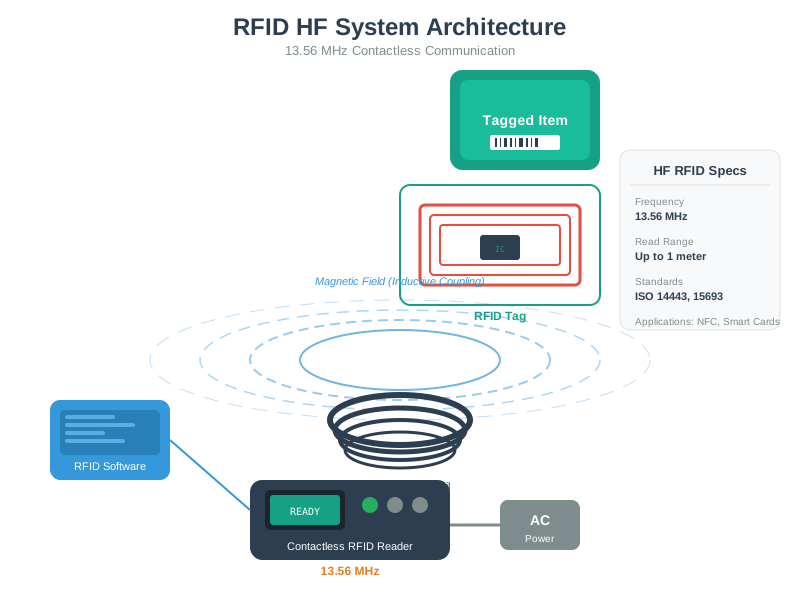
HF RFID at 13.56 MHz powers most access control and payment applications. The standardized ISO 14443 protocol ensures interoperability between readers and cards from different manufacturers.
NoteRelated Chapters
Deep Dives: - RFID Fundamentals and Standards - Operating principles and ISO standards - RFID Security and Privacy - Cryptographic authentication and privacy protocols - NFC Architecture - Near-field communication as HF RFID extension
Comparisons: - NFC vs RFID - When to use NFC versus traditional RFID - Technology Comparison - RFID in context of IoT technology stack
Next Steps: - RFID Labs and Assessment - Complete hands-on projects
873.8 Summary
This chapter covered RFID industry applications and IoT integration:
- Supply Chain: UHF RFID enables real-time inventory tracking, reducing out-of-stock by 30% (Walmart case study)
- Access Control: HF/NFC badges replace magnetic stripe with contactless, encrypted authentication
- Asset Tracking: Healthcare, manufacturing, and IT use RFID for equipment location and utilization
- Animal Identification: LF 134.2 kHz pet microchips follow ISO 11784/11785 for global interoperability
- Retail: Smart shelves with UHF RFID enable automatic reorder and 99%+ inventory accuracy
- Technology Selection: RFID for passive bulk identification; NFC for payments; BLE for continuous tracking
- IoT Integration: MQTT gateway pattern connects RFID readers to cloud dashboards and databases
873.9 What’s Next
The next chapter provides RFID Hands-On Labs and Assessment, with complete ESP32 access control systems, Python inventory dashboards, and comprehensive knowledge checks.