%% fig-alt: "Three communication paradigms compared: Telephony shows 1-to-1 bidirectional connection between two phones; Broadcast shows 1-to-N unidirectional flow from TV tower to multiple receivers; Sensor Networks shows N-to-1 convergecast pattern where many sensor nodes send data through multi-hop paths to a single sink/gateway"
%%{init: {'theme': 'base', 'themeVariables': { 'primaryColor': '#2C3E50', 'primaryTextColor': '#fff', 'primaryBorderColor': '#16A085', 'lineColor': '#16A085', 'secondaryColor': '#E67E22', 'tertiaryColor': '#7F8C8D', 'fontSize': '14px'}}}%%
flowchart TB
    subgraph PARADIGMS["Three Communication Paradigms"]
        subgraph TEL["1-to-1: Telephony"]
            direction LR
            P1[📱 Phone A] <-->|"Bidirectional<br/>Voice/Data"| P2[📱 Phone B]
            TEL_DESC["Point-to-point connection<br/>Both parties equal<br/>Examples: Phone calls, video chat"]
        end

        subgraph BROAD["1-to-N: Broadcast"]
            direction TB
            TV[📡 TV Tower] -->|"Unidirectional"| R1[📺 Receiver 1]
            TV -->|"Same content"| R2[📺 Receiver 2]
            TV -->|"to many"| R3[📺 Receiver 3]
            TV -->|"receivers"| R4[📺 Receiver N]
            BROAD_DESC["Single source, many receivers<br/>No return channel<br/>Examples: Radio, TV, multicast"]
        end

        subgraph WSN["N-to-1: Sensor Networks"]
            direction TB
            S1[🌡️ Sensor 1] -->|"Data"| AG1[⚡ Aggregator]
            S2[🌡️ Sensor 2] -->|"Data"| AG1
            S3[💧 Sensor 3] -->|"Data"| AG2[⚡ Aggregator]
            S4[💧 Sensor 4] -->|"Data"| AG2
            AG1 -->|"Aggregated"| SINK[🏠 Sink/Gateway]
            AG2 -->|"Data"| SINK
            WSN_DESC["Many sources, single sink<br/>Multi-hop with aggregation<br/>Examples: Environmental monitoring"]
        end
    end

    style TEL fill:#16A085,stroke:#2C3E50,color:#fff
    style BROAD fill:#E67E22,stroke:#2C3E50,color:#fff
    style WSN fill:#2C3E50,stroke:#16A085,color:#fff
    style P1 fill:#16A085,stroke:#2C3E50,color:#fff
    style P2 fill:#16A085,stroke:#2C3E50,color:#fff
    style TV fill:#E67E22,stroke:#2C3E50,color:#fff
    style R1 fill:#E67E22,stroke:#2C3E50,color:#fff
    style R2 fill:#E67E22,stroke:#2C3E50,color:#fff
    style R3 fill:#E67E22,stroke:#2C3E50,color:#fff
    style R4 fill:#E67E22,stroke:#2C3E50,color:#fff
    style S1 fill:#2C3E50,stroke:#16A085,color:#fff
    style S2 fill:#2C3E50,stroke:#16A085,color:#fff
    style S3 fill:#2C3E50,stroke:#16A085,color:#fff
    style S4 fill:#2C3E50,stroke:#16A085,color:#fff
    style AG1 fill:#7F8C8D,stroke:#16A085,color:#fff
    style AG2 fill:#7F8C8D,stroke:#16A085,color:#fff
    style SINK fill:#E67E22,stroke:#16A085,color:#fff
378 WSN Communication Patterns and N-to-1 Paradigm
378.1 Learning Objectives
By the end of this chapter, you will be able to:
- Understand N-to-1 Communication: Explain the convergecast pattern and how it differs from telephony and broadcast
- Apply Data Aggregation: Calculate compression ratios and energy savings from hierarchical aggregation
- Design for Convergecast: Implement sink placement and routing strategies to avoid hotspot problems
- Recognize IoT Paradigm Integration: Identify how modern IoT combines N-to-1, 1-to-N, and 1-to-1 patterns
378.2 Prerequisites
- WSN Introduction: Understanding of WSN history and topologies
- WSN Sensor Nodes: Knowledge of node architecture and energy constraints
- WSN Swarm Behavior: Familiarity with distributed coordination
NoteRelated Chapters
Previous: - WSN Introduction - WSN fundamentals - WSN Sensor Nodes - Node hardware - WSN Swarm Behavior - Distributed intelligence
Continue Learning: - WSN Energy Management - Power optimization and duty cycling
Deep Dives: - Data Management and Analytics - Stream processing and time-series databases - MQTT Fundamentals - N-to-1 messaging protocol
378.3 WSN Communication Paradigm: The N-to-1 Pattern
Understanding wireless sensor networks requires recognizing their fundamental communication paradigm. Unlike traditional networking models, WSNs implement a distinctive N-to-1 (many-to-one) data flow pattern that fundamentally shapes their architecture, protocols, and optimization strategies.
378.3.1 The Three Communication Paradigms
Communication networks can be categorized into three fundamental paradigms based on their data flow patterns:
| Paradigm | Pattern | Direction | Examples | Key Characteristic |
|---|---|---|---|---|
| Telephony | 1-to-1 | Bidirectional | Phone calls, video chat, VoIP | Equal peer relationship |
| Broadcast | 1-to-N | Unidirectional (source→receivers) | TV, radio, multicast streaming | Single source, passive receivers |
| Sensor Networks | N-to-1 | Unidirectional (sources→sink) | WSN, IoT monitoring, telemetry | Many sources, single collector |
378.3.2 The N-to-1 Convergecast Pattern
The convergecast (or many-to-one) pattern is the defining characteristic of sensor network communication:
Definition: Data flows from N distributed sensor nodes through multi-hop paths to 1 central sink (gateway or base station).
%% fig-alt: "N-to-1 convergecast data flow in WSN showing 12 sensor nodes organized in three tiers sending data through multi-hop routing to intermediate relay nodes, which aggregate data and forward to a central sink/gateway - arrows show data flow direction converging toward the sink, with hop counts (1-hop, 2-hop, 3-hop) labeled for each tier"
%%{init: {'theme': 'base', 'themeVariables': { 'primaryColor': '#2C3E50', 'primaryTextColor': '#fff', 'primaryBorderColor': '#16A085', 'lineColor': '#16A085', 'secondaryColor': '#E67E22', 'tertiaryColor': '#7F8C8D', 'fontSize': '14px'}}}%%
flowchart TB
    subgraph TIER3["Tier 3: Edge Sensors (3-hop)"]
        N1[Sensor 1<br/>Temp: 22°C]
        N2[Sensor 2<br/>Temp: 23°C]
        N3[Sensor 3<br/>Temp: 21°C]
        N4[Sensor 4<br/>Humidity: 65%]
    end

    subgraph TIER2["Tier 2: Intermediate (2-hop)"]
        N5[Sensor 5<br/>Temp: 24°C]
        N6[Sensor 6<br/>Humidity: 70%]
        N7[Sensor 7<br/>Temp: 22°C]
        N8[Sensor 8<br/>Humidity: 68%]
    end

    subgraph TIER1["Tier 1: Near-Sink (1-hop)"]
        R1[Relay/Aggregator 1<br/>Avg Temp: 22.5°C]
        R2[Relay/Aggregator 2<br/>Avg Humidity: 67.7%]
    end

    subgraph SINK_ZONE["Sink Zone"]
        SINK[🏠 Sink/Gateway<br/>Collects All Data]
    end

    N1 -->|"22°C"| N5
    N2 -->|"23°C"| N5
    N3 -->|"21°C"| N6
    N4 -->|"65%"| N6
    N5 -->|"Temp data"| R1
    N6 -->|"Mixed"| R1
    N7 -->|"22°C"| R2
    N8 -->|"68%"| R2

    R1 -->|"Aggregated<br/>Temp: 22.5°C"| SINK
    R2 -->|"Aggregated<br/>Humidity: 67.7%"| SINK

    SINK -->|"Internet"| CLOUD[☁️ Cloud/Server]

    style N1 fill:#2C3E50,stroke:#16A085,color:#fff
    style N2 fill:#2C3E50,stroke:#16A085,color:#fff
    style N3 fill:#2C3E50,stroke:#16A085,color:#fff
    style N4 fill:#2C3E50,stroke:#16A085,color:#fff
    style N5 fill:#2C3E50,stroke:#16A085,color:#fff
    style N6 fill:#2C3E50,stroke:#16A085,color:#fff
    style N7 fill:#2C3E50,stroke:#16A085,color:#fff
    style N8 fill:#2C3E50,stroke:#16A085,color:#fff
    style R1 fill:#16A085,stroke:#2C3E50,color:#fff
    style R2 fill:#16A085,stroke:#2C3E50,color:#fff
    style SINK fill:#E67E22,stroke:#16A085,color:#fff
    style CLOUD fill:#7F8C8D,stroke:#16A085,color:#fff
    style TIER3 fill:#2C3E50,stroke:#16A085,color:#fff
    style TIER2 fill:#16A085,stroke:#2C3E50,color:#fff
    style TIER1 fill:#E67E22,stroke:#2C3E50,color:#fff
%% fig-alt: "River tributaries analogy for WSN N-to-1 convergecast pattern showing water flow from streams to river to ocean"
%%{init: {'theme': 'base', 'themeVariables': { 'primaryColor': '#2C3E50', 'primaryTextColor': '#fff', 'primaryBorderColor': '#16A085', 'lineColor': '#16A085', 'secondaryColor': '#E67E22', 'tertiaryColor': '#7F8C8D', 'fontSize': '13px'}}}%%
flowchart TB
    subgraph ANALOGY["River System Analogy for WSN Convergecast"]
        subgraph SPRINGS["Mountain Springs = Edge Sensors"]
            SP1[Spring 1<br/>Small flow]
            SP2[Spring 2<br/>Small flow]
            SP3[Spring 3<br/>Small flow]
            SP4[Spring 4<br/>Small flow]
        end

        subgraph STREAMS["Streams = Relay Nodes"]
            ST1[Stream A<br/>Combined flow]
            ST2[Stream B<br/>Combined flow]
        end

        subgraph RIVER["River = Sink/Gateway"]
            RV[Main River<br/>All water converges]
        end

        subgraph OCEAN["Ocean = Cloud"]
            OC[Data Lake<br/>Final destination]
        end

        SP1 -->|"Trickle"| ST1
        SP2 -->|"Trickle"| ST1
        SP3 -->|"Trickle"| ST2
        SP4 -->|"Trickle"| ST2

        ST1 -->|"Stream"| RV
        ST2 -->|"Stream"| RV

        RV -->|"River"| OC
    end

    subgraph MAPPING["WSN Mapping"]
        M1["Springs: Individual sensor readings<br/>(many, small, distributed)"]
        M2["Streams: Aggregator nodes<br/>(combine data, reduce volume)"]
        M3["River: Gateway/Sink<br/>(bottleneck, all data passes)"]
        M4["Ocean: Cloud storage<br/>(unlimited capacity)"]
    end

    style SPRINGS fill:#2C3E50,stroke:#16A085,color:#fff
    style STREAMS fill:#16A085,stroke:#2C3E50,color:#fff
    style RIVER fill:#E67E22,stroke:#16A085,color:#fff
    style OCEAN fill:#7F8C8D,stroke:#16A085,color:#fff
    style MAPPING fill:#fff,stroke:#2C3E50,color:#2C3E50
Key Properties of N-to-1 Communication:
- Asymmetric Traffic: Most data flows inbound (sensor→sink); minimal outbound traffic (commands, queries)
- Multi-hop Necessity: Sensors often beyond single-hop range of sink, requiring relay through intermediate nodes
- Aggregation Opportunity: Intermediate nodes can combine data, reducing total transmissions
- Sink Bottleneck: All traffic converges at sink, creating potential congestion and energy hotspot
- Tree-like Topology: Natural formation of routing trees rooted at sink
378.3.3 Data Aggregation: The Power of N-to-1
The N-to-1 pattern enables in-network data aggregation—one of WSN’s most powerful energy-saving techniques.
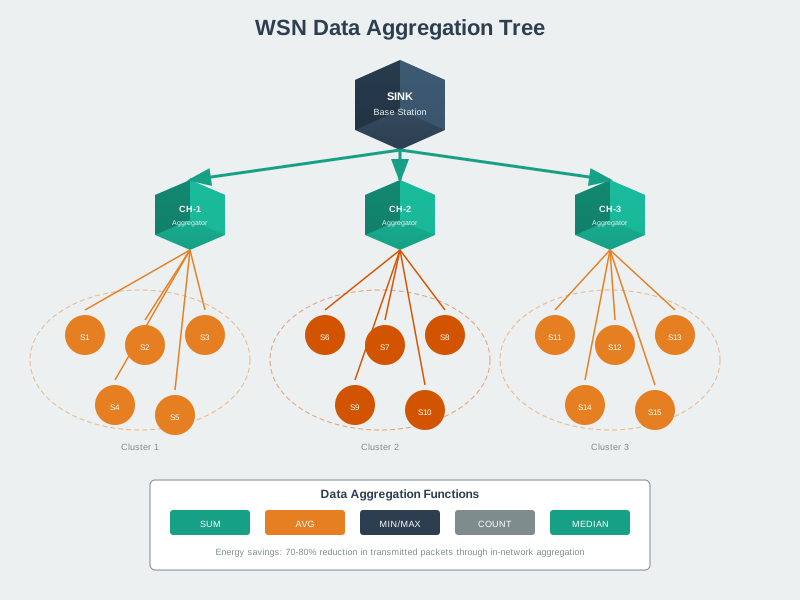
TipWhy Aggregation Matters
Without aggregation: 100 sensors each sending 100 bytes → 10,000 bytes total transmission With aggregation: 100 sensors → 10 aggregators each sending 50 bytes → 500 bytes total (95% reduction!)
Each bit transmitted costs ~1000× more energy than computing locally. Aggregation exploits this ratio.
Common Aggregation Functions:
| Function | Description | Use Case | Compression Ratio |
|---|---|---|---|
| Average | Mean of N readings | Temperature monitoring | N:1 |
| Min/Max | Extreme values only | Threshold alerts | N:1 |
| Count | Number of events | Intrusion detection | N:1 |
| Median | Middle value (outlier-resistant) | Environmental sensing | N:1 |
| Sum | Total accumulation | Energy consumption | N:1 |
| Concatenation | Combine readings | Debugging, raw data | N:N (no reduction) |
378.3.4 Practical Example: Smart Agriculture Monitoring
Consider a precision agriculture deployment monitoring soil moisture across a 50-hectare vineyard:
Deployment Parameters:
- 200 soil moisture sensors deployed in grid pattern
- 1 gateway (sink) at field edge connected to cellular/Wi-Fi
- Sensors sample every 15 minutes
- Each reading: 4 bytes (moisture %) + 4 bytes (timestamp) = 8 bytes
Without Aggregation (Naive Approach):
200 sensors × 8 bytes × 4 samples/hour × 24 hours = 153,600 bytes/day
                                                   = ~154 KB/day
With Hierarchical Aggregation:
Tier 1: 200 sensors → 20 cluster heads (10 sensors each)
        Each cluster computes: avg, min, max = 12 bytes
        20 clusters × 12 bytes × 4/hour × 24 = 23,040 bytes/day

Tier 2: 20 cluster heads → 1 sink
        Already aggregated, minimal additional processing

Total: ~23 KB/day (85% reduction)
Energy Impact:
| Metric | Without Aggregation | With Aggregation | Improvement |
|---|---|---|---|
| Daily Transmissions | 19,200 | 1,920 | 10× fewer |
| Network Lifetime | 3 months | 18+ months | 6× longer |
| Bandwidth Usage | 154 KB/day | 23 KB/day | 85% reduction |
| Gateway Load | High (all raw data) | Low (summaries only) | Reduced congestion |
378.3.5 IoT as the Integration of All Three Patterns
Modern IoT systems uniquely combine all three communication paradigms into unified architectures:
%% fig-alt: "IoT as integration of three paradigms: N-to-1 (sensors to gateway), 1-to-N (cloud to devices for commands/updates), and 1-to-1 (device-to-device direct communication) - showing complete IoT ecosystem with bidirectional flows between sensor layer, edge/gateway layer, and cloud layer"
%%{init: {'theme': 'base', 'themeVariables': { 'primaryColor': '#2C3E50', 'primaryTextColor': '#fff', 'primaryBorderColor': '#16A085', 'lineColor': '#16A085', 'secondaryColor': '#E67E22', 'tertiaryColor': '#7F8C8D', 'fontSize': '14px'}}}%%
flowchart TB
    subgraph SENSORS["Sensor Layer (N-to-1 Uplink)"]
        S1[🌡️ Temp Sensor]
        S2[💧 Moisture Sensor]
        S3[🌬️ Air Quality]
        S4[📷 Camera]
    end

    subgraph EDGE["Edge/Gateway Layer"]
        GW[🔀 IoT Gateway<br/>Protocol Translation<br/>Data Aggregation]
    end

    subgraph CLOUD["Cloud Layer"]
        PLATFORM[☁️ IoT Platform<br/>Storage, Analytics, Rules]
    end

    subgraph ACTUATORS["Actuator Layer (1-to-N Downlink)"]
        A1[💡 Smart Light]
        A2[🚰 Irrigation Valve]
        A3[🌀 HVAC System]
    end

    subgraph P2P["Device-to-Device (1-to-1)"]
        D1[📱 User Phone]
        D2[🔒 Smart Lock]
    end

    %% N-to-1: Sensors to Gateway
    S1 -->|"N-to-1"| GW
    S2 -->|"Convergecast"| GW
    S3 -->|"Data"| GW
    S4 -->|"Upload"| GW

    %% Gateway to Cloud
    GW <-->|"Aggregated Data ↑<br/>Commands ↓"| PLATFORM

    %% 1-to-N: Cloud to Actuators (via Gateway)
    PLATFORM -->|"1-to-N"| GW
    GW -->|"Commands"| A1
    GW -->|"Broadcast"| A2
    GW -->|"Control"| A3

    %% 1-to-1: Direct device communication
    D1 <-->|"1-to-1<br/>Direct"| D2

    style SENSORS fill:#2C3E50,stroke:#16A085,color:#fff
    style EDGE fill:#16A085,stroke:#2C3E50,color:#fff
    style CLOUD fill:#E67E22,stroke:#16A085,color:#fff
    style ACTUATORS fill:#7F8C8D,stroke:#16A085,color:#fff
    style P2P fill:#16A085,stroke:#E67E22,color:#fff
How IoT Combines the Paradigms:
| Direction | Paradigm | IoT Function | Example |
|---|---|---|---|
| Uplink | N-to-1 (WSN) | Sensor data collection | 1000 sensors → 1 cloud platform |
| Downlink | 1-to-N (Broadcast) | Firmware updates, commands | 1 cloud → all devices simultaneously |
| Lateral | 1-to-1 (Telephony) | Device-to-device control | Phone → smart lock direct unlock |
| Hybrid | All combined | Complete smart home | Sensors report (N-to-1), phone controls (1-to-1), alerts broadcast (1-to-N) |
ImportantThe IoT Paradigm Insight
WSNs introduced the N-to-1 pattern to networking. Before sensor networks, networks were dominated by 1-to-1 (telephony/internet) and 1-to-N (broadcast) patterns. WSNs revealed that many real-world sensing applications follow the opposite pattern: many distributed sources feeding into centralized collection points.
IoT’s innovation is seamlessly integrating all three patterns: - Sensing uses N-to-1 (convergecast) - Control uses 1-to-N (broadcast commands) or 1-to-1 (targeted actuation) - User interaction uses 1-to-1 (phone to device)
Understanding which paradigm applies to each data flow enables optimal protocol selection and architecture design.
378.3.6 Design Implications of N-to-1
The N-to-1 pattern creates unique design challenges and opportunities:
Challenges:
- Sink Bottleneck: All traffic converges at sink—congestion, energy depletion, single point of failure
- Hotspot Problem: Nodes near sink relay all traffic, depleting 10-100× faster
- Scalability Limits: Adding sensors increases sink load linearly
- Latency Accumulation: Multi-hop paths add delay at each hop
Solutions:
| Challenge | Solution | Implementation |
|---|---|---|
| Sink bottleneck | Multiple sinks | Deploy 3-5 sinks across large deployments |
| Hotspot problem | Mobile sinks | Sink moves periodically to distribute load |
| Scalability | Hierarchical clustering | LEACH, HEED protocols with rotating cluster heads |
| Latency | Geographic routing | GPSR, greedy forwarding toward sink location |
| Energy balance | Aggregation trees | TAG (Tiny AGgregation) protocol |
TipWorked Example: Calculating Aggregation Savings
Scenario: Environmental monitoring network with 500 sensors, each producing 16-byte readings every 10 seconds.
Without Aggregation: \[\text{Data Rate} = 500 \times 16 \text{ bytes} \times 6/\text{min} = 48,000 \text{ bytes/min} = 2.88 \text{ MB/hour}\]
With 2-Level Aggregation (50 clusters of 10 sensors each):
Level 1: Each cluster head receives 10 readings (160 bytes), computes average (4 bytes) + min (4 bytes) + max (4 bytes) + count (2 bytes) = 14 bytes output
\[\text{Cluster Output} = 50 \times 14 \text{ bytes} \times 6/\text{min} = 4,200 \text{ bytes/min}\]
Level 2: Sink receives from 50 cluster heads
\[\text{Sink Input} = 4,200 \text{ bytes/min} = 252 \text{ KB/hour}\]
Compression Ratio: \(\frac{2.88 \text{ MB}}{252 \text{ KB}} = 11.4:1\) (91% reduction)
Energy Savings: At 50 nJ/bit transmission energy: - Without: \(2.88 \text{ MB} \times 8 \times 50 \text{ nJ} = 1.15 \text{ J/hour}\) - With: \(252 \text{ KB} \times 8 \times 50 \text{ nJ} = 0.10 \text{ J/hour}\) - Savings: 1.05 J/hour = 91% energy reduction in transmission
378.4 Knowledge Check
Test your understanding of WSN fundamental concepts with these questions covering architecture, sensor nodes, and network topologies.
378.5 What’s Next
Complete your WSN fundamentals with: - WSN Energy Management and Duty Cycling - Master energy conservation through duty cycling, routing protocols, and power optimization strategies