%%{init: {'theme': 'base', 'themeVariables': { 'primaryColor': '#2C3E50', 'primaryTextColor': '#fff', 'primaryBorderColor': '#16A085', 'lineColor': '#16A085', 'secondaryColor': '#E67E22', 'tertiaryColor': '#7F8C8D'}}}%%
graph TD
    Root["Root<br/>RANK 0"]
    A["Node A<br/>RANK 100"]
    B["Node B<br/>RANK 200"]
    C["Node C<br/>RANK 400"]

    Root -->|"RANK increase +100"| A
    A -->|"RANK increase +100"| B
    B -->|"RANK increase +200"| C
    C -.->|"FORBIDDEN<br/>RANK 400 to 100<br/>Moving away from root"| A

    style Root fill:#2C3E50,stroke:#16A085,color:#fff
    style A fill:#16A085,stroke:#16A085,color:#fff
    style B fill:#16A085,stroke:#16A085,color:#fff
    style C fill:#E67E22,stroke:#16A085,color:#fff
722 RPL Quiz Questions
722.1 Learning Objectives
By the end of this chapter, you will be able to:
- Explain RANK mechanics: Understand how RANK prevents routing loops and enables hierarchical routing
- Compare RPL modes: Analyze memory and performance trade-offs between Storing and Non-Storing
- Describe control messages: Identify the purpose and flow of DIS, DIO, DAO, and DAO-ACK
- Contrast with traditional routing: Explain why OSPF is unsuitable for IoT LLNs
722.2 Prerequisites
Required Chapters:
- RPL Fundamentals - Core RPL concepts
- RPL Lab: Network Design - Practical design experience
- RPL Knowledge Check - Scenario-based understanding
Estimated Time: 45 minutes
722.3 Quiz: RPL Routing Protocol
NoteQuestion 1: RANK Purpose
What is the primary purpose of RANK in RPL?
- To measure the distance in meters from the root
- To prevent routing loops by defining hierarchical position
- To prioritize packets based on importance
- To encrypt routing information
Click to see answer
Answer: B) To prevent routing loops by defining hierarchical position
Explanation:
RANK Definition: RANK is a scalar value representing a node’s position in the DODAG hierarchy relative to the root.
Primary Purpose: Loop Prevention
How RANK Prevents Loops:
- Root has minimum RANK (typically 0)
- RANK increases as you move away from root
- Upward routing rule: Packets forwarded to nodes with lower RANK
- Parent selection rule: Node cannot choose parent with higher RANK
Loop Prevention Example:
RANK-based loop prevention: Node A (RANK 100) cannot choose Node C (RANK 400) as parent, preventing routing loops
Attempt to create loop: - Node C wants to choose Node A as parent: - Current RANK: 400 - Node A RANK: 100 - ALLOWED (100 < 400, moving toward root) - Node A wants to choose Node C as parent: - Current RANK: 100 - Node C RANK: 400 - FORBIDDEN (400 > 100, moving away from root = loop!)
Without RANK (vulnerable to loops):
%%{init: {'theme': 'base', 'themeVariables': { 'primaryColor': '#E67E22', 'primaryTextColor': '#fff', 'primaryBorderColor': '#E67E22', 'lineColor': '#E67E22', 'secondaryColor': '#E67E22'}}}%%
graph LR
    A["Node A<br/>Hop 2"]
    B["Node B<br/>Hop 3"]
    C["Node C<br/>Hop 4"]

    A -->|"Loop!"| B
    B -->|"Loop!"| C
    C -->|"Loop!"| A

    style A fill:#E67E22,stroke:#E67E22,color:#fff
    style B fill:#E67E22,stroke:#E67E22,color:#fff
    style C fill:#E67E22,stroke:#E67E22,color:#fff
Without RANK: Simple hop count allows routing loops (shown in orange/red to indicate problem)
Option Analysis:
A) Distance in meters: RANK is not physical distance. RANK is a logical hierarchy in DODAG. Two nodes same distance from root can have different RANKs based on link quality.
B) Prevent routing loops: Correct. RANK enforces hierarchy and the acyclic property. Rule: Can only route “upward” (decreasing RANK).
C) Prioritize packets: RANK is for routing, not QoS. Packet prioritization uses IPv6 Traffic Class field or different objective functions.
D) Encrypt routing: RANK is plaintext in DIO messages. Security handled separately through RPL Security mode or link layer encryption.
RANK Calculation Factors:
RANK is calculated by objective function, which may consider: - Hop count: Each hop adds fixed amount - ETX: Expected Transmission Count (link quality) - Latency: Time to reach root - Energy: Remaining battery, power consumption
Example Objective Function (OF0 - Hop Count):
%%{init: {'theme': 'base', 'themeVariables': { 'primaryColor': '#2C3E50', 'primaryTextColor': '#fff', 'primaryBorderColor': '#16A085', 'lineColor': '#16A085', 'secondaryColor': '#E67E22'}}}%%
graph TD
    Root["Root<br/>RANK 0"]
    N1["Node 1<br/>RANK 256<br/>(0 + 256)"]
    N2["Node 2<br/>RANK 512<br/>(256 + 256)"]
    N3["Node 3<br/>RANK 768<br/>(512 + 256)"]

    Root -->|"+256"| N1
    N1 -->|"+256"| N2
    N2 -->|"+256"| N3

    style Root fill:#2C3E50,stroke:#16A085,color:#fff
    style N1 fill:#16A085,stroke:#16A085,color:#fff
    style N2 fill:#16A085,stroke:#16A085,color:#fff
    style N3 fill:#16A085,stroke:#16A085,color:#fff
OF0 (Hop Count) objective function: Fixed RANK increase of 256 per hop
Example Objective Function (ETX-based):
%%{init: {'theme': 'base', 'themeVariables': { 'primaryColor': '#2C3E50', 'primaryTextColor': '#fff', 'primaryBorderColor': '#16A085', 'lineColor': '#16A085', 'secondaryColor': '#E67E22'}}}%%
graph TD
    Root["Root<br/>RANK 0"]
    P1["Parent A<br/>RANK 100<br/>ETX 3.5"]
    P2["Parent B<br/>RANK 120<br/>ETX 1.2"]
    Node["Node<br/>RANK 240<br/>Chose Parent B"]

    Root --> P1
    Root --> P2
    P1 -.->|"ETX 3.5<br/>RANK would be 100+250=350<br/>REJECTED"| Node
    P2 -->|"ETX 1.2<br/>RANK = 120+120=240<br/>SELECTED"| Node

    style Root fill:#2C3E50,stroke:#16A085,color:#fff
    style P1 fill:#E67E22,stroke:#16A085,color:#fff
    style P2 fill:#16A085,stroke:#16A085,color:#fff
    style Node fill:#16A085,stroke:#16A085,color:#fff
ETX-based objective function: Node prefers 2 good hops (RANK 240) over 1 poor hop (RANK 350)
NoteQuestion 2: Storing vs Non-Storing Mode
In a network of 100 battery-powered sensors sending data to a single gateway (many-to-one traffic), which RPL mode is more appropriate?
- Storing mode (better routing efficiency)
- Non-Storing mode (lower memory requirements)
- Both modes have identical performance for this scenario
- RPL doesn’t support many-to-one traffic well
Click to see answer
Answer: C) Both modes have identical performance for this scenario
Explanation:
Many-to-One Traffic is RPL’s primary use case and is handled identically in both modes.
How Many-to-One Works in RPL:
Upward Routing (toward root): - Every node knows its parent (from DODAG construction) - Default route: Send to parent - No routing table needed for upward routes
Both Modes:
%%{init: {'theme': 'base', 'themeVariables': { 'primaryColor': '#2C3E50', 'primaryTextColor': '#fff', 'primaryBorderColor': '#16A085', 'lineColor': '#16A085', 'secondaryColor': '#E67E22'}}}%%
graph BT
    S1["Sensor 1"] -->|"To parent"| R1["Router 1"]
    S2["Sensor 2"] -->|"To parent"| R1
    S3["Sensor 3"] -->|"To parent"| R2["Router 2"]
    S4["Sensor 4"] -->|"To parent"| R2
    R1 -->|"To parent"| Root["Root/Gateway"]
    R2 -->|"To parent"| Root

    style S1 fill:#E67E22,stroke:#16A085,color:#fff
    style S2 fill:#E67E22,stroke:#16A085,color:#fff
    style S3 fill:#E67E22,stroke:#16A085,color:#fff
    style S4 fill:#E67E22,stroke:#16A085,color:#fff
    style R1 fill:#16A085,stroke:#16A085,color:#fff
    style R2 fill:#16A085,stroke:#16A085,color:#fff
    style Root fill:#2C3E50,stroke:#16A085,color:#fff
Many-to-one upward routing: All nodes use parent pointer (default route), identical in both Storing and Non-Storing modes
Storing Mode - Many-to-One: - Upward routing: Uses parent pointer (NOT routing table) - Routing table: Used for downward/P2P, not many-to-one - Memory: Routing table stored but not used for this traffic
Non-Storing Mode - Many-to-One: - Upward routing: Uses parent pointer (same as Storing) - No routing table: Not needed for upward routing - Memory: Lower (no table), but doesn’t matter for this traffic
Performance Comparison:
| Aspect | Storing Mode | Non-Storing Mode |
|---|---|---|
| Hop Count | Same (upward to root) | Same (upward to root) |
| Latency | Same | Same |
| Forwarding Complexity | Same (parent lookup) | Same (parent lookup) |
| Memory Used | Parent pointer + routing table | Parent pointer only |
| Bandwidth | Same | Same |
Key Insight: Routing tables are for downward/P2P routes!
Option Analysis:
A) Storing mode (better routing efficiency): Storing mode adds no efficiency for many-to-one. Routing tables help with downward (root to sensors) and P2P (sensor to sensor). Upward routing doesn’t use routing tables.
B) Non-Storing mode (lower memory): True but not more appropriate for this traffic pattern. Memory savings occur, but same routing performance.
C) Both modes have identical performance: Correct. Many-to-one uses same mechanism (parent pointers). Same hop count and latency.
D) RPL doesn’t support many-to-one: Wrong. Many-to-one is RPL’s primary design goal. RPL specifically optimized for sensors to gateway data collection.
When Modes Differ:
| Scenario | Performance Difference |
|---|---|
| Many-to-One | Identical |
| One-to-Many | Similar (Non-Storing adds header) |
| Point-to-Point | Storing can be better |
NoteQuestion 3: RPL Control Messages
Which RPL control message is used by a node to request DODAG information from neighbors?
- DIO (DODAG Information Object)
- DIS (DODAG Information Solicitation)
- DAO (Destination Advertisement Object)
- DAO-ACK (DAO Acknowledgment)
Click to see answer
Answer: B) DIS (DODAG Information Solicitation)
Explanation:
RPL Control Messages (all ICMPv6):
%%{init: {'theme': 'base', 'themeVariables': { 'primaryColor': '#2C3E50', 'primaryTextColor': '#fff', 'primaryBorderColor': '#16A085', 'lineColor': '#16A085', 'secondaryColor': '#E67E22'}}}%%
graph TD
    DIO["DIO<br/>DODAG Information Object<br/>Advertises DODAG"]
    DIS["DIS<br/>DODAG Information Solicitation<br/>Requests DODAG info"]
    DAO["DAO<br/>Destination Advertisement<br/>Builds downward routes"]
    ACK["DAO-ACK<br/>Confirms DAO receipt"]

    DIO -->|"Sent by"| Root["Root & Routers"]
    DIS -->|"Sent by"| New["New Nodes"]
    DAO -->|"Sent by"| Nodes["All Nodes"]
    ACK -->|"Sent by"| Parents["Parent Nodes"]

    style DIO fill:#2C3E50,stroke:#16A085,color:#fff
    style DIS fill:#16A085,stroke:#16A085,color:#fff
    style DAO fill:#E67E22,stroke:#16A085,color:#fff
    style ACK fill:#7F8C8D,stroke:#16A085,color:#fff
    style Root fill:#2C3E50,stroke:#16A085,color:#fff
    style New fill:#16A085,stroke:#16A085,color:#fff
    style Nodes fill:#E67E22,stroke:#16A085,color:#fff
    style Parents fill:#7F8C8D,stroke:#16A085,color:#fff
DIS (DODAG Information Solicitation):
Purpose: Request DODAG information from neighbors
When Used: 1. New node joins network: Doesn’t know about any DODAG 2. Node loses DODAG info: Parent moved, connection lost 3. Proactive discovery: Node wants to find better DODAG
Message Flow:
%%{init: {'theme': 'base', 'themeVariables': { 'primaryColor': '#2C3E50', 'primaryTextColor': '#fff', 'primaryBorderColor': '#16A085', 'lineColor': '#16A085', 'secondaryColor': '#E67E22'}}}%%
sequenceDiagram
    participant New as New Node
    participant R1 as Router 1
    participant R2 as Router 2
    participant Root as Root

    New->>R1: DIS (multicast)
    New->>R2: DIS (multicast)
    R1->>New: DIO (RANK 256)
    R2->>New: DIO (RANK 512)
    Note over New: Selects R1 as parent<br/>(lower RANK)
    New->>R1: DAO (I'm reachable via you)
    R1->>New: DAO-ACK
DIS/DIO message flow: New node requests DODAG information and receives responses from multiple neighbors
DIS Contents: - Solicitation flags: What kind of DODAG information desired - Predicates: Conditions for response (optional) - Usually sent to multicast address (all RPL nodes)
Example Scenario:
%%{init: {'theme': 'base', 'themeVariables': { 'primaryColor': '#2C3E50', 'primaryTextColor': '#fff', 'primaryBorderColor': '#16A085', 'lineColor': '#16A085', 'secondaryColor': '#E67E22'}}}%%
graph TD
    S1["1. Sensor powers on"]
    S2["2. Send DIS multicast"]
    S3["3. Receive DIO from neighbors"]
    S4["4. Calculate RANK for each"]
    S5["5. Select best parent"]
    S6["6. Send DAO upward"]
    S7["7. Joined DODAG!"]

    S1 --> S2 --> S3 --> S4 --> S5 --> S6 --> S7

    style S1 fill:#E67E22,stroke:#16A085,color:#fff
    style S2 fill:#E67E22,stroke:#16A085,color:#fff
    style S3 fill:#16A085,stroke:#16A085,color:#fff
    style S4 fill:#16A085,stroke:#16A085,color:#fff
    style S5 fill:#16A085,stroke:#16A085,color:#fff
    style S6 fill:#16A085,stroke:#16A085,color:#fff
    style S7 fill:#2C3E50,stroke:#16A085,color:#fff
Complete RPL joining scenario: Sensor powers on, discovers neighbors via DIS/DIO exchange, and joins DODAG
Option Analysis:
A) DIO (DODAG Information Object): Purpose is to advertise DODAG information (not request). Sent periodically by root and nodes using Trickle timer.
B) DIS (DODAG Information Solicitation): Correct. Purpose is to request DODAG information. Triggers DIO response from neighbors.
C) DAO (Destination Advertisement Object): Purpose is to advertise reachability (not request DODAG info). Sent upward toward root to build downward routes.
D) DAO-ACK (DAO Acknowledgment): Purpose is to confirm DAO receipt (not request DODAG info). Optional reliability mechanism.
Message Relationships:
%%{init: {'theme': 'base', 'themeVariables': { 'primaryColor': '#2C3E50', 'primaryTextColor': '#fff', 'primaryBorderColor': '#16A085', 'lineColor': '#16A085', 'secondaryColor': '#E67E22'}}}%%
sequenceDiagram
    participant Root
    participant R1 as Router 1
    participant R2 as Router 2
    participant S1 as Sensor 1

    Note over Root: 1. Root sends DIO (RANK 0)
    Root->>R1: DIO (RANK 0, DODAG ID)
    Root->>R2: DIO (RANK 0, DODAG ID)
    Note over R1,R2: 2. Routers calculate RANK
    Note over R1: RANK = 0 + 256 = 256
    Note over R2: RANK = 0 + 256 = 256
    Note over R1,R2: 3. Routers send DIO
    R1->>S1: DIO (RANK 256)
    R2->>S1: DIO (RANK 256)
    Note over S1: 4. Sensor selects parent
    S1->>R1: 5. DAO (I'm reachable)
    R1->>Root: 6. DAO (S1 reachable via R1)
    Root->>R1: 7. DAO-ACK
    R1->>S1: 7. DAO-ACK
RPL network formation sequence: Seven-step process from root DIO to complete DODAG construction
Trickle Timer and DIS:
Without DIS (passive): - Nodes wait for periodic DIO - Trickle timer: DIOs sent infrequently when network stable (minutes) - Problem: New node may wait long time to join
With DIS (active): - New node sends DIS immediately - Neighbors respond with DIO promptly - Benefit: Fast joining (seconds instead of minutes)
DIS Use Cases:
%%{init: {'theme': 'base', 'themeVariables': { 'primaryColor': '#2C3E50', 'primaryTextColor': '#fff', 'primaryBorderColor': '#16A085', 'lineColor': '#16A085', 'secondaryColor': '#E67E22', 'tertiaryColor': '#7F8C8D'}}}%%
graph TD
    UC1["Use Case 1:<br/>Initial Network Join"]
    UC2["Use Case 2:<br/>Parent Loss Recovery"]
    UC3["Use Case 3:<br/>Path Optimization"]

    UC1 --> A1["New node powers on"]
    A1 --> A2["Send DIS"]
    A2 --> A3["Receive DIOs"]
    A3 --> A4["Join DODAG"]

    UC2 --> B1["Parent link fails"]
    B1 --> B2["Send DIS"]
    B2 --> B3["Find new parent"]

    UC3 --> C1["Detect better path"]
    C1 --> C2["Send DIS"]
    C2 --> C3["Switch to better parent"]

    style UC1 fill:#2C3E50,stroke:#16A085,color:#fff
    style UC2 fill:#16A085,stroke:#16A085,color:#fff
    style UC3 fill:#E67E22,stroke:#16A085,color:#fff
    style A1 fill:#2C3E50,stroke:#16A085,color:#fff
    style A2 fill:#2C3E50,stroke:#16A085,color:#fff
    style A3 fill:#2C3E50,stroke:#16A085,color:#fff
    style A4 fill:#2C3E50,stroke:#16A085,color:#fff
    style B1 fill:#16A085,stroke:#16A085,color:#fff
    style B2 fill:#16A085,stroke:#16A085,color:#fff
    style B3 fill:#16A085,stroke:#16A085,color:#fff
    style C1 fill:#E67E22,stroke:#16A085,color:#fff
    style C2 fill:#E67E22,stroke:#16A085,color:#fff
    style C3 fill:#E67E22,stroke:#16A085,color:#fff
Three primary DIS use cases: Initial joining (Navy), recovery from parent loss (Teal), and path optimization (Orange)
NoteQuestion 4: Traditional vs RPL Routing
Why is OSPF (Open Shortest Path First) not suitable for IoT Low-Power and Lossy Networks?
- OSPF doesn’t support IPv6
- OSPF requires too much processing power and memory
- OSPF can’t handle mesh topologies
- OSPF is proprietary and requires licensing
Click to see answer
Answer: B) OSPF requires too much processing power and memory
Explanation:
OSPF is a link-state routing protocol designed for traditional IP networks (enterprise, ISP). It’s fundamentally incompatible with resource-constrained IoT devices.
Resource Requirements Comparison:
| Resource | OSPF | RPL |
|---|---|---|
| CPU | GHz, multi-core | MHz, single-core |
| RAM | MB-GB | KB (10-128 KB) |
| Flash | MB-GB | KB (32-512 KB) |
| Power | Watts (mains) | Milliwatts (battery) |
| Algorithm | Dijkstra’s SPF | Distance-vector |
| Database | Link-state DB (entire network) | Parent pointer / routing table |
Why OSPF Doesn’t Work for IoT:
1. Memory Requirements:
OSPF: - Link-State Database (LSDB): Stores topology of entire network - Every router knows everything: All links, all routers - Example: 100-node network - Average 3 links per node = 300 links - Link-state data: ~50 bytes per link - LSDB size: 300 x 50 = 15 KB (minimum, just topology) - Add routing table, neighbor table, etc.: 50-100 KB total
IoT Device (e.g., nRF52840): - Total RAM: 256 KB - OSPF would use: 50-100 KB (~40% of RAM!) - Application left with: 150 KB (including OS, app, buffers)
RPL: - Storing mode: Routing table for sub-DODAG only (KBs) - Non-Storing mode: Just parent pointer (2 bytes) - Typical: 1-5 KB for routing state
2. Processing Requirements:
OSPF Algorithm:
1. Receive Link-State Advertisements (LSAs)
2. Update Link-State Database
3. Run Dijkstra's Shortest Path First (SPF) algorithm
   - For 100-node network: O(N^2) = 10,000 operations
   - Recalculate entire routing table
4. Update forwarding table
CPU Time (traditional router): - 100-node network: ~10-50ms (GHz processor) - Acceptable for mains-powered router
CPU Time (IoT device, 32 MHz): - 100-node network: ~500ms - 2 seconds - Energy: 20 mA x 1s = 20 mA-s (significant battery drain) - Worse: Runs every topology change!
RPL Algorithm:
1. Receive DIO from parent
2. Update RANK = parent_RANK + increase
3. (Storing mode) Update routing table for children
4. Done
CPU Time: < 1ms (simple calculation)
3. Protocol Overhead:
OSPF: - Hello packets: Every 10 seconds (keep neighbors alive) - LSA flooding: Every topology change - LSA refresh: Every 30 minutes (even if no change) - Packets: Large (detailed link-state info)
Example overhead (10 neighbors): - Hello: 10 packets/10s = 1 packet/s - Each hello: ~50-100 bytes - Bandwidth: ~800 bps continuous (just hellos!) - Power: RX always on to receive hellos
RPL: - DIO: Trickle timer (adaptive, minutes when stable) - DAO: Only when topology changes - Packets: Smaller (compressed headers with 6LoWPAN)
Example overhead (stable network): - DIO: 1 packet / 16 minutes (Trickle timer) - Bandwidth: ~10 bps average - Power: Can sleep between DIOs
4. Convergence Time:
OSPF Convergence:
%%{init: {'theme': 'base', 'themeVariables': { 'primaryColor': '#E67E22', 'primaryTextColor': '#fff', 'primaryBorderColor': '#E67E22', 'lineColor': '#E67E22', 'secondaryColor': '#E67E22'}}}%%
graph TD
    LSA["1. Receive LSA<br/>(Link State Advertisement)"]
    DB["2. Update Link-State Database<br/>Stores entire network topology<br/>(50-100 KB RAM)"]
    SPF["3. Run Dijkstra's SPF Algorithm<br/>O(N squared) complexity<br/>(500ms-2s on IoT CPU)"]
    RT["4. Rebuild Routing Table<br/>High CPU usage"]
    BAT["Battery Drain:<br/>20 mA x 1s = 20 mA-s per convergence"]

    LSA --> DB --> SPF --> RT --> BAT

    style LSA fill:#E67E22,stroke:#E67E22,color:#fff
    style DB fill:#E67E22,stroke:#E67E22,color:#fff
    style SPF fill:#E67E22,stroke:#E67E22,color:#fff
    style RT fill:#E67E22,stroke:#E67E22,color:#fff
    style BAT fill:#E67E22,stroke:#E67E22,color:#fff
OSPF convergence (Orange): Computationally expensive SPF algorithm drains IoT device batteries
Problem for IoT: SPF computation drains battery
RPL Convergence:
%%{init: {'theme': 'base', 'themeVariables': { 'primaryColor': '#16A085', 'primaryTextColor': '#fff', 'primaryBorderColor': '#16A085', 'lineColor': '#16A085', 'secondaryColor': '#16A085'}}}%%
graph TD
    FAIL["1. Parent Link Fails"]
    BP["2. Switch to Backup Parent<br/>Less than 1ms (already computed)"]
    ALT["OR: Send DIS"]
    DIO["3. Receive DIOs from neighbors"]
    SEL["4. Select new parent<br/>Simple RANK comparison<br/>(O(N) complexity, less than 1ms)"]
    DONE["Converged!<br/>Minimal battery impact"]

    FAIL --> BP
    FAIL --> ALT
    BP --> DONE
    ALT --> DIO --> SEL --> DONE

    style FAIL fill:#16A085,stroke:#16A085,color:#fff
    style BP fill:#16A085,stroke:#16A085,color:#fff
    style ALT fill:#16A085,stroke:#16A085,color:#fff
    style DIO fill:#16A085,stroke:#16A085,color:#fff
    style SEL fill:#16A085,stroke:#16A085,color:#fff
    style DONE fill:#2C3E50,stroke:#16A085,color:#fff
RPL convergence (Teal): Fast recovery via backup parents or DIS, minimal battery impact
Option Analysis:
A) OSPF doesn’t support IPv6: Wrong. OSPFv3 fully supports IPv6 (RFC 5340, published 2008).
B) OSPF requires too much processing power and memory: Correct. OSPF’s link-state database and SPF algorithm exceed IoT capabilities.
C) OSPF can’t handle mesh topologies: Wrong. OSPF excels at mesh topologies. Designed for arbitrary topologies.
D) OSPF is proprietary and requires licensing: Wrong. OSPF is open standard (IETF RFC 2328, RFC 5340). Multiple open-source implementations.
Real-World Example:
IoT Device: nRF52840 (common for Thread, Zigbee) - CPU: 64 MHz ARM Cortex-M4 - RAM: 256 KB - Flash: 1 MB - Power: 5 mA RX, 5 uA sleep
Running OSPF: - LSDB: 50 KB (20% of RAM) - Hello packets: RX always on (5 mA continuous = 120 mA-h per day) - Battery (2000 mAh): Lasts 16 days (vs years with RPL)
Running RPL: - Routing state: 2 KB (< 1% of RAM) - Trickle DIOs: RX on briefly every 16 minutes - Battery: Lasts years (duty cycle < 1%)
Conclusion: OSPF is unsuitable for IoT LLNs primarily because its link-state database and SPF algorithm require far more memory and processing power than battery-powered IoT devices can afford, while RPL is specifically designed for these constraints.722.4 Visual Reference Gallery
Explore these AI-generated visualizations that illustrate RPL concepts covered in this chapter.
NoteVisual: DODAG Construction Process
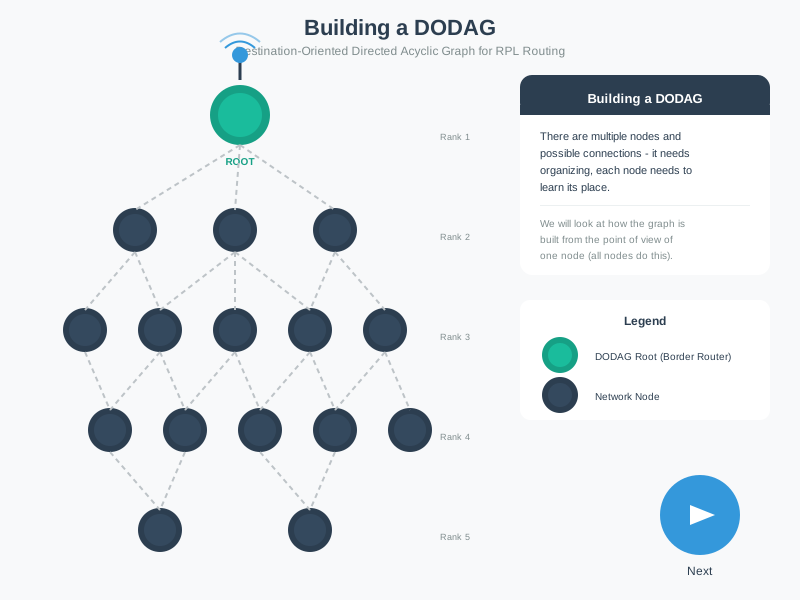
The DODAG construction begins with the root broadcasting DIO messages, which neighboring nodes use to calculate their RANK and select parents.
NoteVisual: DAG vs DODAG Structure
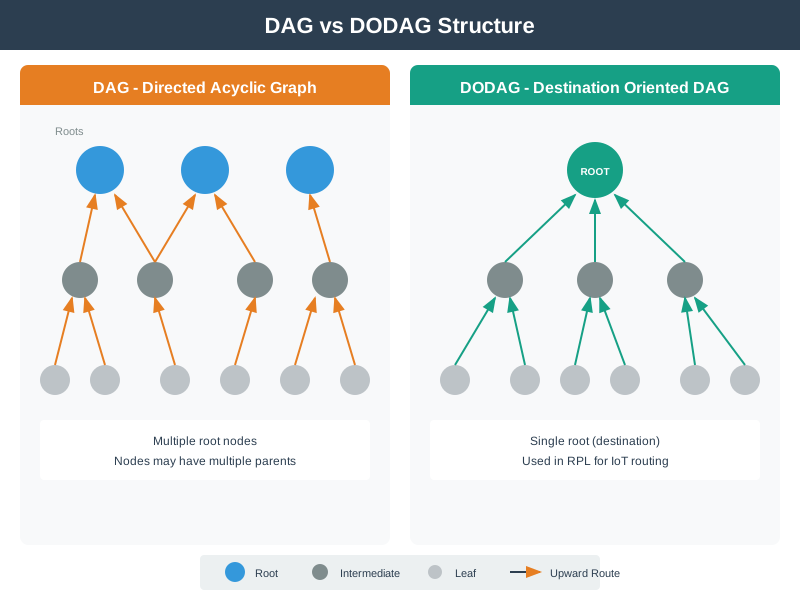
Understanding the difference between a generic DAG and RPL’s DODAG is fundamental to grasping how RPL organizes routing hierarchies.
NoteVisual: RPL Protocol Overview
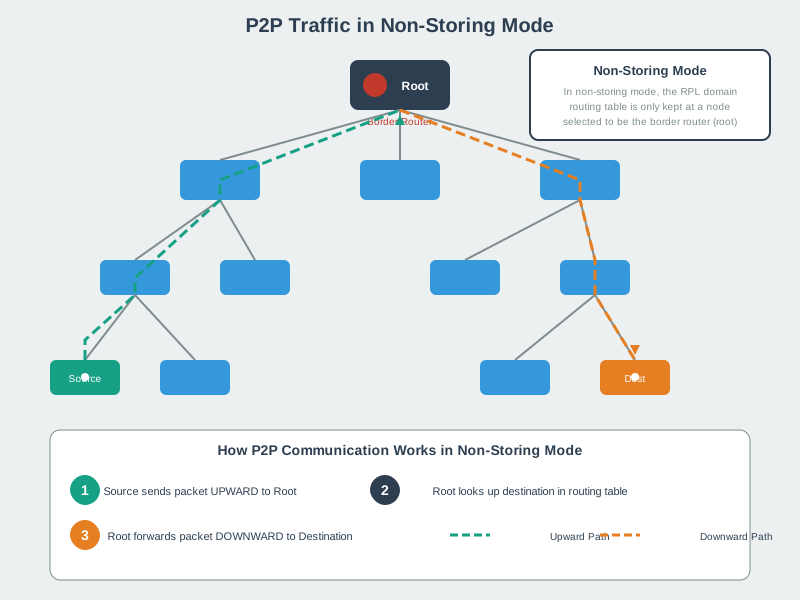
RPL coordinates routing through control messages and objective functions that optimize for IoT-specific metrics like energy consumption.
NoteVisual: RPL Non-Storing Mode Operation
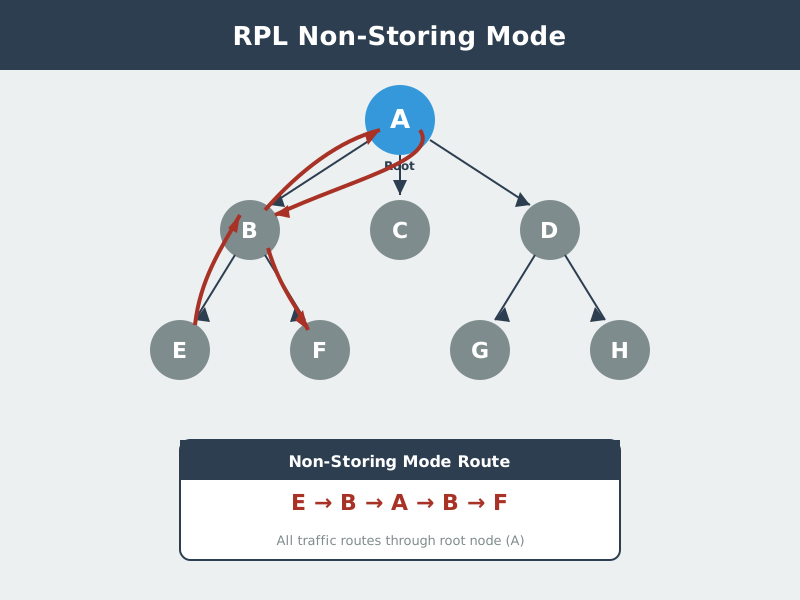
Non-Storing mode centralizes routing state at the root, making it ideal for memory-constrained sensor networks with primarily upward traffic.
722.5 Summary
This detailed quiz chapter covered the core concepts of RPL:
- RANK Mechanics: Loop prevention through hierarchical position enforcement, calculated by objective functions considering hop count, ETX, latency, or energy
- Mode Comparison: Storing vs Non-Storing modes have identical many-to-one performance; choice depends on P2P traffic and memory constraints
- Control Messages: DIS requests DODAG info, DIO advertises it, DAO builds downward routes, DAO-ACK confirms receipt
- Traditional vs RPL: OSPF’s link-state database and Dijkstra algorithm are fundamentally incompatible with IoT resource constraints
722.5.1 Quick Reference: RPL Control Messages
| Message | Purpose | Direction | When Sent |
|---|---|---|---|
| DIS | Request DODAG info | Multicast | Joining, recovery |
| DIO | Advertise DODAG | Downward/broadcast | Trickle timer |
| DAO | Advertise reachability | Upward | After joining |
| DAO-ACK | Confirm DAO receipt | Downward | Optional |
722.6 What’s Next
Return to RPL Labs and Quiz Overview to explore other RPL learning resources, or continue to RPL Production and Review for real-world deployment patterns and optimizations.