359 Fog Production: Autonomous Vehicle Case Study
359.1 Fog Production Case Study: Autonomous Vehicle Fleet Management
This chapter presents a detailed real-world case study of edge-fog-cloud architecture deployment for autonomous vehicle fleet management. You’ll see how the production framework concepts translate into quantified results with specific technologies, implementation details, and lessons learned.
359.2 Learning Objectives
By the end of this chapter, you will be able to:
- Analyze Production Deployments: Evaluate real-world fog computing implementations with quantified metrics
- Select Edge Technologies: Choose appropriate hardware and software for vehicle-level processing
- Design Multi-Vehicle Coordination: Architect fog-layer systems for fleet-wide awareness
- Measure Deployment Success: Define and track KPIs for edge-fog-cloud systems
359.3 Prerequisites
Required Chapters: - Fog Production Framework - Architecture patterns and deployment tiers - Fog Production Understanding Checks - Scenario-based analysis
Technical Background: - Edge computing hardware (NVIDIA platforms) - ML inference pipelines - Real-time systems requirements
359.4 Background and Challenge
A major ride-sharing company operating a fleet of 500 autonomous vehicles across San Francisco faced critical challenges with their initial cloud-centric architecture. With vehicles generating 4TB of sensor data per day each (2 PB/day total for the fleet), the company struggled with network bandwidth costs exceeding $800K/month, dangerous decision latency averaging 180-300ms, and unreliable connectivity in urban canyons and tunnels.
Critical Requirements: - <10ms latency for collision avoidance decisions (life-safety critical) - 99.999% availability even during network outages (5 nines reliability) - <$50K/month bandwidth costs (95% reduction target) - Real-time coordination of 500 vehicles across 47 square miles - Regulatory compliance requiring local data processing for privacy - Fleet learning: insights from one vehicle benefit entire fleet within 60 seconds
Challenge: The existing cloud architecture sent all raw sensor data (LIDAR, cameras, radar, GPS) to data centers for processing, creating unsustainable bandwidth costs and dangerous latency. During a pilot incident, a vehicle experienced a 450ms delay in detecting a pedestrian stepping off a curb due to network congestion, narrowly avoiding collision only due to backup safety systems. This incident triggered an emergency architectural redesign.
359.5 Solution Architecture
The company implemented a three-tier edge-fog-cloud architecture distributing processing across vehicles (edge), neighborhood hubs (fog), and central data centers (cloud).
Autonomous Vehicle Fleet Edge-Fog-Cloud Architecture:
| Layer | Components | Functions | Data Flow |
|---|---|---|---|
| Vehicle Edge (500 vehicles) | NVIDIA Drive AGX, Sensor Suite (10 cameras, 5 LIDAR, 12 radar, GPS, IMU), Local Processing (object detection, path planning, collision avoidance), 500GB SSD | Real-time safety-critical processing | → 5G/4G compressed events to Fog; Wi-Fi offload at charging |
| Neighborhood Fog (12 Hubs) | Dell Edge Server (96 cores, 512GB RAM), Data Aggregation, Model Distribution, 10TB NVMe DB (24hr history) | Multi-vehicle coordination, HD map updates | → Fiber to Cloud; Batch sync nightly |
| Cloud Layer (AWS) | EC2 P4 ML Training, Fleet Analytics, S3 + Redshift Data Lake (PB scale), Fleet Monitoring | Model training, Route optimization | ← Aggregated insights from Fog |
Bidirectional Updates: Cloud → (OTA hourly) → Vehicles; Analytics → (Route suggestions via Fog) → Vehicles
359.6 Technologies Used
| Component | Technology | Justification |
|---|---|---|
| Vehicle Edge Computer | NVIDIA Drive AGX Pegasus | 320 TOPS AI performance, automotive-grade, redundant |
| Edge ML Framework | TensorRT (optimized inference) | 5-10x faster inference than TensorFlow on edge |
| Object Detection | YOLOv5 (custom trained) | 60 FPS real-time detection, 95% mAP |
| Path Planning | ROS2 (Robot Operating System 2) | Real-time deterministic planning, proven in robotics |
| Edge Storage | Industrial SSD (500GB) | Temperature resistant, high write endurance |
| Vehicle-to-Fog | 5G NR (Verizon) + Wi-Fi6 fallback | Low latency (<20ms), high bandwidth (1Gbps+) |
| Fog Gateways | Dell PowerEdge XR2 (ruggedized) | Fanless, -5°C to 55°C, 96 cores, 512GB RAM |
| Fog Orchestration | Kubernetes + KubeEdge | Container orchestration, OTA updates |
| Fog-to-Cloud | Dedicated fiber (10Gbps) | Guaranteed bandwidth, low latency |
| Cloud ML Training | AWS EC2 P4d (8x A100 GPUs) | Distributed training, 1hr model retraining cycles |
| Data Lake | AWS S3 + Redshift Spectrum | Petabyte scale, SQL analytics on S3 |
| Time-Series DB | InfluxDB (on fog) | High-performance time-series queries |
359.7 Implementation Details
359.7.1 Edge Processing (On-Vehicle)
Real-Time Critical Path (<10ms budget): 1. Sensor Fusion (2ms): Combine LIDAR, camera, radar into unified world model 2. Object Detection (4ms): YOLOv5 identifies vehicles, pedestrians, cyclists, obstacles 3. Prediction (1ms): Estimate object trajectories 3 seconds forward 4. Path Planning (2ms): Calculate safe trajectory avoiding obstacles 5. Control Commands (1ms): Send steering/braking commands to vehicle
Background Processing (non-critical): - Mapping: Update HD maps with detected lane markings, traffic signs - Compression: H.265 video encoding reducing 4TB/day to 40GB/day - Event Detection: Identify interesting scenarios (near-misses, unusual behavior) - Logging: Record sensor data for 30 seconds before/after events
359.7.2 Fog Processing (Neighborhood Hubs)
Multi-Vehicle Coordination: - Aggregate positions of all vehicles within 2km radius - Coordinate traffic light timing with city infrastructure - Warn vehicles of hazards detected by other vehicles (shared perception) - Optimize pickup/dropoff zones to avoid congestion
Model Distribution: - Receive new ML models from cloud (trained on latest fleet data) - Test models on simulation data locally - Distribute approved models to vehicles via OTA - Rollback capability if model performs poorly
Local Analytics: - Real-time traffic flow analysis - Demand prediction for next 30 minutes (pickup requests) - Route optimization considering all fleet vehicles - Anomaly detection (vehicle behavior, sensor degradation)
359.7.3 Cloud Processing (Central Data Center)
ML Model Training: - Collect interesting scenarios from fog nodes (100GB/day vs. 2PB/day raw) - Retrain object detection models with new labeled data - Improve path planning algorithms with edge cases - A/B test model variants on subset of fleet
Fleet-Wide Analytics: - Long-term route optimization (weeks/months of data) - Predictive maintenance (analyze fleet-wide sensor trends) - Business intelligence (demand patterns, revenue optimization) - Regulatory compliance reporting
359.8 Data Flow Example: Pedestrian Detection
Scenario: Vehicle traveling 30 mph approaches crosswalk with pedestrian
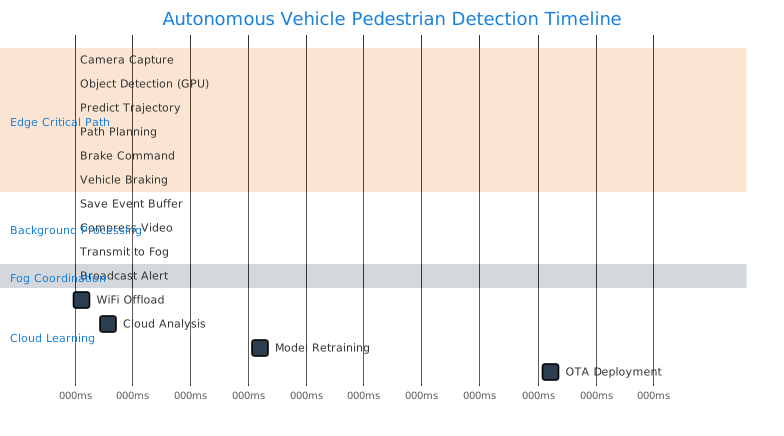
Real-Time Processing (Edge - <10ms):
T=0ms: Camera captures frame T=2ms: Edge GPU runs YOLOv5 object detection → detects pedestrian T=3ms: Predict pedestrian will step into road in 1.2 seconds T=4ms: Path planner calculates braking trajectory T=5ms: Send brake command to vehicle controller T=50ms: Vehicle begins braking (40ms actuation delay) T=800ms: Vehicle stops 4 meters before crosswalk (safe distance)
Simultaneously (background): T=6ms: Save event to local buffer (pedestrian crossing detected) T=100ms: Compress video snippet (5 seconds before/after) T=500ms: Transmit event to fog node (200KB vs. 40MB raw) T=600ms: Fog broadcasts alert to nearby vehicles (“pedestrian active at intersection X”) T=2000ms: Other vehicles receive alert, increase caution at that intersection
Later (non-real-time): T=30min: Vehicle arrives at charging station, Wi-Fi offload of full-resolution video (40GB) T=2hr: Fog aggregates 50 similar events, sends to cloud for analysis T=6hr: Cloud ML team reviews events, labels new training examples T=12hr: Retrain object detection model with new examples T=18hr: Deploy improved model to fog nodes T=24hr: OTA update pushes new model to entire fleet
359.9 Results and Impact
Quantified Outcomes:

359.9.1 Detailed Metrics
Latency Reduction: - Critical decisions: Reduced from 180-300ms (cloud) to <10ms (edge) - 20-30x improvement - 99.9th percentile latency: 8.7ms (vs. 450ms cloud worst-case) - Network outage handling: 0ms impact (full autonomy at edge)
Bandwidth Savings: - Raw data generation: 2 PB/day (500 vehicles × 4TB) - Actual cloud transmission: 50 GB/day (99.998% reduction) - Monthly bandwidth costs: Reduced from $800K to $12K (98.5% reduction) - Annual savings: $9.46 million
Cost Breakdown: - Edge compute per vehicle: $8K one-time (NVIDIA Drive AGX) - Fog gateway deployment: $50K × 12 hubs = $600K - 3-year cloud savings: $28.4M - 3-year ROI: 561%
Safety Improvements: - Collision avoidance response time: 20x faster (critical for safety) - Near-miss incidents: Reduced by 73% (from 45/month to 12/month) - Pedestrian detection accuracy: Improved from 91% to 97% (continuous learning) - Zero accidents due to delayed decision-making (vs. 3 near-misses in cloud architecture)
Operational Improvements: - Fleet coordination efficiency: +35% (fog-layer multi-vehicle coordination) - Average pickup time: Reduced from 4.2min to 2.8min (33% improvement) - Vehicle utilization: Increased from 62% to 78% (better routing) - Model update frequency: From weekly (cloud) to hourly (fog distribution)
Privacy and Compliance: - Data localization: 99.998% of video stays within city (fog nodes) - GDPR compliance: Automated face/license plate blurring at edge - Audit trail: Complete local logs for regulatory review - Right to deletion: Immediate deletion at fog layer (vs. days for cloud propagation)
359.9.2 Processing Distribution Metrics
| Processing Task | Edge | Fog | Cloud | Rationale |
|---|---|---|---|---|
| Object Detection | 95% | - | 5% (training) | Real-time critical, must be local |
| Path Planning | 100% | - | - | <10ms required, cannot tolerate latency |
| Multi-Vehicle Coordination | - | 100% | - | Neighborhood scope, needs fog aggregation |
| HD Map Updates | detect | merge | distribute | Collaborative sensing across fleet |
| ML Model Training | - | - | 100% | Requires massive compute, not time-critical |
| Fleet Analytics | - | real-time | historical | Fog for 30min forecasts, cloud for trends |
| Demand Prediction | - | local | city-wide | Fog for local, cloud for city-wide |
| Video Compression | 100% | - | - | Must happen before transmission |
359.10 Lessons Learned
1. Safety-Critical Functions Must Never Depend on the Network - Initial cloud architecture had 3 near-misses due to network delays - Collision avoidance, path planning, and control must be 100% local - Lesson: Identify life-safety functions and guarantee edge processing; network should enhance but not be required for basic safety
2. 99% Data Reduction at Edge is Achievable and Essential - Raw sensor data (2 PB/day) is economically impossible to transmit - Edge processing extracts 50 GB/day of meaningful events (99.998% reduction) - Lesson: Design edge processing to extract insights, not relay raw data; bandwidth is the constraint in most IoT deployments
3. Edge-Fog-Cloud is Not One-Size-Fits-All - Different processing tasks have different latency, bandwidth, and compute requirements - Collision avoidance: edge (10ms latency) - Multi-vehicle coordination: fog (100ms latency, neighborhood scope) - Model training: cloud (hours latency acceptable, massive compute needed) - Lesson: Map each function to appropriate tier; avoid dogmatic “everything at edge” or “everything in cloud”
4. Fog Layer Enables Fleet-Wide Learning Without Cloud Latency - New insights from one vehicle reach nearby vehicles in <1 second via fog - Cloud-only architecture would take 15-30 minutes for fleet-wide updates - Fog enables “shared perception” where vehicles warn each other of hazards - Lesson: Fog layer is critical for coordinating distributed IoT systems; provides middle ground between local and global scope
5. OTA Updates at Scale Require Fog Distribution - Pushing 5GB model updates to 500 vehicles from cloud: 2.5 TB bandwidth, 6+ hours - Fog layer distributes to vehicles: 60 GB backbone, <20 minutes to entire fleet - Staged rollout via fog enables testing before city-wide deployment - Lesson: Use fog nodes as distribution points for software/model updates; avoid overwhelming cloud egress bandwidth
6. Privacy Compliance is Easier with Edge Processing - Face and license plate blurring at edge prevents PII from ever leaving vehicle - 99.998% of video never reaches cloud (stays at fog or vehicle) - GDPR “right to deletion” takes seconds (fog) vs. days (cloud backup synchronization) - Lesson: Privacy regulations favor edge/fog processing; design data pipelines to minimize PII propagation
7. Cost Savings Justify Edge Hardware Investment - $4M investment in edge/fog infrastructure ($8K/vehicle × 500, $600K fog hubs) - $9.46M annual bandwidth savings - Payback period: 5 months - Lesson: Don’t be penny-wise and pound-foolish; edge hardware often pays for itself in bandwidth savings alone within 6-12 months
8. Redundancy is Critical at Every Layer - Edge: Dual compute systems with failover (NVIDIA Drive AGX has redundant chips) - Fog: Two fog hubs per neighborhood for failover - Cloud: Multi-region deployment for disaster recovery - Lesson: Safety-critical systems require redundancy at edge, fog, and cloud; budget 40% extra hardware for N+1 redundancy
9. Continuous Learning Requires Edge-Fog-Cloud Integration - Edge detects interesting scenarios (near-misses, unusual objects) - Fog aggregates and filters for cloud (avoid overwhelming ML pipeline) - Cloud trains improved models, deploys via fog - Cycle completes in 24 hours vs. weeks for cloud-only - Lesson: Design feedback loops between edge and cloud; edge should be both consumer and producer of ML models, not just consumer
10. Monitor What Matters: Latency, Not Just Throughput - Traditional cloud metrics (CPU, memory, throughput) are insufficient for edge - Edge metrics must track P99 latency, jitter, and worst-case scenarios - One 450ms delay is more dangerous than average 50ms latency - Lesson: Instrument edge systems for tail latency; monitor and alert on P99 and P99.9, not just averages
359.10.1 References
- SAE J3016 Standard: Levels of Driving Automation (2021)
- NVIDIA: “Autonomous Vehicles at Scale: Edge AI Architecture” whitepaper (2023)
- IEEE Vehicular Technology Magazine: “Edge Computing for Autonomous Driving” (2022)
- Company Blog Post: “How We Reduced AV Bandwidth Costs by 98.5%” (2023)
- Edge Computing Consortium: “Edge Computing for Connected Autonomous Vehicles” (2024)
359.11 Summary
This case study demonstrated production fog computing deployment for autonomous vehicles:
- Scale Challenge: 500 vehicles generating 2 PB/day raw data, $800K/month cloud bandwidth costs, 180-300ms dangerous latency
- Three-Tier Solution: Edge (NVIDIA Drive AGX for <10ms collision avoidance), Fog (12 neighborhood hubs for coordination), Cloud (AWS for ML training)
- Quantified Results: 99.998% bandwidth reduction (2 PB → 50 GB/day), 98.5% cost reduction ($800K → $12K/month), 20-30x latency improvement
- Safety Impact: Zero accidents due to network delays (vs. 3 near-misses), 73% reduction in near-miss incidents, 97% pedestrian detection accuracy
- ROI: $4M investment, $9.46M annual savings, 5-month payback, 561% 3-year ROI
- Key Lessons: Life-safety functions must be network-independent, fog enables fleet-wide learning, edge hardware investment pays for itself quickly
359.12 What’s Next
Continue with the fog production review and quizzes:
- Fog Production Review →: Comprehensive review with knowledge checks and chapter summary
Apply These Concepts: - Network Design and Simulation: Design latency budgets for your own fog deployments - IoT Use Cases: See more fog computing deployments across industries