522  Sensor Application Labs and Assessment

Hands-On Exercises and Knowledge Checks

522.1 Learning Objectives

By the end of this chapter, you will be able to:

  • Design Sensor Deployments: Plan complete IoT sensor systems for real-world scenarios
  • Calculate Total Cost of Ownership: Budget hardware, installation, maintenance, and operational costs
  • Optimize Multi-Sensor Systems: Balance coverage, redundancy, and cost constraints
  • Estimate Data Requirements: Calculate storage, bandwidth, and cloud costs
  • Integrate Cross-Domain Sensors: Combine sensors from multiple domains for comprehensive solutions
TipMVU: Minimum Viable Understanding

Core concept: Successful IoT deployments require systematic planning across technical, operational, and financial dimensions. Why it matters: Projects fail not from sensor selection, but from underestimating installation costs, maintenance burden, and operational complexity. Key takeaway: Always prototype with 5-10% of planned sensors, validate assumptions, then scale.

In This Series: - Sensor Applications Overview - Domain introduction - Sensor Selection Wizard - Hardware selection - Sensor Application Architecture - System design patterns

Hands-On Resources: - Sensor Labs Implementation - Wokwi-based labs - Simulation Playground - Interactive simulators - Quiz Navigator - Additional quizzes

522.2 Hands-On Labs

Time: ~30 min | Advanced | P06.C03.U17

522.2.1 Lab 1: Sensor Application Selection for Smart City

Objective: Select and plan sensor deployments for a smart city initiative.

Scenario: You are tasked with implementing IoT solutions for a mid-sized city (population 200,000, area 50 km2) with a $2 million budget over 5 years.

City Priorities: 1. Reduce traffic congestion 2. Improve air quality monitoring 3. Optimize waste collection 4. Enhance public safety

Tasks:

  1. Identify Applications: From the overview catalog, select 4 applications (one per priority)

  2. Calculate Deployment Costs: For each application, determine:

    • Number of sensors needed for adequate coverage
    • Total cost over 5 years
    • Cost per citizen per year
  3. Budget Allocation: Distribute the $2M budget across the 4 applications considering:

    • Impact on citizens
    • Coverage requirements
    • Operating costs
  4. Network Requirements: Calculate data requirements:

    • Total daily data generated
    • Monthly cloud storage costs (assume $0.02/GB)
    • Network bandwidth needs
  5. ROI Analysis: Estimate benefits:

    • Traffic: Reduced congestion ($X saved in productivity)
    • Air Quality: Health improvements
    • Waste: Collection efficiency gains
    • Safety: Incident response time reduction

Deliverables: - Sensor deployment plan with coverage maps - 5-year cost breakdown - Network architecture diagram - ROI justification


522.2.2 Lab 2: Multi-Sensor Deployment Optimization

Objective: Optimize sensor deployment under multiple constraints.

Scenario: Deploy environmental monitoring for a 10 km2 industrial park.

Requirements: - Monitor: Air quality (CO, CO2, NOx), Temperature, Humidity - Coverage: Complete park coverage - Budget: $150,000 (5 years) - Power: Solar-powered sensors (20 mW average)

Tasks:

  1. Sensor Selection: Choose appropriate sensors for each parameter

  2. Coverage Analysis: Calculate:

    • Effective range of each sensor type
    • Minimum sensors for complete coverage
    • Overlap factor for redundancy
  3. Cost Optimization:

    • Find maximum sensors within budget
    • Calculate coverage vs. cost trade-offs
    • Identify optimal sensor placement
  4. Power Budget: For solar deployment:

    • Calculate daily energy consumption
    • Size solar panels (assume 4 hours effective sunlight)
    • Determine battery capacity for 3-day autonomy
  5. Data Management: Estimate:

    • Sampling rates for each sensor
    • Total data generated daily
    • Storage requirements for 1-year retention
    • Network connectivity options (cellular vs. LoRaWAN)

Deliverables: - Optimized deployment plan - Coverage heat map - Power system design - Data management architecture


522.2.3 Lab 3: Sensor Data Rate Planning

Objective: Design network infrastructure for high-data-rate sensor applications.

Scenario: Industrial vibration monitoring system for a manufacturing plant with 100 machines.

Requirements: - Vibration sampling: 1000 Hz per machine - Temperature monitoring: 1 Hz per machine - Real-time anomaly detection - Historical data for 90 days

Tasks:

  1. Data Rate Calculation: For each sensor type:
    • Bytes per sample
    • Samples per second
    • Total data rate (Mbps)
  2. Network Design: Determine:
    • Can Wi-Fi handle the load?
    • Need for edge processing?
    • Data aggregation strategy
  3. Storage Sizing: Calculate:
    • Raw data storage (90 days)
    • Compressed storage (assume 3:1 compression)
    • Database sizing recommendations
  4. Edge Processing: Design edge analytics:
    • FFT analysis at edge (reduce data by 100x)
    • Alert generation rules
    • Cloud upload strategy (alerts vs. raw data)
  5. Cost Analysis: Compare:
    • Option A: Send all data to cloud
    • Option B: Edge processing + alert-only cloud
    • Calculate cloud costs, network costs, edge hardware

Deliverables: - Network architecture diagram - Data flow design - Storage sizing spreadsheet - Cost comparison matrix


522.2.4 Lab 4: Cross-Domain Sensor Integration

Objective: Integrate sensors across multiple domains for smart building management.

Scenario: Design IoT system for a 20-floor commercial building.

Requirements: - Energy management (Smart Metering) - Security (Access control, intrusion detection) - Environmental quality (HVAC optimization) - Occupancy tracking (Space utilization)

Tasks:

  1. Sensor Inventory: List all required sensors:
    • Energy: Current/voltage, power meters
    • Security: PIR, door sensors, cameras
    • Environment: Temp, humidity, CO2
    • Occupancy: PIR, desk sensors, Wi-Fi tracking
  2. Integration Architecture: Design:
    • Sensor bus topology (I2C, SPI, or wireless)
    • Edge gateways per floor
    • Central management system
    • Cloud integration
  3. Data Fusion: Create multi-sensor analytics:
    • Correlate occupancy with HVAC
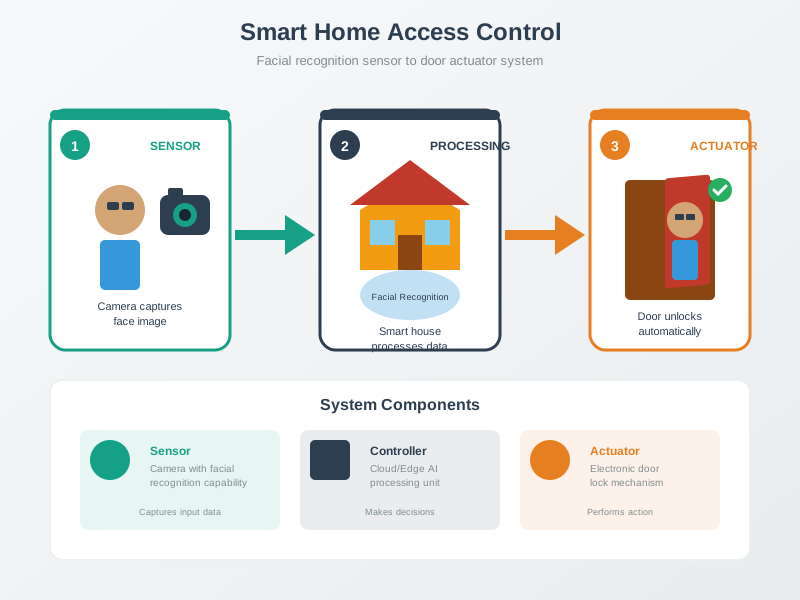
    • Link access control with space usage
    • Combine for energy optimization
  4. Implementation Plan: Create:
    • Phased rollout schedule
    • Testing and validation plan
    • Maintenance procedures
    • Operator training requirements
  5. Business Case: Calculate:
    • Total system cost
    • Energy savings (estimated 20% reduction)
    • Security improvements
    • ROI timeline

Deliverables: - Complete sensor specification - System integration diagram - Implementation timeline - Business case presentation

522.3 Common Pitfalls

CautionPitfall: Over-Deploying Sensors Without Strategic Planning

The mistake: Deploying maximum sensor density assuming “more data is better,” then discovering network congestion, maintenance nightmares, and redundant data that increases costs without improving insights.

Why it happens: It feels safer to over-instrument. Proposals emphasizing “comprehensive coverage” win approval easier than “optimized sparse deployment.” Teams underestimate ongoing maintenance costs ($15-30/sensor/year) and network capacity requirements.

The fix: Start with minimum viable deployment based on spatial correlation analysis. For air quality, pollution diffuses over 1-2 km, so 1 sensor/km2 often suffices. For parking, you need 1:1 coverage. Pilot with 10-20% of planned sensors, analyze data to identify redundancy, then expand strategically. Total cost of ownership includes hardware, installation, connectivity, maintenance, and data storage.

CautionPitfall: Choosing Sensors Based on Lab Specs for Field Deployment

The mistake: Selecting sensors based on datasheet specifications measured under ideal lab conditions (25C, 50% humidity, no interference), then experiencing failures or drift in real-world conditions.

Why it happens: Datasheets present best-case performance. Outdoor deployments face temperature extremes (-20 to +50C), condensation, dust ingress, vibration, and electromagnetic interference. Indoor industrial environments add chemical exposure and mechanical stress.

The fix: Always check operating ranges, not just accuracy specs. For outdoor deployment, require IP65+ ratings and -40 to +85C operating range. Request field performance data or case studies from vendors. Budget for environmental protection (enclosures, sun shields, desiccants) and plan for more frequent calibration than lab-based intervals suggest.

CautionPitfall: Ignoring Power Budget for Battery-Powered Deployments

The mistake: Designing a sensor node that works perfectly when plugged in, then discovering batteries last weeks instead of years when deployed remotely.

Why it happens: Developers test with USB power and only consider power after the design is complete. Transmission power (Wi-Fi: 100-200mA, LoRa: 20-40mA) often dominates the budget, but sensor warm-up power and microcontroller sleep current are overlooked. Duty cycle calculations use best-case numbers.

The fix: Calculate power budget before selecting hardware. Use the formula: Battery life = Battery capacity / Average current. For 5-year life on 2xAA batteries (3000mAh), average current must be under 70 microamps. Choose LoRa/BLE over Wi-Fi, implement deep sleep (1-10 microamps), minimize transmission frequency, and use sensors with fast wake-up times. Always prototype and measure actual consumption.

522.4 Knowledge Check

Test your knowledge of sensor applications across IoT domains with these questions.

Question 1: Which sensor type is most commonly used across IoT applications?

Answer: B) Temperature

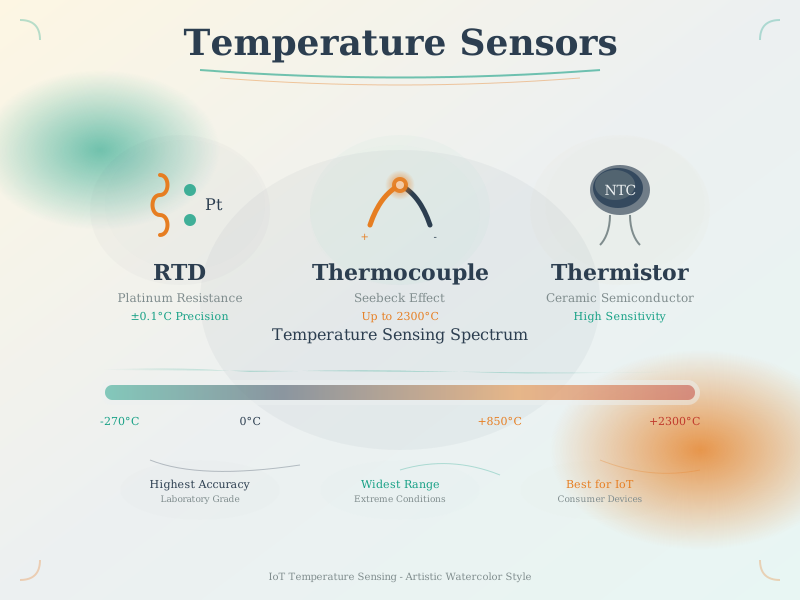
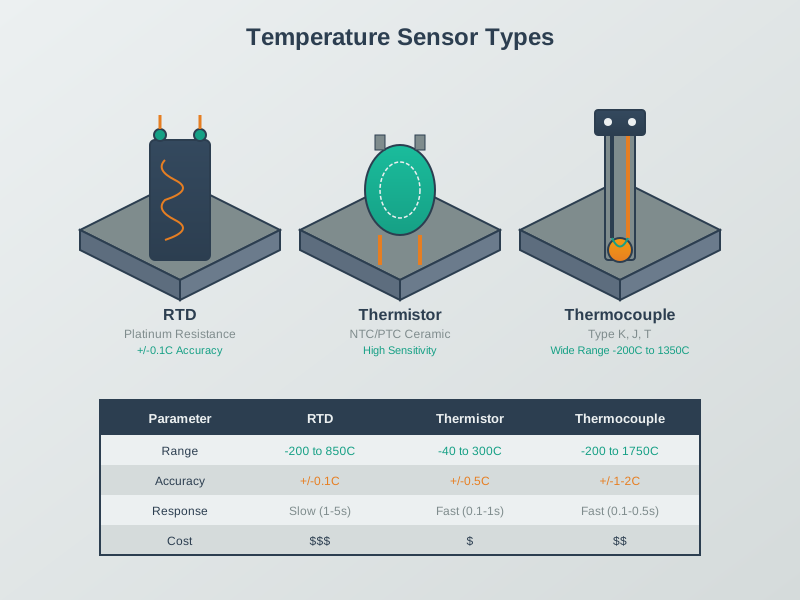
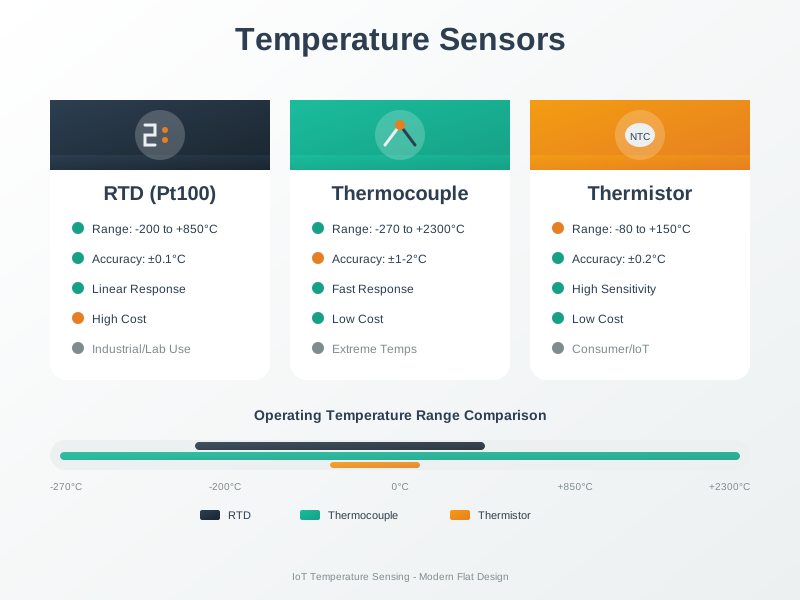
Temperature sensors are used in approximately 15 different application types across smart cities, smart environment, smart water, smart industrial, smart agriculture, smart animal farming, and smart health domains. They’re versatile, low-cost ($2-10), and essential for environmental monitoring, HVAC control, equipment monitoring, and health applications.

Question 2: For smart parking applications, what is the primary sensor used?

    1. Ultrasound
    1. Camera
    1. Magnetic field
    1. Pressure

Answer: C) Magnetic field

Magnetic field sensors detect the presence of large metal objects (vehicles) by measuring disruptions in the Earth’s magnetic field. They’re buried in or mounted under parking spaces, are weather-resistant, low-power, and cost-effective for large-scale deployments. While cameras and ultrasound can work, magnetic sensors are the industry standard due to their reliability and low maintenance.

Question 3: Which application domain typically has the highest sensor data rates?

    1. Smart Agriculture
    1. Smart Health (vital signs)
    1. Smart Parking
    1. Smart Retail

Answer: B) Smart Health (vital signs)

Smart Health vital signs monitoring (ECG, pulse, respiration) requires 100+ Hz sampling rates for accurate waveform capture and medical diagnosis. ECG typically samples at 250-500 Hz. In contrast, smart agriculture might sample every few minutes, smart parking every 10 seconds, and retail inventory on-demand.

Question 4: What is the primary cost component for water quality sensors?

    1. Installation
    1. Energy consumption
    1. Hardware (sensor cost)
    1. Maintenance

Answer: C) Hardware (sensor cost)

Water quality sensors (pH, Dissolved Oxygen, conductivity, nitrates) are expensive, typically $250+ per unit compared to $5-10 for temperature sensors. They require specialized electrodes, calibration, and periodic replacement. This makes deployment planning critical to balance coverage with budget constraints.

Question 5: For a city-wide air quality monitoring network with 1000 sensors sampling at 0.1 Hz and 50 bytes per sample, what is the approximate daily data volume?

    1. ~500 KB
    1. ~5 MB
    1. ~50 MB
    1. ~500 MB

Answer: C) ~50 MB

Calculation: Daily data = 1000 sensors x 0.1 samples/s x 50 bytes/sample x 86,400 seconds/day = 1000 x 0.1 x 50 x 86,400 = 432,000,000 bytes = 43.2 MB = 50 MB (with protocol overhead)

This calculation is essential for network bandwidth planning, cloud storage costs estimation, and edge processing decisions in large-scale IoT deployments.

Question 6: Which sensor application typically requires GPS?

    1. Smart lighting
    1. Fleet tracking
    1. Waste management
    1. Indoor air quality

Answer: B) Fleet tracking

Fleet tracking requires GPS to monitor vehicle locations in real-time for route optimization, delivery tracking, and driver behavior analysis. Smart lighting uses light sensors (LDR), waste management uses ultrasound distance sensors, and indoor air quality uses gas sensors (CO, CO2, VOCs). GPS provides outdoor location accuracy of 5-10 meters.

Question 7: What is the main advantage of edge processing in sensor networks?

    1. Lower hardware costs
    1. Reduced network bandwidth requirements
    1. Simpler software
    1. Better sensor accuracy

Answer: B) Reduced network bandwidth requirements

Edge processing analyzes data locally at or near the sensor, sending only aggregated results, alerts, or compressed data to the cloud. For example, vibration monitoring at 1 kHz generates massive raw data, but FFT analysis at the edge can reduce transmission by 100x, sending only frequency peaks and anomaly alerts. This dramatically reduces network bandwidth costs, cloud storage costs, and enables real-time responses.

Question 8: For industrial vibration monitoring at 1000 Hz sampling rate, which network technology is most suitable?

    1. LoRaWAN
    1. NB-IoT
    1. Wi-Fi or Ethernet
    1. Bluetooth LE

Answer: C) Wi-Fi or Ethernet

High-frequency vibration monitoring at 1000 Hz with 4 bytes per sample generates 4 KB/s per sensor (240 KB/min). Wi-Fi (54+ Mbps) or Ethernet (100+ Mbps) can handle this data rate with multiple sensors. LoRaWAN is limited to ~50 kbps with 1% duty cycle, NB-IoT to ~100 kbps, and BLE to ~1 Mbps. For industrial monitoring, wired Ethernet provides the most reliable high-bandwidth solution.

Question 9: In multi-sensor deployments, what does “sensor coverage” typically refer to?

    1. The physical size of the sensor
    1. The geographic area each sensor can monitor effectively
    1. The number of sensor types deployed
    1. The data transmission range

Answer: B) The geographic area each sensor can monitor effectively

Sensor coverage defines the geographic area or volume that one sensor can effectively monitor, determining how many sensors are needed for complete area coverage. For example, a temperature sensor might cover 100 m2 indoors, a gas sensor 50 m2 (due to diffusion), and a camera 500 m2 (depending on resolution and mounting height). Coverage planning ensures no blind spots while minimizing deployment costs.

Question 10: For a $500,000 budget over 5 years, approximately how many gas sensors can be deployed? (Assuming $45 hardware + $50 installation + $15/year maintenance each)

    1. ~2,500 sensors
    1. ~5,000 sensors
    1. ~7,500 sensors
    1. ~10,000 sensors

Answer: A) ~2,500 sensors

Calculation: Total cost per sensor = Hardware ($45) + Installation ($50) + Maintenance ($15 x 5 years) = $45 + $50 + $75 = $170 per sensor over 5 years.

Maximum sensors = $500,000 / $170 = 2,941 sensors.

Answer A (~2,500) is the closest practical estimate accounting for additional costs like gateways, network infrastructure, and contingency. This calculation is fundamental for IoT project budgeting and ROI analysis.


ImportantChapter Summary

Sensors are the foundation of IoT ecosystems, converting physical phenomena into actionable digital data across 61+ specific applications spanning 12 major domains. This chapter demonstrated how sensor networks enable smart cities, environmental monitoring, industrial control, agriculture, healthcare, and more through real-time data collection and analysis.

Key implementation considerations include selecting appropriate sensor types for each application, calculating deployment costs and power budgets, estimating network bandwidth requirements, and optimizing sensor placement for adequate coverage. The labs provided practical exercises for cost analysis, data rate estimation, and deployment optimization.

Multi-sensor systems combine different sensor types to create comprehensive monitoring solutions. Understanding sensor coverage, sampling rates, power consumption, and network architecture is essential for designing scalable IoT deployments. Real-world applications range from simple single-sensor systems to complex city-wide networks with thousands of distributed nodes.

The economics of sensor deployment involves balancing initial hardware costs, installation expenses, ongoing maintenance, energy consumption, and network infrastructure. Successful IoT implementations carefully consider total cost of ownership, return on investment, and scalability when selecting sensors and designing deployment strategies.

Question 1: Which sensor type is most commonly used across various IoT application domains?

  • GPS sensors
  • Temperature sensors
  • Ultrasound sensors
  • Weight/Load cell sensors

Explanation: Temperature sensors are used in approximately 15 different application types across smart cities, smart environment, smart water, smart industrial, smart agriculture, smart animal farming, and smart health domains. They’re versatile, low-cost, and essential for environmental monitoring, HVAC control, equipment monitoring, and health applications. GPS is specialized for tracking, ultrasound for distance measurement, and load cells for weight sensing.

Question 2: For smart parking applications, what is the primary sensor used to detect vehicle presence?

  • Ultrasound distance sensor
  • Camera with computer vision
  • Magnetic field sensor
  • Pressure sensor

Explanation: Magnetic field sensors detect the presence of large metal objects (vehicles) by measuring disruptions in the Earth’s magnetic field. They’re buried in or mounted under parking spaces, are weather-resistant, low-power, and cost-effective for large-scale deployments. While cameras and ultrasound can work, magnetic sensors are the industry standard for smart parking due to their reliability and low maintenance requirements.

Question 3: Which application domain typically requires the highest sensor data rates?

  • Smart Agriculture (soil moisture monitoring)
  • Smart Health (vital signs monitoring)
  • Smart Parking (occupancy detection)
  • Smart Retail (inventory tracking)

Explanation: Smart Health vital signs monitoring (ECG, pulse, respiration) requires 100+ Hz sampling rates for accurate waveform capture and medical diagnosis. ECG typically samples at 250-500 Hz. In contrast, smart agriculture might sample every few minutes, smart parking every 10 seconds, and retail inventory on-demand. High data rates impact network bandwidth, storage requirements, and power consumption significantly.

Question 4: What is the primary cost component for water quality sensor deployments?

  • Installation labor costs
  • Energy consumption costs
  • Hardware sensor cost
  • Annual maintenance costs

Explanation: Water quality sensors (pH, Dissolved Oxygen, conductivity, nitrates) are expensive, typically $250+ per unit compared to $5-10 for temperature sensors. They require specialized electrodes, calibration, and periodic replacement. While installation and maintenance add costs, the hardware dominates the budget for water quality monitoring systems. This makes deployment planning critical to balance coverage with budget constraints.

Question 5: For a city-wide air quality monitoring network with 1000 sensors sampling at 0.1 Hz and 50 bytes per sample, what is the approximate daily data volume?

  • ~500 KB
  • ~5 MB
  • ~50 MB
  • ~500 MB

Explanation: Daily data = 1000 sensors x 0.1 samples/s x 50 bytes/sample x 86,400 seconds/day = 1000 x 0.1 x 50 x 86,400 = 432,000,000 bytes = 43.2 MB = 50 MB (with protocol overhead). This calculation is essential for network bandwidth planning, cloud storage costs estimation, and edge processing decisions in large-scale IoT deployments.

Question 6: Which sensor application typically requires GPS for accurate operation?

  • Smart lighting control
  • Fleet tracking and management
  • Waste bin fill level monitoring
  • Indoor air quality monitoring

Explanation: Fleet tracking requires GPS to monitor vehicle locations in real-time for route optimization, delivery tracking, and driver behavior analysis. Smart lighting uses light sensors (LDR), waste management uses ultrasound distance sensors, and indoor air quality uses gas sensors (CO, CO2, VOCs). GPS provides outdoor location accuracy of 5-10 meters, essential for logistics and transportation applications.

Question 7: What is the main advantage of edge processing in sensor networks?

  • Lower hardware costs
  • Reduced network bandwidth requirements
  • Simpler software architecture
  • Better raw sensor accuracy

Explanation: Edge processing analyzes data locally at or near the sensor, sending only aggregated results, alerts, or compressed data to the cloud. For example, vibration monitoring at 1 kHz generates massive raw data, but FFT analysis at the edge can reduce transmission by 100x, sending only frequency peaks and anomaly alerts. This dramatically reduces network bandwidth costs, cloud storage costs, and enables real-time responses even with intermittent connectivity.

Question 8: For industrial vibration monitoring at 1000 Hz sampling rate, which network technology is most suitable?

  • LoRaWAN (long-range, low bandwidth)
  • NB-IoT (narrowband cellular)
  • Wi-Fi or Ethernet (high bandwidth)
  • Bluetooth LE (low energy)

Explanation: High-frequency vibration monitoring at 1000 Hz with 4 bytes per sample generates 4 KB/s per sensor (240 KB/min). Wi-Fi (54+ Mbps) or Ethernet (100+ Mbps) can handle this data rate with multiple sensors. LoRaWAN is limited to ~50 kbps with 1% duty cycle, NB-IoT to ~100 kbps, and BLE to ~1 Mbps. For industrial monitoring, wired Ethernet provides the most reliable high-bandwidth solution.

Question 9: In multi-sensor deployments, what does “sensor coverage” typically refer to?

  • The physical size of the sensor device
  • The geographic area each sensor can monitor effectively
  • The number of different sensor types deployed
  • The wireless transmission range

Explanation: Sensor coverage defines the geographic area or volume that one sensor can effectively monitor, determining how many sensors are needed for complete area coverage. For example, a temperature sensor might cover 100 m2 indoors, a gas sensor 50 m2 (due to diffusion), and a camera 500 m2 (depending on resolution and mounting height). Coverage planning ensures no blind spots while minimizing deployment costs.

Question 10: For a $500,000 budget over 5 years, approximately how many gas sensors can be deployed? (Assuming $45 hardware + $50 installation + $15/year maintenance each)

  • ~2,500 sensors
  • ~5,000 sensors
  • ~7,500 sensors
  • ~10,000 sensors

Explanation: Total cost per sensor = Hardware ($45) + Installation ($50) + Maintenance ($15 x 5 years) = $45 + $50 + $75 = $170 per sensor over 5 years. Maximum sensors = $500,000 / $170 = 2,941 sensors. Answer A (~2,500) is the closest practical estimate accounting for additional costs like gateways, network infrastructure, and contingency. This calculation is fundamental for IoT project budgeting and ROI analysis.

522.6 Summary

This series on sensor applications covered:

  • Smart Cities: Air quality monitoring, traffic management, waste management, and street lighting optimization reduce costs and improve quality of life
  • Industrial IoT: Predictive maintenance, vibration monitoring, and asset tracking prevent downtime and optimize operations
  • Agriculture: Soil moisture sensing, weather monitoring, and livestock tracking increase yields while reducing water and resource usage
  • Healthcare: Remote patient monitoring, fall detection, and medication adherence improve patient outcomes and reduce hospital readmissions
  • Environmental Sensing: Climate monitoring, water quality tracking, and wildlife observation support conservation and research
  • Deployment Strategies: Sensor placement, network topology, and power management determine system reliability and longevity
  • Cost Analysis: Total cost of ownership includes hardware, installation, maintenance, connectivity, and data storage over the system lifetime

Fundamentals: - Sensor Fundamentals - Sensor types and specifications - Electronics - Circuit basics for sensor interfacing - Electricity - Power requirements

Processing: - Sensor Interfacing - Signal conditioning and ADC - Sensor Circuits - Hardware design patterns - Mobile Sensors - Smartphone sensor applications

Output: - Actuators - Converting sensor data to action

Architecture: - Wireless Sensor Networks - Large-scale deployments - Edge Computing - Local data processing - Sensing as a Service - Cloud-based sensing

Data: - Multi-Sensor Fusion - Combining sensor data

Learning: - Simulations Hub - Sensor simulators - Videos Hub - Real-world sensor demos - Sensor Labs - Hands-on projects

522.7 What’s Next

You’ve completed the sensor applications series! Continue your learning:

Next Steps: - Sensor Fundamentals and Types - Deep dive into individual sensor technologies - Sensor Labs Implementation - Wokwi-based hands-on projects - Actuators - Learn how to act on sensor data