%%{init: {'theme': 'base', 'themeVariables': {'primaryColor': '#2C3E50', 'primaryTextColor': '#fff', 'primaryBorderColor': '#16A085', 'lineColor': '#16A085', 'secondaryColor': '#E67E22', 'tertiaryColor': '#7F8C8D', 'clusterBkg': '#f9f9f9', 'clusterBorder': '#2C3E50'}}}%%

graph TB
    subgraph Perimeter["Traditional Perimeter Security"]
        FW1[Firewall] --> Internal[Trusted Internal Network]
        Internal --> Sensor1[Temperature Sensor]
        Internal --> Sensor2[Security Camera]
        Internal --> Server1[File Server]
        Internal --> DB1[Database]
        Sensor1 -.Free Access.-> DB1
        Sensor2 -.Free Access.-> Server1
    end

    subgraph ZeroTrust["Zero Trust Model"]
        Device1[Temperature Sensor] -->|Auth Request| ZTA[Zero Trust Agent]
        Device2[Security Camera] -->|Auth Request| ZTA
        ZTA -->|Verify Identity| IdP[Identity Provider]
        ZTA -->|Check Policy| PE[Policy Engine]
        PE -->|Grant Access| Resource1[Temperature DB Only]
        PE -->|Grant Access| Resource2[Video Storage Only]
    end

    Attacker[Attacker] -->|Compromises 1 Device| Sensor1
    Attacker2[Attacker] -->|Compromises 1 Device| Device1

    Sensor1 -.Can Access Everything.-> Internal
    Device1 -.Limited to Authorized Resources.-> Resource1

    style Perimeter fill:#ffcccc
    style ZeroTrust fill:#ccffcc
    style Attacker fill:#E67E22
    style Attacker2 fill:#E67E22
1372 Zero Trust Security Fundamentals
1372.1 Learning Objectives
By the end of this chapter, you will be able to:
- Explain the “never trust, always verify” principle and its importance in IoT security
- Contrast traditional perimeter-based security with zero trust architecture
- Describe why IoT systems amplify the failures of perimeter security
- Apply the three core principles of zero trust: verify explicitly, least privilege, assume breach
1372.2 Introduction
In December 2013, Target Corporation experienced one of the largest retail data breaches in history. Attackers stole 40 million credit card numbers and 70 million customer records. The entry point? Network credentials stolen from a third-party HVAC (heating, ventilation, and air conditioning) vendor. A simple thermostat system, trusted because it was “inside” the corporate network, became the gateway for a devastating breach that cost Target over $200 million.
This incident exemplifies the fundamental failure of perimeter-based security: once an attacker crosses the outer defenses, they can move laterally through the network with minimal resistance. For IoT systems, this problem is amplified exponentially. A smart building might contain 50,000 connected devices, a manufacturing plant 100,000 sensors, and a smart city millions of endpoints. Each device represents a potential entry point, and traditional castle-and-moat security cannot scale to protect them.
Zero Trust Security offers a fundamentally different approach: never trust, always verify. Every device, every user, every network flow is continuously authenticated and authorized. There is no implicit trust, no “inside” versus “outside.” This chapter explores how zero trust principles transform IoT security from perimeter defense to comprehensive, continuous verification.
TipFor Beginners: What is Zero Trust?
Imagine traditional network security as a medieval castle. Once you get past the moat and walls (the firewall), you can walk freely through every room. Guards at the gate checked you once, and now you’re trusted.
Zero Trust is like a modern high-security office building. You need your badge to enter the building, but you also need it for every floor, every restricted area, and sometimes individual rooms. Security cameras constantly monitor your movements. If you try to access areas you don’t need for your job, alarms trigger. And if your badge shows unusual behavior (accessing the server room at 3 AM when you’re normally a 9-to-5 accountant), security investigates immediately.
In IoT terms: your smart thermostat doesn’t automatically get access to your security cameras just because they’re on the same Wi-Fi network. Each device must prove its identity, request specific permissions, and be continuously monitored to ensure it’s behaving normally.
TipFor Kids: Meet the Sensor Squad! 🌟
Zero Trust Security is like a school where EVERYONE needs to show their hall pass for EVERY classroom, EVERY time - even the teachers!
1372.2.1 The Sensor Squad Adventure: The Hall Pass Heroes
The Sensor Squad lived in a smart school building, and they thought they had great security. Sammy the Temperature Sensor watched the main entrance. “I checked everyone’s ID when they came in this morning,” Sammy said proudly. “We’re totally safe now!”
But then something strange happened. A sneaky raccoon had slipped in through a window in the library! Since the raccoon was already “inside” the school, nobody stopped it from walking into the cafeteria, the computer lab, and even the principal’s office. The raccoon ate all the snacks and made a huge mess!
“This is terrible!” cried Lux the Light Sensor. “We trusted everything inside the building, but we shouldn’t have!” That’s when Motio the Motion Detector had a brilliant idea called ZERO TRUST.
“From now on, EVERYONE needs a hall pass - not just to enter the building, but for EVERY room they want to visit!” Motio explained. Now each member of the Sensor Squad became a checkpoint:
- Sammy checked hall passes at the entrance AND at the library door
- Lux verified passes for the computer lab - “Do you really need to be here right now?”
- Pressi the Pressure Sensor monitored who sat in which chairs - “Is this YOUR desk?”
- Motio watched for anyone acting suspiciously - “Why are you running to the supply closet 50 times today?”
The next time a sneaky critter tried to cause trouble, it got stopped right away. Even if it somehow got past Sammy, it couldn’t go ANYWHERE else without the right hall pass!
1372.2.2 Key Words for Kids
| Word | What It Means |
|---|---|
| Zero Trust | A rule that says “never automatically trust anyone” - always check and verify first |
| Hall Pass | In computers, this is like a special permission slip that proves you’re allowed to be somewhere |
| Verify | To double-check that someone really is who they say they are |
| Micro-segmentation | Dividing a building into many small areas, each with its own security checkpoint |
| Least Privilege | Only giving people permission to go exactly where they NEED to go - nowhere else |
1372.2.3 Try This at Home!
Create a Zero Trust Treasure Hunt!
- Set up “security zones” in your house (living room, kitchen, bedroom, etc.)
- Make different colored passes for each zone using paper and crayons:
- Red pass = Kitchen access
- Blue pass = Living room access
- Green pass = Backyard access
- Hide a small treasure (like candy or stickers) somewhere in your house
- Give family members ONLY the passes they need to find the clue in their zone
- Play “Security Guard”: Before anyone enters a zone, they must show the RIGHT colored pass!
- The challenge: Work together, sharing clues (but NOT passes!) to find the treasure
What did you learn? Even people you trust completely (like family!) should only have access to what they need. That way, if someone makes a mistake or loses their pass, the damage is limited to just ONE area!
Think About It: Why is it safer to check passes at EVERY room instead of just the front door? (Hint: What if someone sneaks in through a window, or borrows someone else’s pass?)
NoteKey Takeaway
In one sentence: Zero trust assumes no implicit trust—verify every request regardless of source, location, or previous authentication.
Remember this rule: Never trust, always verify; grant least privilege by default; assume breach will occur and design to contain damage.
NoteCross-Hub Connections
Learning Resources: - Knowledge Gaps Hub - Common zero trust misconceptions and authentication failures - Simulations Hub - Interactive network segmentation simulators - Quizzes Hub - Self-assessment: Zero trust principles and implementation - Videos Hub - Watch: Zero trust architecture case studies and NIST 800-207 overview
Knowledge Map: Explore the Knowledge Map to see how zero trust security connects to encryption (cryptographic foundations), device identity (hardware security), and continuous monitoring (behavioral analytics).
1372.3 The Problem with Perimeter Security
1372.3.1 Castle-and-Moat Failure
Traditional network security operates on a simple model: strong perimeter defenses (firewalls, VPNs, intrusion detection) protect a trusted internal network. Resources inside the perimeter can communicate freely, while external threats are blocked at the boundary.
This model made sense when networks were smaller and primarily accessed from within corporate buildings. But multiple factors have rendered perimeter security obsolete:
Cloud Migration: Resources no longer live behind a single firewall. Data and applications are distributed across AWS, Azure, Google Cloud, and SaaS platforms.
Mobile Workforce: Users access systems from coffee shops, airports, and home networks. The “inside” of the network is everywhere and nowhere.
Lateral Movement: Research shows that 60-70% of successful breaches involve lateral movement - attackers compromise one system, then spread through the internal network. Once inside, attackers encounter minimal resistance.
Insider Threats: Not all attacks come from outside. Malicious insiders or compromised credentials account for 30% of data breaches.
1372.3.2 IoT Amplifies the Problem
IoT systems face unique challenges that make perimeter security particularly ineffective:
Scale and Diversity - A single smart building might contain 50,000 connected devices - Devices range from $5 sensors to $100,000 industrial equipment - Multiple vendors, protocols, and security capabilities - Many devices lack basic security features (encryption, authentication, update mechanisms)
Long Lifecycles - IoT devices often operate for 10-20 years - Firmware becomes outdated, vulnerabilities accumulate - Vendors may no longer provide security updates - Replacing millions of devices is economically impractical
Physical Access - Unlike servers in locked data centers, IoT devices are physically accessible - Attackers can extract credentials, inject malware, or reverse engineer firmware - Environmental sensors in public spaces, medical devices in patient rooms, industrial sensors on factory floors
Resource Constraints - Limited CPU, memory, and battery power - Cannot run traditional security software (antivirus, EDR) - Difficult to implement strong encryption and authentication
Operational Requirements - Industrial systems require 99.999% uptime - Security updates can’t interrupt critical operations - Safety systems must function even if network connectivity fails
Let’s visualize the difference between perimeter and zero trust models:
1372.4 Alternative View: Zero Trust Implementation Timeline
%%{init: {'theme': 'base', 'themeVariables': { 'primaryColor': '#2C3E50', 'primaryTextColor': '#fff', 'primaryBorderColor': '#16A085', 'lineColor': '#16A085', 'secondaryColor': '#E67E22', 'tertiaryColor': '#7F8C8D'}}}%%
flowchart LR
    subgraph Phase1["Phase 1: Foundation<br/>(0-3 months)"]
        direction TB
        P1A[Device Inventory<br/>Discover all IoT assets]
        P1B[Identity System<br/>PKI, certificates]
        P1C[Network Segmentation<br/>VLANs, micro-perimeters]
    end

    subgraph Phase2["Phase 2: Control<br/>(3-6 months)"]
        direction TB
        P2A[Policy Engine<br/>Define access rules]
        P2B[Authentication<br/>MFA, device attestation]
        P2C[Enforcement Points<br/>Deploy at critical paths]
    end

    subgraph Phase3["Phase 3: Monitor<br/>(6-12 months)"]
        direction TB
        P3A[Behavioral Analytics<br/>Baseline normal activity]
        P3B[Anomaly Detection<br/>Flag suspicious behavior]
        P3C[Automated Response<br/>Quarantine, revoke access]
    end

    Phase1 --> Phase2 --> Phase3

    style P1A fill:#2C3E50,stroke:#16A085,color:#fff
    style P1B fill:#2C3E50,stroke:#16A085,color:#fff
    style P1C fill:#2C3E50,stroke:#16A085,color:#fff
    style P2A fill:#E67E22,stroke:#2C3E50,color:#fff
    style P2B fill:#E67E22,stroke:#2C3E50,color:#fff
    style P2C fill:#E67E22,stroke:#2C3E50,color:#fff
    style P3A fill:#16A085,stroke:#2C3E50,color:#fff
    style P3B fill:#16A085,stroke:#2C3E50,color:#fff
    style P3C fill:#16A085,stroke:#2C3E50,color:#fff
The diagram above contrasts perimeter and zero trust approaches to device compromise.
%%{init: {'theme': 'base', 'themeVariables': {'primaryColor': '#2C3E50', 'primaryTextColor': '#fff', 'primaryBorderColor': '#16A085', 'lineColor': '#16A085', 'secondaryColor': '#E67E22', 'tertiaryColor': '#fff'}}}%%
sequenceDiagram
    participant D as IoT Device
    participant PEP as Policy Enforcement Point
    participant PE as Policy Engine
    participant IdP as Identity Provider
    participant R as Resource

    Note over D,R: Every access request follows this flow

    D->>PEP: Request access to resource
    PEP->>IdP: Verify device identity
    IdP->>IdP: Check certificate/credentials
    IdP-->>PEP: Identity confirmed

    PEP->>PE: Evaluate access policy
    PE->>PE: Check device health
    PE->>PE: Check user context
    PE->>PE: Check time/location
    PE-->>PEP: Access decision

    alt Access Granted
        PEP->>R: Forward request
        R-->>D: Response (encrypted)
    else Access Denied
        PEP-->>D: 403 Forbidden
        PEP->>PE: Log attempt
    end

    Note over D,R: Continuous monitoring after access
{fig-alt=“Zero Trust access flow sequence diagram showing IoT device requesting resource access. Policy Enforcement Point queries Identity Provider for device verification, then Policy Engine evaluates device health, user context, time, and location. Access is either granted with encrypted response or denied with logging. Continuous monitoring occurs after any granted access.”}
%%{init: {'theme': 'base', 'themeVariables': {'primaryColor': '#2C3E50', 'primaryTextColor': '#fff', 'primaryBorderColor': '#16A085', 'lineColor': '#16A085', 'secondaryColor': '#E67E22', 'tertiaryColor': '#fff'}}}%%
flowchart LR
    subgraph factors["Trust Score Factors"]
        F1[Device Identity<br/>Certificate valid?]
        F2[Device Health<br/>Firmware current?]
        F3[Behavior<br/>Normal patterns?]
        F4[Context<br/>Expected location?]
        F5[Network<br/>Secure channel?]
    end

    F1 & F2 & F3 & F4 & F5 --> CALC[Trust Score<br/>Calculation]

    CALC --> S1{Score > 80%}
    S1 -->|Yes| FULL[Full Access<br/>All resources]
    S1 -->|No| S2{Score > 50%}
    S2 -->|Yes| LIMITED[Limited Access<br/>Read-only]
    S2 -->|No| S3{Score > 20%}
    S3 -->|Yes| QUARANTINE[Quarantine<br/>Management only]
    S3 -->|No| BLOCK[Blocked<br/>No access]

    style FULL fill:#16A085,stroke:#2C3E50,color:#fff
    style LIMITED fill:#E67E22,stroke:#2C3E50,color:#fff
    style QUARANTINE fill:#7F8C8D,stroke:#2C3E50,color:#fff
    style BLOCK fill:#c0392b,stroke:#2C3E50,color:#fff
{fig-alt=“Trust score decision flowchart showing five factors: device identity (certificate valid), device health (firmware current), behavior (normal patterns), context (expected location), and network (secure channel). Factors combine into trust score calculation. Score above 80% grants full access, 50-80% limited read-only, 20-50% quarantine with management-only access, below 20% completely blocked.”}
The diagram illustrates the critical difference: in perimeter security, compromising one device grants access to the entire internal network. In zero trust, each device can only access explicitly authorized resources.
NoteAI-Generated Visual: Zero Trust Model (Artistic)
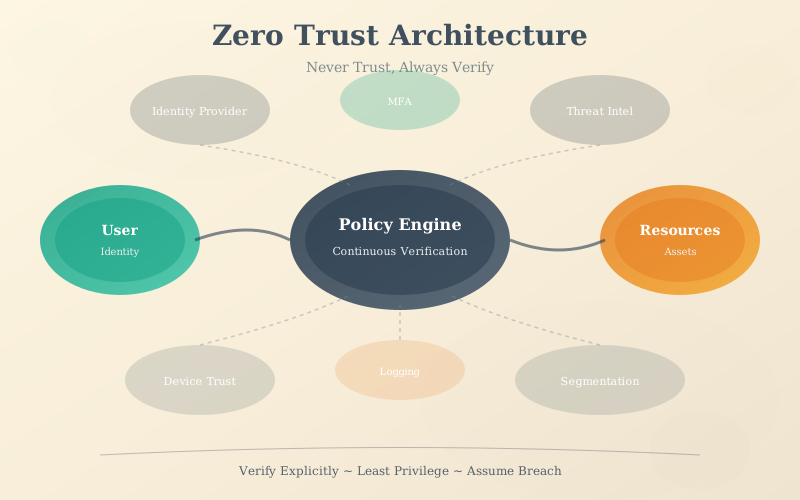
This artistic rendering emphasizes the paradigm shift from perimeter-based trust to resource-level verification, where every access request is treated as potentially hostile regardless of source location.
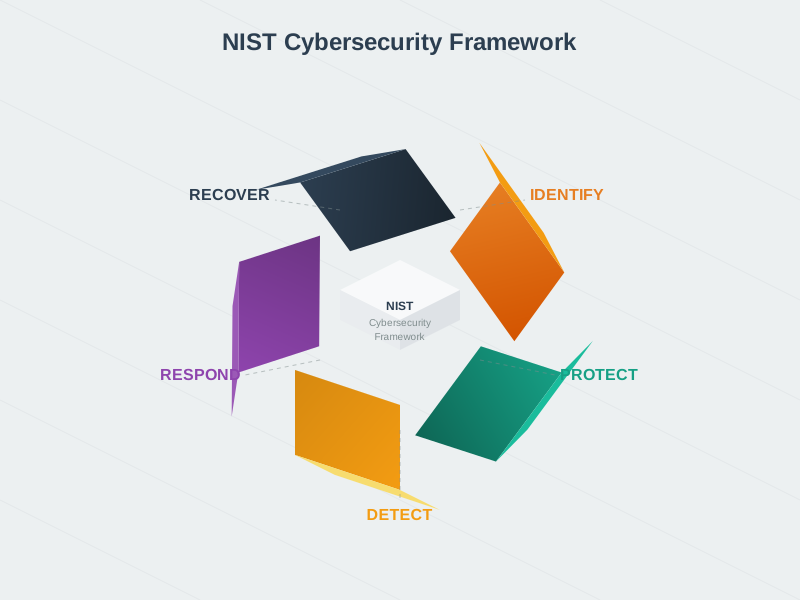
NoteAI-Generated Visual: NIST Zero Trust Framework
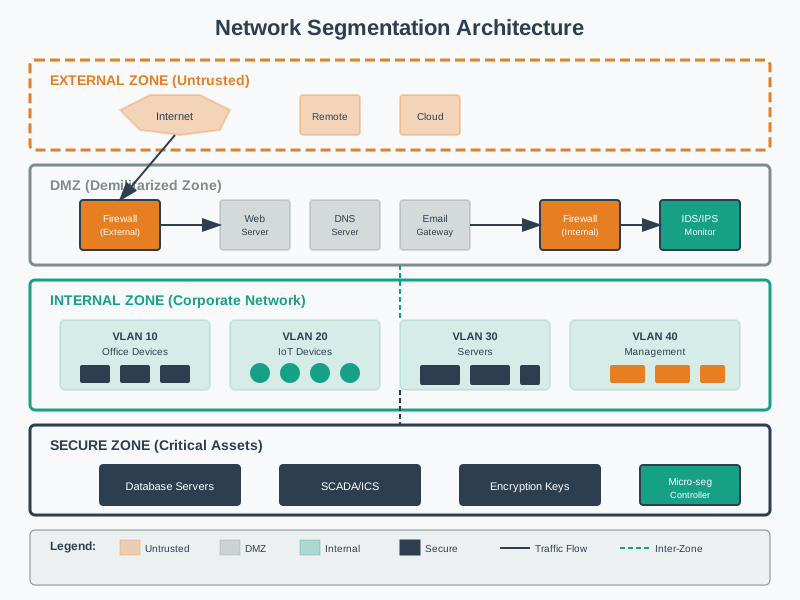
NoteAI-Generated Visual: Network Segmentation for IoT
1372.5 Zero Trust Principles for IoT
Zero Trust Architecture (ZTA) is built on three core principles, originally defined by John Kindervag at Forrester Research and later standardized by NIST in Special Publication 800-207.
1372.5.1 Verify Explicitly
Never assume trust based on network location. Every access request must be authenticated and authorized based on all available data points:
Device Identity - Cryptographic device certificate (X.509) - Hardware-backed identity (TPM, secure element) - Device fingerprint (MAC address, serial number)
User Identity (if applicable) - Human operator credentials - Multi-factor authentication - Role-based access control
Context - Geographic location (is the device where it should be?) - Time of access (unusual for 3 AM?) - Network path (expected route to resource?)
Device Health - Firmware version up to date? - Security patches applied? - No known vulnerabilities?
Resource Sensitivity - Accessing public data vs. PII vs. safety-critical controls - Adjust authentication strength accordingly
Example: A temperature sensor in a smart building requests access to upload data:
REQUEST:
  Device ID: temp-sensor-042
  Certificate: [X.509 cert signed by building CA]
  Location: Floor 3, Zone B
  Timestamp: 2025-12-15 14:30:00 UTC
  Destination: https://building.example.com/api/temperature
  Data: {"temperature": 72.3, "humidity": 45.2}

VERIFICATION:
  ✓ Certificate valid and not revoked
  ✓ Device in expected location
  ✓ Time within normal operation hours
  ✓ Firmware version 2.1.4 (latest)
  ✓ Destination authorized for this device
  ✓ Data size within normal range (50 bytes vs. typical 48 bytes)

DECISION: ALLOW
1372.5.2 Least Privilege Access
Grant the minimum access necessary for a device to fulfill its function, and nothing more. This principle limits the blast radius if a device is compromised.
Principle Application: - A temperature sensor should access only the temperature data API, not the building access control system - A security camera should upload video to designated storage, not browse the corporate file server - A smart light bulb should receive commands from the lighting controller, not access the internet
Implementation Strategies:
Network-Level Segmentation - VLANs separate device types (sensors, cameras, controllers) - Firewall rules restrict inter-VLAN communication - ACLs (Access Control Lists) allow only necessary ports/protocols
Application-Level Authorization - API tokens scoped to specific endpoints - OAuth2 scopes limit permissions - JWT claims specify allowed actions
Time-Based Access - Credentials expire frequently (hours, not months) - Refresh tokens require re-authentication - Temporary access for maintenance windows
Example: A smart thermostat in a commercial building:
ALLOWED:
- Read temperature sensors on same floor
- Write heating/cooling setpoints
- Read occupancy sensors for smart scheduling
- Upload operational logs to building management system

DENIED:
- Access to other floors' systems
- Access to security cameras
- Access to employee databases
- Outbound internet connections
- Access to building access control
1372.5.3 Assume Breach
Design your system assuming attackers are already inside. Focus on limiting damage, detecting anomalies, and responding rapidly.
Defense in Depth: - Multiple layers of security controls - If one layer fails, others still protect critical assets - Compromise of one device doesn’t compromise the entire system
Micro-Segmentation: - Divide the network into small zones with separate access controls - Lateral movement becomes difficult or impossible - Contain breaches to minimal blast radius
Continuous Monitoring: - Real-time analysis of device behavior - Anomaly detection identifies compromised devices - Automated response (quarantine, alert, investigate)
Rapid Response: - Isolate compromised devices within seconds - Revoke credentials immediately - Forensic logging for incident analysis
Let’s visualize the zero trust decision process:
%%{init: {'theme': 'base', 'themeVariables': {'primaryColor': '#2C3E50', 'primaryTextColor': '#fff', 'primaryBorderColor': '#16A085', 'lineColor': '#16A085', 'secondaryColor': '#E67E22', 'tertiaryColor': '#7F8C8D'}}}%%

flowchart TD
    Start[Device Access Request] --> Auth[Authenticate Device Identity]
    Auth -->|Valid?| CheckHealth{Check Device Health}
    Auth -->|Invalid| Deny1[Deny Access]

    CheckHealth -->|Healthy| CheckContext{Verify Context}
    CheckHealth -->|Unhealthy| Quarantine[Quarantine Device]

    CheckContext -->|Normal| CheckPolicy{Evaluate Policy}
    CheckContext -->|Anomaly| Risk[Risk-Based Decision]

    Risk -->|Low Risk| CheckPolicy
    Risk -->|High Risk| MFA[Require Additional Verification]

    MFA -->|Pass| CheckPolicy
    MFA -->|Fail| Deny2[Deny Access]

    CheckPolicy -->|Authorized| LeastPriv[Grant Minimum Access]
    CheckPolicy -->|Not Authorized| Deny3[Deny Access]

    LeastPriv --> Monitor[Continuous Monitoring]
    Monitor -->|Normal Behavior| Allow[Access Granted]
    Monitor -->|Anomaly Detected| Alert[Alert and Reassess]

    Alert --> Investigate{Investigate}
    Investigate -->|False Positive| Allow
    Investigate -->|True Positive| Revoke[Revoke Access]

    style Deny1 fill:#E67E22
    style Deny2 fill:#E67E22
    style Deny3 fill:#E67E22
    style Quarantine fill:#E67E22
    style Revoke fill:#E67E22
    style Allow fill:#16A085
    style LeastPriv fill:#16A085
This flowchart shows how zero trust continuously verifies and monitors every access request, with multiple decision points and fail-safes.
WarningCommon Misconception: “Zero Trust Means Zero Network Security”
The Myth: Organizations often believe that implementing zero trust means they can eliminate firewalls, VPNs, and network segmentation entirely, replacing them with identity-based controls only.
The Reality: Zero trust is additive, not a replacement. It adds identity, context, and continuous verification on top of network security, not instead of it.
Real-World Evidence:
- Google BeyondCorp Study (2019): Despite pioneering zero trust, Google maintains multiple security layers:
- Network segmentation: 85% of internal services remain micro-segmented
- Firewall rules: 12,000+ network policies still actively enforced
- DDoS protection: Network-layer defenses block 500+ Gbps attacks daily
- Finding: Zero trust reduced lateral movement by 93%, but network controls blocked 99.8% of external attacks
- Microsoft Azure Security Benchmark (2023): Analysis of 10,000+ IoT deployments showed:
- Organizations using only identity controls: 64% breach rate within 18 months
- Organizations using identity + network segmentation: 8% breach rate
- Quantified Impact: Network segmentation reduced attack surface by 87% even with zero trust identity controls in place
- NIST SP 800-207 (2020): The official zero trust standard explicitly requires:
- “Defense in depth with multiple enforcement points” (page 13)
- “Network segmentation and micro-segmentation” (page 24)
- “Network-layer controls complement, not replace, identity controls” (page 31)
Why Both Are Essential:
- Network segmentation limits lateral movement (contains breaches to ~5% of network vs. 100%)
- Identity controls prevent unauthorized access (reduces successful authentications by 78%)
- Together: 99.2% reduction in successful attacks vs. 64% with identity alone (Forrester, 2022)
The Correct Approach: Zero trust = Strong Identity + Micro-Segmentation + Continuous Verification. All three layers work together for defense in depth.
WarningCommon Misconception: “Zero Trust = No Trust”
The Misconception: Zero trust means nothing is trusted and everything is blocked.
Why It’s Wrong: - Zero trust means “verify always,” not “deny always” - Trust is earned through continuous authentication - Access is granted based on context and identity - More secure AND more usable (no VPN needed) - Name is misleading - it’s really “earned trust”
Real-World Example: - Traditional: VPN connects you to corporate network → trusted - Zero Trust: Every request verified regardless of network - Result: Work from coffee shop as securely as office - Not “blocked everywhere” but “verified everywhere”
The Correct Understanding: | Principle | Traditional Security | Zero Trust | |———–|———————|————| | Trust model | Network perimeter | Per-request | | Verification | Once (at VPN login) | Continuous | | Access scope | Broad (full network) | Minimal (just needed resources) | | User experience | VPN required | Works anywhere | | Lateral movement | Easy once inside | Blocked |
Zero trust = continuous verification + least privilege. It enables secure access, not denial.
1372.6 Summary
Zero trust fundamentals represent a paradigm shift in security thinking:
Traditional perimeter security has failed for IoT systems due to scale, device diversity, long lifecycles, and physical accessibility.
Zero trust eliminates implicit trust based on network location, requiring continuous verification of every device and request.
Three core principles guide zero trust implementation: verify explicitly (authenticate everything), least privilege (minimum necessary access), and assume breach (design for containment).
Zero trust is additive - it enhances network security with identity and context, not replaces it.
1372.8 What’s Next
Now that you understand the core principles of zero trust security, continue to Zero Trust Implementation to learn the practical steps for deploying zero trust in IoT networks, including the IoT-specific challenges and a phased implementation approach.