1447 Compliance and GDPR for IoT
1447.1 Learning Objectives
By the end of this chapter, you will be able to:
- Handle Erasure Requests: Process GDPR Article 17 “Right to be Forgotten” requests across multi-vendor IoT ecosystems
- Implement Privacy by Design: Apply GDPR Article 25 requirements at the firmware level
- Manage Consent: Design consent management systems that meet GDPR Article 7 requirements
- Navigate Multi-Vendor Compliance: Coordinate erasure and privacy across independent data controllers
What is GDPR? The General Data Protection Regulation (GDPR) is EU law governing how organizations collect, process, and store personal data. It gives individuals rights over their data including the right to access, correct, and delete it.
Why does it matter for IoT? IoT devices collect vast amounts of personal data - from smart home behavior patterns to health metrics. Each device may have its own data controller, making compliance complex across multi-vendor ecosystems.
Key terms: | Term | Definition | |——|————| | Data Controller | Organization that determines purposes and means of processing personal data | | Data Processor | Organization that processes data on behalf of a controller | | Article 17 | Right to Erasure (“Right to be Forgotten”) | | Article 25 | Data Protection by Design and by Default | | Article 7 | Conditions for Consent | | Special Category Data | Sensitive data including health, biometric, and location data |
In one sentence: Multi-vendor IoT ecosystems require coordinated GDPR compliance where each controller processes erasure requests and cascades notifications to all processors within the 30-day deadline.
Remember this rule: Privacy must be “baked in” at the firmware level - technical defaults that cannot be overridden by cloud configuration provide the strongest protection.
1447.2 Prerequisites
Before diving into this chapter, you should be familiar with:
- NIST Framework: Understanding of the Identify and Protect functions provides context for compliance
- Introduction to Privacy: Privacy fundamentals and data protection principles
- Security Controls: Technical implementation of protection measures
1447.3 GDPR Article 17: Right to Erasure
Scenario: A smart home customer in France exercises their GDPR Article 17 “Right to Erasure” (Right to be Forgotten). Their smart home ecosystem includes devices from 5 different vendors: smart thermostat (Nest), security cameras (Ring), voice assistant (Alexa), smart lights (Philips Hue), and a central hub (SmartThings). The customer wants ALL their data deleted across ALL vendors within the GDPR-mandated 30-day timeline.
Given: - Customer: Marie Dupont, French resident, GDPR data subject - Request date: January 15, 2026 - Deadline: February 14, 2026 (30 days per GDPR Article 12(3)) - Data controllers: 5 vendors (each is an independent controller) - Data processors: 12 third-party services (cloud providers, analytics, voice processing) - Complications: Shared household data (spouse also uses devices), legal retention requirements (energy data for French utility billing)
1447.3.1 Step 1: Receive and Validate the Erasure Request (Day 1-3)
| Validation Step | Action | GDPR Reference |
|---|---|---|
| Identity verification | Request government ID or account verification | Art. 12(6) - verify identity |
| Scope clarification | “Do you want all data or specific categories?” | Art. 17(1) - specific or broad |
| Third-party cascade | “Should we notify all processors?” | Art. 17(2) - notification duty |
| Exceptions check | Review for legal retention requirements | Art. 17(3) - exemptions |
Response to customer (Day 3): > “We have received your erasure request dated January 15, 2026. We will process your request within 30 days. We have identified the following data categories and will delete or anonymize as appropriate…”
1447.3.2 Step 2: Map Data Across All Vendors and Processors
| Vendor | Data Types | Retention Requirement | Erasure Action |
|---|---|---|---|
| Nest | Temperature preferences, occupancy patterns, energy usage | French energy law: 3-year billing records | DELETE preferences; ANONYMIZE energy data |
| Ring | Video recordings (90 days), motion events, device IDs | None (no legal obligation) | DELETE all (full erasure) |
| Alexa | Voice recordings, purchase history, routines | None | DELETE all (incl. voice training data) |
| Hue | Lighting schedules, usage patterns | None | DELETE all |
| SmartThings | Device connections, automation rules, location | None | DELETE all |
1447.3.4 Step 4: Technical Implementation
def cascade_erasure_multi_vendor(customer_id, vendors, deadline_days=30):
    """Execute GDPR Article 17 across multi-vendor ecosystem."""
    erasure_log = []

    for vendor in vendors:
        # Step 1: Identify all data for this customer
        data_inventory = vendor.get_data_inventory(customer_id)

        # Step 2: Check for retention exemptions
        exempt_data = check_legal_exemptions(data_inventory,
                                              jurisdiction="FR")

        # Step 3: Execute erasure (with exemptions preserved)
        for data_item in data_inventory:
            if data_item in exempt_data:
                # Anonymize instead of delete (Art. 17(3))
                vendor.anonymize(data_item, remove_fields=[
                    "customer_id", "name", "email", "address"
                ])
                erasure_log.append({
                    "vendor": vendor.name,
                    "data": data_item.type,
                    "action": "anonymized",
                    "reason": "legal_retention_requirement"
                })
            else:
                # Full deletion
                vendor.hard_delete(data_item)
                erasure_log.append({
                    "vendor": vendor.name,
                    "data": data_item.type,
                    "action": "deleted",
                    "timestamp": datetime.now()
                })

        # Step 4: Notify processors (Art. 17(2))
        for processor in vendor.get_processors():
            processor.cascade_erasure(customer_id)
            erasure_log.append({
                "processor": processor.name,
                "action": "notified",
                "deadline": deadline_days
            })

    return erasure_log
1447.3.5 Step 5: Generate Compliance Documentation (Day 28-30)
| Vendor | Data Deleted | Data Anonymized | Processors Notified | Completion Date |
|---|---|---|---|---|
| Nest | Preferences, schedules | 3-year energy usage | Google Cloud, utility API | Feb 10, 2026 |
| Ring | All video, events, metadata | None | AWS, video analytics | Feb 8, 2026 |
| Alexa | Voice recordings, history, routines | None | AWS, ML training | Feb 12, 2026 |
| Hue | Schedules, patterns | None | Philips Cloud | Feb 7, 2026 |
| SmartThings | All hub data, automations | None | Samsung Cloud | Feb 9, 2026 |
1447.3.6 Step 6: Notify Customer of Completion
“Dear Marie Dupont,
Your GDPR Article 17 erasure request (ref: ER-2026-00147) has been completed as of February 12, 2026.
Deleted: Voice recordings, video footage, device preferences, automation rules, usage history across all 5 vendors.
Anonymized (legal retention per French energy law): Historical energy consumption data (identifiers removed).
Processors notified: 12 third-party services have been instructed to delete your data per Article 17(2).
You may verify erasure by logging into each vendor’s privacy dashboard. If you have questions, contact our DPO at dpo@smarthome.example.com.”
Result: All 5 vendors completed erasure within the 30-day deadline. 12 processors were cascade-notified per Article 17(2). French energy retention law was respected by anonymizing (not deleting) 3 years of energy data. The spouse’s data was preserved. Audit trail demonstrates GDPR compliance.
Key Insight: Multi-vendor IoT ecosystems make erasure complex because each vendor is an independent data controller with their own processors. GDPR Article 17(2) requires controllers to “take reasonable steps” to inform processors - this means cascade notification across your entire data supply chain. The 30-day deadline applies to the controller receiving the request; processors have their own deadlines. Always document exceptions (Article 17(3)) thoroughly, as anonymization is often acceptable when full deletion would violate other legal obligations.
1447.4 GDPR Article 25: Privacy by Design
Scenario: A medical device manufacturer is developing firmware for a new continuous glucose monitor (CGM) that transmits blood glucose readings to a smartphone app and cloud platform. Under GDPR Article 25 (“Data protection by design and by default”), the firmware must embed privacy controls at the technical level.
Given: - Device: Continuous glucose monitor, worn 14 days, samples every 5 minutes - Data volume: 288 readings/day x 14 days = 4,032 readings per sensor - Data classification: Special category data (health data, GDPR Article 9) - Users: EU patients with diabetes (Type 1 and Type 2) - Regulatory: GDPR Article 25 (privacy by design), Article 9 (health data), MDR (Medical Device Regulation) - Connectivity: Bluetooth Low Energy to smartphone, HTTPS to cloud
1447.4.1 Step 1: Apply GDPR Article 25(1) - “Appropriate Technical Measures”
| Privacy Requirement | Technical Implementation in Firmware | GDPR Justification |
|---|---|---|
| Data minimization | Transmit only aggregates unless clinically necessary | Art. 5(1)(c) |
| Purpose limitation | Hard-coded purpose flags in data packets | Art. 5(1)(b) |
| Storage limitation | On-device buffer: 24 hours max, auto-overwrite | Art. 5(1)(e) |
| Integrity | HMAC-SHA256 on all readings, tamper detection | Art. 5(1)(f) |
| Confidentiality | AES-256-GCM encryption, per-session keys | Art. 5(1)(f) |
1447.4.2 Step 2: Implement Privacy-Preserving Data Transmission
/* CGM Firmware: Privacy-by-Design Data Transmission */

typedef enum {
    PRIVACY_LEVEL_RAW = 0,      // Full 5-min readings (emergency only)
    PRIVACY_LEVEL_HOURLY = 1,   // Hourly averages (clinical review)
    PRIVACY_LEVEL_DAILY = 2,    // Daily summary (trend analysis)
    PRIVACY_LEVEL_ALERT = 3     // Hypo/hyper alerts only (minimum)
} privacy_level_t;

// Default: Most restrictive level
static privacy_level_t current_privacy = PRIVACY_LEVEL_ALERT;

void transmit_glucose_data(glucose_reading_t* readings, uint16_t count) {
    switch (current_privacy) {
        case PRIVACY_LEVEL_RAW:
            // Requires explicit consent + clinical justification
            if (!verify_explicit_consent() || !verify_clinical_need()) {
                log_privacy_block("RAW_DENIED");
                return;
            }
            transmit_encrypted(readings, count, PURPOSE_CLINICAL);
            break;

        case PRIVACY_LEVEL_HOURLY:
            // Aggregate to hourly before transmission
            glucose_aggregate_t hourly = aggregate_hourly(readings, count);
            transmit_encrypted(&hourly, 1, PURPOSE_MONITORING);
            break;

        case PRIVACY_LEVEL_DAILY:
            // Only daily min/max/average
            glucose_summary_t daily = summarize_daily(readings, count);
            transmit_encrypted(&daily, 1, PURPOSE_TRENDS);
            break;

        case PRIVACY_LEVEL_ALERT:
            // Only transmit if hypo (<70) or hyper (>180)
            if (has_alert_condition(readings, count)) {
                alert_t alert = create_alert(readings, count);
                transmit_encrypted(&alert, 1, PURPOSE_SAFETY);
            }
            // Else: NO transmission (maximum privacy)
            break;
    }
}

bool verify_explicit_consent(void) {
    // Check consent flag stored in secure element
    return secure_element_read(CONSENT_RAW_DATA_FLAG) == CONSENT_GRANTED;
}
1447.4.3 Step 3: Apply GDPR Article 25(2) - “Privacy by Default”
| Default Setting | Value | User Can Change? | Rationale |
|---|---|---|---|
| Transmission privacy level | ALERT (minimum) | Yes (to hourly/daily) | Most protective default |
| Cloud backup | OFF | Yes (opt-in) | Art. 25(2) - minimal processing |
| Data sharing with care team | OFF | Yes (opt-in) | Explicit consent required |
| Historical data retention | 30 days | Yes (up to 90) | Storage limitation |
| Third-party research | OFF | Yes (opt-in) | Art. 9 - special category consent |
1447.4.4 Step 4: Implement Consent Management in Firmware
/* Consent management for GDPR Article 7 compliance */

typedef struct {
    uint8_t raw_data_sharing : 1;      // Art. 9 explicit consent
    uint8_t care_team_access : 1;      // Art. 6(1)(a) consent
    uint8_t research_participation : 1; // Art. 9 research consent
    uint8_t cloud_backup : 1;          // Art. 6(1)(a) consent
    uint8_t reserved : 4;
    uint32_t consent_timestamp;        // When consent was given
    uint8_t consent_version;           // Privacy policy version
} consent_flags_t;

// Store consent in tamper-resistant secure element
void update_consent(consent_flags_t new_consent) {
    // Verify consent came from authenticated user
    if (!verify_user_authentication()) {
        log_security_event("CONSENT_UPDATE_REJECTED");
        return;
    }

    // Log the consent change (audit trail for Art. 7(1))
    log_consent_change(get_current_consent(), new_consent);

    // Store in secure element
    secure_element_write(CONSENT_FLAGS_ADDR, &new_consent, sizeof(new_consent));

    // Update transmission behavior immediately
    if (new_consent.raw_data_sharing) {
        current_privacy = PRIVACY_LEVEL_RAW;
    } else if (new_consent.care_team_access) {
        current_privacy = PRIVACY_LEVEL_HOURLY;
    } else {
        current_privacy = PRIVACY_LEVEL_ALERT;  // Back to default
    }
}

// Consent withdrawal (Art. 7(3) - right to withdraw)
void withdraw_consent(uint8_t consent_type) {
    consent_flags_t current = get_current_consent();

    switch (consent_type) {
        case CONSENT_RAW_DATA:
            current.raw_data_sharing = 0;
            // Immediately stop raw data transmission
            current_privacy = PRIVACY_LEVEL_ALERT;
            break;
        case CONSENT_RESEARCH:
            current.research_participation = 0;
            // Flag data for exclusion from research exports
            break;
    }

    update_consent(current);

    // Notify cloud to stop processing (Art. 7(3))
    send_consent_withdrawal_notification(consent_type);
}
1447.4.5 Step 5: Privacy Impact Assessment Metrics
| Privacy Measure | Implementation Status | Risk Reduction |
|---|---|---|
| Encryption at rest (device) | AES-256-GCM | 99% breach impact reduction |
| Encryption in transit (BLE) | BLE Secure Connections | 95% interception prevention |
| Data minimization (default) | Alert-only transmission | 97% data volume reduction |
| Purpose limitation | Hard-coded purpose flags | 100% scope creep prevention |
| Consent enforcement | Secure element storage | Tamper-resistant consent record |
| Audit logging | Immutable log in flash | GDPR Art. 30 compliance |
Result: The CGM firmware implements GDPR Article 25 privacy by design through multiple technical measures: default alert-only transmission (minimizing data exposure), secure element consent storage (tamper-proof), hierarchical privacy levels (user control), and hard-coded purpose limitation (preventing scope creep). The DPIA demonstrates 97% reduction in transmitted data volume compared to naive “send everything” designs while maintaining full clinical functionality.
Key Insight: GDPR Article 25 requires privacy to be “baked in” at the technical level, not added as configuration. For medical IoT, this means firmware must enforce privacy defaults that cannot be overridden by cloud configuration. The secure element storage of consent prevents tampering, and the hierarchical transmission levels demonstrate proportionality - more data is only transmitted when clinically justified AND user-consented. This approach satisfies both GDPR and Medical Device Regulation (MDR) requirements.
1447.5 Knowledge Check: GDPR Compliance
1447.6 Visual Reference Gallery
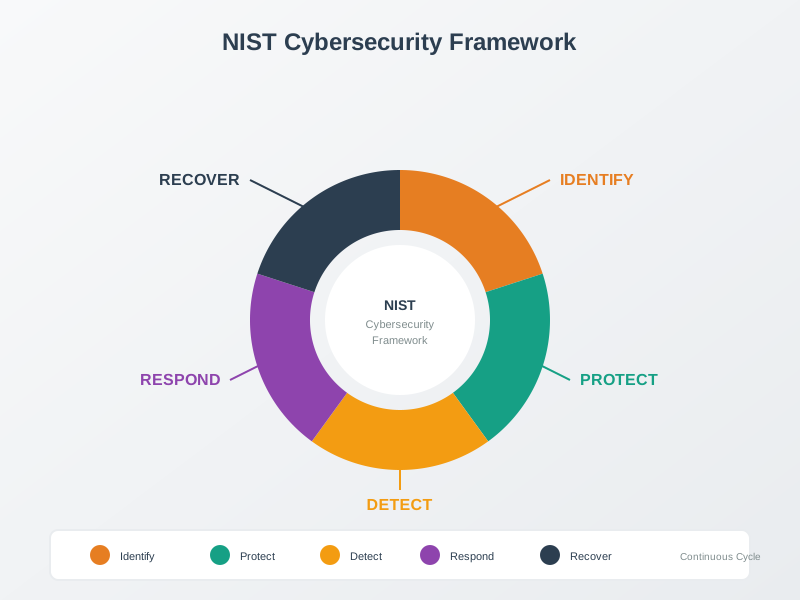
The NIST Framework provides a comprehensive approach to cybersecurity through five interconnected functions.
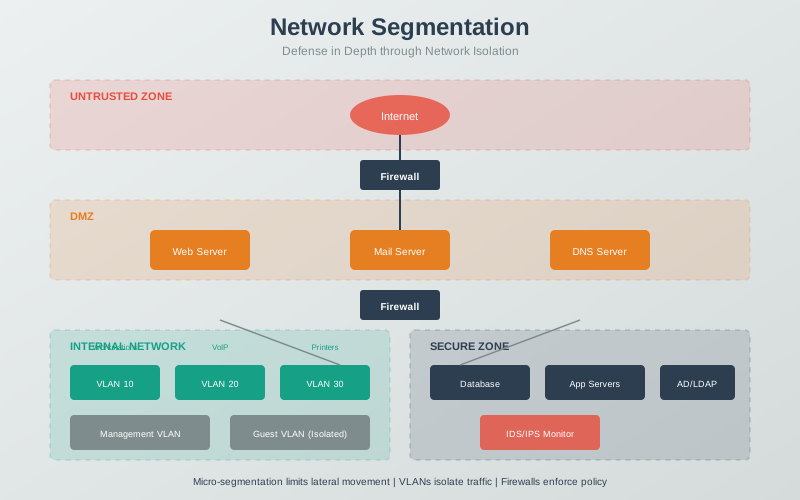
Network segmentation limits breach impact by isolating IoT devices into security zones.
1447.7 Summary
Comprehensive GDPR compliance for IoT requires:
Erasure (Article 17): - 30-day deadline from request receipt - Cascade notifications to all processors - Handle shared household data carefully - Document exemptions (legal retention) - Anonymize when deletion violates other laws
Privacy by Design (Article 25): - Privacy defaults at firmware level - Data minimization as default transmission mode - Consent stored in tamper-resistant secure elements - Purpose limitation through hard-coded flags - Hierarchical privacy levels based on consent
Key Compliance Principles: - Each vendor is an independent data controller - Technical controls must enforce privacy defaults - Audit trails demonstrate compliance - Anonymization acceptable when full deletion impossible
1447.8 What’s Next
With compliance and GDPR frameworks understood, continue your security journey by exploring IoT Devices and Network Security where you’ll learn to secure device architectures, implement secure boot, and establish device lifecycle management.
Continue to IoT Devices and Network Security
Security Foundations: - NIST Framework - Framework for organizing security - Security Controls - Technical implementation
Privacy: - Introduction to Privacy - Privacy fundamentals - Privacy by Design - Building privacy in
Device Security: - Device Security - Securing IoT devices - Secure Data - Data protection strategies
1447.9 Further Reading
- GDPR Official Text (EUR-Lex)
- EDPB Guidelines on Right to Erasure
- NIST SP 800-53: Security Controls
- ISO/IEC 27701: Privacy Information Management
- CNIL Guidelines for IoT Privacy