1450 IoT Devices and Network Security
1450.1 Device and Network Security Overview
This chapter provides a comprehensive guide to IoT device and network security. Due to the breadth of this topic, the content has been organized into focused sub-chapters for easier navigation and learning.
1450.2 Learning Objectives
By completing this chapter series, you will be able to:
- Identify IoT Security Challenges: Explain why IoT security differs from traditional computing (scale, resources, lifespan)
- Secure IoT Devices: Implement secure boot, firmware encryption, and tamper detection mechanisms
- Protect IoT Networks: Deploy firewalls, VPNs, and network segmentation for IoT infrastructure
- Manage Device Lifecycle: Apply security practices across provisioning, operation, update, and decommissioning
- Detect and Respond to Attacks: Identify common attack patterns and implement monitoring and response procedures
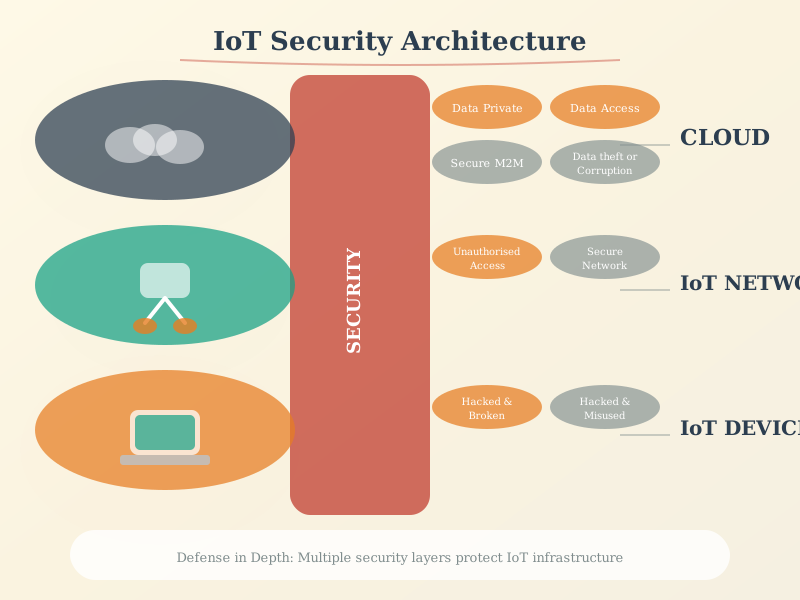
- Apply Defense in Depth: Layer multiple security controls to protect against single-point failures
1450.3 Chapter Organization
This comprehensive security guide is organized into the following focused chapters:
| Chapter | Topics Covered | Estimated Time |
|---|---|---|
| Security Fundamentals | Seven-layer model, Cisco requirements, architecture overview, beginner content | 20 min |
| Secure Boot and Firmware | Secure boot, firmware signing, key management, TPM, hardware root of trust | 25 min |
| OTA Updates | Over-the-air updates, code signing, rollback protection, update strategies | 20 min |
| Hardware Vulnerabilities | Hardware trojans, side-channel attacks, supply chain security, countermeasures | 25 min |
| Access Control | RBAC, ABAC, OAuth 2.0, IAM, identity management for IoT | 20 min |
| Network Segmentation | VLANs, firewall rules, micro-segmentation, worked examples | 25 min |
| Common Mistakes | Security pitfalls, real-world attacks, best practices, scenario analysis | 25 min |
| Intrusion Detection | IDS/IPS, signature vs anomaly detection, NIDS vs HIDS, deployment | 20 min |
| Hands-On Labs | Wokwi ESP32 labs for authentication and threat detection | 45 min |
| Visual Resources | AI-generated diagrams, encryption visuals, attack scenarios | Reference |
1450.4 Prerequisites
Before diving into these chapters, you should be familiar with:
- Security and Privacy Overview: Fundamental security concepts, threat actors, and attack surfaces
- Networking Basics: Network protocols, topologies, and communication models
- Encryption Principles and Crypto Basics: Cryptographic techniques (encryption, hashing, digital signatures)
- IoT Reference Models: IoT architecture layers
- Edge, Fog, and Cloud Computing: Distributed computing architectures
Core Concept: IoT security requires protecting both the device itself (secure boot, firmware signing, tamper detection) and the network it uses (encryption, firewalls, segmentation) because either can be the weak link. Why It Matters: IoT devices face unique challenges that traditional computers do not: limited CPU/memory for security, 10-20 year lifespans outlasting security standards, physical accessibility enabling hardware attacks, and massive scale where one vulnerability compromises millions. Key Takeaway: Apply defense in depth by layering multiple independent security controls so that breaching one protection does not compromise the entire system.
1450.6 What’s Next
Begin with Security Fundamentals to understand the seven-layer IoT security model and core concepts that underpin all subsequent chapters.
Continue to IoT Security Fundamentals →