%%{init: {'theme': 'base', 'themeVariables': { 'primaryColor': '#2C3E50', 'primaryTextColor': '#fff', 'primaryBorderColor': '#16A085', 'lineColor': '#16A085', 'secondaryColor': '#E67E22', 'tertiaryColor': '#7F8C8D', 'clusterBkg': '#f9f9f9', 'clusterBorder': '#2C3E50', 'edgeLabelBackground':'#ffffff'}}}%%
flowchart LR
    subgraph Symmetric["Symmetric Encryption (AES)"]
        direction TB
        A1[Alice & Bob<br/>Share Secret Key] --> A2[Alice Encrypts<br/>with Key]
        A2 --> A3[Bob Decrypts<br/>with Same Key]
        A4[Fast: 500 MB/s<br/>Problem: Key Distribution]
    end

    subgraph Asymmetric["Asymmetric Encryption (RSA)"]
        direction TB
        B1[Bob has Public Key<br/>& Private Key] --> B2[Alice Encrypts<br/>with Bob's Public Key]
        B2 --> B3[Bob Decrypts<br/>with Private Key]
        B4[Slow: 50 KB/s<br/>Solution: No Shared Secret]
    end

    subgraph Hybrid["IoT Hybrid Approach"]
        direction TB
        C1[RSA exchanges<br/>AES session key] --> C2[AES encrypts<br/>bulk data]
        C3[Best of Both Worlds]
    end

    style Symmetric fill:#16A085,stroke:#2C3E50,color:#fff
    style Asymmetric fill:#E67E22,stroke:#2C3E50,color:#fff
    style Hybrid fill:#2C3E50,stroke:#16A085,color:#fff
1442 Encryption Review: Symmetric vs Asymmetric Fundamentals
1442.1 Learning Objectives
By the end of this chapter, you will be able to:
- Compare Encryption Approaches: Understand the fundamental differences between symmetric and asymmetric encryption
- Select Appropriate Algorithms: Choose the right encryption type based on IoT system requirements
- Apply Hybrid Encryption: Combine symmetric and asymmetric methods for optimal security and performance
- Evaluate Performance Trade-offs: Balance encryption strength against computational and power constraints
1442.2 Prerequisites
Required Chapters: - Encryption Fundamentals - Core cryptographic concepts - Security Overview - Security landscape
Concepts You Should Know:
| Concept | Why It Matters |
|---|---|
| Symmetric encryption | Foundation of AES, DES |
| Asymmetric encryption | RSA, key exchange |
| Hash functions | Integrity verification |
Estimated Time: 20 minutes
1442.3 Encryption Approaches Compared
Understanding the fundamental difference between symmetric and asymmetric encryption is critical for IoT security design.
1442.3.1 Key Characteristics Comparison
| Feature | Symmetric (AES) | Asymmetric (RSA/ECC) |
|---|---|---|
| Keys | Single shared key | Public + Private key pair |
| Speed | 100-500 MB/s | 10-100 KB/s |
| Key Size | 128-256 bits | 2048-4096 bits (RSA) |
| Primary Use | Bulk data encryption | Key exchange, signatures |
| Challenge | Key distribution | Computational cost |
1442.3.2 When to Use Each Approach
Use Symmetric Encryption (AES) when: - Encrypting large amounts of data - Processing real-time sensor streams - Working with constrained devices - Both parties already share a key
Use Asymmetric Encryption (RSA/ECC) when: - Establishing new connections - Exchanging session keys - Creating digital signatures - Authenticating device identity
1442.4 IoT Encryption Selection Decision Tree
%%{init: {'theme': 'base', 'themeVariables': { 'primaryColor': '#2C3E50', 'primaryTextColor': '#fff', 'primaryBorderColor': '#16A085', 'lineColor': '#16A085', 'secondaryColor': '#E67E22', 'tertiaryColor': '#7F8C8D'}}}%%
flowchart TD
    Start[IoT Encryption<br/>Decision] --> Q1{Establishing<br/>New Connection?}

    Q1 -->|Yes| Asym[Use Asymmetric<br/>RSA/ECDH]
    Q1 -->|No, Existing Session| Sym[Use Symmetric<br/>AES-128/256]

    Asym --> Q2{Device<br/>Constraints?}
    Q2 -->|Low Power/Memory| ECC[ECC-256<br/>10x smaller keys]
    Q2 -->|Full Resources| RSA[RSA-2048<br/>Widely supported]

    ECC --> Exchange[Key Exchange<br/>50-100 KB/s]
    RSA --> Exchange

    Exchange --> Session[Session Key<br/>Established]

    Session --> Sym

    Sym --> Q3{Authentication<br/>Needed?}
    Q3 -->|Yes| GCM[AES-GCM<br/>Encrypt + Auth]
    Q3 -->|No| CBC[AES-CBC<br/>Encrypt only]

    GCM --> Data[Bulk Data<br/>100-500 MB/s]
    CBC --> Data

    style Asym fill:#E67E22,stroke:#2C3E50,color:#fff
    style Sym fill:#16A085,stroke:#2C3E50,color:#fff
    style ECC fill:#E67E22,stroke:#2C3E50,color:#fff
    style RSA fill:#E67E22,stroke:#2C3E50,color:#fff
    style GCM fill:#16A085,stroke:#2C3E50,color:#fff
    style CBC fill:#16A085,stroke:#2C3E50,color:#fff
1442.5 Hybrid Encryption in Practice
Modern IoT systems combine both approaches for optimal security and performance:
1. Key Exchange Phase (Asymmetric - RSA/ECDH):
   Device → Cloud: "Here's my public key"
   Cloud → Device: AES session key encrypted with device's public key

2. Data Transfer Phase (Symmetric - AES):
   Device → Cloud: Sensor data encrypted with AES session key
   Cloud → Device: Commands encrypted with AES session key
TipFor Beginners: Why Not Just Use One Type?
Why not always use Asymmetric (RSA)? - Too slow! RSA can only encrypt about 50 KB per second - A temperature sensor sending data every second would overwhelm the processor - Battery would drain quickly on constrained devices
Why not always use Symmetric (AES)? - The “key distribution problem” - how do you share the secret key securely? - If you send the key over the network, anyone watching can steal it! - This is like trying to send a house key through the mail
The Hybrid Solution: - Use RSA once to securely exchange the AES key - Use AES for all actual data (10,000x faster) - Like using a secure courier once to deliver a house key, then using the key forever
1442.6 Performance Considerations for IoT
1442.6.1 AES Key Length Trade-offs
| AES Version | Key Size | Rounds | Speed (ESP32) | Power Draw |
|---|---|---|---|---|
| AES-128 | 128 bits | 10 | 1.2 MB/s | 18 mA |
| AES-192 | 192 bits | 12 | 1.0 MB/s | 20 mA |
| AES-256 | 256 bits | 14 | 0.9 MB/s | 24 mA |
Key Insight: AES-128 remains secure for most IoT deployments (battery-powered sensors). Use AES-256 for long-lived critical infrastructure (30+ year deployments) or regulatory requirements.
1442.6.2 ECC vs RSA for Constrained Devices
| Algorithm | Key Size | Security Equivalent | Handshake Time (Cortex-M4) |
|---|---|---|---|
| ECC-256 | 256 bits | RSA-3072 | 180 ms |
| RSA-2048 | 2048 bits | ECC-224 | 350 ms |
| RSA-4096 | 4096 bits | ECC-384 | 2,800 ms |
Recommendation: Use ECC (Elliptic Curve Cryptography) for IoT devices. It provides equivalent security with 10x smaller keys and faster operations.
1442.7 Block Cipher Modes
AES is a block cipher that encrypts 128-bit blocks. The mode determines how multiple blocks are processed:
| Mode | Security | Parallelizable | Authentication | IoT Use Case |
|---|---|---|---|---|
| ECB | Weak | Yes | No | NEVER use |
| CBC | Good | Decrypt only | No | Legacy systems |
| CTR | Good | Yes | No | Stream data |
| GCM | Best | Yes | Yes | Recommended |
WarningNever Use ECB Mode
ECB (Electronic Codebook) mode encrypts each block independently. Identical plaintext blocks produce identical ciphertext blocks, revealing patterns in your data. This is a critical security flaw.
Example: Temperature readings of “22.5C” will always encrypt to the same ciphertext, allowing attackers to identify when temperatures match without decrypting.
1442.8 Visual Reference Gallery
NoteVisual: Symmetric Encryption Block Operations
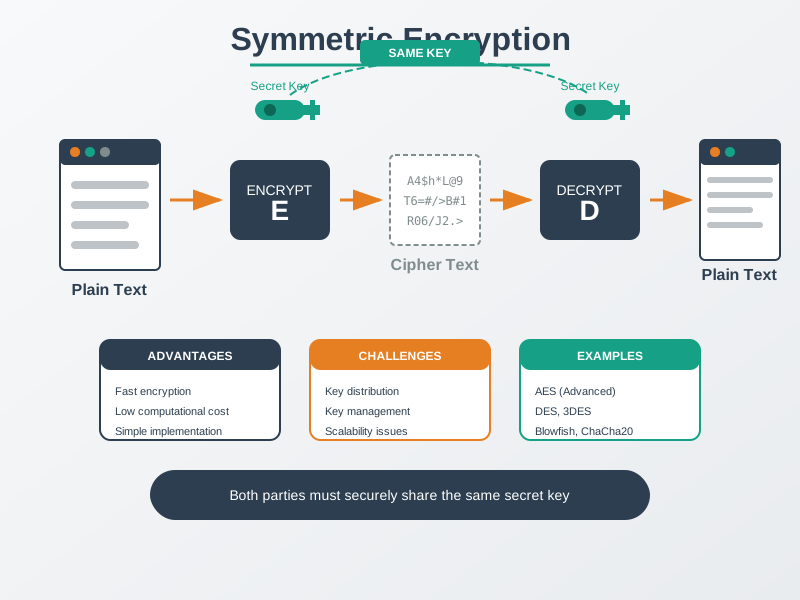
Symmetric encryption provides efficient bulk data protection through shared secret keys, with AES achieving hardware-accelerated performance on constrained IoT devices.
NoteVisual: Asymmetric Encryption Key Pairs
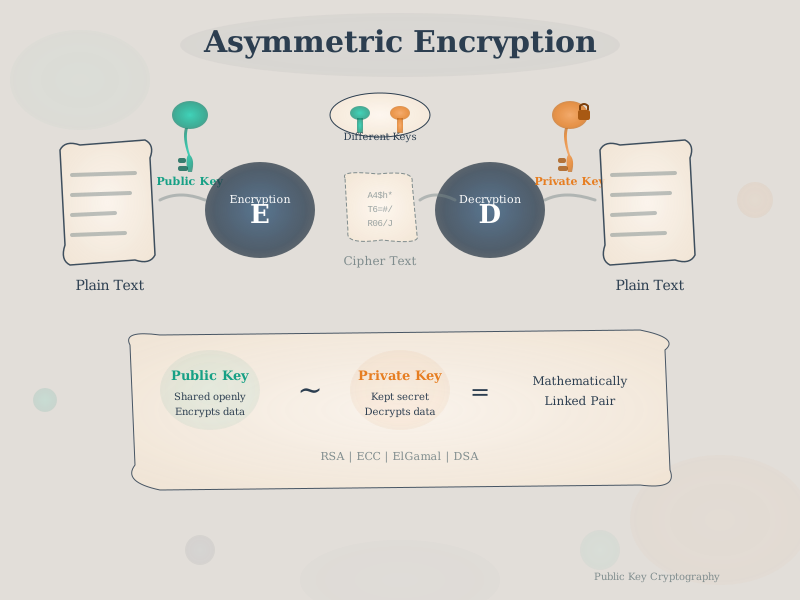
Asymmetric cryptography solves the key distribution problem, enabling secure communication between parties who have never exchanged secrets, fundamental to PKI and certificate-based IoT authentication.
1442.9 Summary
Symmetric vs Asymmetric: - Symmetric (AES): Fast, efficient, single shared key - use for bulk data - Asymmetric (RSA/ECC): Slower, key pairs - use for key exchange and signatures - Hybrid: Combine both for optimal security and performance
Selection Guidelines: - New connection → Asymmetric key exchange - Constrained device → ECC over RSA - Bulk data → Symmetric AES - Need authentication → Use GCM mode
Performance Rules: - AES-128 sufficient for most IoT (10+ year security) - ECC-256 equivalent to RSA-3072 with 10x smaller keys - Never use ECB mode - reveals data patterns
NoteKey Concepts
- Hybrid Encryption: Combining asymmetric key exchange with symmetric data encryption
- ECC (Elliptic Curve Cryptography): Smaller keys with equivalent security to RSA
- AES-GCM: Authenticated encryption providing confidentiality and integrity
- Block Cipher Modes: Different approaches to encrypting multiple blocks (ECB, CBC, CTR, GCM)
1442.10 What’s Next
Now that you understand the fundamental encryption approaches, continue to Multi-Layer Encryption Architecture where you’ll learn about the five-layer E1-E5 encryption model, implementing defense-in-depth security from device to cloud, and hands-on lab exercises for building complete encryption stacks.
Continue to Multi-Layer Encryption Architecture →
1442.11 See Also
- Encryption Fundamentals - Core cryptographic concepts
- Encryption Architecture - E1-E5 layer details
- Security Overview - Broader security context