%%{init: {'theme': 'base', 'themeVariables': {'primaryColor': '#2C3E50', 'primaryTextColor': '#fff', 'primaryBorderColor': '#16A085', 'lineColor': '#16A085', 'secondaryColor': '#E67E22'}}}%%
flowchart LR
    subgraph Node1["Sensor Node A"]
        Data1[Sensor Reading]
        Key1[Shared Network Key<br/>AES-128]
        Enc1[Encrypt at<br/>Link Layer]
    end

    subgraph Network["Wireless Network"]
        Packet[Encrypted Packet]
    end

    subgraph Node2["Router/Gateway"]
        Dec2[Decrypt at<br/>Link Layer]
        Key2[Shared Network Key<br/>AES-128]
        Data2[Sensor Reading]
    end

    Attacker[External Device<br/>No Key]

    Data1 --> Enc1
    Key1 -.-> Enc1
    Enc1 --> Packet
    Packet --> Dec2
    Key2 -.-> Dec2
    Dec2 --> Data2
    Packet -.->|Blocked| Attacker

    style Node1 fill:#2C3E50,stroke:#16A085,stroke-width:2px,color:#fff
    style Node2 fill:#2C3E50,stroke:#16A085,stroke-width:2px,color:#fff
    style Network fill:#E67E22,stroke:#2C3E50,stroke-width:2px,color:#fff
    style Attacker fill:#E74C3C,stroke:#2C3E50,stroke-width:2px,color:#fff
1436 E1: Link Layer Encryption
1436.1 Learning Objectives
By the end of this chapter, you will be able to:
- Understand E1 Link Layer Encryption: Explain how device-to-device encryption protects local wireless communications
- Implement AES-CCM for IoT: Configure AES-128-CCM authenticated encryption for constrained devices
- Recognize Shared Key Vulnerabilities: Identify the blast radius of shared network key compromise
- Select Appropriate Security Levels: Choose IEEE 802.15.4 security levels based on application requirements
1436.2 Introduction to E1 Link Layer Encryption
E1 (Link Layer) encryption protects device-to-device communications at the MAC layer, preventing external devices from joining the network and reading packet contents.
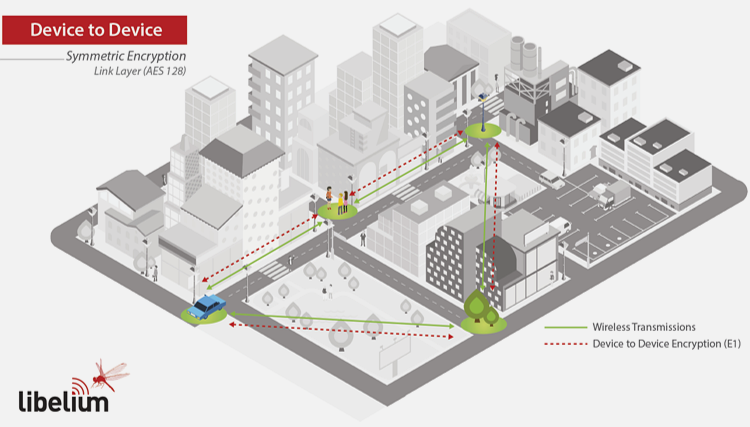
Purpose: Prevent external devices from joining the network and watching packet contents.
Characteristics:
- All nodes share a common pre-shared key
- Implemented at the link layer (MAC)
- AES-128 encryption
- Hardware-accelerated in radio chipset
- Ensures privacy and confidentiality
WarningShared Key Vulnerability
E1 uses a single shared key for all devices—if any one device is compromised, the attacker can decrypt all network traffic. Never rely on E1 alone for security. Always combine with E2 (device-specific keys) to provide defense-in-depth. If a node is compromised, it can only read its own data, not the entire network’s communications.
1436.3 Common Misconception: “E1 Link Layer Encryption is Enough”
WarningWhy E1 Alone Fails
Misconception: “If my Zigbee network uses AES-128 encryption (E1), my IoT devices are secure and I don’t need additional encryption layers.”
Why This Fails: E1 often relies on a shared network key across many devices. If an attacker recovers that key from one compromised device (e.g., physical access, debug interface, or insecure commissioning), the consequences can scale to the whole network:
- Passive decryption: previously captured traffic becomes readable
- Impersonation risk: any device holding the shared key can mimic another device
- Large blast radius: one device compromise can expose many devices’ traffic
| Vulnerability | Impact | Mitigation |
|---|---|---|
| Shared Key Extraction | Any single device compromise exposes all traffic | Add E2 (unique per-device keys) |
| No Device Authentication | Cannot verify which device sent data | Add E2 (device signatures) |
| Passive Eavesdropping | Attacker with key can silently monitor forever | Add E3 (end-to-end encryption) |
| Insider Threat | Gateway operator can read all device data | Add E3 (encrypt beyond gateway) |
Correct Approach: Defense in Depth
Modern IoT security requires layered encryption:
- E1 (Link): Prevents casual eavesdropping and unauthorized network access
- E2 (Device-Gateway): Unique keys per device—compromise of one doesn’t expose others
- E3 (Device-Cloud): End-to-end protection even through untrusted gateways
- E5 (Key Renewal): Periodic key rotation limits damage from past compromises
Minimum Security Standard: Always combine E1 + E2, or use E1 + E3 if gateways are untrusted. Single-layer encryption is a single point of failure.
1436.4 E1 Implementation Details
Algorithm: AES-128 in CCM (Counter with CBC-MAC) mode
Key Characteristics:
| Aspect | Details |
|---|---|
| Key Size | 128 bits (16 bytes) - shared across all network nodes |
| Cipher Mode | CCM (Cipher Block Chaining with MAC) with random IV per packet |
| Hardware Support | Implemented in radio chipset (802.15.4, Zigbee, BLE) |
| Performance | ~20 us encryption time per packet on dedicated hardware |
| Energy Cost | Minimal - hardware acceleration reduces CPU overhead |
Security Properties:
- Confidentiality: External devices cannot read packet contents
- Energy Efficient: Hardware implementation preserves battery life
- Single Point of Failure: Compromise of shared key exposes all traffic
- No Authentication: Any device with key can impersonate others
Real-World Protocol Examples:
- Zigbee: AES-128-CCM at MAC layer (IEEE 802.15.4)
- Bluetooth LE: AES-128-CCM for link encryption
- Thread: AES-128-CCM with network-wide key
- LoRaWAN: AES-128 for network session key (NwkSKey)
1436.5 Deep Dive: AES-CCM Implementation for IoT
NoteAES-CCM Technical Details
AES-CCM (Counter with CBC-MAC) is the dominant authenticated encryption mode for constrained IoT devices. Understanding its internals helps optimize implementation.
AES-CCM Structure:
+-------------------------------------------------------------+
|                     AES-CCM Packet                          |
+----------+---------------------------+----------------------+
|  Nonce   |      Encrypted Payload    |    Auth Tag (MAC)    |
| 13 bytes |       Variable length     |       4-16 bytes     |
+----------+---------------------------+----------------------+

Nonce = [Flags(1)] + [Source Address(8)] + [Frame Counter(4)]
Implementation in C (for microcontrollers):
#include <aes.h>

// AES-CCM encryption for IoT packet
typedef struct {
    uint8_t nonce[13];
    uint8_t *payload;
    uint16_t payload_len;
    uint8_t *aad;        // Additional Authenticated Data (headers)
    uint16_t aad_len;
    uint8_t tag[8];      // 64-bit authentication tag for IoT
} ccm_packet_t;

int aes_ccm_encrypt(ccm_packet_t *pkt, const uint8_t key[16]) {
    // Step 1: Generate CBC-MAC for authentication
    uint8_t cbc_state[16] = {0};

    // Format B0 block (first block for CBC-MAC)
    cbc_state[0] = 0x49;  // Flags: Adata=1, M=3 (8-byte tag), L=2
    memcpy(&cbc_state[1], pkt->nonce, 13);
    cbc_state[14] = (pkt->payload_len >> 8) & 0xFF;
    cbc_state[15] = pkt->payload_len & 0xFF;

    // Encrypt B0 to start CBC chain
    aes_encrypt(cbc_state, key);

    // Process AAD (headers authenticated but not encrypted)
    process_aad(cbc_state, pkt->aad, pkt->aad_len, key);

    // Process payload through CBC-MAC
    for (int i = 0; i < pkt->payload_len; i += 16) {
        xor_block(cbc_state, &pkt->payload[i], MIN(16, pkt->payload_len - i));
        aes_encrypt(cbc_state, key);
    }

    // Step 2: CTR mode encryption
    uint8_t counter[16] = {0};
    counter[0] = 0x01;  // L=2 flag
    memcpy(&counter[1], pkt->nonce, 13);

    // Encrypt authentication tag with A0
    aes_encrypt(counter, key);
    xor_block(pkt->tag, cbc_state, 8);  // Extract 8-byte tag

    // Encrypt payload with A1, A2, ...
    for (int i = 0; i < pkt->payload_len; i += 16) {
        increment_counter(counter);
        uint8_t keystream[16];
        memcpy(keystream, counter, 16);
        aes_encrypt(keystream, key);
        xor_block(&pkt->payload[i], keystream, MIN(16, pkt->payload_len - i));
    }

    return 0;
}
Performance on common IoT platforms:
| Platform | Clock | AES-CCM (64B) | Energy/Packet |
|---|---|---|---|
| ESP32 (HW) | 240 MHz | 15 us | 0.9 uJ |
| nRF52840 (HW) | 64 MHz | 21 us | 0.5 uJ |
| STM32L4 (SW) | 80 MHz | 180 us | 3.6 uJ |
| ATmega328P (SW) | 16 MHz | 2.5 ms | 75 uJ |
Nonce management (critical for security):
// WRONG: Reusing nonces breaks CCM security completely
static uint8_t nonce[13];  // Don't do this!

// RIGHT: Unique nonce per packet
typedef struct {
    uint64_t source_addr;  // 8 bytes: unique per device
    uint32_t frame_counter; // 4 bytes: increment each packet
    uint8_t security_level; // 1 byte: constant
} nonce_t;

void generate_nonce(nonce_t *n, uint64_t device_id, uint32_t *counter) {
    n->source_addr = device_id;
    n->frame_counter = (*counter)++;  // NEVER reuse!
    n->security_level = 0x05;  // ENC-MIC-32
}
Security level options (IEEE 802.15.4):
| Level | Auth Tag | Encryption | Overhead | Use Case |
|---|---|---|---|---|
| 0x00 | None | None | 0 B | No security |
| 0x01 | 4 B | None | 5 B | Integrity only |
| 0x05 | 4 B | Yes | 9 B | Standard IoT |
| 0x06 | 8 B | Yes | 13 B | Enhanced security |
| 0x07 | 16 B | Yes | 21 B | Maximum security |
Recommendation: Use security level 0x05 (4-byte tag) for constrained devices, 0x06 (8-byte tag) for gateways and critical applications.
1436.6 AES-128 vs AES-256 for IoT
WarningCommon Misconception: “AES-256 is Always Better Than AES-128”
The Misconception: Longer keys are always more secure, so use AES-256 everywhere.
Why It’s Wrong:
- AES-128 provides 128-bit security (unbreakable with current technology)
- AES-256 key expansion is 40% slower
- More rounds = more power consumption
- Brute-forcing 2^128 keys would take billions of years
- For IoT, the key exchange is usually the weak point, not AES
Real-World Example:
- Sensor node with AES hardware accelerator
- AES-128 encryption: 0.5ms, 0.1mJ per block
- AES-256 encryption: 0.7ms, 0.14mJ per block
- 1000 messages/day: 100mJ vs 140mJ = 40% more energy
- Security improvement: Negligible (both practically unbreakable)
The Correct Understanding:
| Key Size | Security Level | Speed | Use Case |
|---|---|---|---|
| AES-128 | 128-bit (sufficient) | Faster | IoT, consumer |
| AES-192 | 192-bit | Medium | Rare use |
| AES-256 | 256-bit | Slower | Government, quantum-proofing |
AES-128 is secure. Use AES-256 only if regulations require it or for future quantum protection.
1436.7 Key Exchange Tradeoffs
WarningTradeoff: RSA vs ECC for IoT Key Exchange
Option A (RSA-2048/3072): Widely supported by legacy systems and cloud providers, RSA-2048 signature verification: 0.5ms on Cortex-M4 (hardware) / 50-100ms (software), key generation: 2-30 seconds on constrained MCU, key size: 256-384 bytes (public key), proven 40+ year cryptanalysis history, quantum-vulnerable (requires 4096+ bits for 2030+ security).
Option B (ECC P-256/P-384): 32-byte public key (8x smaller than RSA-2048), ECDSA signature verification: 50-100ms on Cortex-M4 without hardware acceleration, ECDH key agreement: 100-200ms software / 5-10ms with hardware, equivalent security to RSA-3072 with 256-bit ECC, newer algorithm with less cryptanalysis history, quantum-vulnerable but smaller impact on key sizes.
Decision Factors: Choose RSA when: interoperating with legacy enterprise systems (older TLS servers, PKCS#11 HSMs), hardware has dedicated RSA accelerator, certificates must be validated by existing PKI infrastructure, regulatory compliance mandates specific RSA key sizes. Choose ECC when: bandwidth-constrained networks (LoRaWAN payload limit: 51-222 bytes), battery-powered devices (ECC uses 10-20x less energy per operation), storage-constrained MCUs (<64KB flash), modern cloud IoT platforms (AWS IoT, Azure IoT Hub natively support ECC), TLS 1.3 deployments (prefers ECDHE).
WarningTradeoff: Pre-Shared Keys (PSK) vs Certificate-Based Authentication
Option A (Pre-Shared Keys): Symmetric 128-256 bit keys provisioned during manufacturing, DTLS-PSK handshake: 2 round trips (vs 4 for certificates), minimal flash footprint (~2KB for PSK stack), key per device: requires secure provisioning infrastructure, compromised device key doesn’t expose fleet (if unique per device), no certificate expiration management, vulnerable to key extraction via physical access.
Option B (Certificate-Based/PKI): X.509 certificates with RSA-2048 or ECC P-256 keys, device certificate: 500-1500 bytes storage, full TLS/DTLS handshake: 4-6 round trips (1-3 seconds on constrained devices), supports certificate revocation (CRL/OCSP), device identity verifiable by any party with CA trust, certificate expiration requires renewal infrastructure (5-10 year validity typical for IoT), enables mutual TLS (mTLS) for zero-trust architectures.
Decision Factors: Choose PSK when: ultra-constrained devices (<32KB RAM), minimizing handshake latency critical (industrial control <100ms), devices never communicate with third parties, closed ecosystem with controlled provisioning, battery life prioritized over security flexibility. Choose certificates when: devices must authenticate to multiple cloud backends, regulatory compliance requires audit trail of device identity, fleet spans multiple organizations or trust domains, zero-trust architecture mandates mutual authentication, devices have >64KB RAM and hardware crypto acceleration, certificate lifecycle management infrastructure exists.
1436.8 Summary
This chapter covered E1 link layer encryption:
- E1 Purpose: Prevents external devices from joining the network and reading packet contents using AES-128 with shared network keys
- AES-CCM: The dominant authenticated encryption mode for constrained IoT, providing both confidentiality and integrity
- Shared Key Vulnerability: A single compromised device exposes all network traffic—never rely on E1 alone
- Performance: Hardware-accelerated AES-128-CCM is extremely efficient (~15-21 us per packet on modern IoT SoCs)
- Security Levels: IEEE 802.15.4 offers configurable security from integrity-only (4B tag) to maximum security (16B tag)
1436.9 Knowledge Check
Knowledge Check: E1 Link Layer Encryption Quick Check
Concept: Understanding E1 shared key vulnerabilities and defense-in-depth requirements.
Why is E1 link layer encryption alone insufficient for IoT security?
B is correct. E1 typically uses a shared key across all network devices. If an attacker extracts this key from any single device (via physical access, debug interfaces, or insecure provisioning), they can decrypt ALL network traffic from every device. This “blast radius” problem is why defense-in-depth with E2 (per-device keys) is essential.
1436.10 What’s Next
Continue to E2: Device-to-Gateway Encryption to learn how unique per-device keys provide authentication and prevent intermediate nodes from reading data, addressing the shared key vulnerability of E1.
NoteRelated Chapters
- Encryption Architecture Overview - Five-layer encryption framework
- E2: Device-to-Gateway - Per-device keys and replay protection
- Encryption Principles - Cryptographic fundamentals
- IoT Devices and Network Security - Network-level security