%%{init: {'theme': 'base', 'themeVariables': {'primaryColor': '#E8F4F8', 'primaryTextColor': '#2C3E50', 'primaryBorderColor': '#16A085', 'lineColor': '#16A085', 'secondaryColor': '#FFF5E6', 'tertiaryColor': '#F0F0F0', 'noteTextColor': '#2C3E50', 'noteBkgColor': '#FFF5E6', 'textColor': '#2C3E50', 'fontSize': '16px'}}}%%
flowchart LR
    subgraph Reader["📡 RFID READER"]
        R1["RF Transmitter"]
        R2["Receiver"]
        R3["Decoder"]
        R4["Processor"]
    end

    subgraph Field["🌊 ELECTROMAGNETIC FIELD"]
        F1["13.56 MHz<br/>(HF example)"]
        F2["Energy Transfer"]
    end

    subgraph Tag["🏷️ RFID TAG"]
        T1["Antenna<br/>(coil)"]
        T2["Chip<br/>(IC)"]
        T3["Memory<br/>(ID data)"]
    end

    R1 -->|Emits RF| F1
    F1 -->|Powers| T1
    T1 --> T2
    T2 --> T3
    T3 -->|Modulates| T1
    T1 -->|Backscatter| F2
    F2 -->|Signal| R2
    R2 --> R3
    R3 --> R4
    R4 -->|Tag ID| Output["💻 System<br/>(Database)"]

    style Reader fill:#E8F4F8,stroke:#16A085,stroke-width:3px
    style Field fill:#FFF5E6,stroke:#E67E22,stroke-width:3px
    style Tag fill:#F8E8E8,stroke:#2C3E50,stroke-width:3px
860 RFID Fundamentals and Operation
860.1 What is RFID?
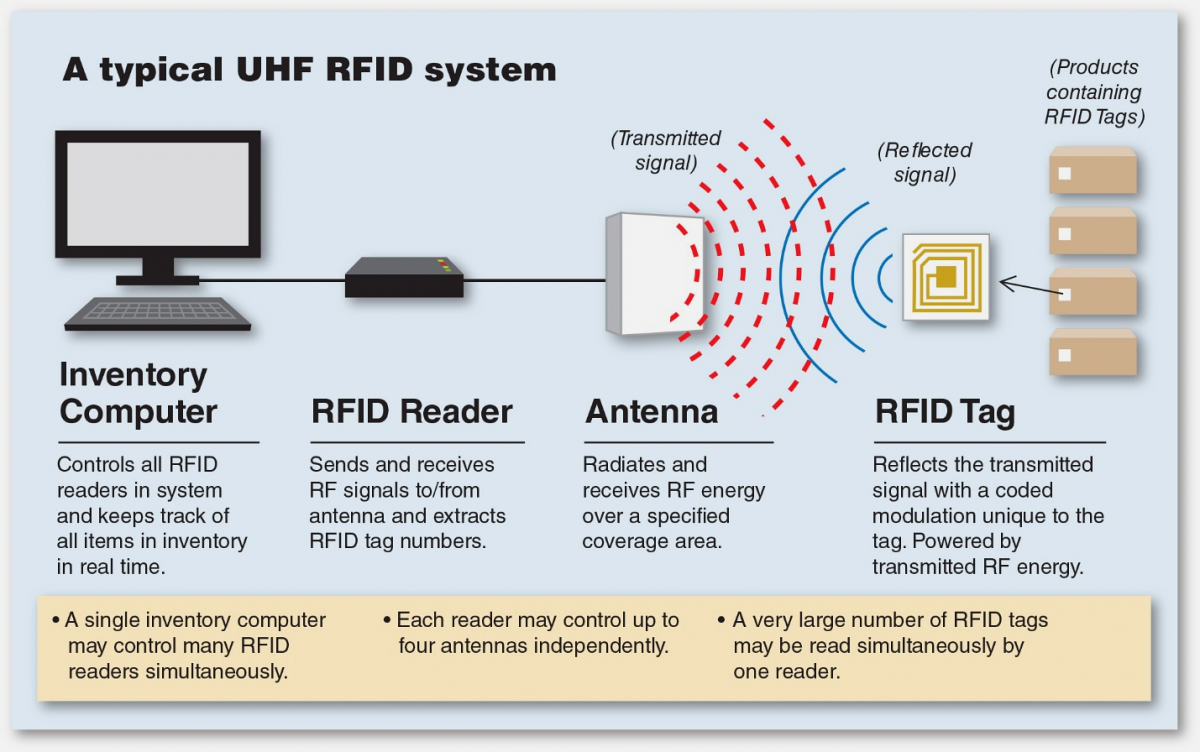
RFID (Radio Frequency Identification) is a wireless technology that uses radio waves to automatically identify and track objects, animals, or people. An RFID system consists of two main components: tags (attached to objects) and readers (that interrogate tags).
Key Characteristics:
- Contactless: No physical contact or line-of-sight required
- Automatic: Identification happens without human intervention
- Simultaneous: Can read multiple tags at once (anti-collision)
- Durable: Tags can withstand harsh environments
- Range: From centimeters to tens of meters depending on frequency
- No Power Needed: Passive tags powered by reader’s electromagnetic field
860.2 Historical Context
| Year | Milestone |
|---|---|
| 1945 | Léon Theremin invents “The Thing” - first espionage RFID device |
| 1973 | Charles Walton patents first modern RFID device |
| 1990s | Walmart pioneers RFID for supply chain management |
| 2000s | RFID becomes mainstream in logistics, retail, access control |
| 2010s | Explosion in IoT integrates RFID with cloud and mobile |
| 2020s | Chipless RFID, blockchain integration, ubiquitous deployment |
NoteVideo: How RFID Works
NoteVideo: RFID and NFC in Real World
860.3 How RFID Works
860.3.1 Basic Operating Principle
Step-by-Step:
- Reader emits RF signal: Creates electromagnetic field
- Tag harvests energy: Passive tag powered by field (or uses battery for active)
- Tag responds: Modulates reader’s signal with its unique ID
- Reader decodes: Extracts tag ID and any stored data
- Action taken: System logs, triggers, or processes the identification
NoteAcademic Reference: HF RFID System Architecture (IIT Kharagpur NPTEL)
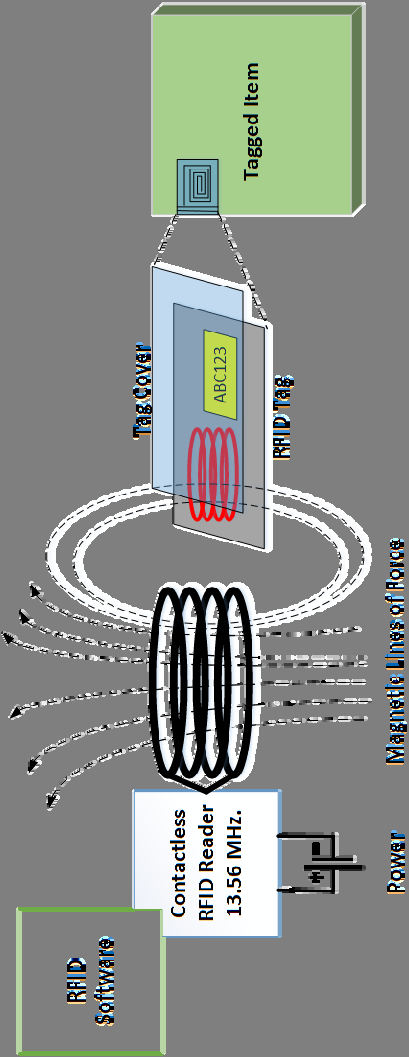
Source: IIT Kharagpur - NPTEL Introduction to Internet of Things
This academic diagram illustrates the inductive coupling principle used in HF RFID systems:
- Magnetic field lines (shown as elliptical curves) emanate from the reader’s antenna coil
- The tag’s coil antenna intercepts these field lines, inducing a current that powers the tag
- At 13.56 MHz, this near-field magnetic coupling provides reliable communication up to ~1 meter
- The tag modulates the field by changing its antenna impedance (load modulation), allowing data transmission back to the reader