%% fig-cap: "Electromagnetic wave properties showing the inverse relationship between frequency and wavelength"
%% fig-alt: "Diagram illustrating electromagnetic wave characteristics with frequency measured in Hertz (cycles per second), wavelength measured in meters (distance between peaks), and the speed of light equation c = f × λ showing higher frequency corresponds to shorter wavelength and higher energy"
%%{init: {'theme': 'base', 'themeVariables': { 'primaryColor': '#2C3E50', 'primaryTextColor': '#2C3E50', 'primaryBorderColor': '#16A085', 'lineColor': '#16A085', 'secondaryColor': '#E67E22', 'tertiaryColor': '#ECF0F1', 'noteTextColor': '#2C3E50', 'noteBkgColor': '#ECF0F1'}}}%%
graph LR
    A["Electromagnetic Wave"] --> B["Frequency (f)<br/>Cycles per second<br/>Unit: Hertz (Hz)"]
    A --> C["Wavelength (λ)<br/>Distance between peaks<br/>Unit: meters (m)"]
    A --> D["Energy (E)<br/>Wave energy<br/>E = h × f"]

    B --> E["Higher Frequency<br/>2.4 GHz, 5 GHz<br/>More cycles/sec"]
    B --> F["Lower Frequency<br/>868 MHz, 433 MHz<br/>Fewer cycles/sec"]

    E --> G["Shorter Wavelength<br/>12.5 cm at 2.4 GHz<br/>Higher Energy"]
    F --> H["Longer Wavelength<br/>34.5 cm at 868 MHz<br/>Lower Energy"]

    style A fill:#2C3E50,stroke:#16A085,stroke-width:3px,color:#fff
    style E fill:#E67E22,stroke:#16A085,stroke-width:2px
    style F fill:#16A085,stroke:#2C3E50,stroke-width:2px,color:#fff
    style G fill:#E67E22,stroke:#16A085,stroke-width:2px
    style H fill:#16A085,stroke:#2C3E50,stroke-width:2px,color:#fff
812 Electromagnetic Waves and Spectrum Basics
812.1 Introduction
Wireless connectivity is often where IoT deployments succeed or fail—not because a protocol is “good” or “bad,” but because frequency band choice, propagation, regulations, and power budgets were misunderstood. This chapter focuses on the fundamental physics of electromagnetic waves that underpin all wireless communication.
NoteLearning Objectives
By the end of this chapter, you will be able to:
- Explain the fundamental properties of electromagnetic waves (frequency, wavelength, energy)
- Compute wavelength from frequency using the wave equation
- Describe how the electromagnetic spectrum is organized for wireless communication
- Identify where common IoT technologies operate within the radio frequency spectrum
- Understand the relationship between frequency and wavelength for antenna design
812.2 Prerequisites
Before diving into this chapter, you should be familiar with:
- Mobile Wireless Technologies Basics: Refresher on waves, spectrum, and where common IoT technologies sit
- Networking Basics for IoT: Understanding of basic networking concepts
- Basic physics concepts: Familiarity with waves, frequency, and electromagnetic concepts
NoteRelated Chapters
Next in Series: - IoT Frequency Bands and Licensing - 2.4 GHz, 5 GHz, and sub-GHz bands - Cellular Spectrum for IoT - LTE-M, NB-IoT, and 5G - Propagation and Design - Path loss, interference, band selection
Deep Dives: - Mobile Wireless Comprehensive Review - Cellular evolution and IoT technologies - Mobile Wireless Labs - Spectrum analysis and RF measurements
Specific Technologies: - Wi-Fi Fundamentals - 2.4 GHz and 5 GHz wireless networking - Bluetooth Overview - Short-range 2.4 GHz communication - LoRaWAN Overview - Sub-GHz long-range LPWAN
NoteKey Takeaway
In one sentence: All wireless communication relies on electromagnetic waves, where frequency determines range, bandwidth, and penetration characteristics.
Remember this: Lower frequencies travel farther and penetrate better; higher frequencies carry more data but over shorter distances.
TipFor Beginners: Electromagnetic Waves
When you use your smartphone, smartwatch, or wireless earbuds, you’re leveraging multiple wireless technologies simultaneously—cellular for internet, Wi-Fi for local networks, Bluetooth for accessories, NFC for payments. But how does wireless communication actually work at a fundamental level?
The Physics: All wireless technologies use electromagnetic waves—the same phenomenon that brings you radio broadcasts, TV signals, and even sunlight. These waves travel at the speed of light and don’t need any physical medium (unlike sound waves that need air). When your IoT sensor sends data, it converts digital bits into electromagnetic waves that ripple through space until a receiver detects and decodes them.
Frequency Matters: Different wireless technologies use different frequencies (measured in Hertz). Think of frequency like the pitch of a musical note—high frequencies carry more information but don’t travel as far through walls and obstacles. 2.4 GHz Wi-Fi is like a high-pitched note—fast but blocked by walls. Sub-GHz LoRa is like a deep bass note—travels far and penetrates walls but carries less information.
| Term | Simple Explanation |
|---|---|
| Electromagnetic Wave | Energy wave traveling through space carrying information |
| Frequency | Wave cycles per second (Hertz)—determines range/bandwidth trade-off |
| Wavelength | Physical distance between wave peaks—inversely related to frequency |
| Modulation | Encoding digital data onto electromagnetic waves |
TipFor Kids: Meet the Sensor Squad!
Wireless signals are like invisible messengers flying through the air to deliver important information!
812.2.1 The Sensor Squad Adventure: The Great Frequency Race
Sammy the Temperature Sensor had a big problem. He needed to send a message to his friend Max the Motion Detector, who was way across the farm watching the chicken coop. But how could he send a message without any wires?
“I know!” said Lila the Light Sensor. “We can use radio waves! They’re like invisible runners that carry our messages through the air.”
Bella the Button explained, “But here’s the tricky part - we have different types of runners. Some run FAST but get tired quickly and can’t go very far. Others run SLOW but can go really, really far without getting tired!”
Sammy was confused. “Which runner should I use?”
Lila drew a picture in the dirt. “The fast runners are like high-pitched sounds - they carry LOTS of information but stop when they hit a wall. The slow runners are like deep bass sounds - they carry less information but can go through walls and travel for miles!”
So Sammy chose a slow, steady runner (a sub-GHz wave) to send his simple message: “Temperature: 72 degrees - chickens are happy!” The message traveled all the way across the farm, through the barn walls, and reached Max perfectly!
812.2.2 Key Words for Kids
| Word | What It Means |
|---|---|
| Radio Waves | Invisible energy that carries messages through the air, like invisible runners |
| Frequency | How fast the wave wiggles - high frequency is like running fast, low frequency is like walking slowly |
| Wavelength | How long each “step” of the wave is - fast runners take tiny steps, slow runners take big steps |
812.2.3 Try This at Home!
The Sound Distance Experiment
- Go to one end of your house with a friend at the other end
- First, try making a HIGH sound (like “eeee!”) - can your friend hear it clearly?
- Now try making a LOW sound (like “oooom”) - can your friend hear this one better?
- Try it with a door closed between you - which sound travels through better?
The LOW sounds usually travel farther and go through doors better - just like low-frequency radio waves travel farther and go through walls better!
812.3 Fundamentals of Wireless Communication
812.3.1 Electromagnetic Waves
Wireless technologies use electromagnetic waves to carry information between devices. Unlike sound waves or water waves, electromagnetic waves (also called electromagnetic radiation) travel through space-time—they don’t need a medium like water or air to propagate. This property makes them ideal for wireless communication across various distances and environments.
Electromagnetic waves carry electromagnetic radiant energy and exhibit properties of both waves and particles. For wireless communication, we focus on their wave properties:
- Frequency (f): The number of wave cycles per second, measured in Hertz (Hz)
- Wavelength (λ): The physical distance between wave peaks, measured in meters
- Energy (E): The energy carried by the wave, related to frequency
TipAlternative View: Frequency Trade-offs as Decision Matrix
This variant shows the same frequency-wavelength relationship as a practical decision matrix - emphasizing what you gain and lose at each frequency band for IoT applications.
%% fig-alt: "Frequency band decision matrix for IoT: Sub-GHz (433/868/915 MHz) offers long range and wall penetration but low bandwidth, ideal for sensors. 2.4 GHz offers balanced range/bandwidth but crowded spectrum, good for smart home. 5+ GHz offers high bandwidth but short range, suited for video/AR."
%%{init: {'theme': 'base', 'themeVariables': { 'primaryColor': '#2C3E50', 'primaryTextColor': '#fff', 'primaryBorderColor': '#16A085', 'lineColor': '#E67E22', 'secondaryColor': '#16A085', 'tertiaryColor': '#7F8C8D', 'fontSize': '10px'}}}%%
flowchart TB
    subgraph SUBGHZ["SUB-GHz (433/868/915 MHz)"]
        direction LR
        SG_GOOD["Range: km-scale<br/>Penetration: Excellent<br/>Battery: Years"]
        SG_BAD["Bandwidth: kbps<br/>Latency: Variable"]
        SG_USE["Best for:<br/>Sensors, Meters,<br/>Agriculture"]
    end

    subgraph TWOFOUR["2.4 GHz (Wi-Fi/BLE/Zigbee)"]
        direction LR
        TF_GOOD["Range: 10-100m<br/>Bandwidth: Mbps<br/>Ecosystem: Huge"]
        TF_BAD["Interference: High<br/>Penetration: Moderate"]
        TF_USE["Best for:<br/>Smart Home,<br/>Wearables"]
    end

    subgraph FIVEGHZ["5+ GHz (Wi-Fi/mmWave)"]
        direction LR
        FG_GOOD["Bandwidth: Gbps<br/>Channels: Many<br/>Latency: Low"]
        FG_BAD["Range: Short<br/>Penetration: Poor"]
        FG_USE["Best for:<br/>Video, AR/VR,<br/>Industrial"]
    end

    SUBGHZ -->|"+Frequency"| TWOFOUR
    TWOFOUR -->|"+Frequency"| FIVEGHZ

    style SG_GOOD fill:#16A085,stroke:#2C3E50,color:#fff
    style SG_BAD fill:#e74c3c,stroke:#2C3E50,color:#fff
    style SG_USE fill:#2C3E50,stroke:#16A085,color:#fff
    style TF_GOOD fill:#16A085,stroke:#2C3E50,color:#fff
    style TF_BAD fill:#e74c3c,stroke:#2C3E50,color:#fff
    style TF_USE fill:#2C3E50,stroke:#16A085,color:#fff
    style FG_GOOD fill:#16A085,stroke:#2C3E50,color:#fff
    style FG_BAD fill:#e74c3c,stroke:#2C3E50,color:#fff
    style FG_USE fill:#2C3E50,stroke:#16A085,color:#fff
Key Insight: There’s no “best” frequency - only the right one for your application. Start with your requirements (range, data rate, power budget) and work backwards to the appropriate band.
NoteQuick Reference: Rules of Thumb
- Wavelength:
λ = c / f→λ (cm) ≈ 30 / f (GHz) - FSPL impact (free space): doubling distance ≈ +6 dB; doubling frequency ≈ +6 dB
- Common wavelengths: 868 MHz ≈ 34.5 cm, 915 MHz ≈ 32.8 cm, 2.4 GHz ≈ 12.5 cm, 5 GHz ≈ 6.0 cm
- Real deployments add multipath fading, obstacles, antenna gain/loss, and noise floor effects.
812.3.2 The Wave-Energy Relationship
The fundamental relationships governing electromagnetic waves are:
\[ c = f \times \lambda \]
Where: - \(c\) = speed of light (approximately \(3 \times 10^8\) m/s) - \(f\) = frequency in Hertz (Hz) - \(\lambda\) = wavelength in meters (m)
This means: - Higher frequency → Shorter wavelength → Higher energy - Lower frequency → Longer wavelength → Lower energy
The energy of electromagnetic radiation is given by:
\[ E = h \times f \]
Where: - \(E\) = energy in Joules - \(h\) = Planck’s constant (\(6.626 \times 10^{-34}\) J·s) - \(f\) = frequency in Hz
NoteNote: Photon Energy vs RF Power
The equation \(E = h f\) describes energy per photon. In most IoT radio design, we treat signals classically: range and battery life are dominated by transmit power, antenna gains, receiver sensitivity, and path loss (FSPL + obstacles), not the quantum energy of individual photons.
812.4 The Electromagnetic Spectrum
812.4.1 Spectrum Overview
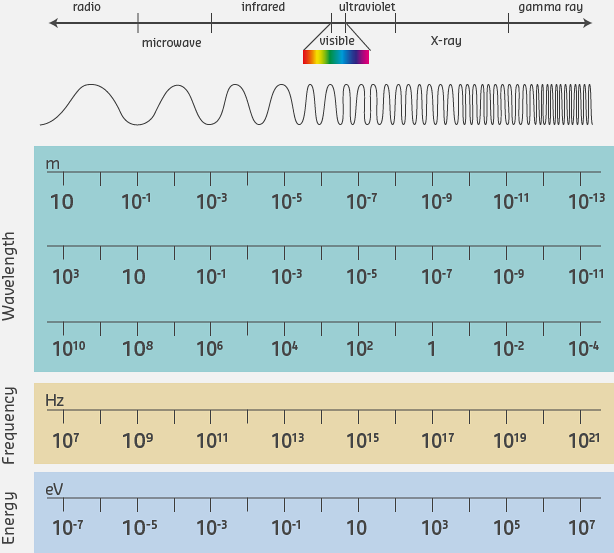
The electromagnetic spectrum encompasses all types of electromagnetic radiation, from radio waves to gamma rays. Visible light is just a small portion of this spectrum. The different regions are distinguished by their frequency and wavelength characteristics.
%% fig-cap: "Electromagnetic spectrum regions showing frequency and wavelength ranges"
%% fig-alt: "Complete electromagnetic spectrum from radio waves (lowest frequency, longest wavelength) through microwave, infrared, visible light, ultraviolet, X-rays, to gamma rays (highest frequency, shortest wavelength), with IoT wireless technologies operating in the radio and microwave regions"
%%{init: {'theme': 'base', 'themeVariables': { 'primaryColor': '#2C3E50', 'primaryTextColor': '#2C3E50', 'primaryBorderColor': '#16A085', 'lineColor': '#16A085', 'secondaryColor': '#E67E22', 'tertiaryColor': '#ECF0F1'}}}%%
graph LR
    A["Electromagnetic<br/>Spectrum"] --> B["Radio Waves<br/>3 kHz - 300 GHz<br/>IoT operates here"]
    A --> C["Microwave<br/>300 MHz - 300 GHz<br/>Wi-Fi, Cellular"]
    A --> D["Infrared<br/>300 GHz - 430 THz"]
    A --> E["Visible Light<br/>430-770 THz"]
    A --> F["Ultraviolet<br/>770 THz - 30 PHz"]
    A --> G["X-Rays<br/>30 PHz - 30 EHz"]
    A --> H["Gamma Rays<br/>> 30 EHz"]

    B --> I["Increasing Frequency →"]
    H --> I
    I --> J["← Decreasing Wavelength"]

    style A fill:#2C3E50,stroke:#16A085,stroke-width:3px,color:#fff
    style B fill:#16A085,stroke:#2C3E50,stroke-width:3px,color:#fff
    style C fill:#16A085,stroke:#2C3E50,stroke-width:2px,color:#fff
    style I fill:#E67E22,stroke:#16A085,stroke-width:2px
    style J fill:#E67E22,stroke:#16A085,stroke-width:2px
812.4.2 Radio Frequency Spectrum for IoT
Radio waves occupy the portion of the electromagnetic spectrum with the longest wavelength and the lowest frequency. This makes them ideal for wireless communication because:
- Long-range propagation: Lower frequencies travel farther
- Building penetration: Longer wavelengths pass through obstacles better
- Easier link budgets: Lower path loss often means less transmit power is needed for the same received signal level (all else equal)
- Well-understood technology: Mature standards and components
%% fig-cap: "Radio frequency bands used for IoT applications"
%% fig-alt: "Radio spectrum allocation showing different frequency bands for IoT: sub-GHz bands (433/868/915 MHz) for long-range LPWAN, 2.4 GHz ISM band for Wi-Fi/Bluetooth/Zigbee, and 5 GHz band for high-speed Wi-Fi, with characteristics of range vs bandwidth trade-offs"
%%{init: {'theme': 'base', 'themeVariables': { 'primaryColor': '#2C3E50', 'primaryTextColor': '#2C3E50', 'primaryBorderColor': '#16A085', 'lineColor': '#16A085', 'secondaryColor': '#E67E22', 'tertiaryColor': '#ECF0F1'}}}%%
graph TB
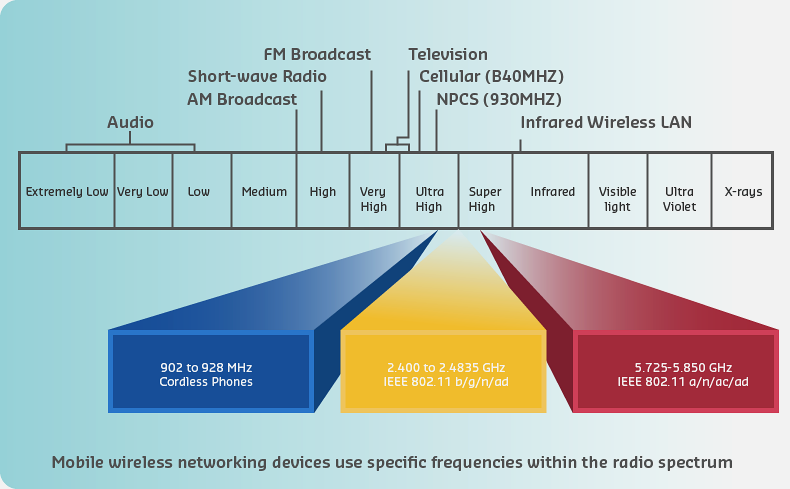
    A["Radio Frequency<br/>Spectrum for IoT"] --> B["Sub-GHz Bands<br/>433, 868, 915 MHz"]
    A --> C["2.4 GHz ISM Band<br/>2.4 - 2.483 GHz"]
    A --> D["5 GHz Band<br/>5.15 - 5.875 GHz"]

    B --> B1["✓ Long Range 10+ km<br/>✓ Excellent Penetration<br/>✓ Low Power<br/>✗ Low Bandwidth"]
    C --> C1["✓ Global Availability<br/>✓ Balanced Range/Speed<br/>✗ Crowded Spectrum<br/>✗ Interference"]
    D --> D1["✓ High Bandwidth<br/>✓ Less Interference<br/>✗ Short Range<br/>✗ Poor Penetration"]

    B --> B2["LoRaWAN, Sigfox<br/>Z-Wave, proprietary FSK"]
    C --> C2["Wi-Fi, Bluetooth<br/>Zigbee, Thread"]
    D --> D2["Wi-Fi 5/6<br/>High-speed only"]

    style A fill:#2C3E50,stroke:#16A085,stroke-width:3px,color:#fff
    style B fill:#16A085,stroke:#2C3E50,stroke-width:2px,color:#fff
    style C fill:#E67E22,stroke:#16A085,stroke-width:2px
    style D fill:#E67E22,stroke:#16A085,stroke-width:2px
812.5 Summary
This chapter introduced the fundamental physics of electromagnetic waves for wireless communication:
- Electromagnetic waves enable wireless communication, characterized by frequency, wavelength, and energy
- Higher frequency signals have shorter wavelengths and higher energy but experience greater path loss
- The fundamental wave equation c = f × λ governs the relationship between frequency and wavelength
- Radio waves (3 kHz - 300 GHz) are ideal for IoT because they balance range, penetration, and data capacity
- IoT wireless technologies operate across sub-GHz, 2.4 GHz, and 5 GHz bands, each with distinct trade-offs
812.6 What’s Next
Continue with the next chapters in this series:
- IoT Frequency Bands and Licensing: Deep dive into 2.4 GHz, 5 GHz, sub-GHz bands and regulatory requirements
- Cellular Spectrum for IoT: LTE-M, NB-IoT, and 5G spectrum allocation
- Propagation and Design: Path loss calculations, interference mitigation, and band selection framework