965 6LoWPAN Overview: IPv6 for Constrained Networks
965.1 Learning Objectives
By the end of this chapter, you will be able to:
- Explain 6LoWPAN’s Purpose: Describe how 6LoWPAN enables IPv6 over IEEE 802.15.4 networks
- Identify the Core Challenge: Understand the size mismatch between IPv6 packets and 802.15.4 frames
- Describe Key Solutions: Explain header compression and fragmentation at a high level
- Recognize Use Cases: Identify scenarios where 6LoWPAN is the right protocol choice
The Problem: There’s a fundamental mismatch between Internet and IoT radio standards:
- IPv6 header: 40 bytes minimum (fixed by standard)
- UDP header: 8 bytes
- 802.15.4 frame: 127 bytes maximum (only ~102 bytes after MAC headers)
- Available for payload: 102 - 40 - 8 = 54 bytes (barely enough for sensor data!)
Why This Is Hard:
- Can’t change IPv6—it’s a global Internet standard
- Can’t change 802.15.4—it’s a hardware limitation
- Fragmentation wastes bandwidth and drains batteries
- Need end-to-end IP addressing for seamless IoT integration
The Solution: 6LoWPAN provides an adaptation layer with intelligent header compression (IPHC) that reduces 40-byte IPv6 headers to just 2-7 bytes, plus fragmentation support for larger payloads.
965.2 Prerequisites
Before diving into this chapter, you should be familiar with:
- Layered Network Models: Understanding of OSI/TCP-IP models for grasping how 6LoWPAN fits as an adaptation layer
- IEEE 802.15.4 Fundamentals: 6LoWPAN operates directly over 802.15.4, so understanding the 127-byte frame limit is essential
- Networking Basics: Familiarity with IP addressing and packet structure
965.3 Getting Started: For Beginners
965.3.1 Breaking Down the Name
6LoWPAN = IPv6 over Low-Power Wireless Personal Area Networks
Let’s decode each part:
| Part | Meaning | Why It Matters |
|---|---|---|
| IPv6 | Internet Protocol version 6 | The language of the internet |
| Low-Power | Battery-operated devices | Sensors, wearables, monitors |
| Wireless | No cables | Radio communication |
| PAN | Personal Area Network | Short-range network (~10-100m) |
In simple terms: 6LoWPAN lets tiny, battery-powered sensors speak the same language as the internet.
965.4 What is 6LoWPAN?
6LoWPAN (IPv6 over Low-Power Wireless Personal Area Networks) is an adaptation layer that enables IPv6 packets to be carried over IEEE 802.15.4 networks. It provides header compression, fragmentation, and forwarding to make the full internet protocol stack work on constrained devices with limited memory, processing power, and battery life.
Key Characteristics:
- Standard: RFC 6282, RFC 4944, RFC 6775
- Physical Layer: IEEE 802.15.4 (Zigbee, Thread use this too)
- IP Support: Full IPv6 (not IPv4)
- Header Compression: Up to 95% reduction in overhead
- MTU: 1280 bytes (IPv6 minimum) over 127-byte 802.15.4 frames
- Addressing: Global IPv6 addresses for every sensor
965.5 6LoWPAN Technology Summary
| Property | Details |
|---|---|
| Name | 6LoWPAN |
| Standard protocol is based on | IEEE802.15.4 |
| Designed for | Extends the use of Internet Protocol for low power devices with limited processing capabilities in a Personal Area Network (PAN) |
| Connection range | 10s (tens) of metres |
| Data rate | Maximum data rate of 250kbps |
| Example | Smart meters in a small network |
965.6 The Problem 6LoWPAN Solves
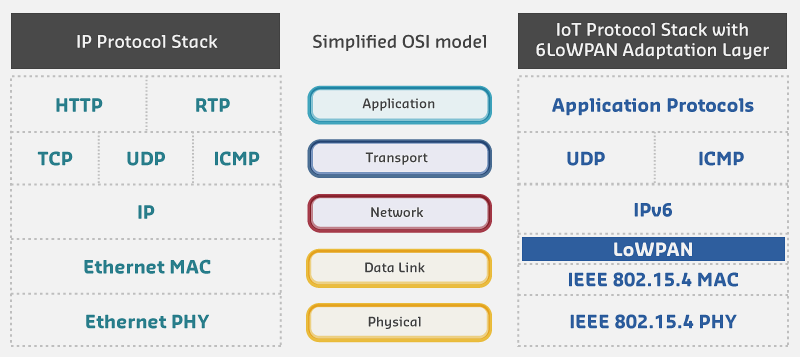
Without 6LoWPAN:
- IPv6 header: 40 bytes
- UDP header: 8 bytes
- Total overhead: 48 bytes
- 802.15.4 payload: ~102 bytes
- Usable data: Only 54 bytes! (53% overhead!)
With 6LoWPAN:
- Compressed IPv6 header: 2-7 bytes (typical)
- Compressed UDP header: 4 bytes
- Total overhead: 6-11 bytes
- Usable data: 91-96 bytes (94% efficient!)
IPv6 is essential for IoT because:
- Abundant addresses: 340 undecillion (enough for every sensor)
- No NAT: Direct end-to-end connectivity
- Auto-configuration: Stateless address autoconfiguration (SLAAC)
- Built-in security: IPsec mandatory in IPv6
- Future-proof: IPv4 exhausted, IPv6 is the future
6LoWPAN doesn’t support IPv4—it’s IPv6-only by design.
965.7 6LoWPAN Architecture Overview
965.7.1 Protocol Stack
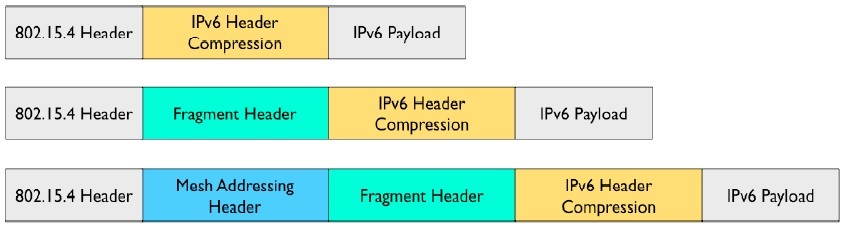
6LoWPAN sits between IPv6 and IEEE 802.15.4:
- Above: Standard IPv6 stack (applications don’t know about 6LoWPAN)
- Below: IEEE 802.15.4 radio (PHY/MAC layers)
- Transparent: Appears as regular IPv6 to upper layers
965.7.2 Network Topology
Device Roles:
- Border Router: Gateway between 6LoWPAN and regular IPv6 internet
- Router: Forwards packets, extends range (similar to Zigbee routers)
- Host: End device (sensor/actuator), may sleep to save power
965.7.3 Two Key Techniques
1. Header Compression (IPHC)
6LoWPAN uses IP Header Compression to reduce the 40-byte IPv6 header to as little as 2 bytes:
- Version, Traffic Class, Flow Label: Often elided (always 6, usually 0)
- Payload Length: Derived from 802.15.4 frame size
- Hop Limit: Compressed to 2 bits for common values (1, 64, 255)
- Addresses: Context-based compression using link-layer addresses
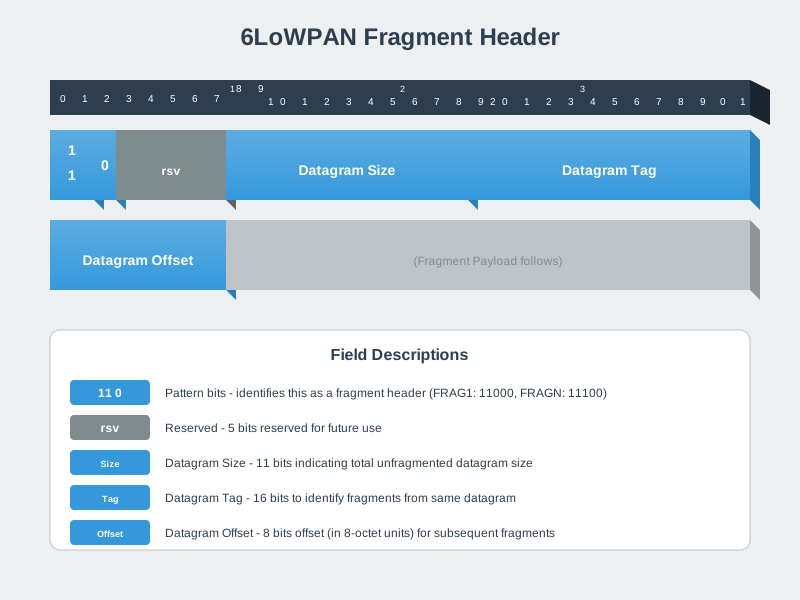
2. Fragmentation and Reassembly
When packets exceed 102 bytes:
- Split into multiple 802.15.4 frames
- Each fragment carries a tag for reassembly
- Receiver buffers fragments until complete
965.8 Real-World Examples
Thread Smart Home Protocol uses 6LoWPAN:
The smart light has its own IPv6 address and can be controlled from anywhere in the world!
Industrial Sensors:
- Factory sensors sending data to cloud
- Each sensor directly addressable via IPv6
- No proprietary gateways needed
965.9 Knowledge Check
The Problem (2005): The IEEE 802.15.4 standard provided an excellent low-power radio layer for wireless sensor networks, but there was a fundamental mismatch with Internet protocols. IPv6 headers are 40 bytes fixed, but 802.15.4 frames max out at 127 bytes. Running native IP over WSN radios seemed impossible.
The 6LoWPAN Solution (2007): RFC 4944 introduced the adaptation layer concept with three key innovations: (1) header compression, (2) fragmentation/reassembly, and (3) mesh addressing. RFC 6282 (2011) improved compression with IPHC, achieving 2-byte headers in the best case.
The Routing Layer (2012): RFC 6550 defined RPL (Routing Protocol for Low-Power and Lossy Networks), purpose-built for constrained devices.
Today’s Stack: 802.15.4 (physical/MAC) -> 6LoWPAN (adaptation) -> RPL (routing) -> UDP (transport) -> CoAP (application). Thread and Matter build on this foundation.
965.10 Summary
This chapter introduced 6LoWPAN (IPv6 over Low-Power Wireless Personal Area Networks):
- 6LoWPAN bridges IPv6 and constrained networks by providing an adaptation layer over IEEE 802.15.4
- The core challenge is the size mismatch: IPv6 requires 40-byte headers, but 802.15.4 frames only have ~102 bytes of usable payload
- Header compression (IPHC) reduces IPv6 headers from 40 bytes to 2-7 bytes by eliding predictable fields
- Fragmentation allows IPv6’s 1280-byte minimum MTU to work over tiny 802.15.4 frames
- End-to-end IP connectivity means every sensor gets a globally routable IPv6 address
965.11 What’s Next
Now that you understand the 6LoWPAN overview, continue to:
- 6LoWPAN Header Compression: Deep dive into IPHC compression mechanics
- 6LoWPAN Fragmentation: How large packets are split and reassembled
- 6LoWPAN Routing with RPL: Mesh networking and route optimization