%% fig-alt: "XMPP federated architecture diagram showing smart light device connected to home.net XMPP server and temperature sensor connected to office.net XMPP server with bidirectional federation between servers enabling cross-domain device communication similar to email"
%%{init: {'theme': 'base', 'themeVariables': { 'primaryColor': '#2C3E50', 'primaryTextColor': '#fff', 'primaryBorderColor': '#16A085', 'lineColor': '#16A085', 'secondaryColor': '#E67E22', 'tertiaryColor': '#ecf0f1', 'noteTextColor': '#2C3E50', 'noteBkgColor': '#fff9e6', 'textColor': '#2C3E50', 'fontSize': '14px'}}}%%
graph LR
    Device1["💡 Light@home.net"] <-->|XMPP| Server1["🖥️ home.net<br/>XMPP Server"]
    Device2["🌡️ Sensor@office.net"] <-->|XMPP| Server2["🖥️ office.net<br/>XMPP Server"]

    Server1 <-->|Federation<br/>Server-to-Server| Server2

    Note["💬 Devices on different<br/>servers can communicate<br/>(like email!)"]

    style Server1 fill:#2C3E50,stroke:#16A085,color:#fff
    style Server2 fill:#2C3E50,stroke:#16A085,color:#fff
    style Device1 fill:#E67E22,stroke:#D35400,color:#fff
    style Device2 fill:#16A085,stroke:#16A085,color:#fff
1251 Extensible Messaging and Presence Protocol (XMPP)
1251.1 Introduction
Extensible Messaging and Presence Protocol (XMPP) is an open-standard communication protocol based on XML (Extensible Markup Language) designed for real-time messaging and presence information. Originally developed for instant messaging (Jabber), XMPP has evolved to support IoT applications, particularly those requiring real-time communication, service discovery, and presence-based interactions.
NoteLearning Objectives
By the end of this chapter, you will be able to:
- Understand XMPP’s architecture and decentralized model
- Explain presence, service discovery, and publish-subscribe in XMPP
- Compare XMPP with MQTT and AMQP for IoT applications
- Evaluate XMPP’s strengths and weaknesses for real-time IoT
- Understand when to use XMPP in IoT architectures
1251.2 Prerequisites
Before diving into this chapter, you should be familiar with:
- MQTT Protocol: Understanding MQTT’s publish-subscribe model and lightweight approach provides essential context for comparing XMPP’s different design philosophy and overhead trade-offs
- Application Protocols: Knowledge of application-layer protocols and messaging patterns helps understand XMPP’s position in the IoT protocol landscape
- Networking Basics: Understanding client-server vs peer-to-peer architectures, XML/JSON data formats, and network communication fundamentals is essential for grasping XMPP’s federated architecture
NoteRelated Chapters
Core Protocols for Comparison: - MQTT Fundamentals - Compare with XMPP’s presence-based approach - AMQP Fundamentals - Enterprise messaging alternative - CoAP Protocol - RESTful lightweight protocol
Protocol Selection: - AMQP vs MQTT - Protocol comparison framework - IoT Protocols Review - When to use XMPP vs alternatives - Application Protocols Overview - Protocol landscape
Real-Time Communication: - Networking Fundamentals - TCP/IP and real-time messaging - Transport Protocols - TCP reliability for XMPP
Architecture Integration: - Edge Computing - XMPP in distributed architectures - IoT Reference Models - Protocol layer placement
Human-Device Interaction: - Design Model for IoT - User interaction patterns - Application Domains - Social IoT use cases
Learning Resources: - Simulations Hub - Interactive protocol demonstrations - Videos Hub - XMPP and messaging protocol tutorials
1251.3 🌱 Getting Started (For Beginners)
TipWhat is XMPP? (Simple Explanation)
Analogy: XMPP is like email for devices—decentralized, open, and designed for real-time chat.
Just like you can email anyone regardless of their provider (Gmail can email Outlook), XMPP lets devices on different servers communicate with each other.
NoteAlternative View: Message Stanza Types
%%{init: {'theme': 'base', 'themeVariables': { 'primaryColor': '#2C3E50', 'primaryTextColor': '#fff', 'primaryBorderColor': '#16A085', 'lineColor': '#16A085', 'secondaryColor': '#E67E22', 'tertiaryColor': '#ecf0f1'}}}%%
graph TD
    ROOT["XMPP Stanza Types<br/>(XML Messages)"]

    ROOT --> MSG["<message><br/>One-way delivery"]
    ROOT --> PRES["<presence><br/>Online/offline status"]
    ROOT --> IQ["<iq><br/>Request-response"]

    MSG --> M1["Chat messages"]
    MSG --> M2["Alerts, notifications"]

    PRES --> P1["Device availability"]
    PRES --> P2["Status updates"]

    IQ --> I1["Query data (get)"]
    IQ --> I2["Set configuration (set)"]
    IQ --> I3["Result response"]

    style ROOT fill:#2C3E50,stroke:#16A085,color:#fff
    style MSG fill:#E67E22,stroke:#2C3E50,color:#fff
    style PRES fill:#16A085,stroke:#2C3E50,color:#fff
    style IQ fill:#7F8C8D,stroke:#2C3E50,color:#fff
This diagram shows the three core XMPP stanza types: <message> for one-way communication, <presence> for status broadcasting, and <iq> for request-response interactions.
NoteXMPP vs MQTT: When to Use Which?
| Feature | XMPP | MQTT |
|---|---|---|
| Origin | Instant messaging (Jabber) | IoT sensors |
| Format | XML (verbose) | Binary (compact) |
| Architecture | Decentralized (federated) | Centralized (broker) |
| Presence | Built-in (“online/offline”) | Not native |
| Best for | Real-time chat, collaboration | Sensor data, telemetry |
%% fig-alt: "Comparison diagram of XMPP decentralized architecture with federated servers and XML messages versus MQTT centralized architecture with single broker and binary messages showing XMPP advantages in presence and decentralization versus MQTT advantages in compactness and efficiency"
%%{init: {'theme': 'base', 'themeVariables': { 'primaryColor': '#2C3E50', 'primaryTextColor': '#fff', 'primaryBorderColor': '#16A085', 'lineColor': '#16A085', 'secondaryColor': '#E67E22', 'tertiaryColor': '#ecf0f1', 'noteTextColor': '#2C3E50', 'noteBkgColor': '#fff9e6', 'textColor': '#2C3E50', 'fontSize': '13px'}}}%%
graph TB
    subgraph XMPP["XMPP: Decentralized"]
        Device1["💡 Device"] <-->|XML Messages| Server1["XMPP Server A"]
        Device2["🌡️ Device"] <-->|XML Messages| Server2["XMPP Server B"]
        Server1 <-->|Federation| Server2
        Note1["✓ Presence<br/>✓ Decentralized<br/>✗ Verbose"]
    end

    subgraph MQTT["MQTT: Centralized"]
        Sensor1["🌡️ Sensor"] -->|Binary| Broker["MQTT Broker"]
        Sensor2["💧 Sensor"] -->|Binary| Broker
        Broker -->|Binary| App["📱 App"]
        Note2["✓ Compact<br/>✓ Efficient<br/>✗ No built-in presence"]
    end

    style XMPP fill:#3498DB,stroke:#2980B9,color:#fff
    style MQTT fill:#E67E22,stroke:#D35400,color:#fff
CautionKey XMPP Concept: Presence
XMPP was built for chat, so it knows if devices are “online” or “offline”:
| Presence State | Meaning | IoT Example |
|---|---|---|
| Available | Device is online and responsive | Sensor is active |
| Away | Device is online but busy | Sensor in low-power mode |
| Unavailable | Device is offline | Sensor powered down |
Why this matters for IoT: You can see which devices are connected without polling them!
TipSelf-Check Questions
Before diving deeper, test your understanding:
- How is XMPP different from MQTT architecturally?
- Hint: Think email vs central server
- What does “presence” mean in XMPP?
- Hint: Online/offline status
- When might you choose XMPP over MQTT?
- Hint: Real-time collaboration, chat-like features
Answers explored in the chapter below!
1251.4 XMPP Overview
1251.4.1 What is XMPP?
XMPP is a communication protocol for message-oriented middleware based on Extensible Markup Language (XML). It enables real-time exchange of structured data between networked entities.
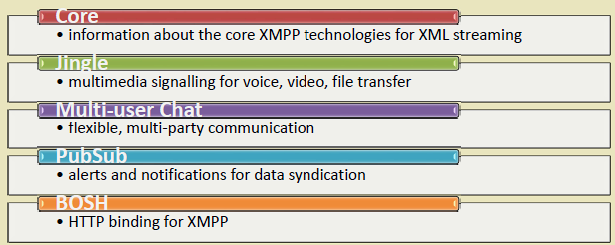
Key characteristics: - Open standard: IETF specifications (RFC 6120, 6121, 6122) - XML-based: Human-readable, extensible message format - Decentralized: No central server required (federated model) - Real-time: Low-latency message exchange - Extensible: Custom extensions (XEPs - XMPP Extension Protocols)
1251.5 Videos
NoteMessaging Protocols Overview
NoteReal-time Messaging Patterns
1251.5.1 XMPP Architecture
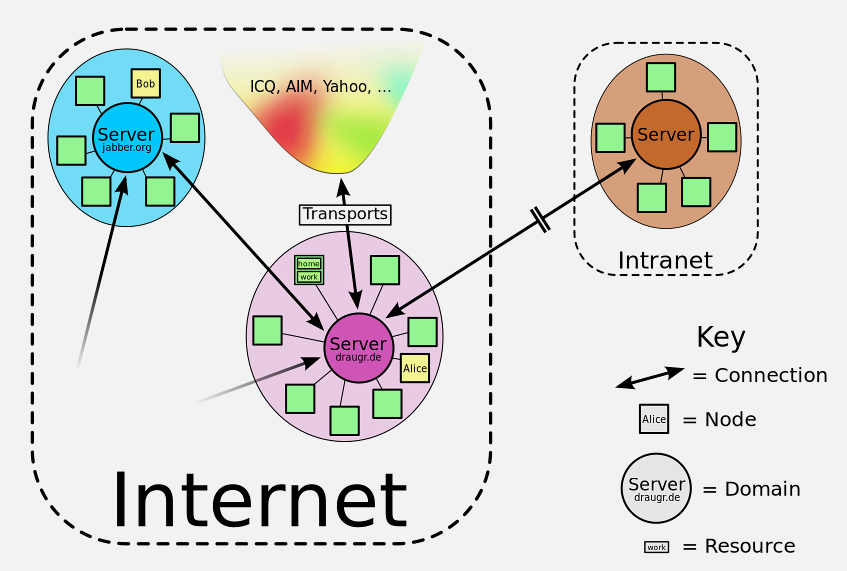
NoteAlternative Views: XMPP Architecture Visualizations
XMPP’s federated architecture allows servers operated by different organizations to communicate. Unlike MQTT’s centralized broker, XMPP servers form a distributed network where user@serverA.com can message device@serverB.org, similar to email federation.
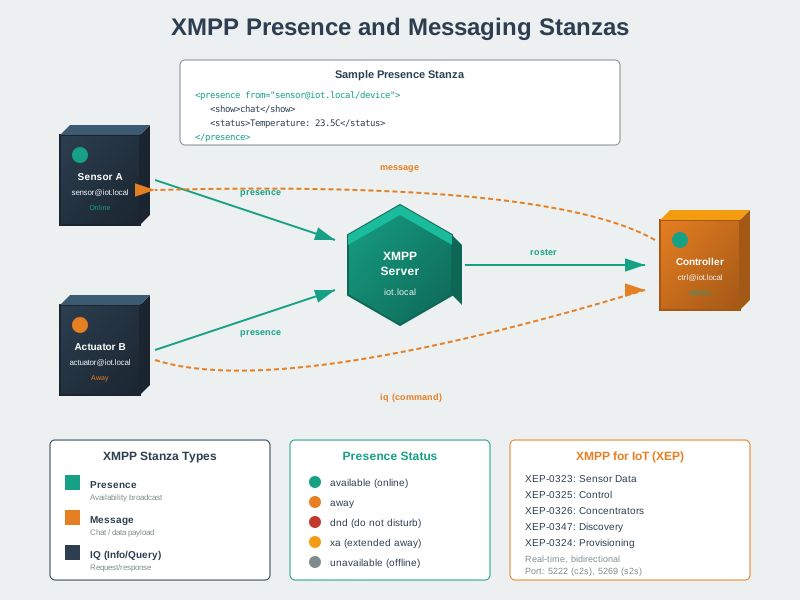
XMPP’s built-in presence system enables real-time awareness of device status. When a device goes offline, its server broadcasts unavailable presence to all subscribers. This eliminates the need for polling or heartbeat mechanisms to detect disconnections.
XMPP’s PubSub extension (XEP-0060) provides publish-subscribe messaging similar to MQTT topics. Devices publish sensor readings to nodes, and subscribers receive notifications. Unlike MQTT, XMPP PubSub supports node hierarchies, access control, and persistent item storage.
%% fig-alt: "XMPP protocol features hierarchy diagram showing four main branches: XML-based messages with structured data and human-readable format, decentralized architecture with federated servers, real-time communication with instant messaging and presence updates, and extensible standards with XEPs and IoT extensions"
%%{init: {'theme': 'base', 'themeVariables': { 'primaryColor': '#2C3E50', 'primaryTextColor': '#fff', 'primaryBorderColor': '#16A085', 'lineColor': '#16A085', 'secondaryColor': '#E67E22', 'tertiaryColor': '#ecf0f1', 'noteTextColor': '#2C3E50', 'noteBkgColor': '#fff9e6', 'textColor': '#2C3E50', 'fontSize': '14px'}}}%%
graph TB
    XMPP["XMPP<br/>(Extensible Messaging and<br/>Presence Protocol)"]

    XMPP --> A["XML-Based<br/>Messages"]
    XMPP --> B["Decentralized<br/>Architecture"]
    XMPP --> C["Real-Time<br/>Communication"]
    XMPP --> D["Extensible<br/>Standards"]

    A --> A1["Structured data<br/>Human-readable<br/>Custom elements"]
    B --> B1["Federated servers<br/>No single authority<br/>Run your own"]
    C --> C1["Instant messaging<br/>Presence updates<br/>Pub-sub events"]
    D --> D1["XEPs extensions<br/>IoT extensions<br/>Community-driven"]

    style XMPP fill:#2C3E50,stroke:#16A085,color:#fff
    style A fill:#16A085,stroke:#16A085,color:#fff
    style B fill:#E67E22,stroke:#D35400,color:#fff
    style C fill:#2C3E50,stroke:#16A085,color:#fff
    style D fill:#16A085,stroke:#16A085,color:#fff
    style A1 fill:#ecf0f1,stroke:#7F8C8D,color:#2C3E50
    style B1 fill:#ecf0f1,stroke:#7F8C8D,color:#2C3E50
    style C1 fill:#ecf0f1,stroke:#7F8C8D,color:#2C3E50
    style D1 fill:#ecf0f1,stroke:#7F8C8D,color:#2C3E50
NoteCross-Hub Connections
Deepen your understanding of XMPP and related concepts:
Interactive Learning: - Simulations Hub - Try the Protocol Comparison Tool to compare XMPP vs MQTT vs AMQP side-by-side with interactive message flow visualization - Explore the Network Topology Visualizer to understand how XMPP’s federated architecture differs from centralized broker models
Visual Learning: - Videos Hub - Watch “Messaging Protocols Overview” (Lesson 4) for context on XMPP vs AMQP/MQTT in real-world messaging scenarios - Review real-time messaging pattern demonstrations showing presence, federation, and use cases
Assessment: - Quizzes Hub - Test your protocol selection skills with “Application Protocol Selection” quiz covering when to use XMPP vs alternatives - Practice calculating bandwidth overhead and cost trade-offs for different protocols
Knowledge Gaps: - Knowledge Gaps Hub - Review common misconceptions about XMPP’s overhead, federation model, and IoT suitability
1251.5.2 History and Evolution
Timeline: - 1999: Jeremie Miller creates Jabber (XMPP precursor) - 2004: IETF standardizes XMPP (RFCs 3920-3923) - 2011: Updated XMPP specifications (RFCs 6120-6122) - 2013+: XEP-0323 to XEP-0326 (IoT extensions)
Original purpose: - Instant messaging (alternative to proprietary protocols like ICQ, AIM) - Presence (online/offline/away status) - Contact lists (roster management)
Modern applications: - IoT device communication (machine-to-machine) - Smart grid monitoring and control - Social networking services - Gaming (real-time multiplayer) - VoIP signaling
WarningCommon Misconception: “XMPP is Too Heavy for IoT”
Misconception: “XMPP’s XML overhead makes it impractical for all IoT applications—always use MQTT instead.”
Reality: While XMPP messages are 3.5-7.9× larger than MQTT (280 bytes vs 40 bytes for a temperature reading), this overhead is negligible for mains-powered devices on unlimited bandwidth networks.
Real-World Example - Smart Home Thermostat:
A Wi-Fi-connected smart home thermostat sends status updates every 5 minutes (288 messages/day):
| Metric | XMPP (280 bytes) | MQTT (40 bytes) | Impact |
|---|---|---|---|
| Daily bandwidth | 78.75 KB | 11.25 KB | +67.5 KB/day |
| Monthly bandwidth | 2.37 MB | 0.34 MB | +2.03 MB/month |
| Annual cost ($0.10/GB) | $0.03 | $0.004 | +$0.026/year |
| Power (Wi-Fi active) | ~500 mW | ~500 mW | Same (Wi-Fi dominates) |
Cost per device: $0.026/year extra for XMPP
When XMPP’s overhead IS justified (mains-powered thermostat): - ✓ Rich presence: Users see “Thermostat online, target 22°C, current 21°C” without polling - ✓ Human interaction: Natural language commands via chat: “Set temperature to 23°C” - ✓ Message history: Review temperature changes and user interactions over time - ✓ Service discovery: Thermostat auto-advertises capabilities (heat/cool/fan modes) - ✓ Federation: Thermostats from different manufacturers communicate via open XMPP
When XMPP overhead is NOT justified (battery-powered soil sensor): - ✗ Battery-powered devices (need MQTT’s efficiency) - ✗ High-frequency telemetry (100+ msgs/hour → significant bandwidth) - ✗ Constrained networks (cellular with data caps → use CoAP/MQTT) - ✗ Simple sensor readings (no human interaction needed)
Bottom Line: XMPP’s overhead is irrelevant when power and bandwidth are unlimited, and its rich features (presence, metadata, federation) significantly improve user experience for interactive devices. Choose protocol based on use case requirements, not blanket assumptions.
1251.6 Knowledge Check
Test your understanding of XMPP protocol with these questions.
1251.6.1 Messaging Protocol Flow Comparison (Variant View)
This sequence diagram contrasts XMPP’s presence-aware messaging with MQTT’s lightweight pub/sub pattern, highlighting architectural differences:
%%{init: {'theme': 'base', 'themeVariables': {'primaryColor': '#2C3E50', 'primaryTextColor': '#fff', 'primaryBorderColor': '#16A085', 'lineColor': '#E67E22', 'secondaryColor': '#16A085', 'tertiaryColor': '#7F8C8D', 'fontSize': '13px'}}}%%
sequenceDiagram
    participant D as Device
    participant XS as XMPP Server
    participant MB as MQTT Broker
    participant A as Application

    Note over D,A: XMPP: Presence + Message Flow
    rect rgb(44, 62, 80)
    D->>XS: 1. Connect + Authenticate (TLS/SASL)
    XS->>D: Stream established
    D->>XS: 2. Send Presence (available)
    XS->>A: Presence notification (device online)
    D->>XS: 3. Publish sensor data (XML stanza)
    XS->>A: Forward message + metadata
    Note over XS: Server stores message history
    end

    Note over D,A: MQTT: Lightweight Pub/Sub
    rect rgb(22, 160, 133)
    D->>MB: 1. CONNECT (optional auth)
    MB->>D: CONNACK
    D->>MB: 2. PUBLISH topic/data (QoS 0/1/2)
    MB->>A: Forward to subscribers
    Note over MB: No presence, no history (unless retained)
    end

    Note over D,A: Key Differences
    Note right of XS: XMPP: Rich features<br/>+ Presence awareness<br/>+ Message history<br/>+ XML extensibility<br/>- Higher overhead
    Note right of MB: MQTT: Efficiency<br/>+ Minimal overhead<br/>+ Battery-friendly<br/>+ QoS levels<br/>- No presence built-in
1251.7 Chapter Summary
XMPP is a real-time, presence-based communication protocol with decentralized architecture:
Key Features: - XML-based: Structured, extensible messages - Decentralized: Federated servers (like email) - Real-time: Low-latency messaging - Presence: Built-in online/offline status - Service discovery: Auto-detect devices and capabilities - Publish-subscribe: XEP-0060 for event distribution - Extensible: XEPs (XMPP Extension Protocols) for IoT
Strengths: - No single point of failure (federation) - Open standard (vendor independence) - Rich presence and discovery - Real-time human-machine interaction - Mature security (TLS, SASL)
Weaknesses: - High network overhead (XML text-based) - No QoS guarantees (best-effort delivery) - Binary data must be Base64 encoded (+33% size) - Less efficient than binary protocols (MQTT, CoAP)
vs MQTT: - XMPP: Real-time, presence, decentralized, high overhead - MQTT: Efficient, pub-sub, centralized, IoT-optimized
vs AMQP: - XMPP: Real-time, decentralized, presence-based - AMQP: Enterprise, centralized, complex routing
Best Applications: - Real-time messaging (human-in-the-loop IoT) - Presence-aware systems (device status critical) - Smart home with user interaction - Gaming and collaborative applications - Federation across organizations - Social IoT platforms
When to Choose XMPP: ✓ Real-time messaging with users ✓ Presence awareness required ✓ Decentralized architecture preferred ✓ Service discovery needed ✓ Social/collaborative features
When to Choose Alternatives: ✗ Constrained devices → Use MQTT (lighter) ✗ Simple telemetry → Use MQTT or CoAP ✗ Enterprise integration → Use AMQP ✗ High-frequency data → Binary protocols more efficient
XMPP occupies a unique niche in IoT: real-time, presence-based communication where human interaction and decentralization are valuable.
1251.7.1 XMPP Federation Architecture (Variant View)
This diagram illustrates XMPP’s decentralized federation model, showing how servers from different organizations interconnect to enable cross-domain messaging:
%%{init: {'theme': 'base', 'themeVariables': {'primaryColor': '#2C3E50', 'primaryTextColor': '#fff', 'primaryBorderColor': '#16A085', 'lineColor': '#E67E22', 'secondaryColor': '#16A085', 'tertiaryColor': '#7F8C8D'}}}%%
graph TB
    subgraph OrgA["Organization A (home.iot)"]
        UA1["User Alice<br/>alice@home.iot"]
        DA1["Smart Lock<br/>lock@home.iot"]
        DA2["Thermostat<br/>hvac@home.iot"]
        SA["XMPP Server A<br/>home.iot:5269"]

        UA1 <-->|C2S| SA
        DA1 <-->|C2S| SA
        DA2 <-->|C2S| SA
    end

    subgraph OrgB["Organization B (office.iot)"]
        UB1["User Bob<br/>bob@office.iot"]
        DB1["Motion Sensor<br/>sensor@office.iot"]
        SB["XMPP Server B<br/>office.iot:5269"]

        UB1 <-->|C2S| SB
        DB1 <-->|C2S| SB
    end

    subgraph OrgC["Cloud Service (cloud.iot)"]
        SC["XMPP Server C<br/>cloud.iot:5269"]
        DC1["Analytics<br/>analytics@cloud.iot"]

        DC1 <-->|C2S| SC
    end

    SA <-->|"S2S Federation<br/>TLS Encrypted"| SB
    SA <-->|"S2S Federation<br/>TLS Encrypted"| SC
    SB <-->|"S2S Federation<br/>TLS Encrypted"| SC

    CrossMsg["Cross-Domain Messages<br/>alice@home.iot → bob@office.iot<br/>sensor@office.iot → analytics@cloud.iot"]

    style OrgA fill:#2C3E50,color:#fff
    style OrgB fill:#16A085,color:#fff
    style OrgC fill:#E67E22,color:#fff
    style SA fill:#fff,stroke:#2C3E50,color:#2C3E50
    style SB fill:#fff,stroke:#16A085,color:#16A085
    style SC fill:#fff,stroke:#E67E22,color:#E67E22
    style CrossMsg fill:#7F8C8D,color:#fff
1251.8 Python Implementations
1251.8.1 XMPP Message Overhead Analyzer
Example Output:
### Scenario 1: Temperature Reading with Rich Metadata ###

======================================================================================
Message Overhead Comparison
Payload: "Temperature: 22.5" (17 bytes)
======================================================================================

Protocol   Encoding   Total Size   Overhead     Overhead %   Efficiency
--------------------------------------------------------------------------------------
XMPP       XML        267          250          93.6         6.4%
MQTT       Binary     34           17           50.0         50.0%
AMQP       Binary     93           76           81.7         18.3%
--------------------------------------------------------------------------------------

Size Ratios:
  XMPP vs MQTT: 7.9x larger
  XMPP vs AMQP: 2.9x larger

XMPP Trade-off:
  + Rich metadata (timestamp, units, type)
  + Human-readable (XML)
  + Extensible (custom elements)
  - 93.6% overhead
  - 7.9x bandwidth vs MQTT


### Scenario 2: Temperature Reading (Minimal XMPP) ###

======================================================================================
Message Overhead Comparison
Payload: "Temperature: 22.5" (17 bytes)
======================================================================================

Protocol   Encoding   Total Size   Overhead     Overhead %   Efficiency
--------------------------------------------------------------------------------------
XMPP       XML        118          101          85.6         14.4%
MQTT       Binary     34           17           50.0         50.0%
AMQP       Binary     93           76           81.7         18.3%
--------------------------------------------------------------------------------------

Size Ratios:
  XMPP vs MQTT: 3.5x larger
  XMPP vs AMQP: 1.3x larger

XMPP Trade-off:
  + Human-readable (XML)
  + Extensible (custom elements)
  - 85.6% overhead
  - 3.5x bandwidth vs MQTT
1251.8.2 XMPP Presence Manager Simulator
Example Output:
### Simulating Smart Home IoT Network ###

✓ Presence updated: sensor1@smarthome.local/livingroom → available
  📢 Notifying 1 subscriber(s):
     → controller@smarthome.local: "sensor1@smarthome.local/livingroom" went online

✓ Presence updated: sensor2@smarthome.local/hallway → available
  📢 Notifying 1 subscriber(s):
     → controller@smarthome.local: "sensor2@smarthome.local/hallway" went online
     ⚠️  Low battery warning: 18%

✓ Presence updated: thermostat@smarthome.local/hallway → available
  📢 Notifying 1 subscriber(s):
     → controller@smarthome.local: "thermostat@smarthome.local/hallway" went online

--- Sensor 1 entering maintenance mode ---

✓ Presence updated: sensor1@smarthome.local/livingroom → dnd
  Status changed: available → dnd
  📢 Notifying 1 subscriber(s):
     → controller@smarthome.local: "sensor1@smarthome.local/livingroom" changed status to dnd

--- Sensor 2 battery depleted, going offline ---

✓ Presence updated: sensor2@smarthome.local/hallway → unavailable
  Status changed: available → unavailable
  📢 Notifying 1 subscriber(s):
     → controller@smarthome.local: "sensor2@smarthome.local/hallway" went offline
     ⚠️  Low battery warning: 0%

================================================================================
XMPP Presence Manager - Status Report
================================================================================

Total Devices: 3
Total Subscriptions: 3

Status Distribution:
  available: 1
  dnd: 1
  unavailable: 1

Device List:
JID                            Status          Battery    Signal     Message
--------------------------------------------------------------------------------
sensor1@smarthome.local/livingroom available       94%        -55 dBm    Calibrating sensor...
sensor2@smarthome.local/hallway unavailable     0%         N/A        Battery depleted
thermostat@smarthome.local/hallway available       N/A        -48 dBm    HVAC control online
================================================================================
1251.8.3 XMPP Pub-Sub Simulator
Example Output:
### XMPP Pub-Sub IoT Scenario ###

✓ Node created: sensors/temperature
  Access: open, Max items: 5

✓ Node created: sensors/humidity
  Access: open, Max items: 5

✓ Node created: alerts/critical
  Access: authorize, Max items: 20

--- Subscribers joining ---

✓ Subscribed: dashboard@iot.local → sensors/temperature
✓ Subscribed: dashboard@iot.local → sensors/humidity
✓ Subscribed: dashboard@iot.local → alerts/critical

✓ Subscribed: hvac@iot.local → sensors/temperature

✓ Subscribed: alertsystem@iot.local → alerts/critical

--- Sensors publishing data ---

✓ Published: sensor1@iot.local/room1 → sensors/temperature
  Item ID: item_20250125103000123456
  Payload: 22.5°C in Room 1...
  📢 Notifying 2 subscriber(s):
     → dashboard@iot.local
     → hvac@iot.local

✓ Published: sensor2@iot.local/room2 → sensors/temperature
  Item ID: item_20250125103000234567
  Payload: 21.0°C in Room 2...
  📢 Notifying 2 subscriber(s):
     → dashboard@iot.local
     → hvac@iot.local

✓ Published: sensor3@iot.local/room1 → sensors/humidity
  Item ID: item_20250125103000345678
  Payload: 45% humidity in Room 1...
  📢 Notifying 1 subscriber(s):
     → dashboard@iot.local

✓ Published: sensor1@iot.local/room1 → alerts/critical
  Item ID: item_20250125103000456789
  Payload: CRITICAL: Temperature exceeded 30°C in Room 1!...
  📢 Notifying 2 subscriber(s):
     → alertsystem@iot.local
     → dashboard@iot.local

================================================================================
XMPP Pub-Sub Service: pubsub.iot.local
================================================================================

Total Nodes: 3

Node: alerts/critical
  Description: Critical system alerts
  Access: authorize
  Subscribers: 2
  Items: 1 (max: 20)
  Subscriber list:
    • alertsystem@iot.local
    • dashboard@iot.local

Node: sensors/humidity
  Description: Humidity sensor readings
  Access: open
  Subscribers: 1
  Items: 1 (max: 5)
  Subscriber list:
    • dashboard@iot.local

Node: sensors/temperature
  Description: Temperature sensor readings
  Access: open
  Subscribers: 2
  Items: 2 (max: 5)
  Subscriber list:
    • dashboard@iot.local
    • hvac@iot.local
================================================================================1251.9 Visual Reference Gallery
NoteXMPP Visualizations
The following AI-generated diagrams provide additional perspectives on XMPP technology.
1251.9.1 XMPP Architecture


1251.10 Summary
This chapter explored XMPP (Extensible Messaging and Presence Protocol) - an open-standard XML-based protocol for real-time communication:
- Protocol Foundation: XMPP originated as Jabber for instant messaging, now extended for IoT with real-time, human-readable XML communication
- Key Features:
- Presence: Built-in status indicators (online/offline/away) for devices and users
- Federated Architecture: Decentralized model where servers communicate peer-to-peer, no central authority required
- Extensibility: Custom extensions (XEPs) for IoT, gaming, multimedia, and more
- IoT Extensions: XEP-0323 through XEP-0326 define sensor data formats, control commands, and discovery mechanisms
- Addressing: JIDs (Jabber IDs) like
sensor@iot.local/room1identify entities with user, domain, and resource components - Comparison with Other Protocols:
- vs. MQTT: XMPP adds presence and rich metadata but has higher overhead (XML vs binary)
- vs. AMQP: XMPP is simpler, federated; AMQP offers stronger message guarantees
- vs. CoAP: XMPP is persistent and real-time; CoAP is lightweight and RESTful
- Best Use Cases: Social IoT applications, presence-based systems, chat-enabled devices, gaming integrations, and scenarios requiring message history
- Trade-offs: XML verbosity increases bandwidth usage but provides human-readability and extensibility
XMPP excels in scenarios where presence awareness, real-time interaction, and social features are important, making it ideal for human-device interaction applications.
1251.11 Further Reading
Standards: - RFC 6120: XMPP Core - RFC 6121: XMPP Instant Messaging and Presence - RFC 6122: XMPP Address Format - XEP-0323 to XEP-0326: IoT Extensions
Books: - “XMPP: The Definitive Guide” by Saint-Andre et al. - “Professional XMPP Programming with JavaScript and jQuery”
Online Resources: - XMPP Standards Foundation: xmpp.org - XMPP IoT: xmpp-iot.org - XEP Index: xmpp.org/extensions
1251.12 References
1251.13 What’s Next
You have completed Chapter 4: Networking and Communications, covering wireless technologies and IoT messaging protocols:
- Wireless Networks Covered: LPWAN (LoRaWAN, Sigfox, Weightless), Cellular IoT (NB-IoT, LTE-M)
- Messaging Protocols Covered: MQTT (publish-subscribe), CoAP (request-response), AMQP (advanced queuing), XMPP (presence-based)
Now transition to Chapter 5: Data Management and Analytics:
- Next Chapter: Big Data Overview - Learn about data collection, storage, and analysis at scale
- Then: Explore time-series databases, stream processing, and analytics for IoT data
- Advanced Topics: Edge computing, machine learning, and real-time processing
These data management and analytics tools are essential for turning IoT sensor data into actionable insights.