1125 Sigfox: Device Management and Firmware Challenges
1125.1 Learning Objectives
By the end of this chapter, you will be able to:
- Understand Firmware Update Challenges: Recognize why OTA updates via Sigfox are impractical
- Design for Extensibility: Plan payloads with reserved bytes for future features
- Troubleshoot Downlink Issues: Diagnose why commands never reach devices
- Compare Update Methods: Evaluate costs of Bluetooth OTA, physical access, and device replacement
- Plan Device Lifecycles: Budget for maintenance over 5-10 year deployments
1125.2 Prerequisites
Required Chapters: - Sigfox Fundamentals - Core Sigfox concepts - Sigfox Architecture - Network structure - Sigfox Review - Overview and quizzes
Technical Background: - Understanding of firmware updates - Basic embedded systems concepts - Sigfox downlink limitations (4 messages/day, 8 bytes)
Estimated Time: 25 minutes
1125.3 The Firmware Update Challenge
Sigfox’s design philosophy prioritizes simplicity and low power, but this creates significant challenges for field updates.
Question: A logistics company tracks 10,000 shipping containers globally. Each container reports GPS location (6 bytes latitude/longitude), battery level (1 byte), temperature (2 bytes), and container ID (2 bytes) = 11 bytes total, 4 times per day. After 2 years, they want to add door sensor status (1 byte) to detect unauthorized access. What challenge will they face?
Option A is CORRECT - Firmware updates are the primary challenge:
The Payload Structure Problem:
Current Payload (11 bytes):
Byte 0-1: Container ID (uint16)
Byte 2-7: GPS coordinates (lat/lon compressed to 6 bytes)
Byte 8: Battery level (uint8)
Byte 9-10: Temperature (int16, 0.1C resolution)
Total: 11 bytes
Desired New Payload (12 bytes):
Byte 0-1: Container ID
Byte 2-7: GPS coordinates
Byte 8: Battery level
Byte 9-10: Temperature
Byte 11: Door status (uint8) <- NEW FIELD
Total: 12 bytes
Why Firmware Updates are Difficult:
Devices must be updated to: 1. Read new door sensor hardware (GPIO configuration) 2. Modify payload encoding (add byte 11) 3. Test and validate new format
OTA via Sigfox is IMPRACTICAL:
Typical firmware size: 64-128 KB
Sigfox downlink: 8 bytes per message, 4 messages/day max

Calculation:
- Firmware: 64 KB = 65,536 bytes
- Per message: 8 bytes
- Messages needed: 65,536 / 8 = 8,192 messages
- Daily limit: 4 messages
- Time required: 8,192 / 4 = 2,048 days = 5.6 years!
Why Other Options Are Wrong:
B: 12-byte payload exceeds Sigfox limit - INCORRECT - 12 bytes is EXACTLY the limit - Proposed payload: 11 + 1 = 12 bytes - 12 = 12, fits perfectly!
C: Adding sensor increases to 5 messages/day - INCORRECT - Door sensor doesn’t change message frequency - Door status is additional data in EXISTING messages - Still 4 messages/day, just with extra byte
D: Door sensor requires bidirectional communication - INCORRECT - Door sensor is UNIDIRECTIONAL (sensor to cloud) - Read GPIO, include in uplink, no commands needed
1125.4 Firmware Update Methods Comparison
Scenario: Add feature to 10,000 deployed devices
| Update Method | Time | Cost | Feasibility |
|---|---|---|---|
| OTA via Sigfox downlink | 5.6 years | $0 | Impractical |
| Bluetooth OTA | 10 days | $41,500 | Feasible |
| Physical USB update | 3 months | $125,000 | Expensive |
| Device replacement | 6-12 months | $275,000 | Very expensive |
| Pre-planned reserved bytes | 0 days | $0 | Ideal! |
1125.4.1 Method 1: OTA via Sigfox Downlink
Challenge: Sigfox downlink severely limited

Typical firmware size: 64-128 KB
Sigfox downlink: 8 bytes per message, 4 messages/day max

Calculation:
- Firmware: 64 KB = 65,536 bytes
- Per message: 8 bytes
- Messages needed: 65,536 / 8 = 8,192 messages
- Daily limit: 4 messages
- Time required: 8,192 / 4 = 2,048 days = 5.6 years!

Conclusion: OTA firmware update via Sigfox is IMPRACTICAL
1125.4.2 Method 2: Dual-Radio Approach (Bluetooth)
Some Sigfox devices include secondary radio:
- Primary: Sigfox (for data transmission)
- Secondary: Bluetooth/Wi-Fi (for configuration/updates)

Update process:
1. Technician visits container location
2. Connects via Bluetooth (10m range)
3. Uploads new firmware (~5 minutes)
4. Validates update success

For 10,000 containers:
- Time: 10,000 x 5 min = 50,000 minutes = 833 hours
- With 10 techs: 83 hours = 10 working days
- Cost: 10 techs x $50/hour x 83 hours = $41,500

Feasible but expensive!
1125.4.3 Method 3: Physical Access Update
Devices with USB or debug port:
- Requires opening container
- Connect programmer/debugger
- Flash new firmware

For 10,000 globally distributed containers:
- Travel costs: $1,000-5,000 per location
- Labor: 30 min per device
- Total cost: $100,000-$500,000

Extremely expensive and time-consuming!
1125.4.4 Method 4: Device Replacement
If firmware update impossible:
- Order new devices with door sensor support
- Replace old devices at next container access
- Gradual migration over months/years

Cost:
- New devices: 10,000 x $15 = $150,000
- Labor for replacement: 10,000 x 15 min = 2,500 hours
- At $50/hour: $125,000
- Total: $275,000

Most expensive option!
1125.5 Designing for Future Extensibility
Original Design (Should Have):
Payload with reserved bytes:

Byte 0-1: Container ID
Byte 2-7: GPS coordinates
Byte 8: Battery level
Byte 9-10: Temperature
Byte 11: RESERVED / Status flags <- Planned for future!
Total: 12 bytes from Day 1

Status byte bit allocation:
- Bit 0: Door open/closed (planned)
- Bit 1: Motion detected (planned)
- Bit 2: Low battery warning
- Bit 3: GPS fix quality
- Bit 4-7: Reserved for future use

With this design:
- Door sensor hardware added later
- Device ALREADY sends status byte
- Cloud ignores bit 0 initially
- After sensor added, device sets bit 0
- Cloud starts processing bit 0
- NO firmware update required!
IoT Device Design Best Practices:
| Practice | Implementation |
|---|---|
| Plan for expansion | Include reserved bytes in payload |
| Secondary update mechanism | Bluetooth/Wi-Fi for local updates |
| Modular firmware | Bootloader for updates, config in EEPROM |
| Consider lifecycle | Budget for updates over 5-10 year life |
Pre-planning saves $41,500-$275,000!
1125.6 Sigfox vs LoRaWAN Update Comparison
LoRaWAN advantages for updates:
LoRaWAN Class A:
- Downlink: After every uplink
- Payload: Up to 243 bytes
- Can implement reliable OTA updates

Example OTA update:
- Firmware: 64 KB
- Chunk size: 200 bytes per message
- Messages: 64 KB / 200 = 320 messages
- Device uplinks: 320 (to trigger downlinks)
- Time: 320 x 60s interval = 19,200s = 5.3 hours
- Feasible for entire fleet update!

LoRaWAN is FAR better for field updateability.| Aspect | Sigfox | LoRaWAN |
|---|---|---|
| OTA Update Time | 5.6 years | 5.3 hours |
| Downlink Payload | 8 bytes | 243 bytes |
| Daily Downlinks | 4 | Unlimited (duty cycle) |
| Update Feasibility | Impractical | Practical |
1125.7 Troubleshooting Downlink Issues
Question: A Sigfox device successfully sends uplink messages but downlink commands never arrive at the device. What is the MOST likely cause?
Option C is MOST LIKELY - Device configuration issue:
Sigfox Downlink Mechanism:
How downlink works: 1. Device sends uplink message 2. Sigfox backend routes uplink to application server 3. Application server processes data 4. If downlink needed, application server sends downlink command to Sigfox backend within 20 seconds 5. Sigfox backend queues downlink for next device transmission 6. Device must explicitly request downlink on next uplink by setting “downlink flag” 7. After uplink, device opens RX window for 20-25 seconds 8. Backend sends downlink during RX window 9. Device receives and processes downlink
Problem Analysis:
C - MOST LIKELY: Device not listening (RX window not enabled): - Root cause: Device firmware doesn’t set “request downlink” flag in uplink - Symptom: Uplinks successful, but device never enters RX mode - How this happens: - Firmware developer forgot to enable downlink request bit - Device uses “uplink-only” mode to save power (skips RX window = saves 500-1000 mAh per message) - Default Sigfox library config may have downlink disabled - Fix: Update firmware to set downlink request flag and open RX window - Debugging: ```cpp // WRONG (uplink only): sigfox.send(payload, 12); // No downlink flag
// CORRECT (request downlink): sigfox.send(payload, 12, true); // Downlink flag = true sigfox.listenForDownlink(20000); // Open RX for 20 seconds ``` - Likelihood: Very common mistake (60-70% of downlink issues)
A - POSSIBLE: Exceeded daily downlink quota: - Trying to send 5+ downlinks to one device in one day - Symptom: First 4 downlinks work, 5th fails - But: Question states downlinks “never arrive” (implies 0 received)
B - UNLIKELY: Backend service outage: - Would affect ALL devices, uplink AND downlink - But: Question states uplinks ARE working
D - UNLIKELY: Downlink payload too large: - Would cause error on backend side, not silent failure at device
1125.8 Diagnostic Steps for Downlink Issues
1. Verify downlink request in uplink:
# Check Sigfox backend callback
{
  "device": "1A2B3C",
  "data": "01020304",
  "seqNumber": 1234,
  "ack": false  # THIS IS THE PROBLEM! Should be "true" for downlink
}
2. Check RX window timing: - Device must listen immediately after uplink transmission - RX window: 20-25 seconds after TX ends - If device sleeps before RX window opens, misses downlink
3. Verify backend downlink queueing: - Application must send downlink to Sigfox API within 20 seconds of uplink callback - Late responses (>20 sec) are queued for next uplink
4. Test with Sigfox backend downlink tool: - Use Sigfox backend web interface to manually queue downlink - Trigger device uplink - If manual downlink succeeds: problem is application server timing - If manual downlink fails: problem is device RX configuration
1125.9 Real-World Case Study: Smart Bin Sensors
Situation: - Deployed 1,000 bins with Sigfox - Uplinks (fill level) working perfectly - Downlinks (config updates) never received
Root cause: Device firmware used “fast TX mode” to save power - TX only: 2-second transmission time - TX + RX: 22-second transmission time (10x longer) - Developer disabled RX to extend battery life
Fix: Added “listen for downlink only when cloud sends flag” logic - Normal uplinks: TX only (skip RX) - Config update needed: Backend sets “config pending” flag, next uplink enables RX - Battery impact: Minimal (only 1-2 RX windows per month for config updates)
1125.10 Knowledge Check: Power and Cost
1125.11 Visual Reference Gallery
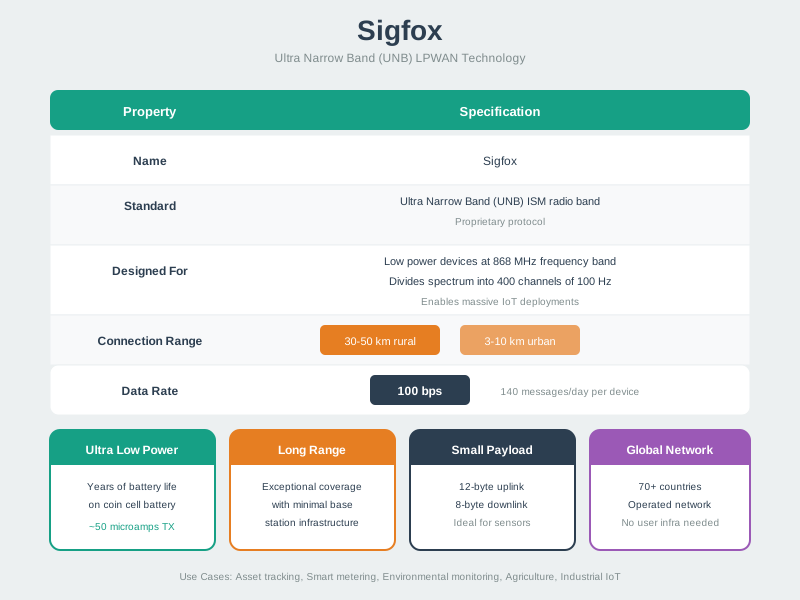
Sigfox provides a fully managed network where operators handle all infrastructure, allowing customers to focus on device development without deploying base stations.
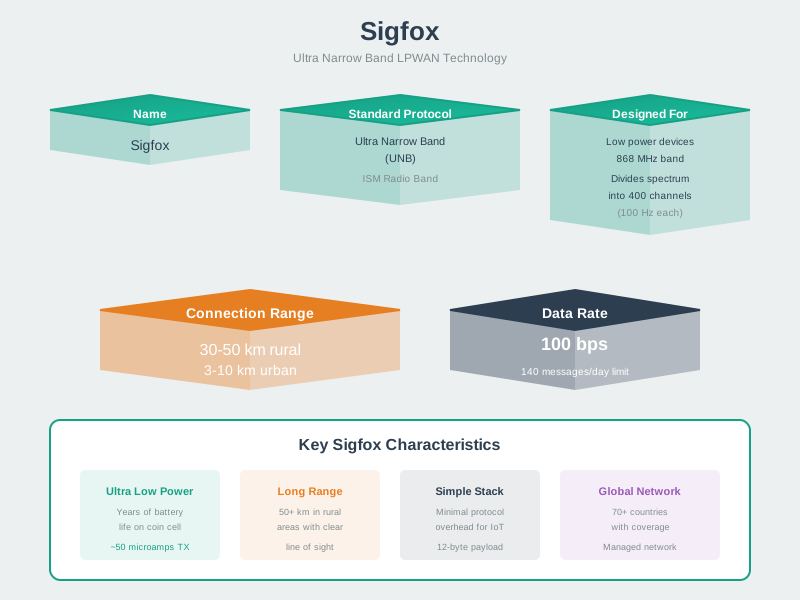
Sigfox’s ultra-narrowband approach uses 100 Hz channels with DBPSK modulation, achieving exceptional receiver sensitivity (-142 dBm) for maximum range with minimal power consumption.
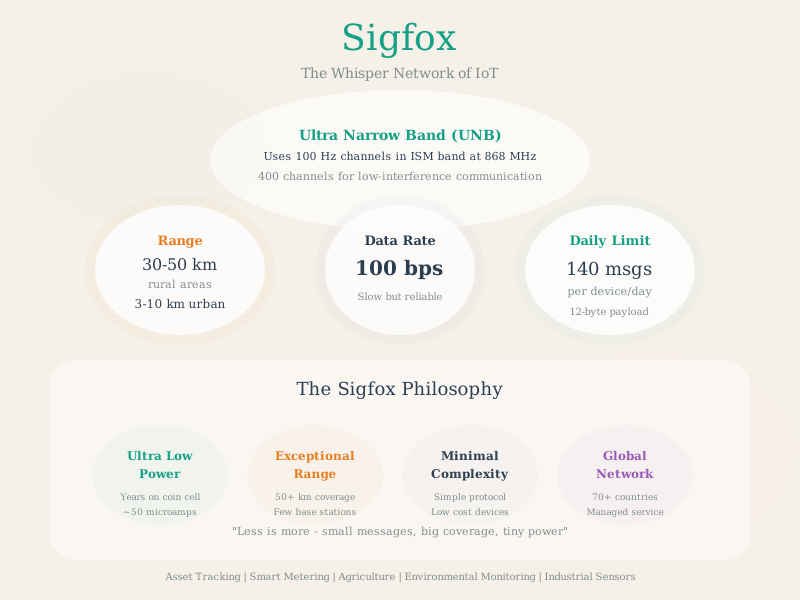
Understanding Sigfox’s strict message limits is essential for application design: 140 uplinks with 12 bytes and only 4 downlinks with 8 bytes per day.
1125.12 Summary
Sigfox device management presents unique challenges due to limited downlink capability:
- OTA firmware updates via Sigfox are impractical (5.6 years for 64KB firmware)
- Physical access required for most firmware changes in deployed devices
- Pre-planning with reserved bytes is crucial for future extensibility
- Bluetooth/Wi-Fi secondary radio enables practical local updates
- LoRaWAN significantly better for field updateability (OTA in hours vs years)
- Device replacement is the most expensive option ($275K for 10K devices)
- Proper initial design saves $40-275K in update costs over device lifetime
- Downlink issues are most commonly caused by missing RX window configuration
1125.13 What’s Next
Continue your Sigfox learning:
- Return to: Sigfox Review - Comprehensive overview
- Then: Sigfox Operator Risks - Infrastructure dependency analysis
- Then: Sigfox Use Case Analysis - Evaluate suitability
- Compare: NB-IoT Fundamentals - Cellular IoT alternative