%%{init: {'theme': 'base', 'themeVariables': {'primaryColor': '#2C3E50', 'primaryTextColor': '#fff', 'primaryBorderColor': '#16A085', 'lineColor': '#E67E22', 'secondaryColor': '#16A085', 'tertiaryColor': '#7F8C8D'}}}%%
pie title Industrial Ethernet Market Share (2024)
    "PROFINET" : 22
    "EtherNet/IP" : 20
    "EtherCAT" : 12
    "Modbus TCP" : 8
    "CC-Link IE" : 6
    "POWERLINK" : 4
    "Others" : 28
1255 Industrial Ethernet Protocols
1255.1 Industrial Ethernet: PROFINET, EtherCAT, and TSN
NoteLearning Objectives
By the end of this section, you will be able to:
- Compare major industrial Ethernet protocols (PROFINET, EtherNet/IP, EtherCAT)
- Understand real-time classes and deterministic networking requirements
- Design EtherCAT networks for high-speed motion control
- Configure PROFINET for Siemens automation systems
- Evaluate Time-Sensitive Networking (TSN) for converged IT/OT
- Select appropriate industrial Ethernet for specific applications
1255.2 Prerequisites
Before diving into this chapter, you should be familiar with:
- Industrial Protocols Overview: IT/OT networking context
- Networking Basics: Ethernet and TCP/IP fundamentals
- Wired Communication: Physical layer concepts
NoteRelated Chapters
Industrial Protocols: - Industrial Protocols Overview - Protocol landscape - OPC-UA Fundamentals - Integration layer - Modbus Protocol - Legacy comparison
Networking: - Networking Basics - Ethernet fundamentals
TipFor Beginners: Why Industrial Ethernet?
Office Ethernet: Designed for files, emails, web browsing - “Best effort” delivery—packets arrive eventually - A 100ms delay? Nobody notices
Industrial Ethernet: Designed for machine control - Deterministic delivery—packets MUST arrive on time - A 100ms delay? Robot crashes, product ruined
The Challenge: Standard Ethernet wasn’t built for this. When you plug a printer and a robot controller into the same switch, the printer’s large print job can delay the robot’s control packets.
The Solutions: 1. Modified Ethernet (PROFINET IRT, EtherCAT): Change how Ethernet works 2. Priority Mechanisms (TSN): Add strict scheduling to standard Ethernet 3. Dedicated Networks: Keep industrial traffic separate
Real-World Analogy: - Standard Ethernet = Regular highway (everyone shares, traffic jams possible) - Industrial Ethernet = Emergency vehicle lane (guaranteed access for critical traffic)
1255.3 Industrial Ethernet Landscape
TipUnderstanding Industrial Ethernet Determinism
Core Concept: Determinism means guaranteed, predictable timing—a control command sent will arrive within a known time window with minimal variation (jitter), regardless of other network traffic.
Why It Matters: Standard Ethernet uses best-effort delivery where packets may be delayed by other traffic. For motion control (robot arms, CNC machines), a delayed command can cause collisions, product defects, or safety hazards. Industrial Ethernet protocols solve this through various mechanisms: time-slotted scheduling (PROFINET IRT), processing-on-the-fly (EtherCAT), or IEEE TSN standards (802.1Qbv time-aware shaper).
Key Takeaway: Match your cycle time requirement to the protocol: <100 microseconds requires EtherCAT or PROFINET IRT; 1-10 milliseconds works with PROFINET RT or EtherNet/IP; >10 milliseconds can use standard Ethernet with OPC-UA or MQTT.
1255.3.2 Protocol Comparison
| Protocol | Vendor | Cycle Time | Nodes | Primary Use |
|---|---|---|---|---|
| PROFINET | Siemens | 250μs - 10ms | 512 | Factory automation |
| EtherNet/IP | Rockwell | 1-10ms | Unlimited | Process, discrete |
| EtherCAT | Beckhoff | <100μs | 65,535 | Motion control |
| CC-Link IE | Mitsubishi | 125μs - 10ms | 254 | Asia-Pacific |
| POWERLINK | B&R | 200μs - 10ms | 253 | CNC, packaging |
| SERCOS III | Bosch | 31.25μs | 511 | Motion control |
1255.4 PROFINET
1255.4.1 Architecture
%%{init: {'theme': 'base', 'themeVariables': {'primaryColor': '#2C3E50', 'primaryTextColor': '#fff', 'primaryBorderColor': '#16A085', 'lineColor': '#E67E22', 'secondaryColor': '#16A085', 'tertiaryColor': '#7F8C8D'}}}%%
graph TB
    subgraph Classes["PROFINET Classes"]
        NRT[PROFINET NRT<br/>Non-Real-Time<br/>TCP/UDP/IP]
        RT[PROFINET RT<br/>Real-Time<br/>100ms - 10ms]
        IRT[PROFINET IRT<br/>Isochronous Real-Time<br/><1ms]
    end

    NRT --> TCP[Standard TCP/IP<br/>Configuration, diagnostics]
    RT --> ETH[Ethernet Layer 2<br/>Priority tagging]
    IRT --> SYNC[Synchronized<br/>Time slots]

    style NRT fill:#7F8C8D,stroke:#2C3E50,color:#fff
    style RT fill:#E67E22,stroke:#2C3E50,color:#fff
    style IRT fill:#16A085,stroke:#2C3E50,color:#fff
{fig-alt=“PROFINET classes showing three performance tiers: NRT (Non-Real-Time) in gray using standard TCP/UDP/IP for configuration, RT (Real-Time) in orange using Ethernet Layer 2 with priority for 100ms-10ms cycles, IRT (Isochronous Real-Time) in teal using synchronized time slots for sub-1ms cycles.”}
1255.4.2 PROFINET Device Roles
| Role | Function | Example |
|---|---|---|
| IO Controller | Master device, initiates communication | PLC (S7-1500) |
| IO Device | Slave device, responds to controller | Remote I/O, drives |
| IO Supervisor | Configuration and diagnostics | Engineering station |
1255.4.3 PROFINET Frame Structure
| Ethernet Header | VLAN Tag | Frame ID | Cyclic Data | Status | FCS |
| 14 bytes        | 4 bytes  | 2 bytes  | Variable    | 4 bytes| 4 bytes|
Frame ID Ranges: | Range | Use | |——-|—–| | 0x0000-0x00FF | Reserved | | 0x0100-0x7FFF | RT unicast | | 0x8000-0xBFFF | RT multicast | | 0xC000-0xFBFF | IRT | | 0xFC00-0xFCFF | Alarm | | 0xFE00-0xFEFF | Reserved | | 0xFF00-0xFFFF | Non-PROFINET |
1255.4.4 Network Topology
%%{init: {'theme': 'base', 'themeVariables': {'primaryColor': '#2C3E50', 'primaryTextColor': '#fff', 'primaryBorderColor': '#16A085', 'lineColor': '#E67E22', 'secondaryColor': '#16A085', 'tertiaryColor': '#7F8C8D'}}}%%
graph TB
    PLC[S7-1500 PLC<br/>IO Controller]

    PLC --> SW1[PROFINET Switch]

    SW1 --> IO1[ET 200SP<br/>Remote I/O]
    SW1 --> IO2[ET 200MP<br/>Remote I/O]
    SW1 --> Drive1[SINAMICS<br/>Drive]
    SW1 --> HMI[HMI Panel]

    IO1 --> M1[Motors]
    IO1 --> S1[Sensors]

    style PLC fill:#16A085,stroke:#2C3E50,color:#fff
    style SW1 fill:#7F8C8D,stroke:#2C3E50,color:#fff
    style IO1 fill:#E67E22,stroke:#2C3E50,color:#fff
    style IO2 fill:#E67E22,stroke:#2C3E50,color:#fff
    style Drive1 fill:#E67E22,stroke:#2C3E50,color:#fff
    style HMI fill:#2C3E50,stroke:#16A085,color:#fff
{fig-alt=“PROFINET network topology showing S7-1500 PLC as IO Controller in teal connecting through PROFINET Switch in gray to IO Devices in orange (ET 200SP, ET 200MP remote I/O, SINAMICS drive) and HMI panel in navy. Remote I/O connects to motors and sensors.”}
1255.5 EtherCAT
1255.5.1 Operating Principle
EtherCAT’s key innovation: Processing on the Fly
%%{init: {'theme': 'base', 'themeVariables': {'primaryColor': '#2C3E50', 'primaryTextColor': '#fff', 'primaryBorderColor': '#16A085', 'lineColor': '#E67E22', 'secondaryColor': '#16A085', 'tertiaryColor': '#7F8C8D'}}}%%
sequenceDiagram
    participant M as Master
    participant S1 as Slave 1
    participant S2 as Slave 2
    participant S3 as Slave 3

    Note over M,S3: Single Frame Travels Through All Slaves

    M->>S1: Ethernet Frame<br/>[All slave data]

    Note over S1: Read relevant bits<br/>Insert output data<br/>Delay: ~1μs

    S1->>S2: Modified Frame

    Note over S2: Read relevant bits<br/>Insert output data<br/>Delay: ~1μs

    S2->>S3: Modified Frame

    Note over S3: Read relevant bits<br/>Insert output data<br/>Delay: ~1μs

    S3-->>M: Return Frame<br/>[Complete I/O data]

    Note over M: All 3 slaves updated<br/>in single network cycle
{fig-alt=“EtherCAT processing-on-the-fly sequence: Master sends single Ethernet frame containing all slave data, each Slave (1, 2, 3) reads its relevant bits, inserts output data with ~1μs delay, passes frame to next slave. Final slave returns frame to Master. All I/O updated in single network cycle, achieving microsecond-level performance.”}
1255.5.2 EtherCAT Frame Structure
| Ethernet Header | EtherCAT Header | Datagram 1 | Datagram 2 | ... | FCS |
| 14 bytes        | 2 bytes         | Variable   | Variable   |     | 4 bytes|
Datagram Structure:
| Header | Address | Data | WKC |
| 10 bytes| 4 bytes | N bytes | 2 bytes|- WKC (Working Counter): Incremented by each slave that processes the datagram
1255.5.3 EtherCAT Addressing Modes
| Mode | Description | Use Case |
|---|---|---|
| Position | Sequential order in network | Simple topologies |
| Node | Configured node address | Large networks |
| Logical | FMMU-mapped logical address | Process image |
| Broadcast | All slaves | Configuration |
1255.5.4 Distributed Clocks
EtherCAT achieves sub-microsecond synchronization:
%%{init: {'theme': 'base', 'themeVariables': {'primaryColor': '#2C3E50', 'primaryTextColor': '#fff', 'primaryBorderColor': '#16A085', 'lineColor': '#E67E22', 'secondaryColor': '#16A085', 'tertiaryColor': '#7F8C8D'}}}%%
graph LR
    M[Master<br/>Reference Clock] --> S1[Slave 1<br/>DC Slave]
    S1 --> S2[Slave 2<br/>DC Slave]
    S2 --> S3[Slave 3<br/>DC Slave]

    M -.->|Sync Signal| S1
    S1 -.->|Propagated| S2
    S2 -.->|Propagated| S3

    Note1[Jitter < 1μs]

    style M fill:#16A085,stroke:#2C3E50,color:#fff
    style S1 fill:#E67E22,stroke:#2C3E50,color:#fff
    style S2 fill:#E67E22,stroke:#2C3E50,color:#fff
    style S3 fill:#E67E22,stroke:#2C3E50,color:#fff
{fig-alt=“EtherCAT Distributed Clocks showing Master as reference clock in teal synchronizing DC Slaves (1, 2, 3) in orange through propagated sync signals with jitter less than 1 microsecond. Enables precise synchronized motion control across multiple drives.”}
1255.5.5 EtherCAT Network Topology
%%{init: {'theme': 'base', 'themeVariables': {'primaryColor': '#2C3E50', 'primaryTextColor': '#fff', 'primaryBorderColor': '#16A085', 'lineColor': '#E67E22', 'secondaryColor': '#16A085', 'tertiaryColor': '#7F8C8D'}}}%%
graph TB
    Master[EtherCAT Master<br/>Industrial PC]

    Master --> S1[Slave 1<br/>I/O Terminal]
    S1 --> S2[Slave 2<br/>Servo Drive]
    S2 --> S3[Slave 3<br/>Servo Drive]
    S3 --> S4[Slave 4<br/>I/O Terminal]

    S2 --> Branch1[Branch Slave<br/>EK1100 Coupler]
    Branch1 --> B1[I/O Module]
    Branch1 --> B2[I/O Module]

    S4 -.->|Hot Standby| Master

    style Master fill:#16A085,stroke:#2C3E50,color:#fff
    style S1 fill:#E67E22,stroke:#2C3E50,color:#fff
    style S2 fill:#E67E22,stroke:#2C3E50,color:#fff
    style S3 fill:#E67E22,stroke:#2C3E50,color:#fff
    style S4 fill:#E67E22,stroke:#2C3E50,color:#fff
    style Branch1 fill:#2C3E50,stroke:#16A085,color:#fff
{fig-alt=“EtherCAT network topology showing Master in teal connected to daisy-chained Slaves (I/O Terminal, Servo Drives) in orange. Branch topology from Slave 2 to EK1100 Coupler with additional I/O modules. Optional hot standby return path from last slave to master for redundancy.”}
1255.6 EtherNet/IP
1255.6.1 Architecture
EtherNet/IP uses the Common Industrial Protocol (CIP) over standard Ethernet:
%%{init: {'theme': 'base', 'themeVariables': {'primaryColor': '#2C3E50', 'primaryTextColor': '#fff', 'primaryBorderColor': '#16A085', 'lineColor': '#E67E22', 'secondaryColor': '#16A085', 'tertiaryColor': '#7F8C8D'}}}%%
graph TB
    subgraph CIP["CIP Application Layer"]
        Objects[CIP Objects<br/>Identity, Assembly, Connection]
        Services[CIP Services<br/>Get Attribute, Set Attribute]
    end

    subgraph Transport["Transport Options"]
        TCP[TCP<br/>Explicit messaging<br/>Port 44818]
        UDP[UDP<br/>Implicit messaging<br/>Port 2222]
    end

    Objects --> Services
    Services --> TCP
    Services --> UDP

    style CIP fill:#16A085,stroke:#2C3E50
    style Transport fill:#E67E22,stroke:#2C3E50
{fig-alt=“EtherNet/IP architecture showing CIP Application Layer in teal (CIP Objects for Identity/Assembly/Connection and CIP Services for Get/Set Attribute) with Transport Options in orange (TCP on port 44818 for explicit messaging, UDP on port 2222 for implicit messaging).”}
1255.6.2 CIP Connections
| Type | Transport | Use Case |
|---|---|---|
| Explicit | TCP | Configuration, diagnostics |
| Implicit (I/O) | UDP multicast | Cyclic data exchange |
| Unconnected | UDP | One-time requests |
1255.7 Time-Sensitive Networking (TSN)
1255.7.1 TSN Standards
TSN is a set of IEEE 802.1 standards for deterministic Ethernet:
| Standard | Name | Function |
|---|---|---|
| 802.1AS | Timing and Sync | Clock synchronization |
| 802.1Qbv | Time-Aware Shaper | Scheduled traffic |
| 802.1Qbu/802.3br | Frame Preemption | Interrupt low-priority |
| 802.1Qci | Stream Filtering | Ingress policing |
| 802.1CB | Redundancy | Frame replication |
| 802.1Qcc | Configuration | Central management |
1255.7.2 TSN Traffic Scheduling
%%{init: {'theme': 'base', 'themeVariables': {'primaryColor': '#2C3E50', 'primaryTextColor': '#fff', 'primaryBorderColor': '#16A085', 'lineColor': '#E67E22', 'secondaryColor': '#16A085', 'tertiaryColor': '#7F8C8D'}}}%%
gantt
    title TSN Time-Aware Shaper (802.1Qbv)
    dateFormat X
    axisFormat %L

    section Critical
    Motion Control    :crit, 0, 100
    Motion Control    :crit, 500, 600
    Motion Control    :crit, 1000, 1100

    section Scheduled
    PLC I/O          :active, 100, 200
    PLC I/O          :active, 600, 700

    section Best Effort
    IT Traffic       :200, 500
    IT Traffic       :700, 1000
{fig-alt=“TSN Time-Aware Shaper Gantt chart showing three traffic classes over time: Critical motion control traffic in red at fixed intervals (0-100, 500-600, 1000-1100μs), Scheduled PLC I/O in blue between critical slots, Best Effort IT traffic filling remaining windows. Demonstrates deterministic scheduling with guaranteed time slots.”}
1255.7.3 TSN Network Architecture
%%{init: {'theme': 'base', 'themeVariables': {'primaryColor': '#2C3E50', 'primaryTextColor': '#fff', 'primaryBorderColor': '#16A085', 'lineColor': '#E67E22', 'secondaryColor': '#16A085', 'tertiaryColor': '#7F8C8D'}}}%%
graph TB
    subgraph Converged["Converged TSN Network"]
        CNC[CNC Controller]
        TSN1[TSN Switch]
        TSN2[TSN Switch]

        Robot[Robot Controller]
        PLC[PLC]
        Camera[Vision Camera]
        PC[Engineering PC]
    end

    CNC --> TSN1
    TSN1 --> TSN2

    TSN1 --> Robot
    TSN1 --> PLC
    TSN2 --> Camera
    TSN2 --> PC

    subgraph Traffic["Traffic Types"]
        T1[Critical: Motion<br/>1ms cycle]
        T2[Scheduled: I/O<br/>10ms cycle]
        T3[Best Effort: IT<br/>No guarantee]
    end

    style Converged fill:#16A085,stroke:#2C3E50
    style Traffic fill:#E67E22,stroke:#2C3E50
{fig-alt=“Converged TSN network in teal showing CNC Controller, Robot Controller, PLC (critical devices), Vision Camera, and Engineering PC all connected through TSN Switches. Traffic types box in orange shows three classes: Critical motion (1ms), Scheduled I/O (10ms), Best Effort IT (no guarantee). Single network carries all traffic types with guaranteed timing.”}
1255.7.4 OPC-UA over TSN
The emerging standard for unified industrial communication:
%%{init: {'theme': 'base', 'themeVariables': {'primaryColor': '#2C3E50', 'primaryTextColor': '#fff', 'primaryBorderColor': '#16A085', 'lineColor': '#E67E22', 'secondaryColor': '#16A085', 'tertiaryColor': '#7F8C8D'}}}%%
graph TB
    subgraph App["Application"]
        OPCUA[OPC-UA<br/>Information Model]
    end

    subgraph PubSub["OPC-UA Pub/Sub"]
        Publisher[Publisher]
        Subscriber[Subscriber]
    end

    subgraph TSN["TSN Ethernet"]
        QBV[802.1Qbv<br/>Scheduling]
        AS[802.1AS<br/>Time Sync]
    end

    OPCUA --> PubSub
    Publisher --> TSN
    Subscriber --> TSN

    style App fill:#16A085,stroke:#2C3E50
    style PubSub fill:#E67E22,stroke:#2C3E50
    style TSN fill:#2C3E50,stroke:#16A085
{fig-alt=“OPC-UA over TSN stack showing three layers: Application with OPC-UA Information Model in teal, OPC-UA Pub/Sub with Publisher and Subscriber in orange, TSN Ethernet with 802.1Qbv scheduling and 802.1AS time sync in navy. Represents unified industrial communication standard.”}
1255.8 Protocol Selection Guide
1255.8.1 Decision Matrix
%%{init: {'theme': 'base', 'themeVariables': {'primaryColor': '#2C3E50', 'primaryTextColor': '#fff', 'primaryBorderColor': '#16A085', 'lineColor': '#E67E22', 'secondaryColor': '#16A085', 'tertiaryColor': '#7F8C8D'}}}%%
flowchart TB
    Start[Select Industrial Ethernet] --> Q1{Cycle Time?}

    Q1 -->|<100μs| EC[EtherCAT]
    Q1 -->|100μs-1ms| Q2{Vendor?}
    Q1 -->|>1ms| Q3{Integration?}

    Q2 -->|Siemens| PNIRT[PROFINET IRT]
    Q2 -->|B&R| PL[POWERLINK]
    Q2 -->|Open| EC2[EtherCAT]

    Q3 -->|Siemens| PNRT[PROFINET RT]
    Q3 -->|Rockwell| EIP[EtherNet/IP]
    Q3 -->|IT Convergence| TSN[TSN + OPC-UA]

    style Start fill:#16A085,stroke:#2C3E50,color:#fff
    style EC fill:#E67E22,stroke:#2C3E50,color:#fff
    style EC2 fill:#E67E22,stroke:#2C3E50,color:#fff
    style PNIRT fill:#E67E22,stroke:#2C3E50,color:#fff
    style PL fill:#E67E22,stroke:#2C3E50,color:#fff
    style PNRT fill:#2C3E50,stroke:#16A085,color:#fff
    style EIP fill:#2C3E50,stroke:#16A085,color:#fff
    style TSN fill:#16A085,stroke:#2C3E50,color:#fff
{fig-alt=“Industrial Ethernet selection flowchart: Starting with cycle time requirement, sub-100μs leads to EtherCAT, 100μs-1ms branches by vendor (Siemens→PROFINET IRT, B&R→POWERLINK, Open→EtherCAT), greater than 1ms branches by integration need (Siemens→PROFINET RT, Rockwell→EtherNet/IP, IT Convergence→TSN+OPC-UA).”}
1255.8.2 Application Suitability
| Application | Best Protocol | Cycle Time | Why |
|---|---|---|---|
| CNC Machining | EtherCAT | 100-250μs | Sub-microsecond sync |
| Robotics | EtherCAT, PROFINET IRT | 250μs-1ms | Coordinated motion |
| Packaging | PROFINET RT, EtherNet/IP | 1-10ms | Fast but not critical |
| Process Control | PROFINET RT, Modbus TCP | 10-100ms | Slow processes |
| Building Automation | BACnet/IP, Modbus TCP | 100ms-1s | Non-critical timing |
1255.9 Understanding Check
WarningKnowledge Check
Scenario: You’re designing a semiconductor wafer handling system with: - 6-axis robot arm (synchronized 8 axes total) - 50+ I/O points for vacuum, sensors - Vision system for alignment - Integration with MES for recipe management - Requirement: 100μs motion synchronization
Questions:
- Which industrial Ethernet would you choose for motion control?
- How would you handle the vision system integration?
- What about MES connectivity?
- How would you ensure 100μs synchronization?
NoteSolution
1. Motion Control: EtherCAT - 100μs requirement eliminates PROFINET RT and EtherNet/IP - EtherCAT achieves 50-100μs cycles easily - Distributed Clocks for sub-microsecond synchronization - Native support in most servo drive manufacturers
2. Vision System Integration: Option A: Separate GigE Vision network (keeps determinism) Option B: EtherCAT with CoE (CAN over EtherCAT) for triggers - Vision processing done off-network - Only trigger/result over EtherCAT (~μs for signal) - Camera images via separate GigE (bulk data)
3. MES Connectivity: OPC-UA via Gateway - EtherCAT master exposes OPC-UA server - MES connects as OPC-UA client - Non-deterministic traffic isolated from motion network - Recipe download before motion, not during
4. Ensuring 100μs Synchronization:
Distributed Clocks Configuration:
- Reference clock: EtherCAT master
- DC slaves: All servo drives
- Propagation delay: Auto-measured at startup
- Sync0 signal: Triggers synchronized motion
- Jitter: <100ns (100× better than requirement)
Network topology:
Master → Drive1 → Drive2 → ... → Drive8 → I/O- Daisy-chain minimizes jitter
- Total propagation: 8 × 1μs = 8μs
- Plenty of margin for 100μs cycle
1255.10 Visual Reference Gallery
Explore these AI-generated diagrams that visualize Industrial Ethernet concepts:
NoteVisual: Industrial Ethernet Protocol Comparison
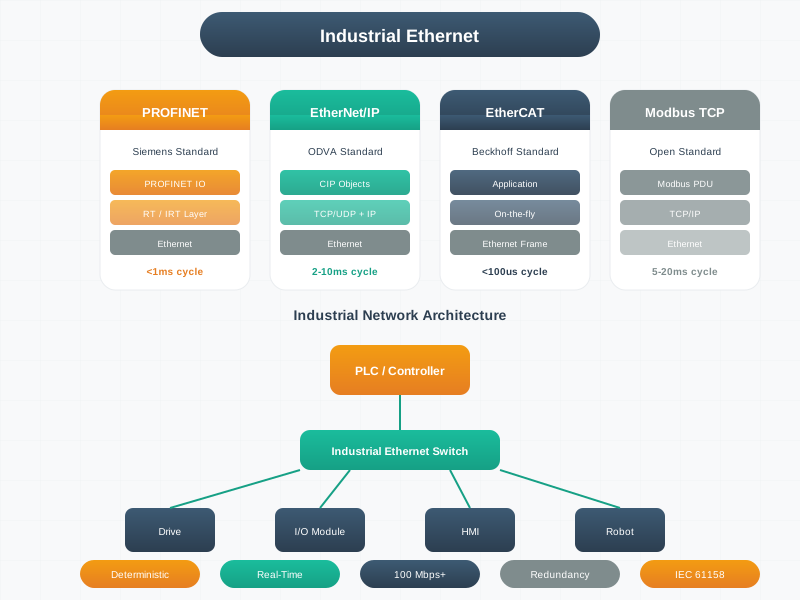
Industrial Ethernet protocols span a range of performance requirements from standard EtherNet/IP to sub-100 microsecond EtherCAT for motion control applications.
NoteVisual: PROFINET Architecture
PROFINET provides a scalable solution from 10ms standard automation to sub-millisecond synchronized motion control using its tiered RT and IRT communication classes.
NoteVisual: EtherCAT Process Data
EtherCAT achieves exceptional performance through processing-on-the-fly, where each node reads and writes its data as the frame passes through with nanosecond-level precision.
1255.11 Key Takeaways
TipSummary
PROFINET dominates Siemens ecosystems with RT (10ms) and IRT (<1ms) classes
EtherCAT achieves the fastest cycles (<100μs) with processing on the fly
EtherNet/IP (Rockwell) uses standard TCP/UDP with CIP application layer
TSN is the future—deterministic standard Ethernet enabling IT/OT convergence
Choose by cycle time: <100μs → EtherCAT, <1ms → PROFINET IRT, >1ms → PROFINET RT/EtherNet/IP
Distributed Clocks (EtherCAT) or PTP (TSN) enable sub-microsecond synchronization
OPC-UA over TSN is emerging as the unified industrial standard
1255.12 What’s Next
Continue exploring industrial protocols:
- OPC-UA Fundamentals - Integration layer for all protocols
- Modbus Protocol - Legacy protocol still in use
- Industrial Protocols Overview - Complete landscape