1136 NB-IoT Technical Specifications
Bandwidth, Data Rates, and Deployment Modes
1136.1 Learning Objectives
By the end of this chapter, you will be able to:
- Analyze technical specifications: Describe NB-IoT bandwidth, data rates, and latency characteristics
- Compare deployment modes: Evaluate standalone, guard-band, and in-band deployment options
- Understand coverage capabilities: Explain the 164 dB MCL and coverage enhancement mechanisms
- Apply specifications to design: Select appropriate NB-IoT configurations for specific applications
1136.2 NB-IoT Overview
Narrowband IoT (NB-IoT) is a Low-Power Wide-Area Network (LPWAN) radio technology standardized by 3GPP (3rd Generation Partnership Project) specifically designed for IoT applications. Unlike LoRaWAN and Sigfox which use unlicensed spectrum, NB-IoT operates in licensed cellular spectrum, providing carrier-grade reliability and quality of service.
1136.2.1 Standardization and Evolution
NB-IoT was standardized by 3GPP in Release 13 (2016) to enable IoT connectivity over existing cellular infrastructure with focus on reliability, coverage, and long battery life.
1136.3 Core Technical Specifications
1136.3.1 Key Parameters
| Parameter | Specification |
|---|---|
| Standard | 3GPP Release 13+ |
| Bandwidth | 180 kHz (1 PRB) |
| Data Rate | DL: 25 kbps (single-tone) UL: 64 kbps (multi-tone) |
| Peak Rate | ~250 kbps (multi-carrier) |
| Latency | <10 seconds (normal) <1 second (exception mode) |
| Duplex | Half-duplex FDD |
| Max Coupling Loss | 164 dB (MCL) |
| Power Class | 23 dBm (200 mW) |
| Modulation | QPSK (uplink), QPSK (downlink) |
1136.3.2 Data Rates and Capacity
NB-IoT supports different data rates depending on the configuration:
Downlink (Network to Device):
- Single-tone: 25 kbps
- Multi-tone: up to 200+ kbps
Uplink (Device to Network):
- Single-tone (3.75 kHz): 16 kbps
- Single-tone (15 kHz): 64 kbps
- Multi-tone (15 kHz x 3): up to 160 kbps
1136.4 Deployment Modes
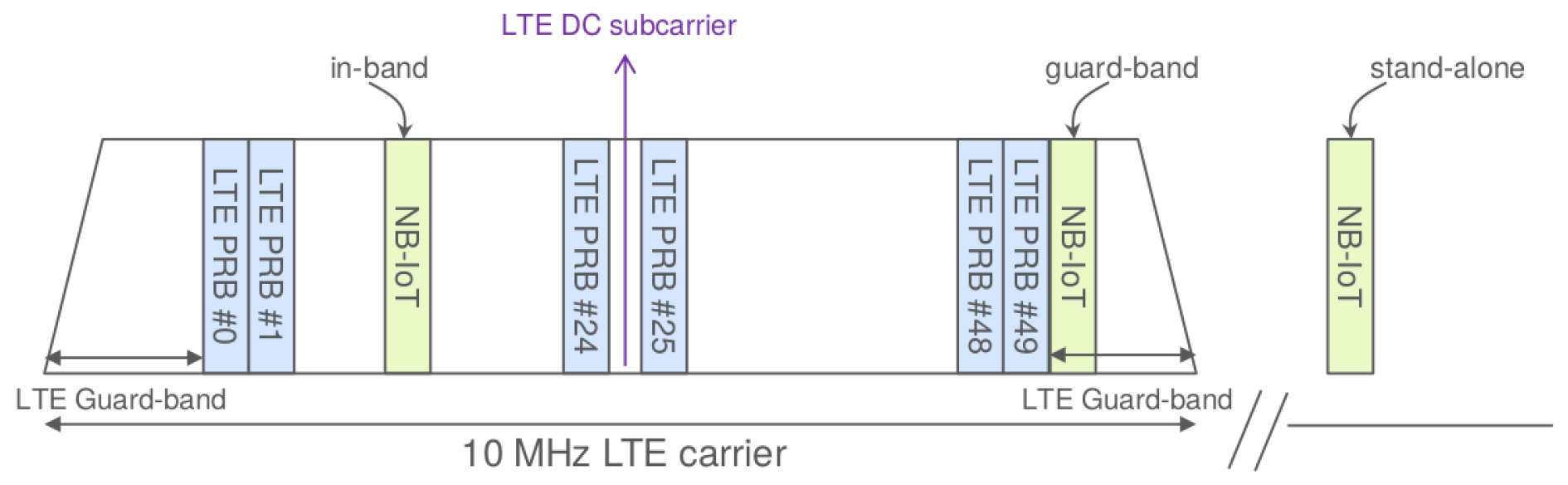
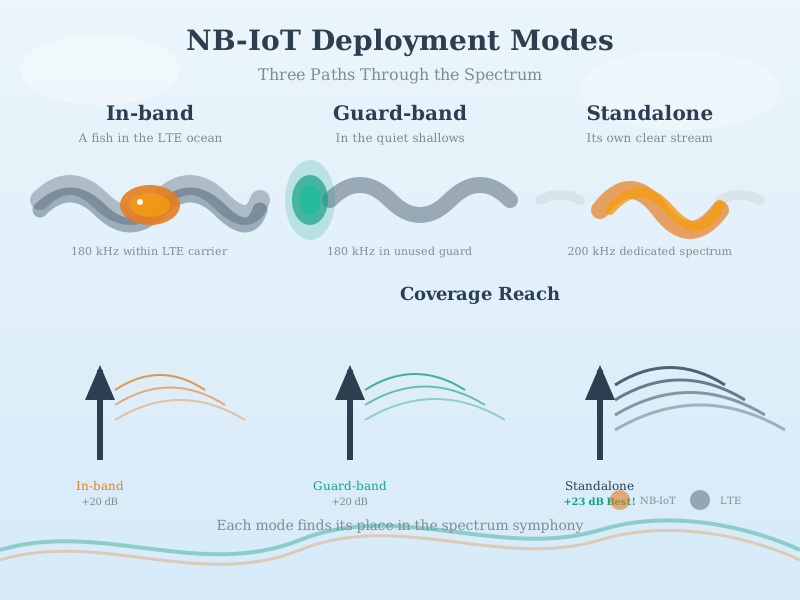
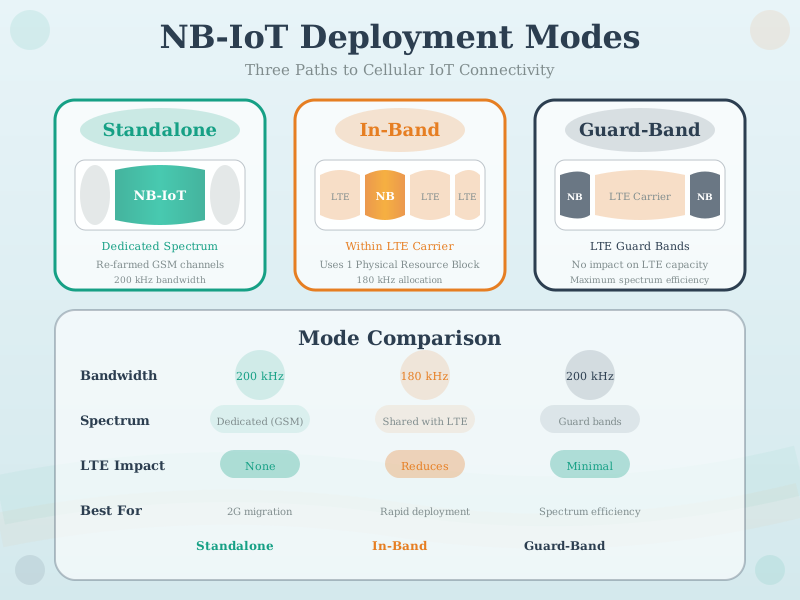
NB-IoT can be deployed in three different modes, allowing operators to introduce IoT services without requiring entirely new spectrum.
The NPTEL IoT course from IIT Kharagpur describes a three-tier fog computing architecture that illustrates how NB-IoT devices integrate with edge and cloud infrastructure:
- IoT Devices Tier (Bottom): Sensors, smart homes, vehicles, and wearables generate data
- Fog Layer (Middle): Fog nodes (switches, routers, gateways) provide local processing for high-sensitivity data, with private server/cloud options for confidential information
- Cloud Tier (Top): Processes less sensitive data and provides global analytics
This architecture demonstrates how NB-IoT sensors can leverage fog computing for local processing before sending aggregated data to the cloud, reducing latency and bandwidth requirements while maintaining data privacy.
Source: NPTEL Internet of Things Course, IIT Kharagpur
1136.4.1 Standalone Mode
Operates in dedicated spectrum (e.g., refarmed GSM spectrum):
Typical bands:
- 900 MHz (former GSM)
- 800 MHz
- 700 MHz
Advantages:
- No impact on existing LTE services
- Full bandwidth available
- Easier network planning
1136.4.2 Guard-Band Mode
Operates in the guard band between LTE carriers:
Use case:
- Maximize spectrum efficiency
- Rapid NB-IoT introduction
- No need for new spectrum
1136.4.3 In-Band Mode
Operates within an LTE carrier using one or more Physical Resource Blocks (PRBs):
Trade-off:
- Easy deployment (software upgrade)
- Slightly reduces LTE capacity
- Most common initial deployment mode
1136.4.4 Deployment Mode Comparison
| Mode | Spectrum | LTE Impact | Complexity | Coverage |
|---|---|---|---|---|
| Standalone | Dedicated (GSM) | None | Low | Excellent |
| Guard-Band | Between LTE | Minimal | Medium | Very good |
| In-Band | Within LTE PRB | Some reduction | Higher | Very good |
1136.4.5 NB-IoT Deployment Mode Selection (Decision Flowchart)
This decision flowchart provides an approach to selecting the optimal NB-IoT deployment mode based on operator constraints and spectrum availability:

1136.5 NB-IoT vs Other LPWAN Technologies
1136.5.1 Technology Comparison
1136.5.2 Detailed Comparison
| Feature | NB-IoT | LoRaWAN | Sigfox |
|---|---|---|---|
| Spectrum | Licensed cellular | Unlicensed ISM | Unlicensed ISM |
| Standard | 3GPP Release 13+ | LoRa Alliance | Proprietary |
| Data Rate | 25-250 kbps | 0.3-50 kbps | 0.1 kbps |
| Latency | <10s (normal) | 1-5s | seconds-minutes |
| Range | 10-15 km (urban) | 2-5 km (urban) | 3-10 km (urban) |
| Battery Life | 10+ years | 5-10 years | 10-20 years |
| QoS | Guaranteed (SLA) | Best effort | Best effort |
| Infrastructure | Existing cellular | Deploy gateways | Operator network only |
| Cost (device) | $5-15 | $5-15 | $5-10 |
| Cost (service) | $1-5/month | $0 (private) or $1-3/month (public) | $1-10/year |
| Mobility | Full support | Limited | Limited |
| Security | 3GPP security (256-bit) | AES-128 | Proprietary |
1136.5.3 When to Choose NB-IoT
Choose NB-IoT when you need:
- Guaranteed quality of service (SLA from mobile operator)
- Existing cellular coverage (no gateway deployment)
- Regulatory compliance (licensed spectrum)
- Full mobility support (handoff between cells)
- Higher data rates occasionally (firmware updates)
- Carrier-grade security and authentication
- No technical team to manage infrastructure
Consider alternatives when:
- Deploying < 100 devices (LPWAN private network more economical)
- Need very low cost per device long-term (Sigfox cheaper for simple apps)
- Require complete data privacy (private LoRaWAN)
- Want zero recurring costs (private LoRaWAN)
1136.6 Knowledge Check
Test your understanding of NB-IoT technical specifications.
Question 1: A cellular operator is deploying NB-IoT to support IoT devices. They have existing LTE infrastructure with 10 MHz carriers. Which deployment mode would allow the FASTEST time-to-market with minimal impact on existing LTE subscribers?
Explanation: In-Band mode enables fastest deployment with software-only changes:
In-Band Deployment Process:
- No new spectrum - use existing LTE license
- No new hardware - software upgrade only
- Minimal planning - same tower locations
- Quick testing - easy rollback if issues
- Gradual rollout - enable per-cell as needed
Why other options are slower:
- Standalone (GSM refarm): Requires migrating GSM users, regulatory approval (6-12 months)
- Guard-Band: May need hardware filters, interference analysis (3-6 months)
- New 700 MHz spectrum: Spectrum auction, new equipment (12-24 months)
Real-world example: Deutsche Telekom launched NB-IoT in Germany using In-Band mode - announcement to commercial service in ~6 months.
Question 2: NB-IoT can be deployed inside an LTE carrier using a single LTE Physical Resource Block (PRB). What is the bandwidth of one PRB?
Explanation: In LTE, one PRB occupies 180 kHz (12 subcarriers x 15 kHz each). NB-IoT can be placed in-band by allocating 1 PRB within an existing LTE carrier (software-configured on the eNodeB).
This narrow bandwidth is why it’s called “Narrowband” IoT - it uses a tiny fraction of the spectrum compared to regular LTE.
1136.7 Summary
- NB-IoT is a 3GPP-standardized LPWAN operating in licensed cellular spectrum with 180 kHz bandwidth
- Three deployment modes enable flexible spectrum utilization: standalone (dedicated spectrum), guard-band (between LTE carriers), and in-band (within LTE carrier using 1 PRB)
- Data rates range from 25 kbps to 250 kbps depending on configuration, suitable for small IoT payloads
- 164 dB Maximum Coupling Loss provides +20 dB better coverage than GPRS, enabling deep indoor penetration
- Licensed spectrum operation provides interference protection, guaranteed QoS, and carrier SLA
1136.8 What’s Next
Continue your NB-IoT learning journey with these related topics:
- NB-IoT Architecture - Understand the CIoT architecture, SCEF, and control/user plane optimization
- NB-IoT Applications - Explore smart metering, asset tracking, and smart city use cases
- NB-IoT Power Optimization - Master PSM and eDRX configuration for 10+ year battery life
- Alternative LPWAN: Compare with LoRaWAN Fundamentals to understand unlicensed spectrum options