1133 NB-IoT Power Optimization
PSM, eDRX, and Battery Life Engineering
1133.1 Learning Objectives
By the end of this chapter, you will be able to:
- Configure PSM timers: Set T3412 and T3324 values for optimal battery life
- Design eDRX cycles: Balance power savings with downlink responsiveness
- Select power modes: Choose between PSM-only, eDRX-only, and combined modes
- Calculate battery life: Account for sleep current, TX duration, and CE repetitions
1133.2 Power Saving Mode (PSM) Deep Dive
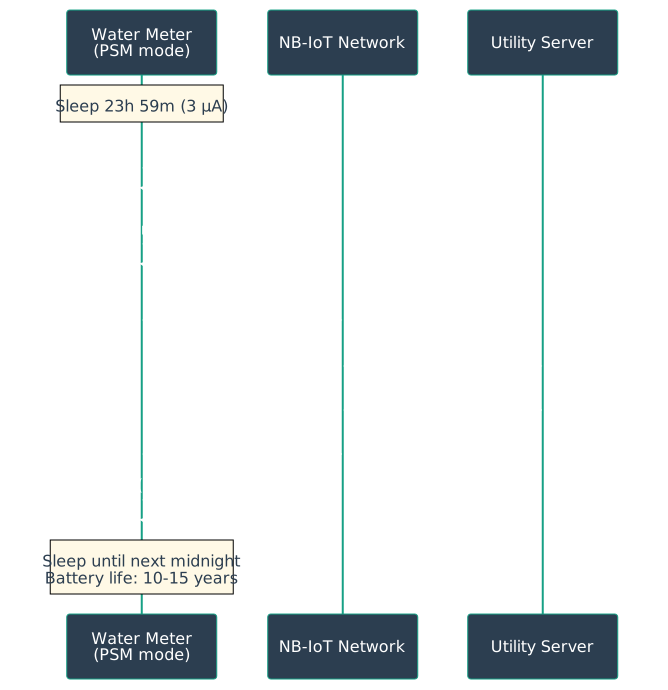
PSM is the foundation of NB-IoT’s 10+ year battery life promise. When in PSM, the device’s radio is completely off, reducing current consumption to 3-10 uA.
1133.2.1 PSM Timer Configuration
Two timers control PSM behavior:
T3412 (TAU Timer - Extended Periodic Tracking Area Update)
- Determines how long the device can sleep while remaining registered
- Range: 2 seconds to 310 hours (configurable in 3GPP Release 13+)
- Device must send TAU before T3412 expires or be de-registered
- Typical values: 24-72 hours for smart metering
T3324 (Active Timer)
- Determines how long device stays in active mode after data transfer
- Range: 2 seconds to 186 minutes
- Device enters PSM when T3324 expires
- Typical values: 10-60 seconds (just long enough for ACK)
1133.2.2 PSM Power Consumption
| State | Current | Duration | Notes |
|---|---|---|---|
| PSM Sleep | 3-10 uA | Hours/days | Radio completely off |
| Waking | 50 mA | ~100 ms | Restoring context |
| RRC Connected | 40-80 mA | 0.5-2 s | Signaling exchange |
| TX Active | 200-300 mA | 0.2-2 s | Data transmission |
1133.2.3 PSM Limitations
Important: During PSM, the device is completely unreachable.
- Network cannot page the device
- Downlink messages are queued until device wakes
- Emergency commands cannot be delivered
- Firmware updates must wait for scheduled wake-up
This is why PSM is ideal for uplink-only applications (metering, environmental monitoring) but problematic for applications requiring downlink responsiveness.
1133.3 Extended Discontinuous Reception (eDRX)
eDRX provides a middle ground between always-connected (high power) and PSM (unreachable). The device periodically wakes to check for paging messages.
1133.3.1 eDRX Configuration
eDRX Cycle: How long between paging windows
- Range: 5.12 seconds to 2.91 hours (NB-IoT specific)
- Longer cycles = better battery life, slower downlink response
Paging Time Window (PTW): How long device listens during each cycle
- Range: 2.56 seconds to 40.96 seconds
- Longer PTW = better downlink reception, higher power
1133.3.2 eDRX Power Consumption
eDRX Cycle (20.48 seconds example):

|----Sleep period-----|--PTW--|----Sleep...
|     (0.5 mA avg)    | 2.5s  |
|                     |       |
|<--- 20.48s -------->|       |
|                     |       |
|  Cannot receive     | Check |
|  downlink           | page  |
Average current during eDRX:
Sleep current: 0.5 mA (light sleep, maintaining timing)
Active during PTW: 40 mA
PTW duration: 2.56 seconds every 20.48 seconds

Average current = (17.92s x 0.5mA + 2.56s x 40mA) / 20.48s
                = (8.96 + 102.4) / 20.48
                = 5.4 mA average

Compare to:
- PSM: 0.003 mA (1800x lower!)
- Always connected: 40 mA (7x higher)
1133.4 PSM vs eDRX: Mode Selection
1133.4.1 Mode Selection Guide
| Use Case | Uplink Frequency | Downlink Needed? | Recommended Mode |
|---|---|---|---|
| Smart meter | Daily | Rare (monthly firmware) | PSM + scheduled wake |
| Asset tracker | Hourly | Yes (change reporting interval) | eDRX (wake every 20 min) |
| Smart parking | Continuous (occupancy change) | No | PSM (wake on sensor trigger) |
| Remote control | Low | Yes (real-time commands) | eDRX or RRC Connected |
1133.5 Worked Example: PSM vs eDRX for Fleet Tracker
Scenario: A fleet management company deploys NB-IoT trackers in delivery vehicles. The vehicles operate 10 hours per day (7 AM - 5 PM) with varying requirements.
Given:
- Vehicle operation: 10 hours/day active, 14 hours/day parked
- Active tracking: Location every 5 minutes
- Parked mode: Location every 2 hours + instant wake on motion
- Downlink requirements:
- During operation: Route updates every 30 minutes
- Parked: Theft alerts (immediate delivery required)
- Battery: 10,000 mAh (replaceable annually)
- Target battery life: 12 months minimum
1133.5.1 Design: Mode Transitions
1133.5.2 Calculation: DRIVING Mode Power
Active hours: 10 hours/day = 36,000 seconds

Position updates:
- Frequency: Every 5 minutes = 120 per day (active)
- GPS fix: 1 second at 30 mA = 30 mAs
- NB-IoT TX: 0.5 second at 200 mA = 100 mAs
- Total per update: 130 mAs

eDRX listening:
- eDRX cycle: 20.48 seconds
- Paging windows per hour: 176
- Listen duration: 10 ms at 40 mA = 0.4 mAs each
- Per hour: 176 x 0.4 = 70.4 mAs
- 10 hours: 704 mAs

Sleep between eDRX:
- Duration: ~35,802 seconds
- Current: 10 uA
- Energy: 358 mAs

Daily DRIVING consumption:
- Position TX: 120 x 130 = 15,600 mAs = 4.33 mAh
- eDRX listening: 704 mAs = 0.20 mAh
- Sleep: 358 mAs = 0.10 mAh
- Total DRIVING: 4.63 mAh/day
1133.5.3 Calculation: PARKED Mode Power
Parked hours: 14 hours/day = 50,400 seconds

Position updates (every 2 hours):
- Updates: 7 per day (parked period)
- GPS + TX: 130 mAs each
- Total: 910 mAs = 0.25 mAh

PSM sleep:
- Duration: ~50,390 seconds
- Current: 3 uA
- Energy: 151 mAs = 0.04 mAh

Accelerometer (always-on for theft detection):
- Current: 5 uA continuous
- 24 hours: 432 mAs = 0.12 mAh

Daily PARKED consumption:
- Position TX: 0.25 mAh
- PSM sleep: 0.04 mAh
- Accelerometer: 0.12 mAh
- Total PARKED: 0.41 mAh/day
1133.5.4 Calculation: Total Battery Life
Total daily: 4.63 + 0.41 = 5.04 mAh

With 10,000 mAh battery:
Theoretical life = 10,000 / 5.04 = 1,984 days = 5.4 years

Apply derating:
- Usable capacity (80%): 8,000 mAh
- Temperature factor (90%): 7,200 mAh
- Aging over 1 year (85%): 6,120 mAh

Practical life = 6,120 / 5.04 = 1,214 days = 3.3 years

RESULT: 12-month target easily met with 2+ years margin!
Result: Use hybrid PSM/eDRX mode with accelerometer wake. During driving (7 AM - 5 PM): eDRX with 20.48s cycle for route updates. While parked (5 PM - 7 AM): PSM with 2-hour T3412, accelerometer-triggered immediate wake for theft alerts. This achieves 5-minute tracking during operation, <5 second theft alerts when parked, and 3.3-year battery life.
Key Insight: PSM and eDRX are not mutually exclusive - design a state machine that transitions between modes based on operational context. The accelerometer is critical - it enables instant theft detection while allowing PSM’s ultra-low power sleep.
1133.6 Knowledge Check
Question: An NB-IoT device is configured with PSM timer T3412 = 24 hours and Active Timer T3324 = 10 seconds. The device sends one uplink message per day. What is the expected behavior when the cloud server needs to send a firmware update to this device?
Explanation: PSM creates long unreachable periods - the server must wait or trigger wake-up:
PSM Timeline:
- Device sends daily reading
- T3324 (10 seconds) starts - device reachable
- T3324 expires - device enters PSM (unreachable)
- Device sleeps for up to 24 hours
- Only wakes when: sensor event, RTC timer, or T3412 expiry
Server downlink options:
- Wait for next wake - up to 24 hours
- Device triggering via SCEF - network pages device (if supported)
- Schedule updates - know when device wakes
Why other options are wrong:
- A: PSM specifically disables always-on connectivity
- C: eNodeB doesn’t buffer user data for hours
- D: Question states PSM, not eDRX mode