1128 NB-IoT Architecture
Cellular IoT Network Architecture and Components
1128.1 Learning Objectives
By the end of this chapter, you will be able to:
- Describe the CIoT architecture: Explain the components and their roles in NB-IoT networks
- Understand data paths: Compare Control Plane and User Plane optimization for small data
- Identify key components: Describe the functions of eNodeB, MME, SCEF, S-GW, and P-GW
- Explain the attach procedure: Understand how NB-IoT devices connect to the network
1128.2 Cellular IoT Architecture Overview
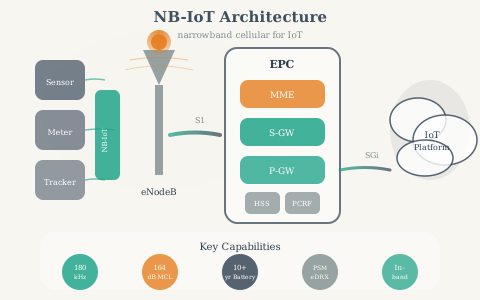
The Cellular IoT (CIoT) architecture extends the traditional LTE Evolved Packet Core (EPC) with optimizations specifically designed for IoT applications. NB-IoT introduces new components and procedures that dramatically reduce power consumption and signaling overhead for devices that send small, infrequent data.

1128.3 Key Architecture Components
1128.3.1 1. Radio Access Network (RAN)
eNodeB (Evolved Node B):
The eNodeB is the LTE base station that handles radio communication with NB-IoT devices.
Functions:
- Manages radio resource scheduling for NB-IoT and LTE traffic
- Handles NB-IoT physical layer (NPSS, NSSS, NPBCH, NPDCCH, NPDSCH, NPUSCH)
- Performs Coverage Enhancement (CE) mode selection
- Manages RRC (Radio Resource Control) connection states
NB-IoT Physical Channels:
| Channel | Direction | Purpose |
|---|---|---|
| NPSS | DL | Narrowband Primary Synchronization Signal |
| NSSS | DL | Narrowband Secondary Synchronization Signal |
| NPBCH | DL | Narrowband Physical Broadcast Channel |
| NPDCCH | DL | Narrowband Physical Downlink Control Channel |
| NPDSCH | DL | Narrowband Physical Downlink Shared Channel |
| NPRACH | UL | Narrowband Physical Random Access Channel |
| NPUSCH | UL | Narrowband Physical Uplink Shared Channel |
1128.3.2 2. Mobility Management Entity (MME)
The MME is the control plane component that manages device registration, authentication, and mobility.
Functions:
- Authentication and security: EPS-AKA (Authentication and Key Agreement) with SIM/USIM
- Mobility management: Tracking Area Updates (TAU), handover coordination
- Session management: EPS bearer context establishment and modification
- Control plane signaling: NAS (Non-Access Stratum) message handling
- PSM/eDRX timer negotiation: Configures power-saving parameters with devices
1128.3.3 3. Service Capability Exposure Function (SCEF)
The SCEF is a new component introduced specifically for IoT in 3GPP Release 13. It provides APIs for IoT applications and enables efficient small data delivery.
Functions:
- APIs for IoT applications: RESTful interfaces for device management
- Non-IP data delivery: Optimized path for small payloads without IP overhead
- Event monitoring: Connectivity status, location, reachability reporting
- Device triggering: Wake up devices in PSM mode
- Group messaging: Multicast/broadcast to device groups
For small IoT payloads (10-100 bytes), traditional IP overhead (40+ bytes for headers) represents 40-400% overhead. SCEF enables Non-IP Data Delivery (NIDD) where raw application data travels through the control plane without IP encapsulation, dramatically improving efficiency for sensor readings and status updates.
1128.3.4 4. Serving Gateway (S-GW) / Packet Gateway (P-GW)
S-GW Functions:
- User plane traffic routing within the EPC
- Mobility anchor for handover between eNodeBs
- Downlink data buffering when device is in idle mode
P-GW Functions:
- IP address assignment (IPv4 or IPv6)
- Connection to external networks (internet, private networks)
- Policy enforcement (QoS, charging)
- Deep packet inspection (optional)
1128.3.5 5. Home Subscriber Server (HSS)
The HSS is the central database for subscriber information and authentication.
Functions:
- Subscriber database: IMSI, service profiles, QoS parameters
- Authentication data: Keys for EPS-AKA authentication
- Location information: Current MME serving the device
- Subscription management: Data limits, roaming permissions
1128.4 Control Plane vs User Plane Optimization
NB-IoT introduces Control Plane CIoT EPS Optimization for efficient small data transmission. This is one of the most important architectural innovations for IoT.

1128.4.1 Control Plane CIoT Optimization (DoNAS)
Data over NAS (DoNAS) sends user data piggy-backed on NAS signaling messages through the control plane.
Benefits:
- Reduced signaling overhead: No user plane bearer establishment needed
- Lower latency for small messages: Data travels with attach/TAU messages
- Lower power consumption: Fewer radio transmissions required
- Optimized for small payloads: Best for < 1600 bytes
Data Path:
Device -> eNodeB -> MME -> SCEF -> Application Server
                    (NAS)   (T6a)    (API)
1128.4.2 User Plane Optimization
Traditional data path through the user plane, suitable for larger data transfers.
Benefits:
- Higher throughput: Better for bulk data (firmware updates)
- Established protocols: Standard IP networking
- Multiple bearer support: Different QoS classes
Data Path:
Device -> eNodeB -> S-GW -> P-GW -> Internet -> Application Server
           (RRC)    (GTP)   (GTP)    (IP)
1128.4.3 When to Use Each Path
| Scenario | Recommended Path | Reason |
|---|---|---|
| Sensor reading (< 100 bytes) | Control Plane | Minimal overhead |
| Status update (100-500 bytes) | Control Plane | Fast delivery |
| Firmware update (> 10 KB) | User Plane | Higher throughput |
| Frequent small messages | Control Plane | Power efficiency |
| Bidirectional session | User Plane | Session state |
1128.5 NB-IoT Attach Procedure
Understanding the attach procedure helps explain the power consumption and latency characteristics of NB-IoT devices.
1128.5.1 Attach Procedure Steps
Step 1: Cell Search and Selection
- Device scans for NB-IoT cells using synchronization signals (NPSS/NSSS)
- Reads Master Information Block (MIB-NB) for system parameters
- Reads System Information Blocks (SIB1-NB, SIB2-NB) for access configuration
- Evaluates cell suitability based on signal quality (RSRP, RSRQ)
- Selects Coverage Enhancement (CE) level based on path loss
Step 2: Random Access (NPRACH)
- Device transmits preamble on NPRACH (Narrowband Physical Random Access Channel)
- Number of repetitions determined by CE level
- eNodeB responds with Random Access Response (RAR)
- Device sends RRC Connection Request (Msg3)
- eNodeB sends RRC Connection Setup (Msg4)
Step 3: Authentication (EPS-AKA)
- MME retrieves authentication vectors from HSS
- Authentication Request sent to device (RAND, AUTN)
- Device verifies network authenticity using USIM
- Device calculates and sends RES (Response)
- Keys derived: K_ASME, K_NASenc, K_NASint
Step 4: Security Mode Establishment
- MME sends NAS Security Mode Command (selected algorithms)
- Device activates NAS security (encryption + integrity)
- Device sends NAS Security Mode Complete
Step 5: Attach Accept
- MME sends Attach Accept with:
- T3412 value (TAU timer - extended periodic tracking area update)
- T3324 value (Active timer - time before entering PSM)
- eDRX parameters (if requested and supported)
- PDN connection parameters
- Device sends Attach Complete
- Device is now EMM-REGISTERED
1128.5.2 Timing Considerations
| Procedure Phase | Typical Duration | Notes |
|---|---|---|
| Cell search | 1-5 seconds | Depends on signal strength |
| Random access | 0.5-2 seconds | Longer with CE repetitions |
| Authentication | 1-2 seconds | Network latency dependent |
| Security mode | 0.5-1 second | |
| Attach complete | 0.5-1 second | |
| Total | 3-10 seconds | First attach; subsequent faster |
1128.6 Architecture for Smart Metering Example
To illustrate the architecture in practice, consider a smart water meter deployment:
Smart Water Meter
       |
       | (NB-IoT Radio - 180 kHz)
       v
   eNodeB (City Cell Tower)
       |
       | (S1 Interface)
       v
   MME (Carrier Core Network)
       |
       +---> HSS (Subscriber Database)
       |
       +---> SCEF (IoT API Gateway)
                  |
                  | (T6a Interface)
                  v
          Utility Company Cloud
          - Billing System
          - Leak Detection AI
          - Customer Portal
Data Flow for Daily Meter Reading:
- Meter wakes from PSM at scheduled time
- Resumes RRC connection (faster than full attach)
- Sends reading via Control Plane (NAS message)
- MME forwards to SCEF via T6a interface
- SCEF delivers to utility company via REST API
- Meter receives ACK, restarts T3324 timer
- After T3324 expires, enters PSM again
Key Architectural Benefits:
- No IP overhead: Meter reading travels as raw bytes through SCEF
- Carrier SLA: Guaranteed delivery to utility company
- Centralized management: SCEF provides fleet management APIs
- Security: End-to-end encryption via 3GPP security
1128.7 Knowledge Check
Question: Which NB-IoT network component provides APIs for IoT applications and enables efficient small data delivery without IP overhead?
Explanation: The SCEF (Service Capability Exposure Function) is a new component introduced in 3GPP Release 13 specifically for IoT. It provides:
- RESTful APIs for IoT application integration
- Non-IP Data Delivery (NIDD) for efficient small payloads
- Device triggering to wake devices from PSM
- Event monitoring (connectivity, location, reachability)
The SCEF enables Control Plane CIoT Optimization where small sensor data travels through the control plane without IP encapsulation, reducing overhead from 40+ bytes (IP headers) to just a few bytes.
Question: For an NB-IoT smart meter sending 50-byte daily readings, which data path provides the most power-efficient transmission?
Explanation: Control Plane (DoNAS) is optimal for small payloads like 50-byte meter readings because:
- No bearer establishment: Data piggy-backs on NAS signaling
- No IP overhead: Raw data through SCEF (vs 40+ byte IP headers)
- Fewer radio transmissions: Less time in active mode
- Power savings: Estimated 30-50% reduction vs User Plane
User Plane is better for larger transfers (firmware updates) where the overhead becomes proportionally smaller.
1128.8 Summary
- CIoT architecture extends LTE EPC with IoT-specific components (SCEF) and optimizations
- Key components: eNodeB (radio), MME (control), SCEF (IoT APIs), S-GW/P-GW (user plane), HSS (subscriber database)
- Control Plane optimization (DoNAS) sends small data through signaling path for maximum efficiency
- User Plane optimization provides higher throughput for larger data transfers
- SCEF enables Non-IP Data Delivery, device triggering, and event monitoring APIs
- Attach procedure takes 3-10 seconds for initial connection; subsequent wakeups are faster
1128.9 What’s Next
Continue your NB-IoT learning journey with these related topics:
- NB-IoT Power Optimization - Master PSM and eDRX configuration for 10+ year battery life
- NB-IoT Applications - Explore smart metering, asset tracking, and smart city use cases with worked examples
- NB-IoT Practical Guide - Learn from common mistakes and real-world deployment pitfalls