%%{init: {'theme': 'base', 'themeVariables': { 'primaryColor': '#2C3E50', 'primaryTextColor': '#fff', 'primaryBorderColor': '#16A085', 'lineColor': '#16A085', 'secondaryColor': '#E67E22', 'tertiaryColor': '#7F8C8D', 'fontSize': '14px'}}}%%
flowchart TB
    subgraph DEVICES["IoT Devices (10,000+)"]
        D1["Sensors 1-3000"]
        D2["Sensors 3001-6000"]
        D3["Sensors 6001-10000"]
    end

    LB["Load Balancer<br/>(HAProxy/NGINX)"]

    subgraph CLUSTER["MQTT Broker Cluster"]
        B1["Broker Node 1<br/>(3000 connections)"]
        B2["Broker Node 2<br/>(3000 connections)"]
        B3["Broker Node 3<br/>(4000 connections)"]
    end

    REDIS["Redis<br/>(Session Store)"]
    DB["PostgreSQL<br/>(Retained Messages<br/>QoS 1/2 Queue)"]

    D1 --> LB
    D2 --> LB
    D3 --> LB

    LB --> B1
    LB --> B2
    LB --> B3

    B1 <-->|"Message Bridge"| B2
    B2 <-->|"Message Bridge"| B3
    B1 <-->|"Message Bridge"| B3

    B1 --> REDIS
    B2 --> REDIS
    B3 --> REDIS

    B1 --> DB
    B2 --> DB
    B3 --> DB

    style DEVICES fill:#2C3E50,stroke:#16A085,stroke-width:2px,color:#fff
    style LB fill:#7F8C8D,stroke:#2C3E50,stroke-width:3px,color:#fff
    style CLUSTER fill:#16A085,stroke:#2C3E50,stroke-width:2px,color:#fff
    style REDIS fill:#E67E22,stroke:#2C3E50,stroke-width:2px,color:#fff
    style DB fill:#2C3E50,stroke:#E67E22,stroke-width:2px,color:#fff
    style D1 fill:#d4edda,stroke:#16A085,stroke-width:1px,color:#000
    style D2 fill:#d4edda,stroke:#16A085,stroke-width:1px,color:#000
    style D3 fill:#d4edda,stroke:#16A085,stroke-width:1px,color:#000
    style B1 fill:#d4edda,stroke:#16A085,stroke-width:1px,color:#000
    style B2 fill:#d4edda,stroke:#16A085,stroke-width:1px,color:#000
    style B3 fill:#d4edda,stroke:#16A085,stroke-width:1px,color:#000
1209 MQTT Production Deployment
1209.1 Learning Objectives
By the end of this chapter, you will be able to:
- Design Scalable Architectures: Plan MQTT broker clustering for high availability and horizontal scaling
- Implement Security Best Practices: Configure TLS encryption, authentication, and topic-level authorization
- Troubleshoot Performance Issues: Identify and resolve common production bottlenecks
- Avoid Common Pitfalls: Recognize and prevent client ID collisions, QoS misuse, and session misconfigurations
1209.2 Prerequisites
Required Chapters:
- MQTT Architecture Patterns - Pub/sub concepts and topics
- MQTT QoS and Reliability - Delivery guarantees
Technical Background:
- TLS/SSL concepts
- Load balancing basics
- Database fundamentals (Redis, PostgreSQL)
Estimated Time: 15 minutes
1209.3 MQTT Broker Clustering Architecture
Production MQTT deployments require clustering for scalability and high availability:
MQTT broker clustering architecture for production scalability: Load balancer distributes 10,000+ IoT device connections across three broker nodes. Inter-node message bridging ensures subscribers on Node 2 receive messages published to Node 1. Shared Redis session store provides fast session lookup for client reconnections. PostgreSQL database persists retained messages and queued QoS 1/2 messages for offline clients. Architecture supports horizontal scaling (add nodes as load increases) achieving 100K-1M+ concurrent connections with less than 50ms end-to-end latency.
1209.3.1 Clustering Architecture Layers
Layer 1: IoT Devices (10,000+)
| Device Type | Role | Connection Pattern |
|---|---|---|
| Sensors | Publishers | Periodic data upload |
| Actuators | Subscribers | Command reception |
| Gateways | Pub/Sub | Bidirectional |
Layer 2: Load Balancer
| Function | Method |
|---|---|
| Distribution | Round Robin / Sticky Sessions |
| Monitoring | Health Checks |
| Ports | 1883 (TCP), 8883 (TLS) |
Layer 3: MQTT Broker Cluster
| Node | Connections | Inter-Node Communication |
|---|---|---|
| Broker Node 1 | 5K | Message Bridge + Session Replication to Node 2, 3 |
| Broker Node 2 | 3K | Message Bridge + Session Replication to Node 1, 3 |
| Broker Node 3 | 2K | Message Bridge + Session Replication to Node 1, 2 |
Layer 4: Shared Storage
| Store | Technology | Purpose |
|---|---|---|
| Session Store | Redis | Persistent Sessions, Subscriptions |
| Message Persistence | PostgreSQL/MongoDB | Retained Messages, Queued Messages |
1209.3.2 Scalability Strategies
- Horizontal Scaling: Add broker nodes to cluster as load increases (100K -> 1M+ connections)
- Load Balancing: Distribute client connections across brokers (sticky sessions preserve QoS state)
- Message Bridging: Brokers forward subscribed messages between nodes (subscriber on Node 2 receives messages published to Node 1)
- Shared Session Store: Redis/Memcached provides fast session lookup for client reconnections
- Message Persistence: Database stores retained messages and queued QoS 1/2 messages for offline clients
1209.3.3 Capacity Planning Metrics
| Metric | Typical Value | High-Performance |
|---|---|---|
| Connections/Node | 50K-100K | EMQX: 1M+, Mosquitto: 100K |
| Message Throughput | 100K msgs/sec | 500K+ msgs/sec per node |
| Latency Target | less than 50ms | less than 10ms end-to-end |
| Memory per Connection | ~4KB | + message queue storage |
1209.4 Security Configuration
Default MQTT port 1883: Unencrypted - username, password, payload visible to network sniffers.
Secure MQTT port 8883: TLS-encrypted TCP tunnel.
1209.4.1 TLS Configuration
client.tls_set(
    ca_certs="ca.crt",
    certfile="client.crt",
    keyfile="client.key"
)
This enables TLS with mutual authentication.
1209.4.2 Security Layers
| Layer | Protection | Implementation |
|---|---|---|
| Transport encryption (TLS) | Prevents eavesdropping | Port 8883 |
| Authentication | Proves client identity | Username/password |
| Client certificates | Mutual TLS (mTLS) | Broker verifies client cert |
| Authorization (ACLs) | Topic access control | Per-client permissions |
1209.4.3 Access Control Lists (ACLs)
Production example:
broker.acl:
  user sensor_device
    topic readwrite sensors/#
    topic read commands/device_123
Sensor can publish to sensors/*, read commands addressed to it, cannot access other devices’ data.
1209.4.4 Why Alternatives Are Insufficient
- Application-layer encryption only: Misses metadata (topic names visible), doesn’t protect credentials
- VPN: Adds latency/complexity, not always available on constrained devices
Cloud providers: AWS IoT Core, Azure IoT Hub, HiveMQ Cloud enforce TLS + certificate authentication by default. Never deploy production IoT with unencrypted MQTT.
1209.5 Performance Troubleshooting
1209.5.1 Symptom: Broker CPU at 100%, Message Delays
10,000 sensors: Modern brokers (Mosquitto, HiveMQ, EMQX) handle 100K-1M concurrent connections. If CPU is saturated, the issue is message throughput, not connection count.
Bottleneck analysis - CPU 100% suggests:
- QoS overhead: QoS 1/2 require acknowledgment processing (CPU-intensive). 10K sensors x 1 msg/sec x QoS 1 = 20K msgs/sec (publish + puback)
- Large messages: 10KB payloads x 10K/sec = 100MB/sec processing
- Complex ACLs: Authorization checks on every publish/subscribe
1209.5.2 Solutions
| Solution | Impact | Implementation |
|---|---|---|
| Broker clustering | Distribute load | EMQX, VerneMQ native clustering |
| Optimize QoS | 50% reduction | Use QoS 0 for high-frequency data |
| Reduce message size | 10x reduction | Send deltas, not full payloads |
| Batch messages | Fewer operations | Combine readings in single message |
| Edge brokers | Local aggregation | Per-floor/building brokers |
Benchmark reference:
| Broker | Throughput |
|---|---|
| HiveMQ Enterprise | ~1M msgs/sec |
| Mosquitto (single) | ~200K msgs/sec |
Production recommendations:
- Use managed MQTT services (AWS IoT Core auto-scales to millions of devices)
- Monitor broker metrics (Prometheus + Grafana)
- Implement backpressure/rate limiting on publishers
1209.6 Common Pitfalls
1209.6.1 Pitfall 1: Using QoS 2 for All Messages
CautionPitfall: Using QoS 2 for All Messages “Just to Be Safe”
The Mistake: Developers set QoS 2 (exactly-once delivery) for all messages, assuming higher QoS always means better reliability without considering the costs.
Why It Happens: QoS 2 sounds like the safest option, and developers don’t realize the significant overhead. The 4-way handshake (PUBLISH, PUBREC, PUBREL, PUBCOMP) seems like “extra safety” rather than a trade-off.
The Fix: Match QoS to actual requirements:
- QoS 0 for high-frequency sensor data (temperature every 5 seconds) - missing one reading is acceptable
- QoS 1 for important alerts and commands (door open, motion detected) - duplicates are acceptable, loss is not
- QoS 2 only for critical single-execution commands (financial transactions, medication dispensing) - duplicates and losses are both unacceptable
Real Impact: QoS 2 uses 4x the network messages of QoS 0 and 2x of QoS 1. For 10,000 sensors sending 1 message/second, QoS 2 generates 40,000 messages/second vs 10,000 for QoS 0. This can saturate broker capacity and increase latency from 10ms to 200ms+ under load. Battery-powered devices see 3-4x shorter battery life with QoS 2 vs QoS 0.
1209.6.2 Pitfall 2: Client ID Collisions
CautionPitfall: Ignoring Client ID Collisions in Production
The Mistake: Using the same client ID across multiple devices, or using predictable client IDs like “sensor_1” without proper uniqueness guarantees. When two clients connect with the same ID, the broker disconnects the first client.
Why It Happens: In development, a single device works fine. In production with auto-scaling, containerized deployments, or device replacements, multiple instances may attempt to use the same client ID simultaneously.
The Fix: Generate globally unique client IDs using:
# Good: UUID-based client ID
import uuid
client_id = f"sensor_{uuid.uuid4().hex[:12]}"  # "sensor_8f3a2b1c9d0e"

# Good: Device-specific identifier
client_id = f"sensor_{device_mac_address}_{deployment_id}"

# Bad: Sequential or predictable IDs
client_id = "sensor_1"  # Will collide with other "sensor_1" devices
Real Impact: Client ID collision causes constant reconnection loops where two devices fight for the same session. This creates:
- 50% message loss as each device is disconnected every few seconds
- Broker log flooding with connect/disconnect events
- Session state corruption if using persistent sessions
A 2021 smart home incident saw 5,000 devices in a reconnection storm because a firmware update hardcoded the same client ID.
1209.7 Protocol Bridging
1209.7.1 CoAP-MQTT Gateway
Protocol gateway bridges CoAP and MQTT by translating between request-response and publish-subscribe paradigms.
Architecture:
CoAP Sensors (battery-powered) <-- CoAP --> Gateway <-- MQTT --> Cloud Broker <-- MQTT --> ApplicationsGateway functions:
- CoAP->MQTT: Sensor POST to
coap://gateway/sensor/temp-> Gateway publishes tosensors/tempMQTT topic - MQTT->CoAP: Application publishes command to
commands/sensor1-> Gateway converts to CoAP PUTcoap://sensor1/config - Observe->Subscribe: CoAP Observe on sensor -> Gateway maintains subscription, forwards updates to MQTT
Benefits:
- Sensors use power-efficient CoAP/UDP locally
- Cloud services use reliable MQTT/TCP
- Gateway caches sensor data (reduce sensor wake time)
- Protocol translation invisible to both sides
Production examples: AWS IoT Greengrass (edge gateway with protocol translation), Eclipse IoT Gateway (open-source CoAP-MQTT bridge), Azure IoT Edge (custom modules)
Topology mapping:
| CoAP Operation | MQTT Equivalent |
|---|---|
RESTful resource /sensor/temp |
Topic devices/{device_id}/sensor/temp |
| CoAP GET | MQTT subscribe |
| CoAP POST | MQTT publish |
| CoAP PUT | MQTT publish with retained flag |
TipFor Beginners: Production MQTT Simplified
Think of production MQTT like running a postal distribution center:
| Home Setup | Production Setup |
|---|---|
| One post office | Multiple post offices (clustering) |
| No security | Locked mailboxes + ID verification (TLS + auth) |
| Manual sorting | Automated routing (load balancer) |
| Paper records | Database backup (Redis + PostgreSQL) |
The three things that break in production:
- Too many letters (messages) -> Add more post offices (broker nodes)
- Wrong addresses (client IDs) -> Make every mailbox unique (UUID)
- Thieves reading mail -> Encrypt everything (TLS on port 8883)
1209.8 Visual Reference Gallery
Explore these AI-generated diagrams that visualize MQTT protocol concepts:
NoteVisual: MQTT QoS Level Comparison
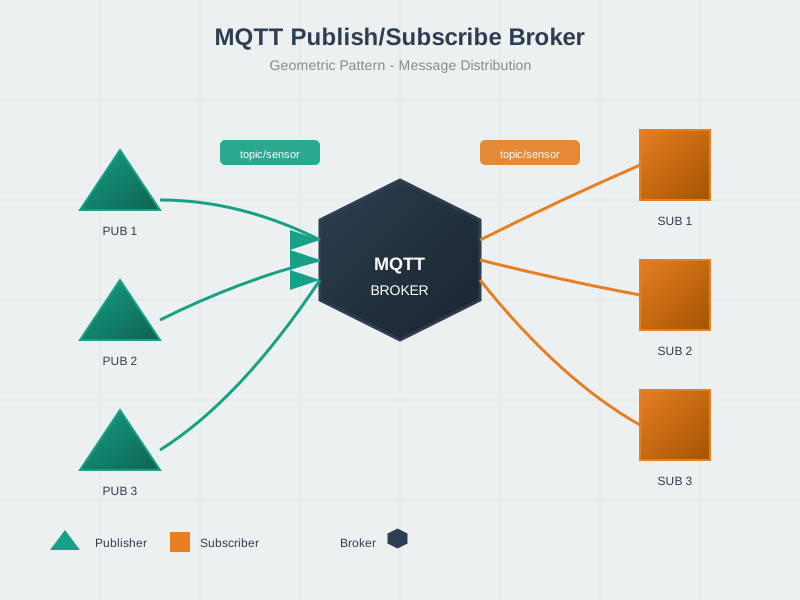
Understanding the trade-offs between QoS levels is essential for balancing reliability, latency, and power consumption in IoT deployments.
NoteVisual: MQTT Topic Hierarchy
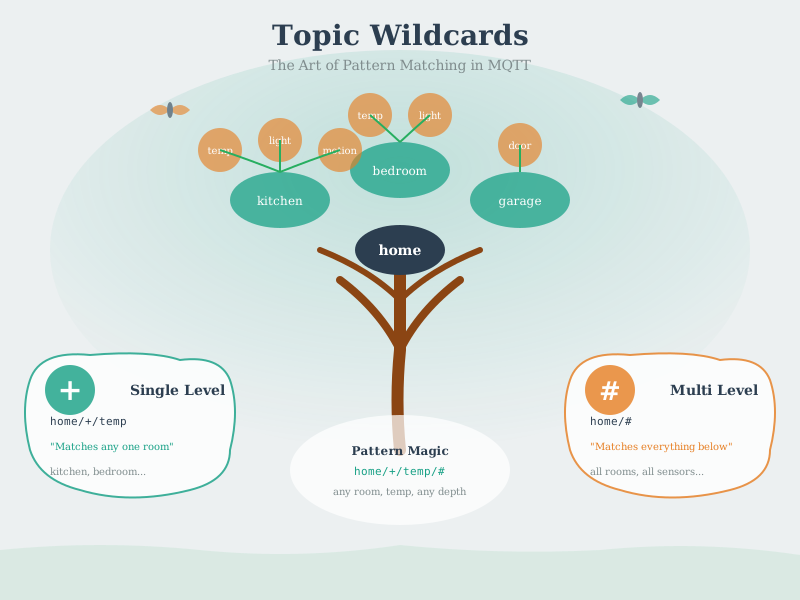
MQTT topics use hierarchical naming with powerful wildcard subscriptions, enabling efficient filtering of messages across large-scale IoT deployments.
1209.9 Summary
This chapter covered MQTT production deployment considerations:
- Broker Clustering: Horizontal scaling with load balancing, message bridging between nodes, and shared session/message storage achieves 100K-1M+ concurrent connections
- Security Configuration: TLS encryption (port 8883), username/password authentication, client certificates for mTLS, and topic-level ACLs are essential for production
- Performance Optimization: Use appropriate QoS levels, reduce message size, batch messages, and implement edge brokers for local aggregation
- Common Pitfalls: Avoid QoS 2 overuse (4x overhead), ensure unique client IDs (UUID-based), and configure sessions appropriately
- Protocol Bridging: Gateways translate between CoAP (battery-efficient) and MQTT (cloud-connected) for heterogeneous IoT deployments
1209.10 What’s Next
Continue exploring MQTT with these related chapters:
- Practice: MQTT Knowledge Check - Test your understanding with scenario-based questions
- Compare: CoAP - Learn the alternative request-response protocol
- Enterprise: AMQP Fundamentals - Understand advanced message queuing