%% fig-alt: "Decision tree flowchart for selecting LPWAN technology. Starting with mobility requirement, branches to LTE-M if mobile. For stationary devices, checks downlink needs (NB-IoT for heavy downlink), then payload size (Sigfox for tiny payloads), then coverage (NB-IoT for deep indoor), and finally network preference (LoRaWAN for private, NB-IoT for carrier-managed)."
%%{init: {'theme': 'base', 'themeVariables': {'primaryColor': '#2C3E50', 'primaryTextColor': '#fff', 'primaryBorderColor': '#16A085', 'lineColor': '#E67E22', 'secondaryColor': '#ECF0F1'}}}%%
flowchart TD
    START([Start: Select LPWAN]) --> Q1{Device moves<br/>during operation?}

    Q1 -->|Yes, mobile| LTE[**LTE-M**<br/>Mobility + handover]
    Q1 -->|No, stationary| Q2{Frequent downlink<br/>or OTA updates?}

    Q2 -->|Yes, heavy downlink| Q3{Indoor/basement<br/>deployment?}
    Q2 -->|No, mostly uplink| Q4{Payload size?}

    Q3 -->|Deep indoor| NB1[**NB-IoT**<br/>Best indoor penetration]
    Q3 -->|Outdoor/shallow| LTE2[**LTE-M**<br/>Better throughput]

    Q4 -->|< 12 bytes, < 140 msgs/day| SIG[**Sigfox**<br/>Ultra-simple, lowest power]
    Q4 -->|Larger payloads needed| Q5{Private network<br/>preferred?}

    Q5 -->|Yes, own infrastructure| LORA[**LoRaWAN**<br/>Flexible, private/public]
    Q5 -->|No, carrier-managed| Q6{Deep indoor<br/>coverage needed?}

    Q6 -->|Yes| NB2[**NB-IoT**<br/>Carrier + indoor]
    Q6 -->|No| LORA2[**LoRaWAN**<br/>Public network]

    style LTE fill:#16A085,color:#fff
    style LTE2 fill:#16A085,color:#fff
    style NB1 fill:#E67E22,color:#fff
    style NB2 fill:#E67E22,color:#fff
    style SIG fill:#9B59B6,color:#fff
    style LORA fill:#2C3E50,color:#fff
    style LORA2 fill:#2C3E50,color:#fff
1069 LPWAN Comparison and Review
1069.1 Learning Objectives
By the end of this chapter, you will be able to:
- Compare LPWAN options: Explain the trade-offs between LoRaWAN, Sigfox, NB-IoT, LTE-M, and other LPWAN choices
- Select by requirements: Choose a technology based on range, power, payload, latency, mobility, and cost constraints
- Validate assumptions: Spot common mismatches (e.g., downlink needs, mobility, duty cycle limits) that break deployments
1069.2 Prerequisites
Before you start, it helps to review:
- LPWAN Introduction: Big-picture landscape and the “why” of LPWAN
- LPWAN Fundamentals: Range/power/data-rate constraints and MAC-layer realities
- LPWAN Architectures: Star-of-stars vs cellular topologies and where complexity lives
NoteRelated Chapters
- LoRaWAN Overview - Device classes, join procedure, payload constraints
- Sigfox Fundamentals - Ultra-narrowband trade-offs and strict message budgets
- NB-IoT Fundamentals - Cellular LPWAN capabilities and deployment modes
- Cellular IoT Fundamentals - LTE-M vs NB-IoT positioning and mobility considerations
1069.3 LPWAN Comparison Matrix
Use this as a quick “first pass” filter. Always confirm with regional regulations, operator coverage, and your device’s real duty cycle and payload profile.
| Technology | Strengths | Typical Constraints | Best Fit |
|---|---|---|---|
| LoRaWAN | Private or public networks, long range, good battery life, flexible deployments | Limited payload and downlink, duty cycle limits, higher latency | Smart city sensing, metering, asset tracking (low update rates) |
| Sigfox | Extremely low power, simple uplink model, long range | Very limited messages/day and payload, constrained downlink | Simple telemetry, alarms, low-volume metering |
| NB-IoT | Deep indoor coverage, operator-managed, higher reliability than unlicensed LPWAN | Operator dependency, higher complexity/cost, latency variability | Utility metering, indoor sensors, deployments needing managed QoS |
| LTE-M | Mobility support, higher throughput, lower latency than NB-IoT | Higher power than unlicensed LPWAN, operator dependency | Mobile assets, wearables, firmware updates, voice/SMS (where applicable) |
| Weightless (family) | Multiple variants for different needs | Ecosystem and availability vary by region | Niche deployments where supported |
1069.3.1 LPWAN Selection Decision Tree
Use this decision tree to quickly narrow down your LPWAN choice based on key requirements:
1069.3.2 LPWAN Trade-off Comparison
This diagram shows where each technology sits on the power vs. data rate spectrum:
%% fig-alt: "Quadrant diagram comparing LPWAN technologies on two axes: power consumption (vertical) and data rate (horizontal). Sigfox sits at lowest power and lowest data rate. LoRaWAN is low power with low-medium data rate. NB-IoT is medium power with medium data rate. LTE-M is highest power with highest data rate. Arrows show the trade-off progression."
%%{init: {'theme': 'base', 'themeVariables': {'primaryColor': '#2C3E50', 'primaryTextColor': '#fff', 'primaryBorderColor': '#16A085', 'lineColor': '#E67E22'}}}%%
flowchart LR
    subgraph Power["⚡ Power Consumption"]
        direction TB
        LOW["Lowest"]
        MED["Medium"]
        HIGH["Highest"]
    end

    subgraph Tech["LPWAN Technologies"]
        SIG["**Sigfox**<br/>100 bps<br/>~10 μA sleep"]
        LORA["**LoRaWAN**<br/>0.3-50 kbps<br/>~1 μA sleep"]
        NB["**NB-IoT**<br/>~250 kbps<br/>~3 μA PSM"]
        LTE["**LTE-M**<br/>~1 Mbps<br/>~3 μA PSM"]
    end

    subgraph Rate["📶 Data Rate"]
        direction TB
        R1["100 bps"]
        R2["50 kbps"]
        R3["1 Mbps"]
    end

    SIG --> LORA --> NB --> LTE

    style SIG fill:#9B59B6,color:#fff
    style LORA fill:#2C3E50,color:#fff
    style NB fill:#E67E22,color:#fff
    style LTE fill:#16A085,color:#fff
1069.4 Selection Checklist
Answer these questions before you pick a protocol:
- Payload + frequency: How many bytes per message, and how often (worst case)?
- Downlink needs: Do you need remote actuation, config, or OTA updates?
- Mobility: Does the device move (handover, roaming, speed)?
- Coverage: Indoor depth, basements, rural range, and operator footprint.
- Power budget: Battery size, expected lifetime, and peak current limits.
- Cost model: Hardware BOM, certification, SIM/subscription, gateway ownership.
1069.5 Knowledge Check
Test your understanding of LPWAN technology comparisons with these scenario-based questions.
1069.6 Visual Reference Gallery
Explore these AI-generated diagrams that illustrate LPWAN technology comparison concepts:
NoteVisual: LPWAN Technology Comparison Overview
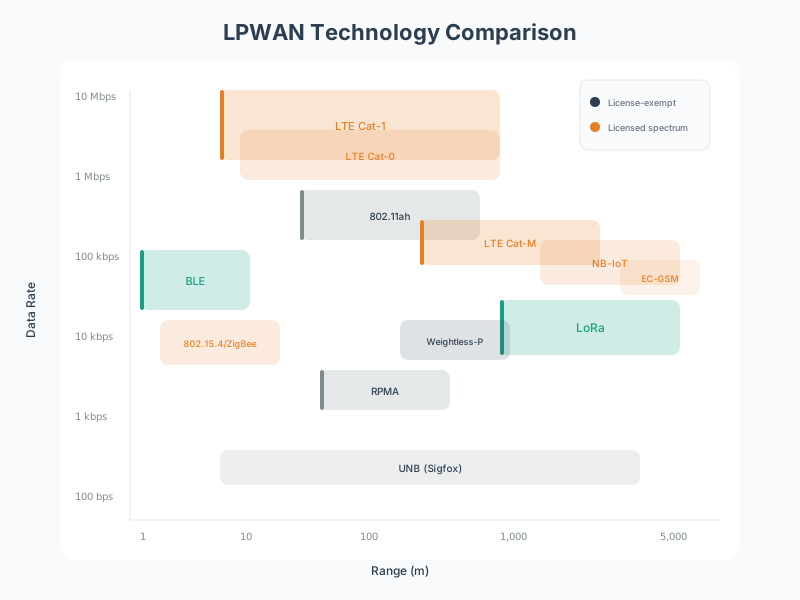
This diagram provides a comprehensive visual comparison of the major LPWAN technologies, helping you understand the trade-offs between range, data rate, power consumption, and deployment complexity.
NoteVisual: LPWAN Comparison Matrix
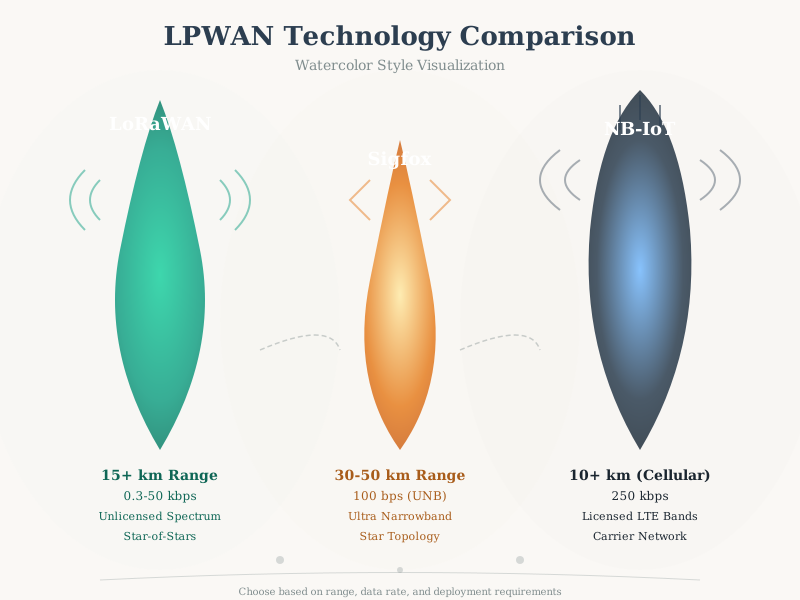
A stylized view of LPWAN comparison focusing on the key decision factors: private vs operator networks, uplink vs downlink capabilities, and coverage requirements.
NoteVisual: LoRaWAN Class Comparison
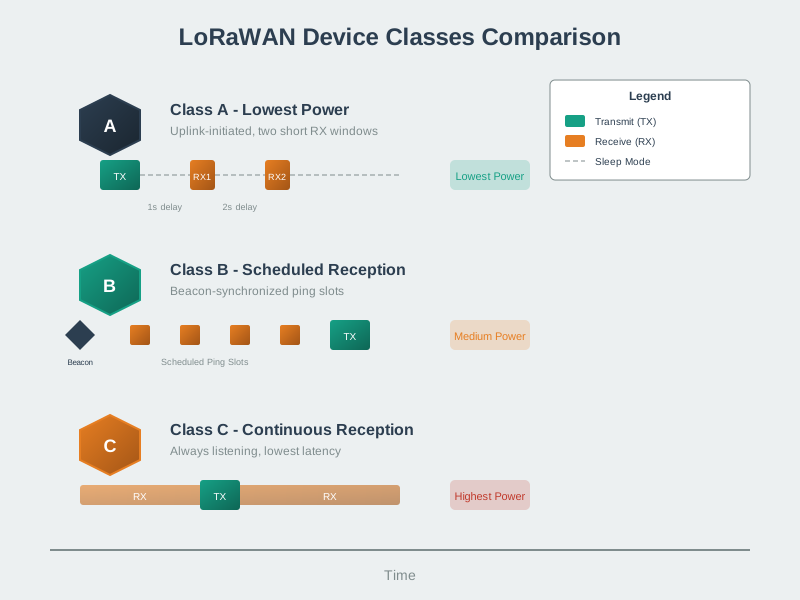
Understanding the three LoRaWAN device classes is essential for choosing the right balance between power consumption and downlink latency for your application.
1069.7 Worked Examples
These worked examples demonstrate the LPWAN technology selection process for real-world deployment scenarios.
NoteWorked Example: Selecting LPWAN for Smart Water Meters
Scenario: A municipal water utility needs to deploy 50,000 smart water meters across a city. Meters must report daily readings, support remote valve shutoff commands, and operate for 15+ years without battery replacement. The city has mixed terrain with urban high-rises, suburban homes, and some basement installations.
Given: - Device count: 50,000 meters - Message frequency: 1 daily reading (small uplink) + occasional valve commands (downlink) - Payload size: 12 bytes (meter reading + battery status + tamper flag) - Required battery life: 15+ years - Coverage requirement: Indoor, including basements - Budget: Minimize total cost of ownership over 15 years
Steps:
- Eliminate technologies that fail requirements:
- Sigfox: 12-byte payload fits, but 4 downlinks/day limit may constrain valve control during emergencies. Eliminate for operational flexibility.
- LTE-M: Higher power consumption (5-10 year battery typical), higher module cost ($8-15). Overkill for stationary meters. Eliminate.
- LoRaWAN: Excellent battery life, but requires deploying and maintaining gateway infrastructure across entire city. Calculate 200+ gateways needed.
- Compare LoRaWAN vs NB-IoT for this use case:
- Indoor coverage: NB-IoT has +20 dB MCL advantage (164 dB vs 157 dB). Critical for basement meters.
- Infrastructure: LoRaWAN requires utility to deploy/maintain gateways. NB-IoT uses existing cellular infrastructure.
- Scale: 50,000 devices x 15 years = 750,000 device-years of management.
- Reliability SLA: NB-IoT offers carrier-grade reliability. LoRaWAN reliability depends on utility’s network management.
- Calculate 15-year TCO:
- LoRaWAN: 200 gateways x $800 = $160,000 CAPEX + $50,000/year maintenance + replacement every 7 years = $910,000 over 15 years. Per device: $18.20
- NB-IoT: $0 infrastructure + $2/year/device subscription = 50,000 x $2 x 15 = $1,500,000. Per device: $30.00
- Hybrid consideration: LoRaWAN is cheaper IF utility has resources to manage network infrastructure.
Result: Choose NB-IoT. Despite higher subscription cost, the utility avoids infrastructure complexity, gains carrier-grade reliability with SLA, and ensures deep indoor coverage for basement meters. The $11.80/device premium over 15 years is justified by operational simplicity and guaranteed coverage.
Key Insight: For large-scale deployments with deep indoor requirements and no existing IoT infrastructure expertise, operator-managed cellular LPWAN (NB-IoT) often wins despite higher subscription costs. The hidden costs of gateway deployment, backhaul connectivity, and 24/7 network monitoring favor cellular for utilities without IoT operations teams.
NoteWorked Example: LPWAN Selection for Remote Agricultural Sensors
Scenario: A farming cooperative wants to deploy 2,000 soil moisture sensors across 20 farms spread over 150 km² of rural farmland. No cellular coverage exists in most farm areas. Sensors transmit every 4 hours and must last 5+ years on battery.
Given: - Device count: 2,000 sensors across 20 farms - Geographic spread: 150 km² rural area with no cellular coverage - Message frequency: 6 transmissions/day (every 4 hours) - Payload size: 20 bytes (soil moisture, temperature, battery level) - Required battery life: 5+ years - Downlink needs: Occasional configuration updates (monthly) - Budget constraint: Limited capital for infrastructure
Steps:
- Eliminate cellular options due to coverage gap:
- NB-IoT: No cellular coverage in rural farms. Would require carrier to deploy new towers (not feasible).
- LTE-M: Same coverage limitation. Eliminated.
- Satellite IoT (Swarm/Iridium): $5/month/device = 2,000 x $5 x 12 x 5 = $600,000 over 5 years. Too expensive.
- Evaluate LoRaWAN private network feasibility:
- LoRaWAN rural range: 10-15 km per gateway with clear line-of-sight
- Coverage calculation: 150 km² / (pi x 10km²) = ~5 gateways minimum, 8 for redundancy
- Gateway cost: 8 x $1,200 (outdoor industrial grade with solar) = $9,600
- Sensor modules: 2,000 x $15 = $30,000
- Network server: Self-hosted ChirpStack = $0 or The Things Industries = $500/year
- Verify Sigfox viability:
- Check Sigfox coverage map: Likely no coverage in rural area (operator networks concentrated in urban areas)
- Even if coverage existed: 6 messages/day x 365 = 2,190 messages/year (within 140/day limit but no coverage)
- Eliminated due to coverage gap
- Calculate LoRaWAN battery life:
- SF10 average (rural range), 20-byte payload: 371 ms time-on-air
- Daily TX time: 6 x 0.371s = 2.23 seconds
- TX current: 120 mA for 2.23s = 0.074 mAh/day
- RX windows + sleep: 0.15 mAh/day
- Total: 0.224 mAh/day
- 2400 mAh battery / 0.224 = 10,714 days = 29 years theoretical, 10+ years practical
Result: Deploy private LoRaWAN network with 8 solar-powered gateways. Total 5-year cost: $9,600 (gateways) + $30,000 (sensors) + $2,500 (network server) = $42,100. Per sensor: $21.05 for 5 years of operation. Zero monthly fees after deployment.
Key Insight: When cellular coverage is unavailable, LoRaWAN’s ability to deploy private infrastructure becomes a decisive advantage. Rural deployments with line-of-sight can achieve 10-15 km ranges, meaning a few well-placed gateways can cover vast agricultural areas at minimal cost.
1069.8 Engineering Tradeoffs
WarningTradeoff: Unlicensed Spectrum (LoRaWAN/Sigfox) vs Licensed Spectrum (NB-IoT/LTE-M)
Option A (Unlicensed - LoRaWAN/Sigfox): Free spectrum access with no recurring spectrum fees. Deploy your own infrastructure (LoRaWAN) or use operator network (Sigfox). Subject to duty cycle limits: EU868 allows 1% duty cycle (~36 seconds/hour airtime). Interference from other users in crowded areas possible. LoRaWAN gateway: $500-1,500, Sigfox subscription: $1-2/device/year.
Option B (Licensed - NB-IoT/LTE-M): Carrier-managed spectrum with guaranteed interference-free operation. No duty cycle limits - transmit whenever needed. Operator SLA with 99.9%+ availability guarantees. Deep indoor coverage (+20 dB MCL for NB-IoT). Subscription required: $2-5/device/year NB-IoT, $3-8/device/year LTE-M. No infrastructure deployment needed.
Decision Factors: Choose unlicensed when operating in areas with low ISM band congestion, deploying private infrastructure is acceptable, or minimizing recurring costs is priority. Choose licensed when mission-critical reliability is required, deployments are in dense urban areas with ISM interference, or deep indoor/basement coverage is needed. Key metric: In EU, duty cycle limits mean LoRaWAN Class A sensor sending 50-byte payload at SF12 can transmit max ~30 messages/hour. If you need more, consider NB-IoT.
WarningTradeoff: Sigfox Simplicity vs LoRaWAN Flexibility
Option A (Sigfox): Ultra-simple device design with smallest power footprint. Global roaming with single subscription across 70+ countries. 100 bps uplink, 600 bps downlink - forces efficient data encoding. Strict limits: 140 uplinks/day (12 bytes each), 4 downlinks/day (8 bytes each). Operator-managed network - zero infrastructure. Module cost: $10-15. Best for: Simple, infrequent telemetry (alarms, daily readings).
Option B (LoRaWAN): Flexible data rates from 0.3-50 kbps depending on spreading factor. No hard message limits (duty cycle is soft limit). Larger payloads: 51-222 bytes depending on region and data rate. Bidirectional communication with Class A/B/C options. Private or public network options. Gateway cost: $500-1,500. Module cost: $8-15. Best for: Applications needing configuration updates, firmware OTA, or variable reporting rates.
Decision Factors: Choose Sigfox when your application truly needs minimal data (<12 bytes, <140 messages/day), global coverage matters, and you want zero infrastructure responsibility. Choose LoRaWAN when you need firmware updates, variable reporting rates, larger payloads, or private network control. Critical question: Can your use case survive with only 4 downlink messages per day? If yes, Sigfox simplifies everything. If no, LoRaWAN is required.
1069.9 Summary
This chapter covered LPWAN technology selection and comparison:
- LoRaWAN Classes: Class A (lowest power, uplink-triggered downlinks), Class B (scheduled beacon windows), Class C (continuous receive for actuators) - choose based on downlink latency vs power trade-off
- Sigfox Asymmetry: 140 uplink vs 4 downlink messages per day reflects power-optimized design for sensor telemetry, not bidirectional control
- Payload Constraints: Sigfox 12 bytes vs LoRaWAN 51-222 bytes determines data encoding complexity
- Mobility Requirements: LTE-M supports vehicular handover; NB-IoT/LoRaWAN/Sigfox are stationary-focused
- Coverage Dependency: Sigfox/NB-IoT require operator infrastructure; LoRaWAN enables private deployment in remote areas
- Scale Economics: Sigfox/NB-IoT subscriptions compound ($X/device/year); LoRaWAN gateway investment amortizes across all devices
- Indoor Penetration: NB-IoT +20 dB advantage for basement/underground deployments
- Battery Life: All technologies support 10+ years with proper class/PSM configuration
1069.10 What’s Next
- If you are leaning toward LoRaWAN, continue to LoRaWAN Overview.
- If you need operator-managed cellular LPWAN, continue to NB-IoT Fundamentals or Cellular IoT Fundamentals.