%%{init: {'theme': 'base', 'themeVariables': { 'primaryColor': '#2C3E50', 'primaryTextColor': '#fff', 'primaryBorderColor': '#16A085', 'lineColor': '#16A085', 'secondaryColor': '#E67E22', 'tertiaryColor': '#7F8C8D'}}}%%
graph LR
    subgraph "LoRaWAN Topic Review Path"
        PHY["1. Physical Layer<br/>SF, Bandwidth, CSS"]
        ARCH["2. Architecture & Classes<br/>Topology, A/B/C"]
        SEC["3. Security & ADR<br/>Keys, Optimization"]
        DEPLOY["4. Deployment<br/>Regional, TTN, Debug"]
    end

    PHY --> ARCH
    ARCH --> SEC
    SEC --> DEPLOY

    style PHY fill:#27AE60,color:#fff
    style ARCH fill:#16A085,color:#fff
    style SEC fill:#E67E22,color:#fff
    style DEPLOY fill:#2C3E50,color:#fff
1099 LoRaWAN: Topic Review
1099.1 Learning Objectives
By the end of this review, you will be able to:
- Summarize LoRaWAN Architecture: Recall star-of-stars topology and network server roles
- Compare Device Classes: Understand A, B, C trade-offs for latency vs battery life
- Apply Security Features: Implement OTAA activation and AES-128 encryption
- Plan Deployments: Design sensor networks using TTN or private LoRaWAN servers
- Evaluate Alternatives: Compare LoRaWAN with NB-IoT and LTE-M for specific applications
- Take Next Steps: Set up TTN accounts and build first LoRaWAN sensor nodes
1099.2 Prerequisites
Required Chapters:
- LoRaWAN Overview - Core concepts
- LoRaWAN Architecture - Network structure
- LoRaWAN Comprehensive Review - Full review
This Quick Review Covers:
| Topic | Key Points |
|---|---|
| LoRa PHY | Chirp spread spectrum, SF |
| LoRaWAN MAC | Device classes A/B/C |
| Network | Gateways, network server |
| Security | AES-128, session keys |
Interactive Tool:
- Try the LoRaWAN Range Calculator
Estimated Time: 60 minutes (all sections) or 15 minutes per focused chapter
TipFor Beginners: How to Use This Review
What is this chapter? Topic-based review consolidating LoRaWAN concepts, organized into focused sections.
When to use:
- After studying LoRaWAN fundamentals
- When reviewing specific topics
- Before comprehensive assessment
Topics Organized:
| Topic | Key Concepts | Chapter |
|---|---|---|
| Physical Layer | LoRa modulation, spreading factors | Physical Layer Review |
| Architecture | Star-of-stars, gateways | Architecture & Classes Review |
| Device Classes | Class A, B, C trade-offs | Architecture & Classes Review |
| Security | AES-128, session keys | Security & ADR Review |
| ADR | Adaptive data rate | Security & ADR Review |
| Deployment | Gateway planning, TTN | Deployment Review |
Prerequisites:
- LoRaWAN Overview
- LoRaWAN Architecture
- Basic RF and networking concepts
Recommended Path:
- Review fundamentals chapters first
- Study topics here by section
- Complete Quiz Bank
1099.3 LoRaWAN Topic Review: Index
This comprehensive review is organized into four focused chapters. Study them in order or jump to specific topics as needed.
1099.3.1 Review Chapters
{fig-alt=“LoRaWAN topic review learning path showing four sequential chapters: Physical Layer covering spreading factors and chirp spread spectrum, Architecture and Classes covering network topology and device classes A/B/C, Security and ADR covering encryption keys and adaptive data rate, and Deployment covering regional parameters, The Things Network, and troubleshooting.”}
1099.3.2 Chapter 1: Physical Layer and Modulation
Physical Layer Review (~15 minutes)
| Topic | What You’ll Learn |
|---|---|
| Quick Reference | Essential LoRaWAN parameters table |
| LoRa vs LoRaWAN | Physical vs MAC layer distinction |
| Spreading Factors | SF7-SF12 trade-offs for range, speed, battery |
| Bandwidth Options | 125/250/500 kHz selection |
| Link Budget | Sensitivity and path loss calculations |
1099.3.3 Chapter 2: Network Architecture and Device Classes
Architecture & Classes Review (~15 minutes)
| Topic | What You’ll Learn |
|---|---|
| Star-of-Stars Topology | Gateways, network server, application server |
| Gateway Role | Transparent relay function |
| Network Server Functions | Deduplication, ADR, MAC commands |
| Device Classes | Class A, B, C comparison |
| Class Selection | Decision tree for choosing classes |
1099.3.4 Chapter 3: Security Architecture and Adaptive Data Rate
Security & ADR Review (~15 minutes)
| Topic | What You’ll Learn |
|---|---|
| Security Layers | Application, network, physical layer protection |
| Key Hierarchy | Root keys to session keys |
| OTAA vs ABP | Activation method comparison |
| Frame Counters | Replay attack prevention |
| ADR Operation | Automatic SF and power optimization |
1099.3.5 Chapter 4: Deployment, Regional Parameters, and Troubleshooting
Deployment Review (~20 minutes)
| Topic | What You’ll Learn |
|---|---|
| Regional Parameters | EU868, US915, duty cycle compliance |
| Gateway Planning | Coverage and capacity calculations |
| Application Scenarios | Use case selection matrix |
| The Things Network | TTN architecture and quick start |
| Troubleshooting | Debug decision tree |
1099.4 Quick Knowledge Check
Before diving into the detailed chapters, test your baseline knowledge:
1099.5 Summary
LoRaWAN is a powerful LPWAN protocol that enables long-range, low-power IoT communication. Key takeaways:
- LoRa = Physical layer modulation, LoRaWAN = MAC layer protocol
- Star-of-stars topology with gateways relaying to network servers
- Three device classes (A, B, C) for different latency/power requirements
- Spreading factors (SF7-SF12) trade range for data rate
- OTAA provides secure, scalable device activation
- AES-128 encryption with end-to-end security
- Ideal for battery-powered sensors in agriculture, smart cities, asset tracking
- Compare with NB-IoT/LTE-M for cellular alternatives
1099.6 What’s Next
Recommended Study Path:
- Start with: Physical Layer Review - Understand LoRa modulation
- Continue to: Architecture & Classes Review - Network design
- Then study: Security & ADR Review - Secure deployments
- Complete with: Deployment Review - Real-world planning
After Completing Review:
- Test Knowledge: LoRaWAN Quiz Bank - Practice questions
- Compare Technologies: Sigfox, NB-IoT
- Hands-On: Set up a free TTN account and build your first LoRaWAN sensor node
NoteRelated Chapters
Prerequisites:
- LoRaWAN Overview - Start here if new to LoRaWAN
- LoRaWAN Architecture - Network structure and device classes
- LPWAN Fundamentals - Core LPWAN concepts
Deep Dives:
- LoRaWAN Comprehensive Review - Full technical review with all topics
- LoRaWAN Quiz Bank - Test your knowledge with practice questions
Comparisons:
- Sigfox - Operator-managed LPWAN alternative
- LPWAN Comparison - Compare all LPWAN technologies
- NB-IoT - Cellular LPWAN comparison
- Weightless - Open-standard LPWAN alternative
Hands-On:
- Quizzes Hub - Comprehensive LoRaWAN quiz collection
- Simulations Hub - LoRaWAN range and capacity calculators
- Videos Hub - LoRaWAN deployment video tutorials
1099.7 Visual Reference Gallery
NoteVisual: LoRaWAN Protocol Stack
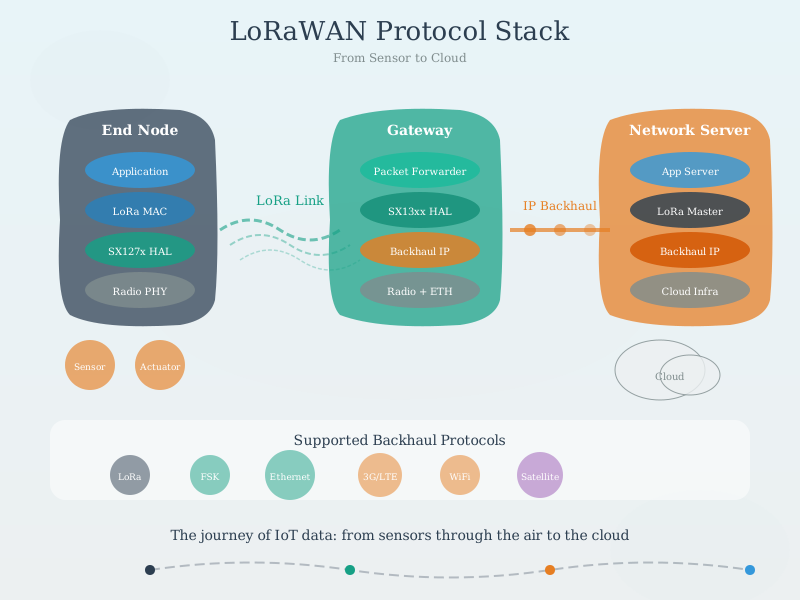
This layered view clarifies the distinction between LoRa (physical modulation) and LoRaWAN (MAC protocol) - a key concept tested in topic review assessments.
NoteVisual: LoRaWAN Class Comparison
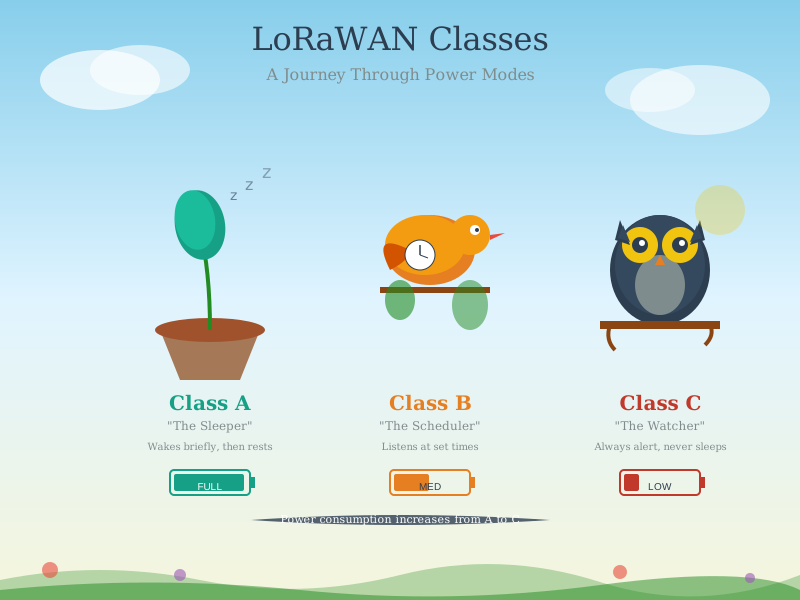
Understanding class selection trade-offs is fundamental to LoRaWAN deployment - this visualization summarizes the key decision factors for choosing between Class A, B, and C devices.
NoteVisual: LoRaWAN Frame Format
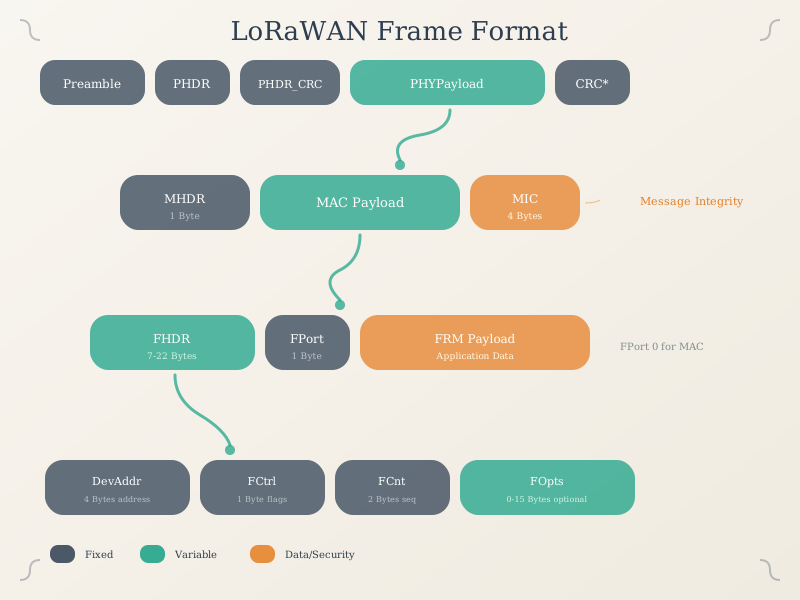
The frame format visualization helps review how LoRaWAN achieves security through MIC (Message Integrity Code) and manages device addressing through DevAddr and frame counters.