%%{init: {'theme': 'base', 'themeVariables': { 'primaryColor': '#2C3E50', 'primaryTextColor': '#fff', 'primaryBorderColor': '#16A085', 'lineColor': '#16A085', 'secondaryColor': '#E67E22', 'tertiaryColor': '#7F8C8D', 'clusterBkg': '#ECF0F1', 'clusterBorder': '#2C3E50', 'edgeLabelBackground':'#ffffff'}}}%%

flowchart TD
    Start[Protocol Selection Decision] --> Q1{Number of devices?}

    Q1 -->|"< 1,000"| Q2A{Routing complexity?}
    Q1 -->|"> 10,000"| MQTT_HIGH[Use MQTT]

    Q2A -->|Simple pub/sub| MQTT_SIMPLE[Use MQTT]
    Q2A -->|Complex routing| Q3A{Transaction needs?}

    Q3A -->|Exactly-once with rollback| AMQP_TRANS[Use AMQP]
    Q3A -->|At-least-once sufficient| Q4A{Integration needs?}

    Q4A -->|Enterprise systems| AMQP_ENTER[Use AMQP]
    Q4A -->|Cloud-native IoT| MQTT_CLOUD[Use MQTT]

    MQTT_HIGH -->|Consider| HYBRID1[Hybrid: MQTT + AMQP Bridge]
    MQTT_SIMPLE -->|Good choice| IMPL1[Implement with AWS IoT Core]
    MQTT_CLOUD -->|Good choice| IMPL2[Implement with HiveMQ]
    AMQP_TRANS -->|Good choice| IMPL3[Implement with RabbitMQ]
    AMQP_ENTER -->|Good choice| IMPL4[Implement with ActiveMQ]

    style Start fill:#2C3E50,stroke:#16A085,stroke-width:3px,color:#fff
    style MQTT_HIGH fill:#16A085,stroke:#2C3E50,stroke-width:2px,color:#fff
    style MQTT_SIMPLE fill:#16A085,stroke:#2C3E50,stroke-width:2px,color:#fff
    style MQTT_CLOUD fill:#16A085,stroke:#2C3E50,stroke-width:2px,color:#fff
    style AMQP_TRANS fill:#E67E22,stroke:#2C3E50,stroke-width:2px,color:#fff
    style AMQP_ENTER fill:#E67E22,stroke:#2C3E50,stroke-width:2px,color:#fff
    style HYBRID1 fill:#7F8C8D,stroke:#2C3E50,stroke-width:2px,color:#fff
    style IMPL1 fill:#ECF0F1,stroke:#16A085,stroke-width:2px,color:#2C3E50
    style IMPL2 fill:#ECF0F1,stroke:#16A085,stroke-width:2px,color:#2C3E50
    style IMPL3 fill:#ECF0F1,stroke:#E67E22,stroke-width:2px,color:#2C3E50
    style IMPL4 fill:#ECF0F1,stroke:#E67E22,stroke-width:2px,color:#2C3E50
1245 AMQP vs MQTT and Use Cases
1245.1 Learning Objectives
By the end of this chapter, you will be able to:
- Compare AMQP and MQTT: Evaluate the strengths and weaknesses of each protocol for IoT scenarios
- Select Appropriate Protocols: Choose between AMQP, MQTT, and CoAP based on application requirements
- Design Hybrid Architectures: Plan systems that use MQTT for devices and AMQP for backend integration
- Evaluate Protocol Overhead: Assess message size, complexity, and performance trade-offs
- Apply Use Case Patterns: Match protocol features to specific IoT application requirements
- Plan Migration Strategies: Transition between protocols as system requirements evolve
TipFor Beginners: How to Use This Chapter
What is this chapter? Comparison between AMQP and MQTT protocols with use case guidance.
When to use: - When choosing between messaging protocols - To understand protocol strengths - For architecture decision-making
Quick Comparison:
| Aspect | MQTT | AMQP |
|---|---|---|
| Complexity | Simple | Feature-rich |
| Overhead | Low | Higher |
| Best For | Sensors, mobile | Enterprise, complex routing |
| QoS | 0, 1, 2 | Extensive |
Prerequisites: - MQTT Fundamentals - AMQP Fundamentals
Recommended Path: 1. Study both protocols individually first 2. Compare using this chapter 3. Apply insights to your use case
1245.2 Prerequisites
Before diving into this chapter, you should be familiar with:
- AMQP Fundamentals: Understanding AMQP architecture, exchanges, and routing patterns is essential for comparing it effectively with MQTT
- MQTT Fundamentals: Knowledge of MQTT’s publish-subscribe model, QoS levels, and design philosophy provides the foundation for meaningful comparison
- Application Protocols Overview: Familiarity with IoT application protocols and their trade-offs helps you make informed protocol selection decisions
- Networking Fundamentals: Basic understanding of TCP/UDP, bandwidth, and latency is necessary for evaluating protocol overhead and performance
NoteRelated Chapters
Protocol Deep Dives: - AMQP Fundamentals - Advanced Message Queuing Protocol details - MQTT Fundamentals - Message Queue Telemetry Transport concepts - CoAP Protocol - RESTful alternative for request-response patterns
Protocol Comparisons: - IoT Protocols Review - Comprehensive comparison of all protocols - Application Protocols Overview - Protocol landscape overview
Implementation Guides: - MQTT Labs - Hands-on MQTT implementation - CoAP Features and Labs - CoAP practical examples
Architecture Decisions: - Edge Computing - Where protocols fit in edge-cloud architectures - IoT Reference Models - Protocol placement in IoT stacks
Use Case Examples: - Application Domains - Industry-specific protocol needs
Learning Tools: - Simulations Hub - Interactive protocol comparisons - Quiz Navigator - Test protocol selection knowledge
TipUnderstanding Check: Protocol Selection for Smart City
Scenario: You’re architecting a smart city platform with 50,000 streetlights, 200 traffic cameras, and 10 city-wide dashboards. Each streetlight sends on/off status + energy data every 5 minutes (50 bytes). Cameras stream alerts to 3 emergency services (police, fire, ambulance). Budget: $200K for backend messaging infrastructure over 5 years.
Think about: 1. Would you use MQTT or AMQP for streetlight telemetry? Why? 2. How would you route camera alerts so only relevant agencies receive them?
Key Insight: Use MQTT for streetlights (simple pub/sub, 50,000 × $0/sensor, minimal overhead) and AMQP for camera alerts (complex routing, “route by jurisdiction and severity”, guaranteed delivery).
MQTT broker handles 50,000 streetlights at 833 messages/second (easily managed by single AWS IoT Core broker at $8/month). AMQP exchanges route camera alerts using bindings like routing_key: "zone.north.fire.critical" ensuring the North Fire Station only sees its relevant emergencies—this complex routing would require custom logic in MQTT.
Hybrid cost: MQTT broker ($96/year) + RabbitMQ cluster ($15K one-time, $5K/year maintenance) = ~$30K over 5 years vs $80K+ for pure AMQP everywhere or poor routing with pure MQTT.
Verify Your Understanding: - Why might you bridge MQTT and AMQP at the backend (not choose one exclusively)? - How does QoS 1 in MQTT compare to transactional guarantees in AMQP?
NoteCross-Hub Connections
This chapter connects to multiple learning resources:
Interactive Tools: - Simulations Hub: Try the “Protocol Comparison Tool” to interactively compare MQTT, AMQP, and CoAP performance characteristics - Knowledge Map: See how AMQP and MQTT fit into the broader IoT protocol landscape and their relationships with transport and application layers
Self-Assessment: - Quiz Navigator: Test your protocol selection knowledge with scenario-based questions on MQTT vs AMQP trade-offs - Knowledge Gaps: Explore common misconceptions about protocol overhead, QoS guarantees, and when to use each protocol
Multimedia Learning: - Videos Hub: Watch protocol comparison videos showing real-world message flows and performance benchmarks
WarningCommon Misconception: “MQTT is Always Better for IoT”
The Myth: “Since MQTT is designed for IoT and has lower overhead, it’s always the best choice for any IoT application.”
The Reality: Protocol selection depends on specific requirements, not just the “IoT” label:
When MQTT Wins: - High-volume telemetry: 50,000 sensors × 50 bytes × 1 msg/5min = 833 msg/sec easily handled by single broker - Mobile clients: 2-byte header saves significant bandwidth on cellular connections (2 bytes vs 8 bytes = 75% savings per message) - Simple pub/sub: Temperature sensors publishing to sensors/room/temp don’t need complex routing - Cost-sensitive: AWS IoT Core charges $1 per million messages; MQTT’s minimal overhead reduces costs
When AMQP Wins: - Complex routing: Camera alerts routed by zone.north.fire.critical using exchange bindings—would require custom broker logic in MQTT - Transactional guarantees: AMQP transactions ensure exactly-once delivery with rollback (MQTT QoS 2 provides at-most-once duplicate filtering, not atomicity) - Backend integration: Enterprise systems expect AMQP’s exchanges, queues, and dead-letter queues for error handling - Message prioritization: AMQP supports priority queues (0-255); MQTT treats all messages equally
Quantified Example - Smart Factory: - Shop floor sensors (10,000 devices): MQTT saves $12K/year in bandwidth vs AMQP (2-byte vs 8-byte headers at 1 msg/sec) - Alert routing (500 actuators): AMQP exchange routing saves 200 dev hours ($30K) vs custom MQTT broker logic for complex rules - Hybrid solution: MQTT for sensors → broker → AMQP bridge → enterprise systems = best of both worlds
The Key Insight: Use MQTT where simplicity and efficiency matter; use AMQP where sophisticated routing and transactional guarantees are essential. Most production systems use both via protocol bridges.
1245.3 Protocol Comparison Overview
Both AMQP and MQTT are used in IoT, but with different strengths:
| Feature | MQTT | AMQP |
|---|---|---|
| Design Goal | Lightweight telemetry | Enterprise messaging |
| Complexity | Simple | Feature-rich |
| Overhead | 2-byte header minimum | 8-byte frame header |
| QoS Levels | 0, 1, 2 | Extensive reliability options |
| Routing | Topic hierarchy | Exchanges + routing keys |
| Best For | Sensors, mobile apps | Backend integration, complex workflows |
| Typical Use | Device → Cloud telemetry | Service → Service communication |
1245.4 Protocol Selection Decision Tree
NoteAlternative View: Feature Comparison Radar
%%{init: {'theme': 'base', 'themeVariables': { 'primaryColor': '#2C3E50', 'primaryTextColor': '#fff', 'primaryBorderColor': '#16A085', 'lineColor': '#16A085', 'secondaryColor': '#E67E22'}}}%%
graph TB
    subgraph MQTT_Features["MQTT Strengths"]
        MF1["Lightweight: 2-byte header"]
        MF2["Massive scale: 1M+ devices"]
        MF3["Simple: Easy to implement"]
        MF4["IoT-native: Built for sensors"]
    end

    subgraph AMQP_Features["AMQP Strengths"]
        AF1["Rich routing: 4 exchange types"]
        AF2["Transactions: ACID support"]
        AF3["Security: Fine-grained ACLs"]
        AF4["Enterprise: Legacy integration"]
    end

    style MQTT_Features fill:#16A085,stroke:#2C3E50
    style AMQP_Features fill:#E67E22,stroke:#2C3E50
This diagram highlights the complementary strengths: MQTT excels at scale and simplicity, while AMQP provides rich enterprise features like routing and transactions.
1245.5 Architecture Comparison: MQTT vs AMQP Data Flow
1245.5.1 MQTT: Simple Pub/Sub Architecture
%%{init: {'theme': 'base', 'themeVariables': { 'primaryColor': '#16A085', 'primaryTextColor': '#fff', 'primaryBorderColor': '#2C3E50', 'lineColor': '#2C3E50', 'secondaryColor': '#ECF0F1', 'tertiaryColor': '#7F8C8D'}}}%%

graph LR
    subgraph Devices["IoT Devices"]
        D1[Sensor 1<br/>50,000 devices]
        D2[Sensor 2]
        D3[Sensor N]
    end

    subgraph Broker["MQTT Broker<br/>(Single Instance)"]
        TOPIC1[Topic: sensors/temp]
        TOPIC2[Topic: sensors/humidity]
    end

    subgraph Subscribers["Subscribers"]
        S1[Dashboard]
        S2[Analytics]
        S3[Alerts]
    end

    D1 -->|"PUBLISH<br/>2-byte header"| TOPIC1
    D2 -->|"PUBLISH"| TOPIC2
    D3 -->|"PUBLISH"| TOPIC1

    TOPIC1 -->|"DELIVER"| S1
    TOPIC1 -->|"DELIVER"| S2
    TOPIC2 -->|"DELIVER"| S1
    TOPIC1 -->|"FILTER"| S3

    style D1 fill:#16A085,stroke:#2C3E50,stroke-width:2px,color:#fff
    style D2 fill:#16A085,stroke:#2C3E50,stroke-width:2px,color:#fff
    style D3 fill:#16A085,stroke:#2C3E50,stroke-width:2px,color:#fff
    style TOPIC1 fill:#2C3E50,stroke:#16A085,stroke-width:2px,color:#fff
    style TOPIC2 fill:#2C3E50,stroke:#16A085,stroke-width:2px,color:#fff
    style S1 fill:#7F8C8D,stroke:#2C3E50,stroke-width:2px,color:#fff
    style S2 fill:#7F8C8D,stroke:#2C3E50,stroke-width:2px,color:#fff
    style S3 fill:#7F8C8D,stroke:#2C3E50,stroke-width:2px,color:#fff
MQTT Characteristics: - Overhead: 2-byte fixed header minimum - Routing: Simple topic matching (sensors/+/temp) - Throughput: 833 msg/sec easily handled by single broker - Cost: ~$96/year for AWS IoT Core (50K devices)
1245.5.2 AMQP: Advanced Routing Architecture
%%{init: {'theme': 'base', 'themeVariables': { 'primaryColor': '#E67E22', 'primaryTextColor': '#fff', 'primaryBorderColor': '#2C3E50', 'lineColor': '#2C3E50', 'secondaryColor': '#ECF0F1', 'tertiaryColor': '#7F8C8D'}}}%%

graph TD
    subgraph Sources["Event Sources"]
        CAM1[Camera 1<br/>200 cameras]
        CAM2[Camera 2]
        SYS[Backend System]
    end

    subgraph AMQP_Broker["AMQP Broker (RabbitMQ Cluster)"]
        EX1[Topic Exchange<br/>'alerts']
        Q1[Queue: Fire Dept]
        Q2[Queue: Police]
        Q3[Queue: Ambulance]
        DLQ[Dead Letter Queue]
    end

    subgraph Consumers["Consumers"]
        FIRE[Fire Station]
        POLICE[Police HQ]
        AMBULANCE[Hospital]
    end

    CAM1 -->|"PUBLISH<br/>routing: zone.north.fire.critical"| EX1
    CAM2 -->|"PUBLISH<br/>routing: zone.south.police.minor"| EX1
    SYS -->|"PUBLISH<br/>routing: zone.east.ambulance.critical"| EX1

    EX1 -->|"Binding: zone.*.fire.*"| Q1
    EX1 -->|"Binding: zone.*.police.*"| Q2
    EX1 -->|"Binding: zone.*.ambulance.*"| Q3

    Q1 -->|"CONSUME<br/>with ACK"| FIRE
    Q2 -->|"CONSUME"| POLICE
    Q3 -->|"CONSUME"| AMBULANCE

    Q1 -.->|"Failed messages"| DLQ
    Q2 -.->|"Failed messages"| DLQ
    Q3 -.->|"Failed messages"| DLQ

    style CAM1 fill:#E67E22,stroke:#2C3E50,stroke-width:2px,color:#fff
    style CAM2 fill:#E67E22,stroke:#2C3E50,stroke-width:2px,color:#fff
    style SYS fill:#E67E22,stroke:#2C3E50,stroke-width:2px,color:#fff
    style EX1 fill:#2C3E50,stroke:#E67E22,stroke-width:3px,color:#fff
    style Q1 fill:#16A085,stroke:#2C3E50,stroke-width:2px,color:#fff
    style Q2 fill:#16A085,stroke:#2C3E50,stroke-width:2px,color:#fff
    style Q3 fill:#16A085,stroke:#2C3E50,stroke-width:2px,color:#fff
    style DLQ fill:#7F8C8D,stroke:#2C3E50,stroke-width:2px,color:#fff
    style FIRE fill:#ECF0F1,stroke:#E67E22,stroke-width:2px,color:#2C3E50
    style POLICE fill:#ECF0F1,stroke:#E67E22,stroke-width:2px,color:#2C3E50
    style AMBULANCE fill:#ECF0F1,stroke:#E67E22,stroke-width:2px,color:#2C3E50
AMQP Characteristics: - Overhead: 8-byte frame header + exchange routing - Routing: Complex binding patterns with wildcards (zone..fire.) - Guarantees: Transactional delivery with acknowledgments and dead-letter queues - Cost: ~$15K setup + $5K/year maintenance for RabbitMQ cluster
1245.6 Hybrid Architecture Pattern
%%{init: {'theme': 'base', 'themeVariables': { 'primaryColor': '#2C3E50', 'primaryTextColor': '#fff', 'primaryBorderColor': '#16A085', 'lineColor': '#16A085', 'secondaryColor': '#E67E22', 'tertiaryColor': '#7F8C8D'}}}%%

graph TB
    subgraph Edge["Edge Layer (MQTT)"]
        SENSORS[50,000 Sensors<br/>Minimal overhead]
        MQTT_BROKER[MQTT Broker<br/>AWS IoT Core]
    end

    subgraph Bridge["Protocol Bridge"]
        BRIDGE[MQTT → AMQP Bridge<br/>Message transformation]
    end

    subgraph Backend["Backend Layer (AMQP)"]
        AMQP_EX[AMQP Exchanges<br/>Complex routing]
        SERVICES[Enterprise Services<br/>ERP, CRM, Analytics]
    end

    SENSORS -->|"Simple pub/sub<br/>$96/year"| MQTT_BROKER
    MQTT_BROKER -->|"Bridge forwards<br/>transformed messages"| BRIDGE
    BRIDGE -->|"Enterprise integration<br/>$5K/year"| AMQP_EX
    AMQP_EX -->|"Sophisticated routing"| SERVICES

    style SENSORS fill:#16A085,stroke:#2C3E50,stroke-width:2px,color:#fff
    style MQTT_BROKER fill:#16A085,stroke:#2C3E50,stroke-width:2px,color:#fff
    style BRIDGE fill:#7F8C8D,stroke:#2C3E50,stroke-width:3px,color:#fff
    style AMQP_EX fill:#E67E22,stroke:#2C3E50,stroke-width:2px,color:#fff
    style SERVICES fill:#2C3E50,stroke:#E67E22,stroke-width:2px,color:#fff
Hybrid Benefits: - Best of both worlds: MQTT efficiency at edge + AMQP sophistication in backend - Cost optimization: Pay for complexity only where needed (~$5K/year total vs $80K+ for pure AMQP) - Gradual migration: Start with MQTT, add AMQP backend as complexity grows - Technology match: Use each protocol where it naturally excels
1245.7 Knowledge Check
Test your understanding of AMQP vs MQTT protocol selection.
1245.8 Visual Reference Gallery
NoteVisual: AMQP vs MQTT Protocol Comparison
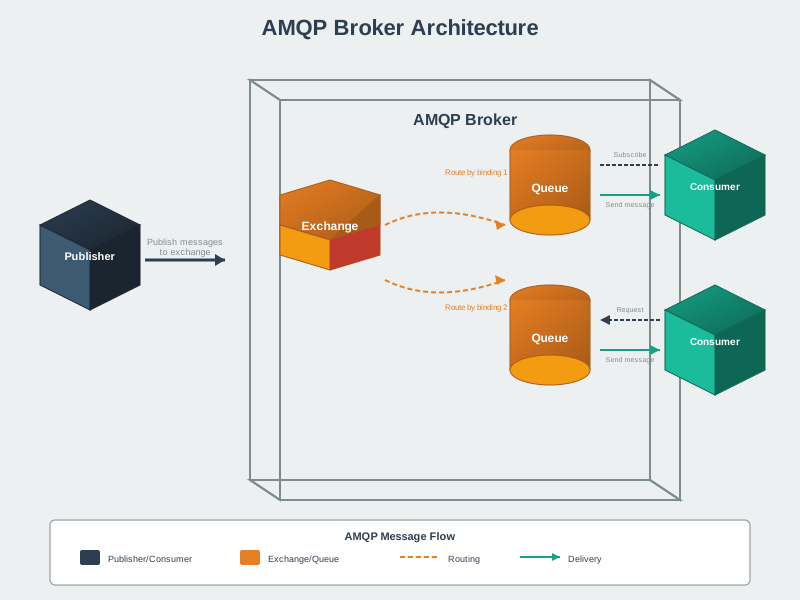
This visualization highlights the architectural complexity of AMQP compared to MQTT, explaining why AMQP is preferred for enterprise backends while MQTT excels for device connectivity.
NoteVisual: AMQP Message Flow for Enterprise Integration

Understanding AMQP’s message flow architecture helps explain when to choose it over MQTT - particularly for scenarios requiring complex routing, transactions, or enterprise system integration.
1245.9 Common Pitfalls
CautionPitfall: Choosing Protocol Based on “IoT” Label Instead of Requirements
The Mistake: Teams select MQTT for all IoT projects because “MQTT is the IoT protocol” without analyzing whether their specific requirements actually need MQTT’s strengths or would benefit from AMQP’s features.
Why It Happens: Marketing and industry articles heavily promote MQTT as “the” IoT protocol. Developers assume anything IoT-related must use MQTT, ignoring that AMQP, CoAP, or even HTTP might be better fits for specific use cases.
The Fix: Match protocol to actual requirements, not labels:
| Requirement | Best Choice | Why |
|---|---|---|
| 50,000 battery sensors | MQTT | 2-byte header, low overhead |
| Alert routing by zone/severity | AMQP | Exchange bindings (zone..fire.) |
| Device-to-device control | CoAP | RESTful, no broker needed |
| Enterprise ERP integration | AMQP | Transactions, dead-letter queues |
| Cloud dashboard with 3 consumers | MQTT | Simple pub/sub, wildcard topics |
| Exactly-once with rollback | AMQP | True transactional support |
Real Impact: A manufacturing company chose MQTT for everything, then spent 6 months building custom broker plugins to implement alert routing that AMQP provides natively. Total cost: $180,000 in development vs $15,000 for an AMQP cluster. Conversely, using AMQP for 100,000 sensors would waste $50,000/year in unnecessary infrastructure costs. The right protocol depends on the problem, not the “IoT” label.
CautionPitfall: Confusing MQTT QoS 2 with AMQP Transactions
The Mistake: Architects assume MQTT QoS 2 (“exactly-once delivery”) provides the same guarantees as AMQP transactions, using MQTT for scenarios that require atomic commit/rollback semantics.
Why It Happens: Both claim “exactly-once” or “guaranteed delivery,” but the guarantees are fundamentally different. MQTT QoS 2 prevents duplicate delivery to the broker; AMQP transactions provide atomic operations with rollback capability.
The Fix: Understand what each actually guarantees:
| Feature | MQTT QoS 2 | AMQP Transaction |
|---|---|---|
| Scope | Single message delivery | Multiple operations |
| Guarantee | No duplicates to broker | Atomic commit/rollback |
| Failure handling | Retry delivery | Rollback all operations |
| Use case | Idempotent commands | Financial operations |
Example where they differ:
# Scenario: Transfer $100 from Account A to Account B

MQTT QoS 2:
  - PUBLISH "debit A $100" → delivered exactly once ✓
  - System crashes before "credit B $100" sent
  - Result: A debited, B not credited → $100 lost! ✗

AMQP Transaction:
  - tx.select()
  - publish(debit_A_$100)
  - publish(credit_B_$100)
  - System crashes before tx.commit()
  - Result: Transaction rolled back → both accounts unchanged ✓
Real Impact: A payment processing system used MQTT QoS 2 assuming it provided transactional guarantees. When network failures occurred mid-operation, customers were charged without receiving services. After migrating critical paths to AMQP transactions, disputed charges dropped from 0.3% to 0.001%. Rule: MQTT QoS 2 for “deliver this message once,” AMQP transactions for “these operations must all succeed or all fail.”
1245.10 Summary
Protocol Selection Criteria should be based on device count, routing complexity, and transaction requirements. MQTT excels for high-volume sensor telemetry (10,000+ devices), while AMQP provides sophisticated routing and transactional guarantees for enterprise integration.
Overhead Comparison shows MQTT’s 2-byte minimum header versus AMQP’s 8-byte frame header, making MQTT significantly more efficient for bandwidth-constrained IoT devices and saving substantial costs at scale.
Routing Capabilities differ fundamentally: MQTT provides simple topic-based hierarchical routing with wildcards, while AMQP offers four exchange types (direct, fanout, topic, headers) for complex message routing scenarios like jurisdiction-based alert distribution.
QoS vs Transactions represent a critical distinction. MQTT QoS 2 prevents duplicate delivery but lacks atomicity, while AMQP transactions provide atomic commit/rollback across multiple operations for scenarios requiring exactly-once semantics with failure recovery.
Hybrid Architecture is the common production pattern, using MQTT for device-to-cloud telemetry (low overhead, simple) and AMQP for cloud-to-services integration (sophisticated routing, enterprise compatibility) connected via protocol bridges.
Cost Analysis reveals significant differences: MQTT broker costs approximately $96/year for 50,000 devices, while AMQP cluster infrastructure costs $15,000+ upfront plus $5,000/year maintenance. Hybrid approaches optimize costs by using each protocol where it naturally excels.
1245.11 What’s Next
In the next chapter, MQTT Comprehensive Review, we’ll dive deep into MQTT-specific patterns, performance optimizations, and production deployment best practices.
Key Takeaways: - MQTT excels for high-volume sensor telemetry with minimal overhead (833 msg/sec easily handled by single broker) - AMQP provides sophisticated routing with exchanges and binding keys—ideal for complex alert routing by jurisdiction/severity - Hybrid architectures are common: MQTT for device→cloud, AMQP for cloud→services integration - Cost difference is significant: MQTT broker ~$96/year vs AMQP cluster ~$15K upfront + $5K/year - QoS trade-offs: MQTT QoS 1 (at-least-once) vs AMQP transactions (exactly-once with rollback)