1240 AMQP Knowledge Assessment
1240.1 Learning Objectives
By the end of this chapter, you will be able to:
- Test your understanding of AMQP core concepts
- Apply routing key patterns to real-world scenarios
- Evaluate exchange type selection for different use cases
- Identify correct AMQP configurations for reliability requirements
1240.2 Introduction
This chapter provides knowledge assessment through interactive quizzes covering AMQP fundamentals, exchange types, routing patterns, and reliability features. Use these questions to validate your understanding before moving to implementation.
1240.3 Prerequisites
Before taking this assessment, you should be familiar with:
- AMQP Core Concepts: Exchange types, routing patterns, and the post office analogy
- AMQP Reliability Patterns: Acknowledgment strategies, persistence, and delivery guarantees
- Layered Network Models: AMQP operates at the application layer (OSI Layer 7)
- IoT Protocols Overview: Context on different IoT messaging approaches
This chapter connects to other learning resources:
Interactive Learning:
- Simulations Hub - Try the Protocol Comparison Tool to see AMQP routing patterns in action
- Knowledge Map - See how AMQP fits into the broader IoT protocol ecosystem
Assessment:
- Quizzes Hub - Test your understanding with additional quizzes
- Knowledge Gaps - Address common misconceptions about message queuing
Visual Learning:
- Videos Hub - Watch demonstrations of RabbitMQ setup and exchange configuration
1240.4 Knowledge Check: AMQP Overview
Test your understanding of fundamental concepts with these questions.
Question: A smart factory uses AMQP for message routing. Sensors publish messages with routing keys like “sensor.temperature.line1.machine3” and “sensor.vibration.line2.machine7”. The maintenance system needs to subscribe ONLY to vibration and temperature data from ALL production lines and machines. Which exchange type and binding pattern should be configured?
This demonstrates AMQP Topic Exchange with wildcard routing:
From the text - Exchange Types:
Topic Exchange:
- Routes based on pattern matching
- Wildcards:
*(one word),#(zero or more words) - Use case: Flexible subscription patterns
Why Topic Exchange with # wildcard is correct:
Routing Key Structure:

Binding Patterns Needed:
# Maintenance queue needs these bindings:
queue.bind(
    exchange="sensor-exchange",
    routing_key="sensor.temperature.#"  # Matches ALL temperature sensors
)
queue.bind(
    exchange="sensor-exchange",
    routing_key="sensor.vibration.#"    # Matches ALL vibration sensors
)

# What gets matched:
"sensor.temperature.line1.machine3"  YES Matches sensor.temperature.#
"sensor.temperature.line2.machine7"  YES Matches sensor.temperature.#
"sensor.vibration.line1.machine5"    YES Matches sensor.vibration.#
"sensor.vibration.line2.machine7"    YES Matches sensor.vibration.#
"sensor.pressure.line1.machine3"     NO  No match (pressure not bound)
Wildcard Comparison:
**Single-level wildcard (*):**
Pattern: "sensor.*.line1"
Matches: sensor.temperature.line1 YES
         sensor.vibration.line1   YES
Does NOT match: sensor.temperature.line1.machine3 NO (too many levels)
Multi-level wildcard (#):
Pattern: "sensor.temperature.#"
Matches: sensor.temperature.line1           YES
         sensor.temperature.line1.machine3  YES
         sensor.temperature.anything.else   YES
Does NOT match: sensor.vibration.line1.machine3 NO (different type)
Why Other Options Are Wrong:
A: Direct Exchange with partial routing keys:
# Direct exchange requires EXACT match
queue.bind(exchange, routing_key="sensor.temperature")

# This published message DOES NOT MATCH:
publish(routing_key="sensor.temperature.line1.machine3")

# Because "sensor.temperature" is not equal to "sensor.temperature.line1.machine3"
Direct exchanges can’t do pattern matching - they need exact routing key match.
B: Fanout Exchange:
# Fanout broadcasts to ALL bound queues, ignoring routing key
fanout.bind(maintenance_queue)  # Gets EVERYTHING

# Maintenance receives:
sensor.temperature.line1.machine3  YES (wanted)
sensor.vibration.line2.machine7    YES (wanted)
sensor.pressure.line1.machine3     NO  (NOT wanted - wasted bandwidth)
sensor.humidity.line2.machine9     NO  (NOT wanted - wasted processing)
Fanout can’t filter - it’s all-or-nothing broadcasting. Maintenance system would be overwhelmed with unwanted data.
D: Headers Exchange:
# Headers exchange routes based on message headers, not routing key
headers_exchange.bind(
    maintenance_queue,
    headers={"sensor_type": "temperature,vibration"},
    match="all"  # or "any"
)

# Problems:
# 1. Sensors must set headers (additional overhead)
# 2. Comma-separated values require custom logic
# 3. Less efficient than topic routing
# 4. Not the AMQP idiom for this use case
Headers exchange works but is unnecessarily complex for hierarchical routing.
Performance Comparison:
Scenario: 100 sensors, 10 msg/sec each = 1000 msg/sec total
- 33% temperature, 33% vibration, 34% other types
Topic Exchange (Correct):
Messages to maintenance queue: 660 msg/sec (temp + vibration only)
Broker routing operations: 1000 pattern matches/sec
Network bandwidth to maintenance: 660 x 200 bytes = 132 KB/sec
Fanout Exchange (Wrong):
Messages to maintenance queue: 1000 msg/sec (ALL types)
Network bandwidth to maintenance: 1000 x 200 bytes = 200 KB/sec
Application must filter: 340 unwanted messages/sec
Extra processing: 51% more CPU, 51% more network
1240.5 Knowledge Check: AMQP Fundamentals
Question 1: What is the primary advantage of AMQP over MQTT for enterprise IoT applications?
AMQP’s exchange-based architecture provides sophisticated message routing capabilities:
- Direct exchange: Exact routing key matching
- Topic exchange: Pattern-based routing with wildcards
- Fanout exchange: Broadcast to all bound queues
- Headers exchange: Routing based on message headers
MQTT uses simpler topic-based pub/sub, which is lighter but less flexible. AMQP is better suited for enterprise systems needing complex routing, while MQTT excels for resource-constrained IoT devices.
Question 2: A logistics company needs to route delivery status updates to different systems: the customer portal gets all updates, the warehouse only gets “package_arrived” messages, and the analytics system needs everything from “region_west”. Which AMQP setup is correct?
A single topic exchange with different binding patterns efficiently serves all consumers:
Publisher sends: "region_west.package_arrived.truck42"
Topic Exchange evaluates bindings:

This is more efficient than fanout (where consumers waste CPU filtering) or multiple exchanges (adds complexity without benefit).
Question 3: In AMQP, what happens if a message is published to an exchange with no queues bound to matching routing keys?
By default, AMQP discards messages with no matching bindings. This can be problematic if publishers don’t know bindings exist. Solutions include:
- Alternate Exchange: Configure a fallback exchange for unroutable messages
- Mandatory Flag: Publisher receives a
basic.returnif no queues match - Publisher Confirms: Confirms only indicate broker received the message, not that it was routed
Best practice: Use alternate exchanges to capture unroutable messages for debugging or dead-letter processing.
Question 4: What is the key difference between AMQP 0-9-1 and AMQP 1.0?
AMQP 0-9-1 and AMQP 1.0 are incompatible protocols:
| Feature | AMQP 0-9-1 | AMQP 1.0 |
|---|---|---|
| Model | Broker-centric (exchanges, queues, bindings) | Peer-to-peer messaging |
| Standard | De facto (RabbitMQ) | ISO/IEC 19464, OASIS |
| Wire format | Different frame structure | Different frame structure |
| Interop | 0-9-1 clients only | 1.0 clients only |
RabbitMQ supports 0-9-1 natively and 1.0 via plugin. Azure Service Bus uses 1.0. When choosing brokers, verify version compatibility.
1240.6 Version Compatibility Note
AMQP 0-9-1 and AMQP 1.0 are fundamentally different protocols with different models. When selecting an AMQP broker, verify which version(s) are supported. The content in this assessment covers concepts from both versions while noting key differences where relevant.
1240.7 Visual Reference Gallery
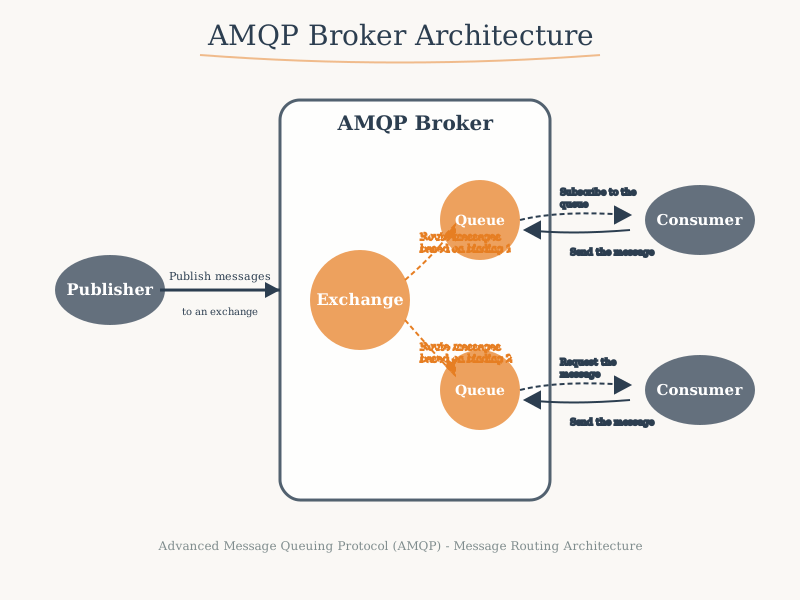
These visual references provide alternative perspectives on AMQP architecture concepts covered in this assessment.


The following figure from the CP IoT System Design Guide provides an alternative visual representation of AMQP architecture.
AMQP Architecture Overview:
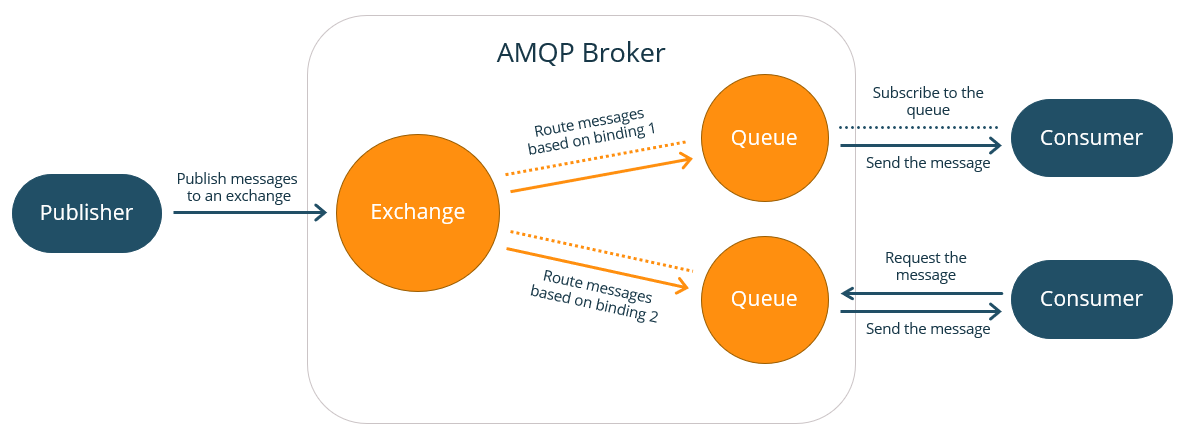
Source: CP IoT System Design Guide, Chapter 4 - Application Protocols
1240.8 Summary
This chapter provided knowledge assessment for AMQP concepts:
- Exchange Type Selection: Topic exchange with wildcards for flexible hierarchical routing
- Protocol Comparison: AMQP provides rich routing vs MQTT’s simpler pub/sub
- Unroutable Messages: Default silent discard requires alternate exchanges and mandatory flag
- Version Compatibility: AMQP 0-9-1 and 1.0 are incompatible protocols with different models
- Visual References: Architecture diagrams, post office analogy, and protocol comparisons
1240.9 What’s Next
Continue your AMQP learning with:
- AMQP Architecture and Frames - Deep dive into message structure, frame types, and reliability features
- AMQP vs MQTT and Use Cases - Detailed protocol comparison and selection criteria
- AMQP Implementations and Labs - Hands-on RabbitMQ setup and Python examples
AMQP Series:
- AMQP Fundamentals - Overview and navigation
- AMQP Core Concepts - Exchange types and routing
- AMQP Reliability Patterns - Delivery guarantees and acknowledgments
Deep Dives:
- AMQP Architecture and Frames - Message structure and frame types
- AMQP Comprehensive Review - Complete protocol coverage
Comparisons:
- AMQP vs MQTT and Use Cases - When to use AMQP versus MQTT
- IoT Protocols Overview - Application protocol landscape
- Application Protocols - Comparing HTTP, MQTT, CoAP, and AMQP
Practical Implementation:
- AMQP Implementations and Labs - Hands-on RabbitMQ setup
Learning:
- Quizzes Hub - Test your AMQP knowledge
- Simulations Hub - Interactive protocol demonstrations