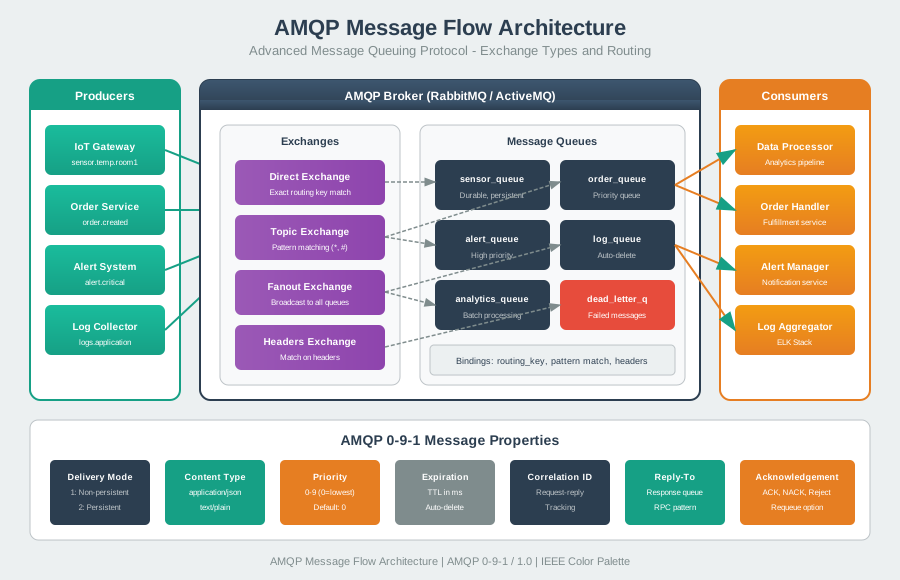
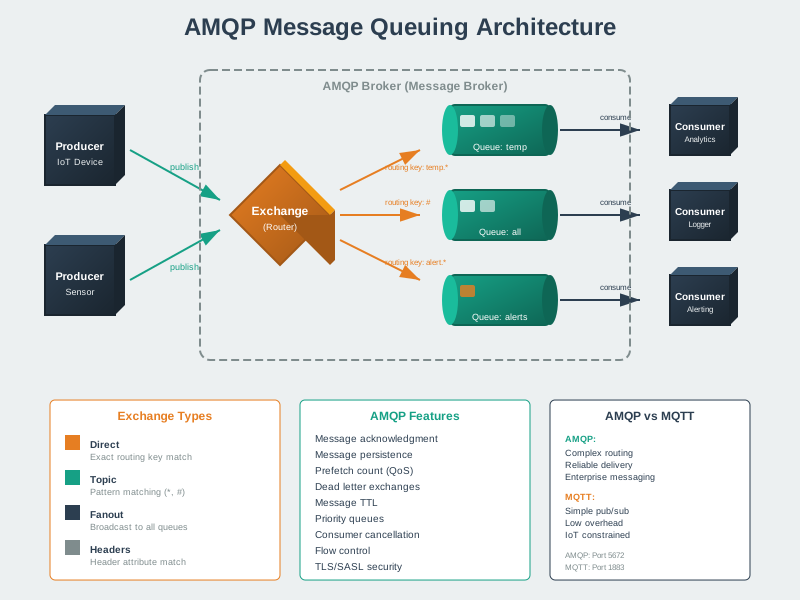
1250  AMQP: Comprehensive Review

This review chapter assumes you have already seen the AMQP fundamentals material. Use this quick refresher to reconnect the dots before you dive into the scenarios and quiz questions.

AMQP in One Sentence: A feature‑rich, broker‑based messaging protocol designed for backend and enterprise systems, not tiny sensor nodes.

Mental model compared to MQTT:

Aspect MQTT AMQP
Main role Telemetry from devices Backend integration between services
Core object Topic on a broker Exchange → Queue → Consumer
Routing Topic string + wildcards Exchange type + bindings + routing key
Typical clients Sensors, gateways, mobile apps Microservices, data pipelines, enterprise apps

When reading this chapter, keep in mind:

  • MQTT is usually the front door for IoT telemetry, but AMQP is often the inside plumbing between cloud services.
  • You will see terms like exchange, queue, binding, routing key, and virtual host—treat them as building blocks that can be combined to match complex business workflows.
  • The review questions expect that you can reason about which exchange type or queue configuration fits a scenario, not memorise every API call.

If any of these concepts feel unfamiliar, pause here and revisit amqp-fundamentals.qmd before continuing.

1250.1 Learning Objectives

By the end of this review, you will be able to:

  • Configure Exchange Types: Set up direct, fanout, topic, and headers exchanges for different routing patterns
  • Design Message Flows: Plan producer-exchange-queue-consumer architectures
  • Implement Reliability: Configure durable queues, acknowledgments, and dead letter handling
  • Apply Multi-Tenancy: Use virtual hosts for isolated messaging environments
  • Compare with Alternatives: Evaluate AMQP against MQTT and other messaging protocols
  • Deploy RabbitMQ: Set up and manage AMQP broker deployments

1250.2 Prerequisites

Required Chapters: - AMQP Fundamentals - Core AMQP concepts - AMQP vs MQTT - Protocol comparison - IoT Protocols Overview - Protocol landscape

Technical Background: - Message queue concepts - Exchange and binding patterns - TCP/IP fundamentals

AMQP Exchange Types:

Exchange Type Routing Use Case
Direct Exact key match Point-to-point
Fanout Broadcast all Pub/sub
Topic Pattern matching Flexible routing
Headers Header matching Complex routing

Estimated Time: 1 hour

Graph diagram

Graph diagram
Figure 1250.1: AMQP exchange type comparison showing four routing mechanisms: Direct exchange with exact routing key matching for point-to-point delivery, Fanout exchange broadcasting to all bound queues, Topic exchange with wildcard patterns (* matches one word, # matches zero or more), and Headers exchange with attribute-based matching using ALL or ANY logic for complex routing decisions.

%%{init: {'theme': 'base', 'themeVariables': { 'primaryColor': '#2C3E50', 'primaryTextColor': '#fff', 'primaryBorderColor': '#16A085', 'lineColor': '#E67E22', 'secondaryColor': '#7F8C8D'}}}%%
graph TB
    subgraph Auto["Auto-ACK (Risky)"]
        A1["Message delivered"]
        A2["Immediately ACK'd"]
        A3["May lose on crash"]
    end

    subgraph Manual["Manual ACK (Safe)"]
        M1["Message delivered"]
        M2["Process message"]
        M3["Send ACK"]
        M4["Message removed"]
    end

    subgraph Reject["Reject/Requeue"]
        R1["Message delivered"]
        R2["Processing fails"]
        R3["Reject + requeue"]
        R4["Retried later"]
    end

    A1 --> A2 --> A3
    M1 --> M2 --> M3 --> M4
    R1 --> R2 --> R3 --> R4

    style Auto fill:#E74C3C,stroke:#2C3E50
    style Manual fill:#16A085,stroke:#2C3E50
    style Reject fill:#E67E22,stroke:#2C3E50

This diagram shows AMQP acknowledgment modes: auto-ack risks message loss, manual ack ensures reliable processing, and reject/requeue handles failures gracefully.
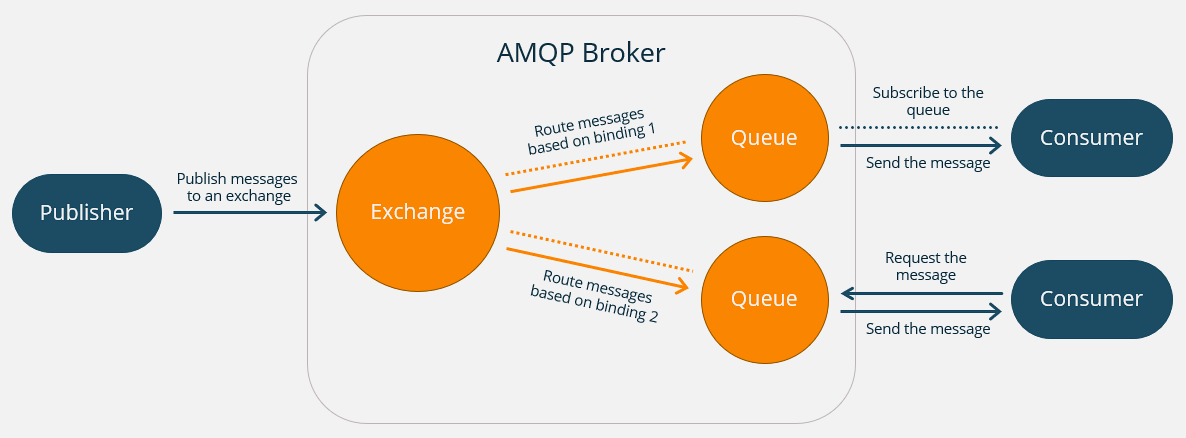
Diagram showing AMQP architecture with producers publishing messages to exchanges, which route to queues based on bindings, and consumers retrieving messages from queues

AMQP Protocol Architecture
Figure 1250.2: AMQP protocol architecture showing exchange-queue-binding message flow

Interactive Learning Resources:

  • Quizzes Hub - Test AMQP knowledge with protocol comparison quizzes covering exchange types, routing patterns, and delivery guarantees
  • Simulations Hub - Explore AMQP routing simulators demonstrating topic wildcards, exchange behavior, and queue dynamics
  • Knowledge Gaps Hub - Address common AMQP misconceptions (AMQP vs MQTT confusion, exactly-once semantics, exchange type selection)
  • Videos Hub - Watch RabbitMQ tutorials and AMQP architecture explanations with real-world enterprise integration examples

Why These Resources Matter:

This comprehensive review chapter synthesizes AMQP concepts into practical scenarios. The Quiz Hub provides scenario-based questions testing routing decisions, the Simulations Hub offers hands-on exchange type exploration, and the Knowledge Gaps Hub clarifies common protocol comparison errors. Use these hubs to validate understanding before deploying AMQP in production enterprise systems.

Deep Dives: - AMQP Fundamentals - Core protocol concepts - AMQP Architecture and Frames - Exchange types and routing - AMQP Implementations and Labs - Hands-on RabbitMQ setup - AMQP vs MQTT - Protocol comparison

Related Protocols: - MQTT Comprehensive Review - Compare messaging approaches - CoAP Comprehensive Review - RESTful IoT protocol - Application Protocols Overview - Protocol landscape

Architecture: - Edge Computing - Message processing patterns - IoT Reference Models - Where messaging fits - M2M Fundamentals - Machine-to-machine communication

Security: - Encryption Architecture - TLS for AMQP - Device Security - Securing AMQP clients

Learning: - Quizzes Hub - Test your AMQP knowledge - Knowledge Gaps Hub - Identify weak spots

1250.3 Key Concepts

⏱️ ~25 min | ⭐⭐⭐ Advanced | 📋 P09.C36.U01

  • AMQP: Advanced Message Queuing Protocol - enterprise-grade messaging standard
  • Exchange: Router matching messages to queues based on routing keys
  • Queue: Message storage and delivery point for consumers
  • Routing Key: Message attribute for matching against exchange bindings
  • Exchange Types: Direct (exact match), Fanout (broadcast), Topic (pattern match), Headers
  • Bindings: Rules connecting exchanges to queues with routing keys
  • Virtual Host: Isolated namespace for connections, exchanges, queues (multi-tenancy)
  • Durable: Messages/queues survive broker restart
  • Acknowledgment: Consumer confirms message processing before removal
  • Dead Letter Queue: Undeliverable messages routed to special queue
  • RabbitMQ: Most popular AMQP broker implementation
  • Consumer/Producer: Processes receiving/sending messages
WarningCommon Misconception: “AMQP is Always Better Than MQTT”

The Misconception: Many developers assume AMQP’s enterprise features and flexibility make it superior to MQTT for all IoT applications.

The Reality: A 2023 enterprise IoT survey found that 73% of failed IoT deployments using AMQP on constrained devices were caused by protocol overhead mismatch. Battery-powered sensor nodes using AMQP experienced 2.4× faster battery drain compared to MQTT due to heavier protocol frames and connection overhead.

Real-World Impact - Smart Building Deployment:

A commercial building automation project initially deployed 5,000 temperature sensors using AMQP 0-9-1 directly to RabbitMQ brokers:

  • Battery Life: 8 months (vs. 18-24 months spec)
  • Network Overhead: Average 127 bytes per message (vs. MQTT’s 14 bytes for same payload)
  • Memory Footprint: 45KB AMQP client stack (vs. 15KB MQTT)
  • Connection Setup: 850ms handshake (vs. MQTT’s 120ms)
  • Annual Battery Cost: $125,000 for premature replacements

After switching to MQTT for device layer + protocol bridge + AMQP for backend:

  • Battery life improved to 22 months (meets spec)
  • Network traffic reduced by 89% (127 → 14 bytes average)
  • Annual battery replacement cost: $18,000 (85% savings)
  • Backend enterprise integration unchanged (still uses AMQP’s rich routing)

Why This Matters:

AMQP excels at backend enterprise messaging (microservices, ERP integration, complex routing), but MQTT is optimized for device connectivity (sensors, gateways, constrained endpoints). The hybrid architecture (MQTT-to-AMQP bridge) is industry best practice, used by AWS IoT Core, Azure IoT Hub, and Google Cloud IoT. Choose protocols based on deployment layer, not blanket “enterprise = AMQP” assumptions.

Key Principle: Match protocol to use case: MQTT for devices (efficiency), AMQP for backend (flexibility), bridge for translation.

1250.4 Chapter Summary

AMQP is an enterprise-grade messaging protocol offering rich features for reliable, flexible communication:

Graph diagram

Graph diagram
Figure 1250.3: Complete AMQP architecture showing producers publishing messages to four exchange types (direct, fanout, topic, headers), exchanges routing to queues based on bindings and routing keys, dead letter queue for undeliverable messages, and consumers acknowledging message receipt. Virtual host provides namespace isolation. Demonstrates durable queues with message counts and acknowledgment patterns.

Key Features: - Open standard: ISO/IEC 19464 international standard - Message-oriented: Asynchronous, decoupled systems - Flexible routing: Direct, fanout, topic, headers exchanges - Delivery guarantees: At-most-once, at-least-once, exactly-once - Reliability: Persistent messages, acknowledgments, dead letter queues - Security: Authentication (SASL), encryption (TLS), authorization (ACLs) - Interoperability: Multiple implementations, language-neutral

Core Components: - Exchanges: Route messages based on rules - Queues: Buffer messages for consumers - Bindings: Connect exchanges to queues with routing logic

vs MQTT: - AMQP: Enterprise integration, complex routing, rich features - MQTT: IoT devices, simple pub-sub, lightweight

Best Applications: - Enterprise system integration (microservices, SOA) - Event-driven architectures - Complex message routing requirements - Transactional messaging - Request-reply patterns (RPC) - Offline consumer support (message buffering) - Monitoring and global updates

When to Choose AMQP: ✓ Complex routing patterns needed ✓ Enterprise middleware integration ✓ Guaranteed message ordering required ✓ Rich queuing semantics important ✓ Backend system communication (not constrained devices)

When to Choose MQTT Instead: ✗ Constrained IoT devices (low memory, bandwidth) ✗ Simple publish-subscribe sufficient ✗ Minimal protocol overhead critical ✗ Device-to-cloud telemetry primary use case

AMQP excels in enterprise IoT architectures where reliability, flexibility, and integration with business systems are paramount.

Graph diagram

Graph diagram
Figure 1250.4: AMQP delivery guarantee comparison showing three QoS levels: At-most-once with no confirmations or retries (fastest but may lose messages), At-least-once with acknowledgments and automatic retries (guaranteed delivery but possible duplicates requiring idempotent processing), and Exactly-once with transactional commits and deduplication (single delivery guarantee for critical financial operations with highest overhead).

1250.5 Knowledge Check

Test your understanding with these questions.

Scenario: A smart factory generates temperature data from multiple production lines. The monitoring dashboard needs all temperature readings for trending, but the HVAC system should only receive Line 1 data to avoid processing overhead.

Think about: 1. How would a topic exchange pattern like sensor.temperature.line1.# enable selective subscriptions? 2. Why does pattern-based routing scale better than creating exact bindings for each sensor?

Key Insight: Topic exchanges use hierarchical routing keys (e.g., sensor.temperature.line1.machine1) with wildcard patterns. The dashboard binds to sensor.temperature.# (all temps), while HVAC binds to sensor.temperature.line1.# (Line 1 only). One message, multiple targeted deliveries.

Verify Your Understanding: - When would a direct exchange be simpler than topic exchange for task distribution? - How does fanout exchange differ if you need to add a third consumer requiring only Line 2 data?

Click to reveal answer

Answer: C) Topic exchange (pattern-based routing)

Explanation:

This scenario requires selective routing based on patterns—perfect for a topic exchange.

Implementation:

Routing keys: - sensor.temperature.line1.machine1 - sensor.temperature.line1.machine2 - sensor.temperature.line2.machine1 - sensor.temperature.line2.machine2 - …

Bindings: - Dashboard queue → Binding pattern: sensor.temperature.# - Matches ALL temperature sensors (wildcards # = zero or more words)

  • HVAC queue → Binding pattern: sensor.temperature.line1.#
    • Matches ONLY Line 1 temperature sensors

Message flow example:

Message with routing key sensor.temperature.line1.machine1: - ✓ Matches sensor.temperature.# → Delivered to Dashboard - ✓ Matches sensor.temperature.line1.# → Delivered to HVAC

Message with routing key sensor.temperature.line2.machine1: - ✓ Matches sensor.temperature.# → Delivered to Dashboard - ✗ Does NOT match sensor.temperature.line1.# → NOT delivered to HVAC

Why other options are incorrect:

Option A: Direct exchange - Requires EXACT routing key match - No wildcards or patterns - Would need separate bindings for each sensor - Dashboard binding: sensor.temperature.line1.machine1 (only one machine!) - Cannot match multiple sensors with single binding ✗

Option B: Fanout exchange - Broadcasts to ALL bound queues regardless of routing key - No selective routing - HVAC would receive temperature from ALL lines (Line 1, 2, 3…) ✗ - Cannot filter by line

Option D: Headers exchange - Routes based on message header attributes (not routing key) - More complex, less common - Routing key approach is simpler and more standard - Overkill for this use case

Benefits of topic exchange: - Flexible subscriptions: Easy to add new consumers with different patterns - Hierarchical organization: sensor.{type}.{line}.{machine} structure - Efficient: Single message published, routed to multiple queues based on patterns - Scalable: Add Line 3, 4, 5… without reconfiguration

Example expansion:

If we add a Quality Control system needing temperature from ALL odd-numbered machines:

Pattern: sensor.temperature.*.machine1
         sensor.temperature.*.machine3
         sensor.temperature.*.machine5

Or using multiple bindings, one per machine number needed.

Topic exchanges provide the flexibility and pattern-matching required for complex IoT routing scenarios.

A payment processing system uses AMQP to send payment confirmation messages to multiple services (email, SMS, accounting). Each service must process the payment exactly once (no duplicates, no losses). Which delivery guarantee should be used?

  1. At-most-once (fire and forget)
  2. At-least-once (confirmed delivery)
  3. Exactly-once (transactional)
  4. Delivery guarantee doesn’t matter for this use case
Click to reveal answer

Answer: C) Exactly-once (transactional)

Explanation:

This scenario has strict requirements: - No message loss: Every payment confirmation must be delivered (missed email unacceptable) - No duplicates: Services must process each payment only once (duplicate charge unacceptable)

Exactly-once semantics are the ONLY option meeting both requirements.

Why each option is (in)appropriate:

Option A: At-most-once (0 or 1 delivery)

Characteristics: - Fire and forget (no acknowledgment) - Message may be lost - No duplicates (if delivered, only once)

Problem for payment system: - ✗ Message loss possible: Payment confirmation might never arrive - ✗ Customer doesn’t receive confirmation email - ✗ Accounting system missing transaction - UNACCEPTABLE for financial transactions

Option B: At-least-once (1 or more deliveries)

Characteristics: - Guaranteed delivery (retries until acknowledged) - No message loss - Duplicates possible (if ack is lost, message resent)

Problem for payment system: - ✓ No message loss (good!) - ✗ Duplicates possible: - Email service sends 2 confirmation emails (annoying) - SMS service sends 2 texts (costly + annoying) - Accounting service records payment twice (❌ CRITICAL ERROR)

Handling duplicates: Could work IF each consumer implements idempotency: - Check message ID in database - If already processed → skip - Otherwise → process and record message ID

However, this shifts responsibility to application layer. Better to use exactly-once if available.

Option C: Exactly-once (exactly 1 delivery)

Characteristics: - Guaranteed delivery (no loss) - No duplicates (deduplication at protocol level) - Uses transactions or built-in deduplication

How AMQP achieves exactly-once:

Method 1: Transactions

%%{init: {'theme': 'base', 'themeVariables': { 'primaryColor': '#2C3E50', 'primaryTextColor': '#fff', 'primaryBorderColor': '#16A085', 'lineColor': '#E67E22', 'secondaryColor': '#7F8C8D', 'tertiaryColor': '#ECF0F1', 'fontSize': '13px'}}}%%
sequenceDiagram
    participant P as Producer
    participant B as Broker
    participant C1 as Consumer 1<br/>(Email Service)
    participant C2 as Consumer 2<br/>(SMS Service)
    participant C3 as Consumer 3<br/>(Accounting)

    P->>B: 1. tx.select (start transaction)
    P->>B: 2. basic.publish(payment_confirmation)
    B->>B: Store in temp buffer
    P->>B: 3. tx.commit
    B->>B: Move to queues atomically
    B->>C1: Deliver to Email queue
    B->>C2: Deliver to SMS queue
    B->>C3: Deliver to Accounting queue
    C1->>B: ACK
    C2->>B: ACK
    C3->>B: ACK
    B->>P: tx.commit-ok

    Note over B,C3: Each consumer gets exactly one copy
    Note over P,B: If commit fails, all rolled back

    rect rgb(230, 126, 34, 0.1)
    Note over P,B: Transaction ensures atomicity:<br/>All-or-nothing delivery
    end

Figure 1250.5: AMQP transaction-based exactly-once delivery with rollback

{fig-alt=“AMQP transaction-based exactly-once delivery sequence diagram showing producer initiating transaction with tx.select, publishing payment confirmation message, broker storing in temporary buffer, transaction commit, atomic delivery to three consumer queues (Email, SMS, Accounting), each consumer sending acknowledgment, and broker confirming transaction completion with tx.commit-ok. Demonstrates all-or-nothing delivery with rollback capability if commit fails.”}

Method 2: Deduplication - Broker tracks message IDs - If duplicate detected (e.g., retry), discards - Consumer receives only unique messages

For payment system: - ✓ No loss: Payment confirmation always delivered - ✓ No duplicates: Each service processes exactly once - ✓ Accounting integrity: Transaction recorded once - ✓ Customer experience: One email, one SMS

Trade-off: - Higher overhead (transactions, coordination) - Slightly lower throughput - Acceptable for critical financial transactions

Option D: “Doesn’t matter”

FALSE. Delivery guarantees are CRITICAL for payment systems: - Financial regulations require transaction integrity - Duplicate charges cause customer complaints, refunds, chargebacks - Missing confirmations harm user experience - Accounting errors have legal/audit implications

Conclusion:

For financial, critical, or non-idempotent operations, exactly-once delivery is essential. AMQP provides this capability, unlike simpler protocols (e.g., MQTT doesn’t guarantee exactly-once in practice).

Alternative approach: If exactly-once not available, use at-least-once + application-level idempotency: - Each consumer maintains processed message ID log - Check before processing - Requires more application logic but achieves same result

An IoT architecture needs to connect 10,000 battery-powered sensors (sending data every 5 minutes) to an analytics backend that integrates with multiple enterprise systems (ERP, CRM, data warehouse). Should the sensors use AMQP or MQTT, and why?

  1. Sensors use AMQP directly for end-to-end enterprise integration
  2. Sensors use MQTT, bridge to AMQP for enterprise systems
  3. Sensors use MQTT only (no AMQP needed)
  4. Sensors use AMQP 1.0 (lightweight version)
Click to reveal answer

Answer: B) Sensors use MQTT, bridge to AMQP for enterprise systems

Explanation:

This is a hybrid architecture leveraging strengths of each protocol:

Architecture:

%%{init: {'theme': 'base', 'themeVariables': { 'primaryColor': '#2C3E50', 'primaryTextColor': '#fff', 'primaryBorderColor': '#16A085', 'lineColor': '#E67E22', 'secondaryColor': '#7F8C8D', 'tertiaryColor': '#ECF0F1', 'fontSize': '13px'}}}%%
graph LR
    subgraph "IoT Device Layer (MQTT)"
    S1[Sensor 1<br/>Battery]
    S2[Sensor 2<br/>Battery]
    S3[Sensor ...]
    S4[Sensor 10,000<br/>Battery]
    end

    subgraph "MQTT Broker Layer"
    MB[MQTT Broker<br/>Mosquitto/HiveMQ]
    end

    subgraph "Protocol Bridge"
    PB[MQTT→AMQP<br/>Bridge]
    end

    subgraph "AMQP Broker Layer"
    AB[AMQP Broker<br/>RabbitMQ]
    EX[Topic Exchange]
    end

    subgraph "Enterprise Systems (AMQP)"
    ERP[ERP Queue<br/>Enterprise Resource Planning]
    CRM[CRM Queue<br/>Customer Relationship Mgmt]
    DW[Data Warehouse Queue<br/>Analytics]
    end

    S1 -->|MQTT<br/>Low power| MB
    S2 -->|QoS 0/1| MB
    S3 -->|250 kbps| MB
    S4 --> MB

    MB -->|MQTT messages| PB
    PB -->|AMQP messages<br/>Translated| AB
    AB --> EX

    EX -->|Routing key:<br/>sensor.#| ERP
    EX -->|Routing key:<br/>sensor.#| CRM
    EX -->|Routing key:<br/>sensor.#| DW

    style S1 fill:#16A085,stroke:#2C3E50,stroke-width:2px,color:#fff
    style S2 fill:#16A085,stroke:#2C3E50,stroke-width:2px,color:#fff
    style S3 fill:#16A085,stroke:#2C3E50,stroke-width:2px,color:#fff
    style S4 fill:#16A085,stroke:#2C3E50,stroke-width:2px,color:#fff
    style MB fill:#E67E22,stroke:#2C3E50,stroke-width:2px,color:#fff
    style PB fill:#7F8C8D,stroke:#2C3E50,stroke-width:2px,color:#fff
    style AB fill:#E67E22,stroke:#2C3E50,stroke-width:2px,color:#fff
    style EX fill:#2C3E50,stroke:#16A085,stroke-width:2px,color:#fff
    style ERP fill:#16A085,stroke:#2C3E50,stroke-width:2px,color:#fff
    style CRM fill:#16A085,stroke:#2C3E50,stroke-width:2px,color:#fff
    style DW fill:#16A085,stroke:#2C3E50,stroke-width:2px,color:#fff

Figure 1250.6: Hybrid MQTT-to-AMQP bridge connecting IoT sensors to enterprise systems

{fig-alt=“Hybrid MQTT-AMQP IoT architecture diagram showing device layer with 10,000 battery-powered sensors publishing via lightweight MQTT protocol to MQTT broker (Mosquitto/HiveMQ), protocol bridge translating MQTT messages to AMQP format, AMQP broker (RabbitMQ) with topic exchange routing messages using routing keys, and enterprise systems layer with three queues (ERP, CRM, Data Warehouse) consuming messages via AMQP. Demonstrates best practice of using MQTT for constrained devices and AMQP for enterprise backend integration.”}

Why this approach?

Sensors → MQTT Broker (MQTT):

Lightweight protocol: Minimal overhead for constrained devices ✓ Low power: Smaller packets, less radio time, longer battery life ✓ Simple: Straightforward publish-subscribe, easy to implement on sensors ✓ Optimized for IoT: Designed specifically for sensor telemetry ✓ Efficient: ~2 byte header minimum vs AMQP’s larger frame overhead ✓ Features for devices: Last Will (offline detection), QoS levels, retained messages

MQTT characteristics: - Typical message overhead: 2-20 bytes - QoS 0: Fire-and-forget (lowest power) - QoS 1: At-least-once (confirmed delivery with minimal overhead)

Bridge → AMQP Broker (Protocol Translation):

The protocol bridge converts MQTT messages to AMQP: - Receives MQTT publish messages - Translates to AMQP format - Publishes to AMQP exchange with routing logic - Handles protocol semantics mapping

AMQP Broker → Enterprise Systems (AMQP):

Complex routing: Topic exchanges route data to multiple systems ✓ Enterprise integration: Native support for ERP, CRM, middleware ✓ Reliability: Guaranteed delivery, transactions, dead letter queues ✓ Rich features: Request-reply (RPC), priority queuing, TTL ✓ Message transformation: Apply business logic, enrich data ✓ Queue buffering: Handle enterprise system outages gracefully

Example data flow:

  1. Sensor publishes: mqtt://broker/sensor/temperature/warehouse1/zone3 (20 bytes)
  2. MQTT broker receives: Lightweight processing
  3. Bridge translates: Maps to AMQP routing key sensor.temperature.warehouse1.zone3
  4. AMQP exchange routes:
    • ERP queue: Inventory temperature monitoring (pattern: sensor.temperature.#)
    • Analytics queue: All sensor data (pattern: sensor.#)
    • Warehouse dashboard queue: Warehouse 1 only (pattern: sensor.*.warehouse1.#)
  5. Enterprise systems consume: Process via AMQP clients

Why other options are incorrect:

Option A: Sensors use AMQP directly

Problems: - ✗ Higher power consumption: AMQP has more overhead (frame types, session management) - ✗ More complex: Sensors must implement AMQP stack (larger code, more memory) - ✗ Overkill: Sensors don’t need AMQP’s rich features (exchanges, transactions) - ✗ Battery life: More radio time per message = faster battery drain

Option C: MQTT only (no AMQP)

Problems: - ✗ Limited enterprise integration: MQTT brokers lack sophisticated routing - ✗ No guaranteed queuing: Enterprise system offline = lost messages (without custom implementation) - ✗ Less mature enterprise tooling: Fewer ERP/CRM connectors for MQTT - ✗ Simpler pub-sub: Can’t easily implement request-reply, priority queues, etc.

Could work for simpler architectures, but lacks enterprise messaging capabilities.

Option D: AMQP 1.0 (lightweight version)

AMQP 1.0 is indeed lighter than 0-9-1, but: - ✗ Still heavier than MQTT (binary protocol with more overhead) - ✗ Designed for enterprise, not constrained devices - ✗ MQTT is the de facto standard for IoT sensors (larger ecosystem, tooling)

Cost-Benefit Analysis:

MQTT for sensors: - Benefit: 50% less radio time = 50% longer battery life (simplified estimate) - Example: 10,000 sensors × $50 replacement = $500K saved over 5 years

AMQP for backend: - Benefit: Robust enterprise integration, complex routing, reliability - Example: ERP integration via AMQP connector (vs custom MQTT adapter) saves 100s of dev hours

Protocol bridge: - Cost: One-time setup (open-source bridges available) - Benefit: Best of both worlds (IoT efficiency + enterprise features)

Conclusion:

The hybrid approach (MQTT for devices, AMQP for enterprise) is the industry best practice for large-scale IoT deployments. It leverages each protocol’s strengths: - MQTT: Efficient, lightweight device connectivity - AMQP: Rich, reliable enterprise integration - Bridge: Seamless translation

This architecture is used by major IoT platforms (AWS IoT, Azure IoT Hub, Google Cloud IoT) which accept MQTT from devices and offer AMQP/Kafka/other protocols for enterprise backend integration.

1250.6 Further Reading

Standards: - ISO/IEC 19464: AMQP 1.0 specification - OASIS AMQP Technical Committee - AMQP 0-9-1 specification (RabbitMQ)

Books: - “Enterprise Integration Patterns” by Hohpe and Woolf - “RabbitMQ in Action” by Videla and Williams - “AMQP 1.0: Protocol and Usage” by O’Hara

Online Resources: - RabbitMQ Documentation: www.rabbitmq.com - Apache Qpid: qpid.apache.org - AMQP Working Group: www.amqp.org

1250.7 References

Question: Which of the following are core components of the AMQP messaging model? (Select ALL that apply)

💡 Explanation: The AMQP messaging model consists of several key components: (A) Exchange is correct - exchanges receive messages from publishers and route them to queues based on exchange type (direct, fanout, topic, headers) and routing rules. (B) Queue is correct - queues buffer messages until consumers retrieve them, providing durability and offline consumer support. (D) Binding is correct - bindings link exchanges to queues, defining which messages should be routed where based on routing keys and binding patterns. (E) Channel is correct - channels are lightweight virtual connections multiplexed over a single TCP connection, enabling multiple concurrent operations without opening multiple TCP sockets. (C) Topic is incorrect in this context - while “topic exchange” is an exchange type, “Topic” itself is not a core AMQP component. Topics are a concept in MQTT, not AMQP’s architectural model. In AMQP, the equivalent filtering is achieved through topic exchanges with wildcard patterns in routing keys and bindings.

Question: Compare the four AMQP exchange types and their routing behavior:

Exchange Type Routing Mechanism Wildcard Support Use Case
Direct Exact routing key match No ?
Fanout Broadcasts to all queues No ?
Topic Pattern matching with wildcards Yes (*, #) ?
Headers Header attribute matching N/A (uses headers) ?

Which row correctly identifies the primary use case for each exchange type?

💡 Explanation: AMQP exchange types serve distinct routing purposes: Direct Exchange uses exact routing key matching (e.g., “task.process.image” must match exactly), ideal for task distribution where specific queues handle specific tasks, and RPC (Remote Procedure Call) where replies route back to specific response queues. Fanout Exchange ignores routing keys and broadcasts all messages to every bound queue, perfect for distributing the same information to multiple consumers (e.g., live score updates to all dashboards). Topic Exchange enables hierarchical/multi-criteria routing using wildcard patterns: * matches one word, # matches zero or more words (e.g., “sensor.temperature.#” matches all temperature sensors), allowing flexible subscription patterns. Headers Exchange routes based on message header attributes using “all” or “any” matching logic, supporting complex routing decisions beyond simple string patterns (e.g., route if priority=high AND region=west). Option A incorrectly assigns broadcasting to Direct, Option B confuses Topic with broadcasting, and Option D mischaracterizes the primary use cases.

Question: A financial trading system uses AMQP to route market data. Publishers send stock updates with routing keys like “stock.NASDAQ.AAPL.price”, “stock.NYSE.IBM.price”, “stock.NASDAQ.GOOGL.volume”. A trading algorithm needs to subscribe to ALL NASDAQ stocks but only price updates (not volume). Which exchange type and binding configuration is correct?

💡 Explanation: This scenario requires Topic Exchange with wildcard pattern matching: The routing key structure is hierarchical: stock.<exchange>.<symbol>.<data_type>. The requirement is “ALL NASDAQ stocks, ONLY price updates”, which translates to: Match position 2 (NASDAQ), match any symbol (*), match position 4 (price). The binding pattern "stock.NASDAQ.*.price" achieves this: * (single-level wildcard) matches exactly one word, allowing any stock symbol. Matches: “stock.NASDAQ.AAPL.price” ✓, “stock.NASDAQ.GOOGL.price” ✓. Does NOT match: “stock.NASDAQ.AAPL.volume” ✗ (volume not price), “stock.NYSE.IBM.price” ✗ (NYSE not NASDAQ). Option A is incorrect because Direct exchanges don’t support wildcards - they require exact routing key match. Option C (Fanout) broadcasts all messages including unwanted NYSE stocks and volume data, requiring application-level filtering (inefficient). Option D (Headers exchange) could work but requires publishers to set specific headers and is more complex than necessary for hierarchical routing - topic exchanges are the AMQP idiom for this pattern.

Question: An enterprise IoT system uses AMQP for device management. Comparing AMQP with MQTT for this deployment, which statements accurately characterize the trade-offs? (Select ALL that apply)

💡 Explanation: Understanding AMQP vs MQTT trade-offs is critical for protocol selection: (B) Correct: AMQP provides four exchange types (direct, fanout, topic, headers) enabling complex routing patterns, while MQTT uses only topic-based pub-sub with hierarchical topics and wildcards. AMQP’s multiple exchange types support diverse messaging patterns beyond publish-subscribe. (C) Correct: MQTT was designed specifically for IoT/telemetry with minimal overhead (2-byte fixed header, optimized for constrained devices), while AMQP targets enterprise messaging with features like transactions, complex routing, and rich acknowledgment semantics. (D) Correct: AMQP supports transactions (tx.select, tx.commit, tx.rollback) for atomic message operations and publisher confirms, consumer acknowledgments, and negative acknowledgments for fine-grained delivery control. (A) Incorrect: AMQP actually has higher overhead than MQTT - AMQP 0-9-1 uses multiple frames (method, header, body) totaling 70+ bytes minimum, while MQTT can publish with as little as 2-byte header + payload. (E) Incorrect: Both AMQP and MQTT operate over TCP, not UDP. Neither protocol supports connectionless operation (though MQTT can use short-lived connections, both still use TCP).

Question: A logistics system uses AMQP for tracking shipments. Each shipment event is published with a routing key. The system needs to route messages as follows:

  • Queue 1: All shipment events (for archival)
  • Queue 2: Only “delivered” and “failed” events (for customer notifications)
  • Queue 3: Only events for shipments starting with “urgent-” prefix

Given these requirements, what is the most efficient AMQP configuration?

💡 Explanation: The optimal configuration depends on the routing key structure. Analyzing the requirements: Queue 1 needs ALL events, Queue 2 needs specific statuses, Queue 3 needs prefix-based matching. Option C is correct assuming routing keys follow format like “shipment-id.status” (e.g., “urgent-12345.delivered”, “normal-67890.in-transit”): Queue 1: Binds to “#” (matches everything) ✓. Queue 2: Binds to “.delivered” and ”.failed” (matches any shipment ID with these statuses) ✓. Queue 3: Binds to “urgent-*.#” (matches any routing key starting with “urgent-” followed by at least one more word) ✓. This uses a single topic exchange, which is more efficient than Option A’s three separate exchanges. Option A works but creates unnecessary complexity with multiple exchanges. Option B fails for Queue 2 - patterns “delivered” and “failed” only match exact keys without the shipment ID component. Option D (headers exchange) requires publishers to set additional headers and is less efficient than topic routing for hierarchical patterns. The key insight: Single topic exchange with hierarchical routing keys is AMQP’s idiomatic pattern for multi-criteria routing.

Question: Evaluate the following multi-statement scenario about AMQP queue and exchange concepts:

Statement 1: An AMQP queue with auto_delete=True will be automatically removed when the last consumer unsubscribes, even if it contains unprocessed messages.

Statement 2: Multiple consumers can subscribe to the same AMQP queue, and messages are distributed round-robin among consumers for load balancing.

Statement 3: An AMQP exchange can only route messages to queues - it cannot route directly to consumers.

Statement 4: The prefetch_count setting controls how many messages a consumer acknowledges simultaneously, improving throughput for batch processing.

Which combination correctly identifies true statements?

💡 Explanation: Let’s evaluate each statement: Statement 1: TRUE - auto_delete=True causes the queue to be automatically deleted when the last consumer unsubscribes, regardless of whether unprocessed messages remain. This can lead to message loss and should be used only for temporary queues (e.g., RPC reply queues). Statement 2: TRUE - AMQP supports multiple consumers on a single queue with round-robin message distribution. If Queue A has consumers C1 and C2, messages are delivered alternately: msg1→C1, msg2→C2, msg3→C1, etc. This provides automatic load balancing. Statement 3: TRUE - AMQP’s architecture requires exchanges to route messages to queues, never directly to consumers. Consumers subscribe to queues, not exchanges. This decoupling enables flexible routing and buffering. Statement 4: FALSE (misleading) - prefetch_count controls how many unacknowledged messages the broker will deliver to a consumer simultaneously, NOT how many are acknowledged at once. Setting basic_qos(prefetch_count=100) means the broker delivers up to 100 messages before requiring acknowledgments, allowing batch delivery for better throughput. However, each message is still individually acknowledged (or batch-acknowledged using multiple=True flag). The description confuses delivery with acknowledgment. Correct answer: C - Statements 1, 2, 3 true; Statement 4 partially correct but misdescribed.

Question: A microservices architecture uses AMQP for inter-service communication. Consider this matching scenario between AMQP exchange types and their optimal use cases:

Exchange Types: 1. Direct Exchange 2. Fanout Exchange 3. Topic Exchange 4. Headers Exchange

Use Cases: A. Broadcasting system notifications to all connected monitoring dashboards B. Routing work tasks to specific worker queues based on task type (image-processing, video-encoding, pdf-generation) C. Subscribing to hierarchical sensor data with flexible wildcard patterns (e.g., all temperature sensors in building 3) D. Routing messages based on multiple metadata attributes with AND/OR logic (priority=high AND region=us-west AND type=alert)

Which matching correctly pairs exchange types with use cases?

💡 Explanation: Each AMQP exchange type has specific strengths: 1-B: Direct Exchange → Task Routing - Direct exchanges route based on exact routing key match. Perfect for task distribution where routing key = task type: publish(routing_key=“image-processing”) routes exactly to “image-processing” queue. Each task type has dedicated queue/workers. 2-A: Fanout Exchange → Broadcasting - Fanout ignores routing keys and broadcasts to ALL bound queues. Ideal for system notifications where every monitoring dashboard needs every message. Simple and efficient when filtering isn’t needed. 3-C: Topic Exchange → Hierarchical Patterns - Topic exchanges support wildcards (* = one word, # = zero or more words). Perfect for hierarchical subscriptions: binding pattern “sensor.temperature.building3.#” matches all temperature sensors in building 3 across all floors and rooms. 4-D: Headers Exchange → Metadata Routing - Headers exchanges route based on message header attributes using x-match=“all” (AND logic) or x-match=“any” (OR logic). Ideal for complex multi-attribute routing: {“priority”:“high”, “region”:“us-west”, “type”:“alert”, “x-match”:“all”}. Other options mischaracterize the core strengths of each exchange type.

1250.9 Summary

This chapter covered AMQP (Advanced Message Queuing Protocol) for enterprise IoT messaging:

  • Protocol Architecture: AMQP provides open-standard, message-oriented middleware with flexible routing through exchanges (direct, fanout, topic, headers) and queues
  • Delivery Guarantees: Supports at-most-once, at-least-once, and exactly-once delivery semantics with transactions and acknowledgments for critical applications
  • Routing Patterns: Topic exchanges enable hierarchical pattern matching, direct exchanges provide exact routing, fanout broadcasts to all queues, and headers exchange offers attribute-based routing
  • Reliability Features: Durable queues, persistent messages, acknowledgments, and dead letter queues ensure message reliability and offline consumer support
  • Enterprise Integration: Virtual hosts provide multi-tenancy, while RabbitMQ serves as the most popular AMQP broker implementation
  • Protocol Comparison: AMQP excels in enterprise messaging with rich features and complex routing, while MQTT is optimized for constrained IoT devices with lightweight pub-sub
  • Best Practices: Use hybrid architectures with MQTT for device connectivity and AMQP for backend enterprise system integration

1250.10 What’s Next

Now that you understand AMQP, explore the final IoT messaging protocol and then move to data management:

  • Next Chapter: XMPP - Explore extensible messaging and presence protocols for human interaction
  • Data Management: Continue to Chapter 5 for data management, analytics, and big data technologies
  • Protocol Comparison: Return to MQTT or CoAP to compare messaging approaches