%%{init: {'theme': 'base', 'themeVariables': { 'primaryColor': '#2C3E50', 'primaryTextColor': '#fff', 'primaryBorderColor': '#16A085', 'lineColor': '#16A085', 'secondaryColor': '#E67E22', 'tertiaryColor': '#7F8C8D', 'fontSize': '14px'}}}%%
flowchart TB
    subgraph CLIENT["IoT Device (Client)"]
        C1["Application<br/>(CoAP)"]
        C2["DTLS Layer<br/>(Encryption)"]
        C3["UDP Layer<br/>(Transport)"]
        C1 --> C2 --> C3
    end

    subgraph HANDSHAKE["DTLS Handshake"]
        H1["1. ClientHello"]
        H2["2. HelloVerifyRequest<br/>(Cookie for DoS protection)"]
        H3["3. ClientHello + Cookie"]
        H4["4. ServerHello + Certificate"]
        H5["5. Key Exchange<br/>(PSK or ECC)"]
        H6["6. Finished"]
        H1 --> H2 --> H3 --> H4 --> H5 --> H6
    end

    subgraph RECORD["DTLS Record Protection"]
        R1["Plaintext Data"]
        R2["Add Sequence Number<br/>(Replay protection)"]
        R3["Encrypt with AES-GCM<br/>(Confidentiality)"]
        R4["Add Auth Tag 16B<br/>(Integrity)"]
        R5["DTLS Record Header 13B<br/>(Type, Version, Length)"]
        R1 --> R2 --> R3 --> R4 --> R5
    end

    subgraph SERVER["Cloud Server"]
        S1["UDP Layer<br/>(Transport)"]
        S2["DTLS Layer<br/>(Decryption)"]
        S3["Application<br/>(CoAP)"]
        S1 --> S2 --> S3
    end

    CLIENT --> HANDSHAKE
    HANDSHAKE --> RECORD
    RECORD --> SERVER

    FEATURES["DTLS Features<br/>━━━━━━━━━━━━<br/>✓ Cookie-based DoS protection<br/>✓ Session resumption (68% savings)<br/>✓ Replay protection (sequence numbers)<br/>✓ AES-GCM encryption (confidentiality)<br/>✓ HMAC authentication (integrity)<br/>✓ PSK or certificate-based auth<br/>━━━━━━━━━━━━<br/>Overhead: 13B header + 16B tag<br/>Handshake: 620B full, 200B resumed"]

    HANDSHAKE --> FEATURES
    RECORD --> FEATURES

    style CLIENT fill:#2C3E50,stroke:#16A085,stroke-width:3px,color:#fff
    style SERVER fill:#2C3E50,stroke:#16A085,stroke-width:3px,color:#fff
    style HANDSHAKE fill:#E67E22,stroke:#2C3E50,stroke-width:3px,color:#fff
    style RECORD fill:#16A085,stroke:#2C3E50,stroke-width:3px,color:#fff
    style FEATURES fill:#7F8C8D,stroke:#2C3E50,stroke-width:2px,color:#fff
    style C1 fill:#34495E,stroke:#16A085,stroke-width:1px,color:#fff
    style C2 fill:#34495E,stroke:#16A085,stroke-width:1px,color:#fff
    style C3 fill:#34495E,stroke:#16A085,stroke-width:1px,color:#fff
    style S1 fill:#34495E,stroke:#16A085,stroke-width:1px,color:#fff
    style S2 fill:#34495E,stroke:#16A085,stroke-width:1px,color:#fff
    style S3 fill:#34495E,stroke:#16A085,stroke-width:1px,color:#fff
    style H1 fill:#F39C12,stroke:#2C3E50,stroke-width:1px,color:#000
    style H2 fill:#F39C12,stroke:#2C3E50,stroke-width:1px,color:#000
    style H3 fill:#F39C12,stroke:#2C3E50,stroke-width:1px,color:#000
    style H4 fill:#F39C12,stroke:#2C3E50,stroke-width:1px,color:#000
    style H5 fill:#F39C12,stroke:#2C3E50,stroke-width:1px,color:#000
    style H6 fill:#F39C12,stroke:#2C3E50,stroke-width:1px,color:#000
    style R1 fill:#1ABC9C,stroke:#2C3E50,stroke-width:1px,color:#fff
    style R2 fill:#1ABC9C,stroke:#2C3E50,stroke-width:1px,color:#fff
    style R3 fill:#1ABC9C,stroke:#2C3E50,stroke-width:1px,color:#fff
    style R4 fill:#1ABC9C,stroke:#2C3E50,stroke-width:1px,color:#fff
    style R5 fill:#1ABC9C,stroke:#2C3E50,stroke-width:1px,color:#fff
757 Transport Review: DTLS Security Architecture
757.1 Learning Objectives
By the end of this chapter, you will be able to:
- Understand DTLS architecture: Explain how DTLS secures UDP-based IoT communication
- Analyze handshake process: Describe the DTLS handshake stages and their purpose
- Apply DoS protection: Explain cookie-based protection for constrained devices
- Optimize for IoT: Use session resumption to reduce handshake overhead
757.2 Prerequisites
Required Chapters:
- Transport Review: Protocol Selection - Protocol trade-offs
- Transport Fundamentals - TCP/UDP basics
Estimated Time: 20 minutes
757.3 DTLS Security Architecture
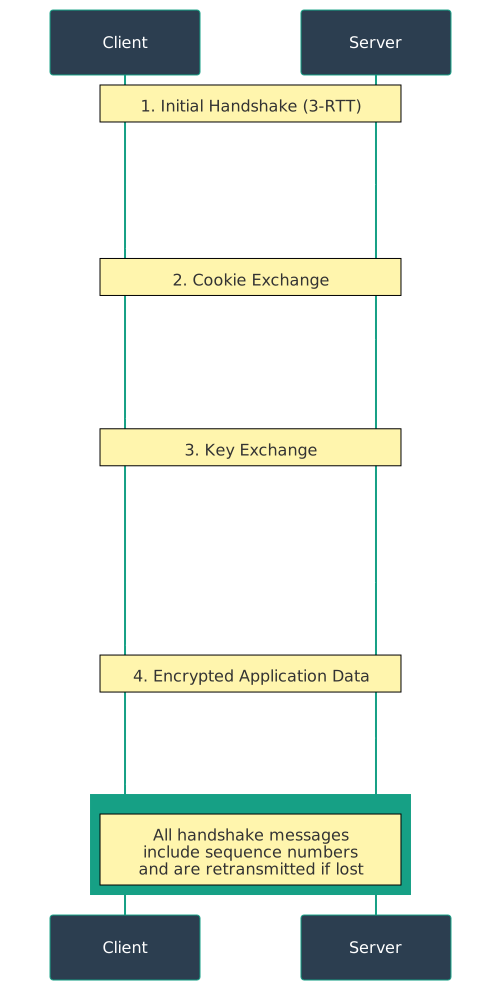
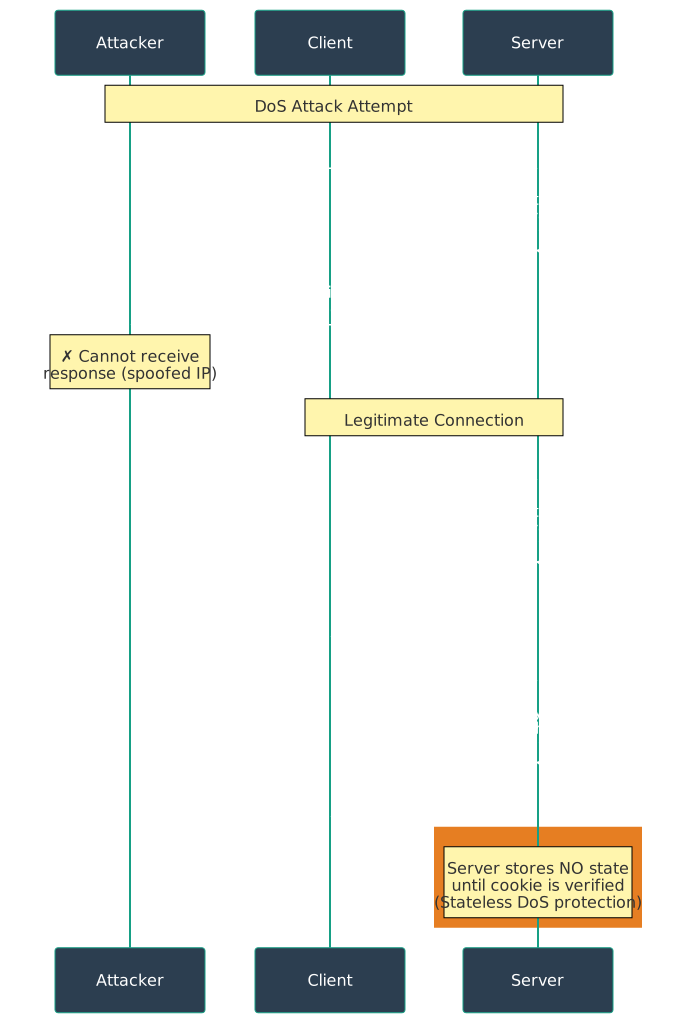
DTLS (Datagram Transport Layer Security) architecture for securing UDP-based IoT communication. System spans three components: IoT device client (application→DTLS→UDP layers), DTLS handshake protocol, record protection mechanism, and cloud server (UDP→DTLS→application). Handshake proceeds in 6 steps including cookie-based DoS protection (HelloVerifyRequest prevents resource exhaustion from spoofed ClientHello messages) and key exchange supporting PSK or ECC. Record protection applies 5-stage pipeline: plaintext data → sequence number (replay protection) → AES-GCM encryption (confidentiality) → 16-byte authentication tag (integrity) → 13-byte DTLS record header. Key features enable constrained IoT deployment: cookie verification protects limited-RAM gateways (64KB) from DoS attacks, session resumption reduces handshake energy by 68% (200B vs 620B), AES-GCM provides authenticated encryption, PSK mode avoids expensive certificate validation. Typical overhead: 29 bytes per record (13B header + 16B auth tag), amortized handshake cost with resumption. DTLS enables secure CoAP (CoAPS) achieving 5-10 year battery life for sensors reporting every minute.
757.4 DTLS Key Features
| Feature | Purpose | Benefit for IoT |
|---|---|---|
| Cookie-based DoS protection | Prevents resource exhaustion | Protects constrained gateways |
| Session resumption | Abbreviated handshake | 68% energy savings |
| Sequence numbers | Replay protection | Prevents repeated commands |
| AES-GCM encryption | Confidentiality | Protects sensor data |
| Authentication tag | Integrity | Detects tampering |
| PSK mode | Pre-shared keys | Avoids certificate overhead |
757.5 DTLS Handshake Process
The DTLS handshake establishes a secure session:
- ClientHello: Client initiates with supported cipher suites
- HelloVerifyRequest: Server sends cookie for DoS protection
- ClientHello + Cookie: Client proves address reachability
- ServerHello + Certificate: Server responds with chosen parameters
- Key Exchange: PSK or ECC-based key agreement
- Finished: Both sides confirm successful handshake
757.5.1 Handshake Overhead
| Handshake Type | Messages | Bytes | Round Trips |
|---|---|---|---|
| Full handshake | 6 | 620 | 3 RTT |
| Session resumption | 3 | 200 | 1 RTT |
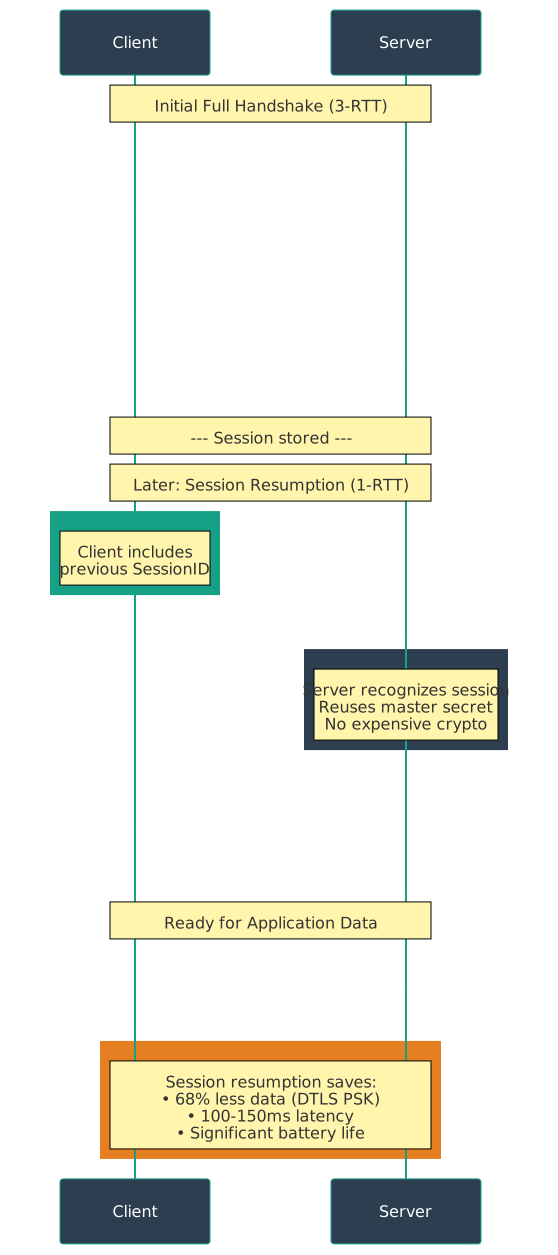
Session resumption saves 68% bytes and 2 round trips.
757.7 Session Resumption for Battery Savings
Session resumption dramatically reduces energy consumption:
Without session resumption:
Every message: Full handshake (120 mJ) + data transmission (10 mJ)
Energy per message: 130 mJ
Per day (2,880 messages): 374 J = 104 mAh
With session resumption:
First message: Full handshake (120 mJ) + data (10 mJ) = 130 mJ
Subsequent: Abbreviated handshake (40 mJ) + data (10 mJ) = 50 mJ
Per day: 1 × 130 mJ + 2,879 × 50 mJ = 144 J = 40 mAh
Savings: 64% reduction!
How session resumption works:
- Initial handshake creates session ID and master secret
- Both parties cache session state
- Subsequent connections reference session ID
- Skip expensive key exchange, reuse master secret
- Session lifetime: hours to days (configurable)
Best practices:
- Enable session resumption (IETF RFC 6347)
- Session lifetime: 8-24 hours (balance security vs efficiency)
- Periodic full handshake (daily) for key rotation
757.8 Visual Reference Gallery
NoteVisual: DTLS Handshake Process
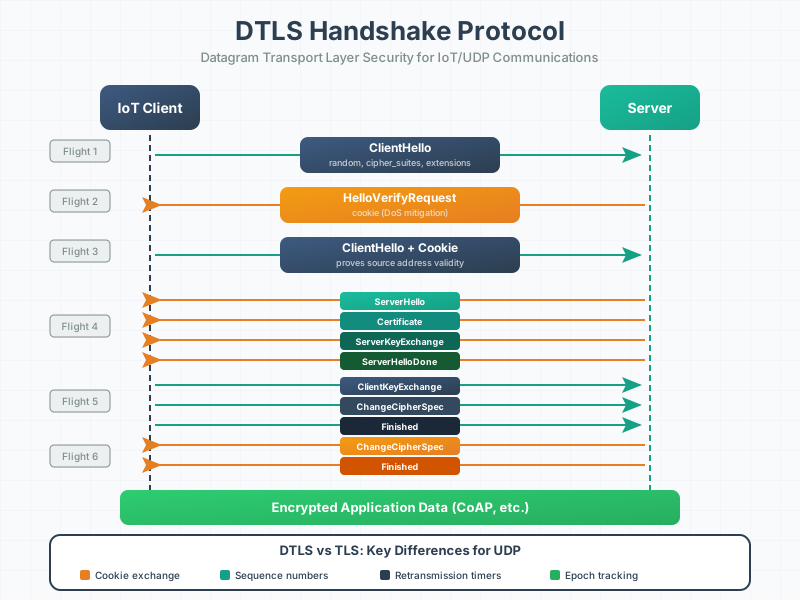
DTLS provides TLS-level security for UDP-based IoT protocols like CoAP, with modifications for datagram transport.
NoteAI-Generated Figure Variants for DTLS

757.9 Summary
DTLS provides essential security for UDP-based IoT:
- Cookie-based DoS protection prevents resource exhaustion attacks on constrained devices
- Session resumption reduces handshake overhead by 68%, enabling long battery life
- AES-GCM encryption provides confidentiality and integrity with minimal overhead
- PSK mode avoids expensive certificate operations for constrained devices
757.10 What’s Next
Continue exploring transport protocol analysis:
- Transport Review: Knowledge Check: Quiz questions to test your understanding
- DTLS and Security: Deep dive into DTLS implementation
- CoAP Protocol: RESTful communication secured by DTLS