733 Transport Protocol Decision Framework
By the end of this section, you will be able to:
- Apply a systematic decision framework for transport protocol selection
- Recognize and avoid common transport protocol pitfalls
- Evaluate real-world scenarios using detailed comparison matrices
- Apply best practices for IoT transport layer design
733.1 Prerequisites
Before diving into this chapter, you should be familiar with:
- Transport Protocol Fundamentals: TCP and UDP characteristics
- DTLS Security: When and how to secure UDP
- Protocol Selection: Basic selection criteria
- TCP Optimizations: Making TCP efficient
In one sentence: Systematic protocol selection based on quantified trade-offs prevents costly design mistakes.
Remember this: The three questions - (1) Can I tolerate loss? (2) Am I battery-powered? (3) Do I transmit frequently? - guide 90% of transport decisions.
733.2 Quick Decision Tree
Step 1: Is this a one-time command or continuous stream? - One-time command (unlock door, turn on light) -> Go to Step 2 - Continuous stream (video, sensor data) -> Go to Step 3 - Large file transfer (firmware update, config) -> Use TCP (guaranteed delivery essential)
Step 2: One-Time Command Decision - Critical (missed command = safety risk or significant cost) -> TCP or UDP + CoAP CON - Non-critical (missed command = user retries) -> UDP + CoAP NON
Step 3: Continuous Stream Decision - Real-time (latency < 100ms critical, occasional loss OK) -> UDP (possibly with FEC) - Recorded (data must be complete, latency not critical) -> TCP
Step 4: Power Budget Check - Mains powered -> TCP acceptable - Battery (daily recharge) -> Prefer UDP, TCP OK for infrequent use - Battery (months/years) -> UDP only (TCP keep-alive kills battery)
733.3 Detailed Scenario-Based Comparison
The following table compares TCP and UDP across real-world IoT scenarios with actual measurements and recommendations.
| Scenario | Data Type | TCP Behavior | UDP Behavior | Recommendation | Why? |
|---|---|---|---|---|---|
| Temperature sensor (every 30 sec) | 10 bytes payload | 3-way handshake (192 bytes) + data (74 bytes) + FIN (192 bytes) = 458 bytes 46x overhead! | Single datagram (42 bytes) 4.2x overhead | UDP + CoAP NON | Occasional missing reading OK, fresh data more valuable than old data |
| Door lock command | 20 bytes payload | Handshake + data + FIN = 468 bytes 23x overhead But guaranteed delivery | Single datagram (52 bytes) without confirmation = Risk! | UDP + CoAP CON (app-layer ACK) | Need confirmation but TCP overkill for single packet |
| Firmware update (500 KB) | 512,000 bytes payload | Automatic segmentation, in-order delivery, flow control, 5-10% overhead = ~550 KB | Would need to implement: fragmentation, ordering, ACKs, retransmission = recreating TCP! | TCP | Large reliable transfer is exactly what TCP is designed for |
| Security camera (1080p) | 1-5 Mbps stream | Retransmits cause jitter (200ms spikes), video freezes, poor UX | Drops packets (1-5% loss), slight artifacts, smooth playback | UDP + FEC | Real-time video: fresh frame > perfect old frame |
| MQTT telemetry (1 msg/min) | 50 bytes payload | Persistent connection: handshake once, send data (84 bytes), keep-alive every 60s (54 bytes) = 138 bytes/min | One datagram per minute (80 bytes), no keep-alive = 80 bytes/min | Depends on scale: <100 devices -> TCP, >1000 devices -> MQTT-SN (UDP) | TCP scales poorly with many connections |
| Industrial sensor (100 Hz sampling) | 4 bytes x 100/sec = 400 bytes/sec | Head-of-line blocking: 1 lost packet delays all subsequent packets, latency spikes! | Drops occasional packet (99% delivery still OK), consistent latency | UDP | 100Hz real-time control: predictable latency > perfect delivery |
Key Insight: TCP overhead is not just bytes - it’s round-trips and state! - TCP handshake: 1.5 round-trip times (RTT) before data transmission - Battery-powered sensor (250ms RTT cellular): 375ms wasted per connection - UDP: 0 RTT, immediate data transmission
733.4 TCP vs UDP Trade-Off Matrix
| Aspect | TCP Advantage | UDP Advantage | When It Matters Most |
|---|---|---|---|
| Reliability | Automatic retransmission, In-order delivery, No data loss | No guarantees, Packet loss (1-10%), Out-of-order delivery | TCP: Financial transactions, firmware updates; UDP: Sensor readings (next reading overwrites) |
| Latency | Retransmissions add jitter (50-500ms spikes), Head-of-line blocking | Consistent low latency, No waiting for retransmits | TCP: Acceptable for human interaction; UDP: Critical for real-time control, gaming, VoIP |
| Throughput | Congestion control optimizes throughput, Flow control prevents overwhelming | Can congest network, No automatic throttling | TCP: Large file transfers, bulk data; UDP: Small messages, pre-determined rate |
| Power Consumption | 3-way handshake wastes power, Keep-alive packets drain battery, Connection state requires RAM | No connection overhead, No keep-alive, Minimal state | TCP: Mains-powered devices OK; UDP: Battery-powered devices critical |
| Complexity | Handles all edge cases automatically, Mature implementations | Application must handle reliability if needed, More code to write/debug | TCP: Rapid development, reliability critical; UDP: Custom reliability needs (CoAP) |
| Scalability | Server maintains state per connection, 10K connections = 40MB+ RAM | Stateless (connectionless), 1M+ “connections” possible | TCP: <1000 clients fine; UDP: >10,000 clients need stateless |
| Firewall/NAT | Easier through firewalls (stateful tracking), Port forwarding straightforward | Many firewalls block UDP, NAT timeouts (30-60 sec) | TCP: Enterprise deployments; UDP: May need NAT keep-alive tricks |
How to Use This Matrix: 1. Identify your top 2 priorities from the left column (e.g., Power Consumption + Latency) 2. Check which protocol has advantages for those aspects 3. Verify you can accept the trade-offs for the chosen protocol 4. Consider hybrid approaches if trade-offs are unacceptable
733.5 Hybrid Approaches: Best of Both Worlds
| Hybrid Strategy | When to Use | Example Implementation | Benefit |
|---|---|---|---|
| UDP + Application-Layer ACK | Need reliability without TCP overhead | CoAP Confirmable messages: Send over UDP, wait for ACK, retry 2-4 times with exponential backoff | 80% of TCP reliability with 20% of TCP overhead |
| TCP + UDP dual path | Critical + real-time data | Smart car: Send emergency brake command via both TCP (reliable) and UDP (fast). First to arrive triggers action. | Reliability of TCP, latency of UDP |
| UDP with Forward Error Correction (FEC) | Streaming with lossy links | Video codec sends 10% redundant data. Receiver reconstructs 5-10% lost packets without retransmission. | Smooth streaming despite packet loss |
| QUIC (UDP-based but TCP-like) | Need TCP features with UDP speed | Modern web browsers, mobile apps. QUIC provides reliability, flow control, but faster handshake (0-RTT) | Combines benefits, but complex to implement |
| Short-lived TCP connections | Occasional reliable transfers, battery-powered | Send data over TCP, immediately close. 50x per day OK. 50,000x per day -> kills battery. | Reliability when needed, low average power |
| MQTT-SN (UDP-based MQTT) | Pub/sub telemetry at scale on constrained networks | Zigbee/Thread networks use MQTT-SN over UDP. Gains pub/sub semantics without TCP overhead. | IoT-optimized publish-subscribe |
733.6 Real-World Decision Examples
Example 1: Smart Agriculture Soil Sensors - Requirement: 500 sensors, battery-powered (5-year life), reading every 15 minutes - Decision: UDP + CoAP NON (non-confirmable) - Reasoning: Missing 1% of readings acceptable (next reading in 15 min), TCP keep-alive would drain battery in months - Alternative rejected: TCP - Battery life reduced from 5 years to 6 months due to connection overhead
Example 2: Industrial Machine Diagnostics - Requirement: Predict bearing failure, 1000 Hz vibration sampling, <10ms latency - Decision: UDP (raw datagrams) - Reasoning: Real-time control loop needs consistent latency, TCP retransmits cause 200ms spikes (unacceptable) - Alternative rejected: TCP - Head-of-line blocking causes latency jitter, missing failure prediction window
Example 3: Smart Home Firmware Updates - Requirement: Distribute 5 MB firmware to 50 smart bulbs - Decision: TCP (HTTP download) - Reasoning: 100% reliability required (corrupted firmware bricks device), TCP handles all edge cases - Alternative rejected: UDP - Would need to implement chunking, ACKs, retransmission, reassembly = reinventing TCP
Example 4: Video Doorbell - Requirement: 1080p stream to smartphone, real-time (low latency), mains-powered - Decision: UDP + FEC (Forward Error Correction) - Reasoning: Low latency critical for conversation, 2-3% packet loss acceptable with FEC reconstruction - Alternative rejected: TCP - Retransmissions cause video freezing (poor UX), 500ms jitter breaks real-time feel
Example 5: Smart Parking Sensors - Requirement: 10,000 sensors, report state change (car arrives/leaves), cellular connectivity - Decision: UDP + CoAP CON (confirmable) - Reasoning: State changes infrequent (1-20 per day), need confirmation, but cellular data costs -> minimize packets - Alternative rejected: TCP - 3-way handshake + FIN wastes cellular data, persistent connections impractical for 10K devices
733.7 Common Pitfalls
The mistake: Sending small TCP packets without disabling Nagle’s algorithm, causing 40-200ms delays as TCP waits to batch data before transmission.
Symptoms: - Button presses take 100-200ms to register on remote device - Real-time control feels “laggy” or “sluggish” - Small sensor readings arrive in bursts instead of continuously - Latency varies unpredictably between 1ms and 200ms
Why it happens: Nagle’s algorithm (RFC 896) improves TCP efficiency by buffering small packets until either: - A full MSS (Maximum Segment Size, ~1460 bytes) accumulates - The previous packet’s ACK arrives (up to 200ms delayed ACK timer)
The fix:
// Disable Nagle's algorithm for low-latency IoT
int sock = socket(AF_INET, SOCK_STREAM, 0);
int flag = 1;
setsockopt(sock, IPPROTO_TCP, TCP_NODELAY, &flag, sizeof(flag));

// Now small packets send immediately
send(sock, sensor_data, 10, 0);  // Sends NOW, not after 200ms
# Python equivalent
import socket
sock = socket.socket(socket.AF_INET, socket.SOCK_STREAM)
sock.setsockopt(socket.IPPROTO_TCP, socket.TCP_NODELAY, 1)Prevention: Always set TCP_NODELAY for interactive IoT applications.
The mistake: Assuming UDP packets arrive in the same order they were sent, then processing them sequentially without sequence numbers.
Symptoms: - Sensor graphs show impossible jumps (future reading appears before past) - Commands execute in wrong order (unlock before authenticate) - Data reassembly produces garbage (file chunks out of order) - Application works on localhost but fails across networks
Why it happens: UDP provides no ordering guarantees: - Packets may take different network paths with different latencies - Routers may queue packets differently based on instantaneous load - Wi-Fi and cellular networks especially prone to reordering
The fix: Always include monotonic sequence numbers in UDP payloads:
typedef struct {
    uint32_t sequence_number;  // Monotonically increasing
    uint32_t timestamp_ms;     // For timing/staleness checks
    uint8_t  payload[MAX_PAYLOAD];
} udp_message_t;Prevention: Implement a reorder buffer with timeout for missing packets. Consider CoAP which has built-in message IDs.
The Mistake: Establishing a new TCP connection for each sensor reading on devices that transmit infrequently (every 5-60 minutes), wasting 70-90% of transmitted bytes on connection setup and teardown.
The Fix: Calculate your connection overhead ratio and choose appropriately:
| Interval | Strategy | Rationale |
|---|---|---|
| <30 seconds | Persistent TCP | Keep-alive cost < reconnection cost |
| 30s - 5 minutes | Persistent TCP with aggressive timeout | Balance connection maintenance vs setup |
| 5 - 30 minutes | UDP + CoAP | Connection overhead exceeds data; use stateless |
| >30 minutes | UDP + CoAP CON | Application-level reliability without TCP weight |
The Mistake: Deploying IoT applications over 6LoWPAN, LoRaWAN, or other constrained networks without enabling header compression, transmitting full 48-60 byte IPv6/UDP headers when 6-12 bytes would suffice.
6LoWPAN Header Compression (RFC 6282 IPHC):
| Header Type | Uncompressed | Compressed | Savings |
|---|---|---|---|
| IPv6 header | 40 bytes | 2-3 bytes (link-local) | 92-95% |
| IPv6 header | 40 bytes | 7-12 bytes (global) | 70-82% |
| UDP header | 8 bytes | 2-4 bytes | 50-75% |
| IPv6 + UDP | 48 bytes | 4-16 bytes | 67-92% |
Impact: Without compression, a 10-byte sensor reading over 6LoWPAN/IPv6 becomes 58 bytes - 83% overhead. With proper IPHC compression, the same reading is 16-20 bytes - 38-50% overhead.
733.8 Comprehensive Knowledge Check
733.9 Transport Protocol Design Principles
The 3-Question Framework: 1. Can I tolerate loss? YES = UDP | NO = TCP or UDP+App-Layer ACK 2. Am I battery-powered? YES = prefer UDP | NO = either works 3. Do I transmit frequently? YES = UDP critical | NO = TCP acceptable
Real-World Data Points: - Temperature sensor (every 10s): UDP 45-year battery vs TCP 8-year battery - Firmware update (monthly, 1MB): TCP essential (ordering + reliability) - Smart doorbell (video): UDP+RTP (real-time > perfection) - Payment terminal (transaction): TCP critical (zero loss tolerance)
Common Mistakes to Avoid: 1. Using TCP for frequent telemetry -> Battery dies 5x faster 2. Using UDP for firmware -> Corrupted updates brick devices 3. Ignoring packet loss rate -> 30% loss makes TCP unusable (retransmission storm) 4. Over-engineering reliability -> CoAP CON better than TCP for sporadic commands
733.10 Summary
Decision Framework: 1. Start with the 3-question framework 2. Use comparison matrices for detailed analysis 3. Consider hybrid approaches when trade-offs unacceptable 4. Always quantify overhead and power impact
Avoid Common Pitfalls: - Disable Nagle’s algorithm for interactive TCP - Include sequence numbers in UDP messages - Use header compression on constrained networks - Calculate connection overhead for infrequent transmissions
Best Practices: - UDP for telemetry, real-time, power-constrained - TCP for firmware, configuration, critical commands - DTLS for security on UDP - CoAP Confirmable for application-level reliability on UDP
733.11 Visual Reference Gallery
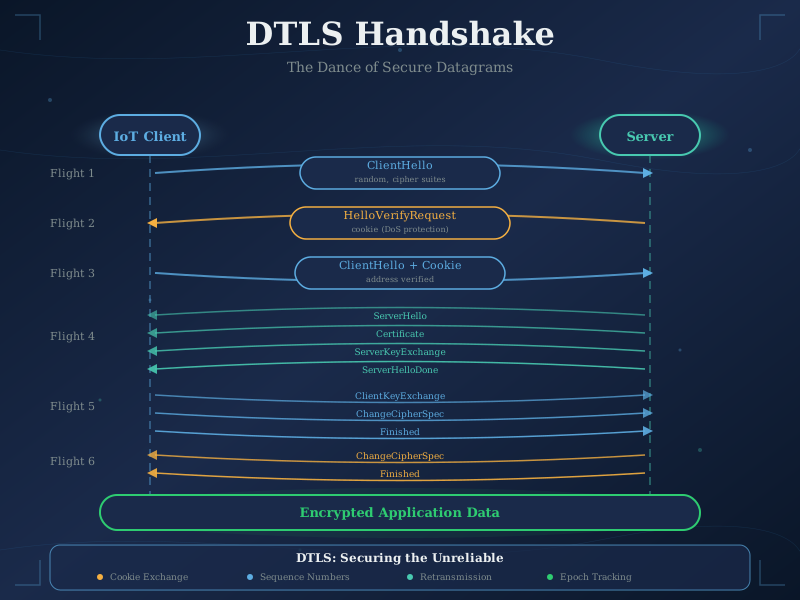
DTLS adapts TLS security for datagram transport, enabling secure CoAP communication without TCP overhead.
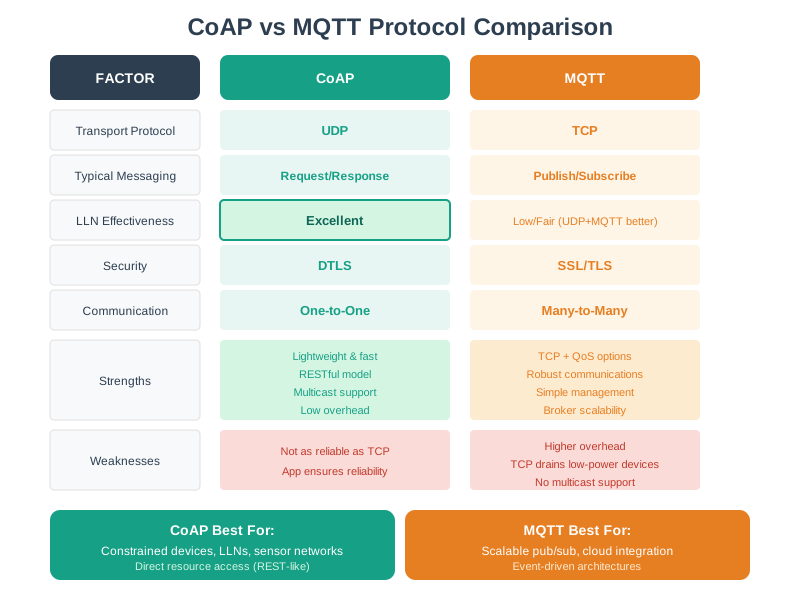
Understanding the differences between CoAP and MQTT helps in selecting the right application protocol for IoT scenarios.
733.12 What’s Next?
Return to the Transport Protocols Overview for links to all transport protocol topics, or continue to CoAP Protocol to see how these transport concepts apply to IoT application protocols.