%%{init: {'theme': 'base', 'themeVariables': {'primaryColor':'#2C3E50','primaryTextColor':'#fff','primaryBorderColor':'#16A085','lineColor':'#16A085','secondaryColor':'#E67E22','tertiaryColor':'#ecf0f1','background':'#ffffff','mainBkg':'#2C3E50','secondBkg':'#16A085','tertiaryBorderColor':'#95a5a6','clusterBkg':'#ecf0f1','clusterBorder':'#95a5a6','titleColor':'#2C3E50','edgeLabelBackground':'#ffffff','nodeTextColor':'#2C3E50'}}}%%
sequenceDiagram
    participant C as Client
    participant S as Server

    Note over C,S: 1. Connection Establishment
    C->>S: SYN (seq=100)
    S->>C: SYN-ACK (seq=200, ack=101)
    C->>S: ACK (ack=201)
    Note over C,S: Connection OPEN

    Note over C,S: 2. Reliable Data Transfer
    C->>S: Data (seq=101, len=50)
    S->>C: ACK (ack=151)
    Note over C,S: ACK confirms receipt

    S->>C: Data (seq=201, len=100)
    C->>S: ACK (ack=301)

    Note over C,S: 3. Connection Termination
    C->>S: FIN (seq=151)
    S->>C: ACK (ack=152)
    S->>C: FIN (seq=301)
    C->>S: ACK (ack=302)
    Note over C,S: Connection CLOSED
731 Transmission Control Protocol (TCP)
731.1 Transmission Control Protocol (TCP)
TCP is a connection-oriented protocol that guarantees establishment of connection before data transmission and ensures reliable, ordered delivery.
731.1.1 TCP Characteristics
TCP provides reliable, ordered delivery through connection setup, acknowledgments, and graceful teardown
731.2 TCP Properties
Connection-Oriented: - 3-way handshake: SYN, SYN-ACK, ACK before data transfer - Connection state: Both endpoints maintain connection information - 4-way termination: Graceful connection closure
Reliable: - Acknowledgments: Receiver confirms receipt of each segment - Retransmission: Lost packets automatically resent - Ordering: Sequence numbers ensure correct order - Error Detection: Checksum for data integrity
Flow Control: - Sliding window: Prevents sender from overwhelming receiver - Window size: Receiver advertises how much data it can accept
Congestion Control: - Slow start: Gradually increases transmission rate - Congestion avoidance: Backs off when network congested - Fast retransmit/recovery: Quickly recovers from packet loss
Use Cases: - Firmware updates (must be reliable) - Configuration data - File transfers - HTTP (web browsing) - MQTT (reliable pub/sub messaging)
731.2.1 TCP Header Structure
%%{init: {'theme': 'base', 'themeVariables': {'primaryColor':'#2C3E50','primaryTextColor':'#fff','primaryBorderColor':'#16A085','lineColor':'#16A085','secondaryColor':'#E67E22','tertiaryColor':'#ecf0f1','background':'#ffffff','mainBkg':'#2C3E50','secondBkg':'#16A085','tertiaryBorderColor':'#95a5a6','clusterBkg':'#ecf0f1','clusterBorder':'#95a5a6','titleColor':'#2C3E50','edgeLabelBackground':'#ffffff','nodeTextColor':'#2C3E50'}}}%%
graph TB
    subgraph "TCP Segment"
        subgraph "TCP Header: 20-60 bytes"
            H1[Source Port<br/>16 bits]
            H2[Dest Port<br/>16 bits]
            H3[Sequence Number<br/>32 bits<br/>Ordering]
            H4[Ack Number<br/>32 bits<br/>Reliability]
            H5[Header Length<br/>4 bits]
            H6[Flags<br/>SYN/ACK/FIN<br/>9 bits]
            H7[Window Size<br/>16 bits<br/>Flow Control]
            H8[Checksum<br/>16 bits]
            H9[Options<br/>0-40 bytes]
        end
        subgraph "Data"
            D[Application Payload]
        end
    end

    H1 --> D
    H2 --> D
    H3 --> D
    H4 --> D
    H5 --> D
    H6 --> D
    H7 --> D
    H8 --> D
    H9 --> D

    style H1 fill:#2C3E50,stroke:#16A085,color:#fff
    style H2 fill:#2C3E50,stroke:#16A085,color:#fff
    style H3 fill:#E67E22,stroke:#16A085,color:#fff
    style H4 fill:#E67E22,stroke:#16A085,color:#fff
    style H5 fill:#2C3E50,stroke:#16A085,color:#fff
    style H6 fill:#E67E22,stroke:#16A085,color:#fff
    style H7 fill:#16A085,stroke:#2C3E50,color:#fff
    style H8 fill:#2C3E50,stroke:#16A085,color:#fff
    style H9 fill:#2C3E50,stroke:#16A085,color:#fff
    style D fill:#27ae60,stroke:#16a085,color:#fff
TCP header is 20-60 bytes with extensive fields for reliability, ordering, and flow control - higher overhead than UDP
TCP Header Fields (simplified):
| Field | Size | Purpose |
|---|---|---|
| Source/Dest Port | 16 bits each | Application endpoints |
| Sequence Number | 32 bits | Byte stream position |
| Acknowledgment Number | 32 bits | Next expected byte |
| Flags | 9 bits | SYN, ACK, FIN, RST, PSH, URG |
| Window Size | 16 bits | Flow control (receiver buffer) |
| Checksum | 16 bits | Error detection |
| Options | 0-40 bytes | MSS, timestamps, window scaling |
Total Header: 20-60 bytes (vs 8 bytes for UDP)
731.2.2 Why TCP for IoT?
Advantages:
- Reliability: Guaranteed delivery (critical for firmware updates)
- Ordering: Data arrives in correct sequence
- Error Recovery: Automatic retransmission
- Flow Control: Prevents buffer overflow
- Congestion Control: Network-friendly
Disadvantages:
- High Overhead: 20-60 byte header + connection state
- Higher Latency: 3-way handshake before data, retransmission delays
- Power Consumption: Connection state, acknowledgments, retransmissions
- Memory: Connection state requires RAM
- Not Real-Time: Retransmissions cause variable latency
IoT Applications Using TCP: - MQTT (Message Queue Telemetry Transport): Pub/sub messaging - HTTP/HTTPS: Web APIs, RESTful services - Firmware Updates: OTA (Over-The-Air) updates - Configuration: Device configuration and management - File Transfer: Log files, images
NoteAlternative Views: Transport Protocol Visualizations
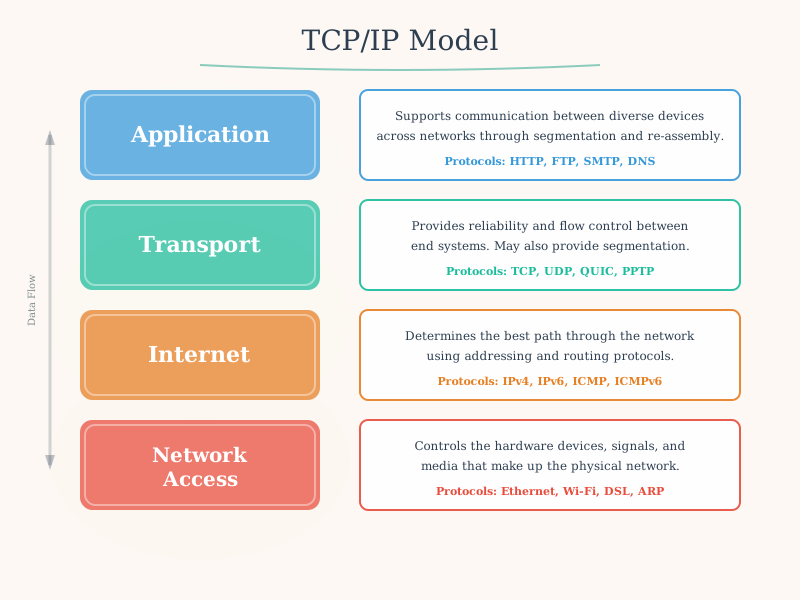
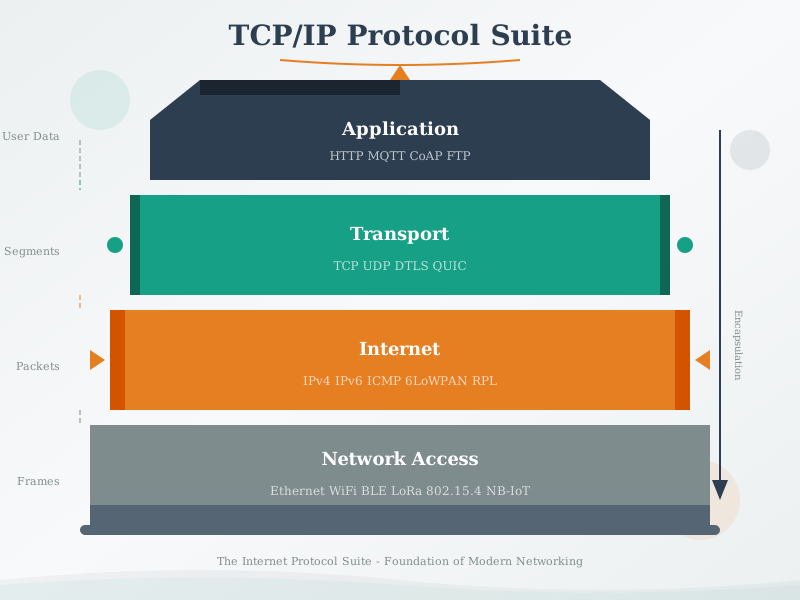
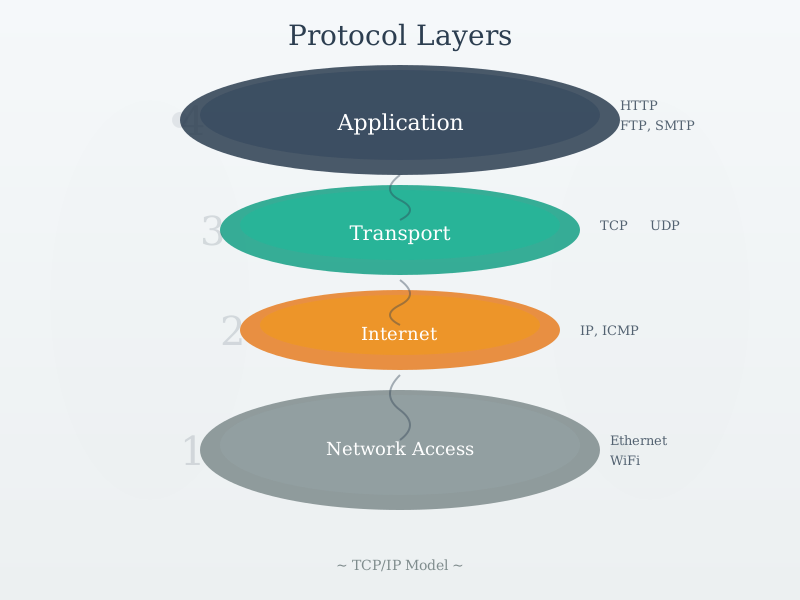
The TCP/IP model simplifies the OSI reference model into four practical layers. The transport layer (TCP/UDP) provides end-to-end communication, while the internet layer (IP) handles addressing and routing across networks.
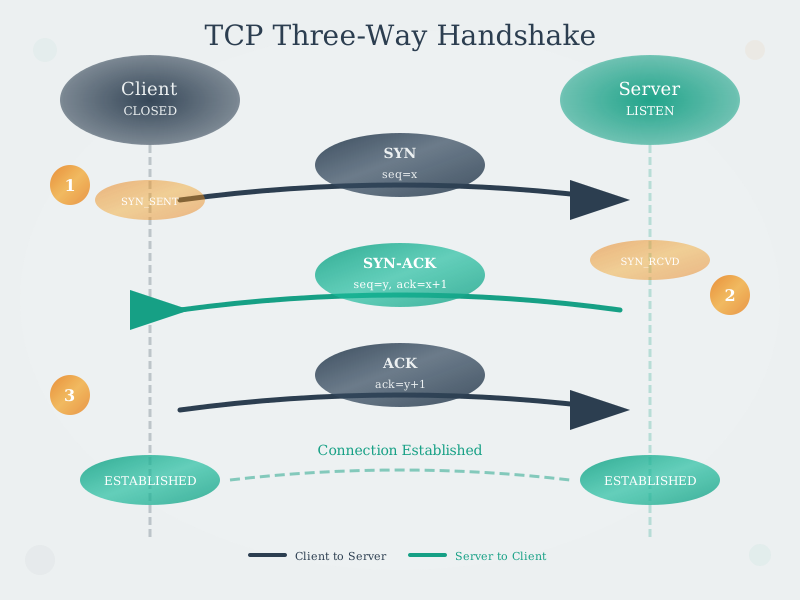
The three-way handshake ensures both endpoints are ready to communicate and synchronizes sequence numbers. For IoT, this overhead of 3 packets before any data transfer makes TCP costly for infrequent sensor readings.
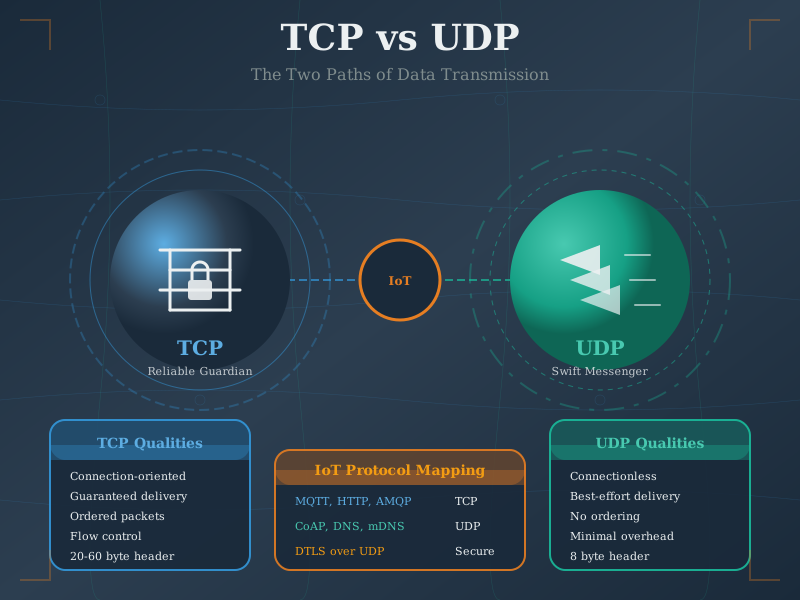
TCP provides reliability through acknowledgments, sequencing, and retransmission but at the cost of overhead and latency. UDP offers minimal overhead and low latency but provides no delivery guarantees. IoT protocols like CoAP build reliability on top of UDP when needed.

Beyond TCP and UDP, modern transport protocols include QUIC (Google’s UDP-based protocol with built-in TLS, used by HTTP/3), SCTP (multi-stream with failover), and DCCP (datagram with congestion control). For IoT, understanding when to use each helps optimize performance.
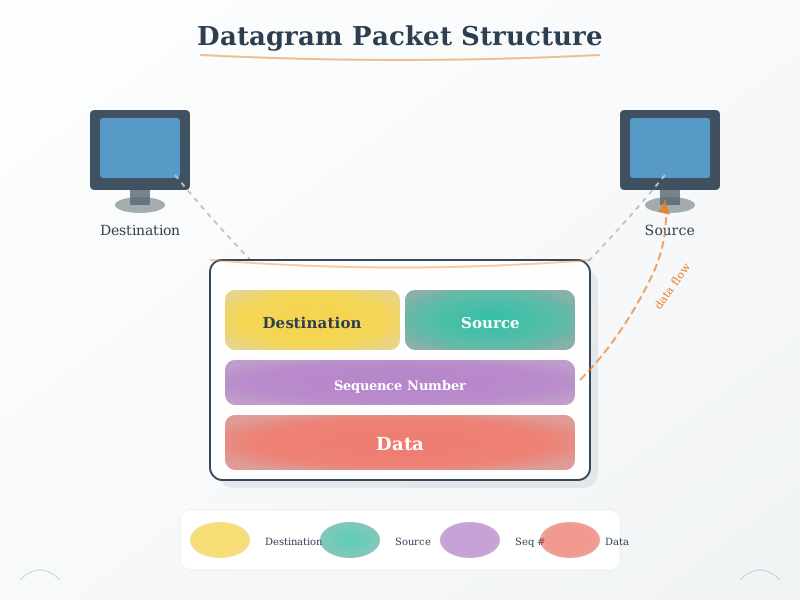
UDP’s connectionless model means each datagram is independent. The sender fires off datagrams without waiting for acknowledgments, and the receiver processes them as they arrive. This simplicity makes UDP ideal for real-time applications where occasional loss is acceptable.
731.2.3 TCP Analogy
TipTCP is Like a Telephone Call
TCP is similar to a telephone system:
- Dial number (SYN - request connection)
- Other person answers (SYN-ACK - acknowledge request)
- You say hello (ACK - confirm connection)
- Connection established - can now talk
- Conversation - back-and-forth communication
- “Did you hear me?” - acknowledgments
- Repeat if needed - retransmission
- “Goodbye” (FIN - close connection)
- “Goodbye back” (FIN-ACK - confirm closure)
Both ends must be connected before communication can begin.
731.3 TCP vs UDP Comparison
%%{init: {'theme': 'base', 'themeVariables': {'primaryColor':'#2C3E50','primaryTextColor':'#fff','primaryBorderColor':'#16A085','lineColor':'#16A085','secondaryColor':'#E67E22','tertiaryColor':'#ecf0f1','background':'#ffffff','mainBkg':'#2C3E50','secondBkg':'#16A085','tertiaryBorderColor':'#95a5a6','clusterBkg':'#ecf0f1','clusterBorder':'#95a5a6','titleColor':'#2C3E50','edgeLabelBackground':'#ffffff','nodeTextColor':'#2C3E50'}}}%%
graph TB
    subgraph "TCP Characteristics"
        T1[Connection-Oriented<br/>3-way handshake]
        T2[Reliable<br/>ACKs + Retransmission]
        T3[Ordered<br/>Sequence numbers]
        T4[Flow Control<br/>Window size]
        T5[Header: 20-60 bytes]
        T6[Higher Power]
    end

    subgraph "UDP Characteristics"
        U1[Connectionless<br/>No handshake]
        U2[Best-Effort<br/>No guarantees]
        U3[Unordered<br/>No sequencing]
        U4[No Flow Control]
        U5[Header: 8 bytes]
        U6[Lower Power]
    end

    subgraph "Best Use Cases"
        TC[TCP:<br/>Firmware Updates<br/>Configuration<br/>MQTT]
        UC[UDP:<br/>Sensor Readings<br/>CoAP<br/>Video Streaming]
    end

    T1 & T2 & T3 & T4 & T5 & T6 --> TC
    U1 & U2 & U3 & U4 & U5 & U6 --> UC

    style T1 fill:#2C3E50,stroke:#16A085,color:#fff
    style T2 fill:#2C3E50,stroke:#16A085,color:#fff
    style T3 fill:#2C3E50,stroke:#16A085,color:#fff
    style T4 fill:#2C3E50,stroke:#16A085,color:#fff
    style T5 fill:#e74c3c,stroke:#c0392b,color:#fff
    style T6 fill:#e74c3c,stroke:#c0392b,color:#fff
    style U1 fill:#16A085,stroke:#2C3E50,color:#fff
    style U2 fill:#16A085,stroke:#2C3E50,color:#fff
    style U3 fill:#16A085,stroke:#2C3E50,color:#fff
    style U4 fill:#16A085,stroke:#2C3E50,color:#fff
    style U5 fill:#27ae60,stroke:#16a085,color:#fff
    style U6 fill:#27ae60,stroke:#16a085,color:#fff
    style TC fill:#E67E22,stroke:#16A085,color:#fff
    style UC fill:#E67E22,stroke:#16A085,color:#fff
TCP vs UDP trade-offs: reliability and ordering vs low overhead and power efficiency
731.3.1 Detailed Comparison Table
| Feature | TCP | UDP |
|---|---|---|
| Connection | Connection-oriented (handshake) | Connectionless |
| Reliability | Reliable (ACKs, retransmission) | Best-effort (no guarantees) |
| Ordering | Ordered delivery | Unordered (may arrive out of sequence) |
| Header Size | 20-60 bytes | 8 bytes |
| Overhead | High (ACKs, state, retrans) | Low (fire and forget) |
| Speed | Slower (handshake, ACKs) | Faster (immediate transmission) |
| Latency | Higher (variable due to retrans) | Lower (predictable) |
| Flow Control | Yes (sliding window) | No |
| Congestion Control | Yes (slow start, etc.) | No |
| Error Recovery | Automatic retransmission | None (app must handle) |
| Broadcast/Multicast | No (point-to-point only) | Yes |
| Power Consumption | Higher (state, ACKs) | Lower (minimal processing) |
| Memory Usage | Higher (connection state) | Lower (stateless) |
| Best For | Reliability critical | Low latency, real-time |
| IoT Use Cases | Firmware, config, MQTT | CoAP, telemetry, streaming |
NoteAlternative View: Congestion Control Behavior Comparison
This variant shows how TCP and UDP behave differently during network congestion - critical for understanding IoT performance during high-traffic periods.
%%{init: {'theme': 'base', 'themeVariables': {'primaryColor': '#2C3E50', 'primaryTextColor': '#fff', 'primaryBorderColor': '#16A085', 'lineColor': '#E67E22', 'secondaryColor': '#16A085', 'tertiaryColor': '#E8F6F3', 'fontSize': '10px'}}}%%
sequenceDiagram
    box rgb(46, 125, 50) TCP Congestion Control
    participant TS as Sensor
    participant TN as Network
    participant TG as Gateway
    end

    box rgb(231, 76, 60) UDP No Congestion Control
    participant US as Sensor
    participant UN as Network
    participant UG as Gateway
    end

    Note over TS,TG: TCP: Backs off when congested
    TS->>TN: Data (window=4)
    TN--xTG: Congestion detected!
    TN->>TS: ACK (window=2)
    Note over TS: Reduce rate by 50%
    TS->>TN: Data (window=2)
    TN->>TG: OK
    Note over TS,TG: TCP adapts, network recovers

    Note over US,UG: UDP: Ignores congestion
    US->>UN: Data 1
    US->>UN: Data 2
    US->>UN: Data 3
    US->>UN: Data 4
    UN--xUG: Packets 2,3 dropped!
    UN->>UG: Data 1, 4
    Note over US,UG: UDP keeps sending<br/>Congestion persists
Key Insight: TCP’s congestion control is “network-friendly” but adds latency. For IoT with bursty traffic, UDP with application-level rate limiting often provides better predictable performance.
731.3.2 When to Use TCP vs UDP in IoT
731.4 Decision Guide
Use TCP when: - Reliability is critical: Firmware updates, configuration - Data must be ordered: Sequential commands, file transfers - Data loss unacceptable: Financial transactions, critical commands - Network is reliable: Wired connections, stable Wi-Fi - Power not a constraint: Mains-powered devices
Use UDP when: - Low latency required: Real-time monitoring, video streaming - Periodic data: Sensor readings every N seconds - Data loss tolerable: Occasional reading loss OK - Broadcast/multicast needed: One-to-many communication - Power constrained: Battery-powered sensors - Overhead matters: 6LoWPAN, constrained networks
Consider hybrid approach: - UDP for telemetry (sensor data) - TCP for critical ops (firmware, config) - Application-level reliability on UDP (CoAP confirmable messages)
731.5 Interactive Tool: TCP vs UDP Protocol Selector
Use this interactive tool to help determine whether TCP or UDP is more appropriate for your IoT application. Select the requirements that apply to your use case, and the tool will recommend a protocol based on a weighted scoring system.
NoteProtocol Selector Tool
731.6 Visual Reference Gallery
NoteTransport Protocol Comparison
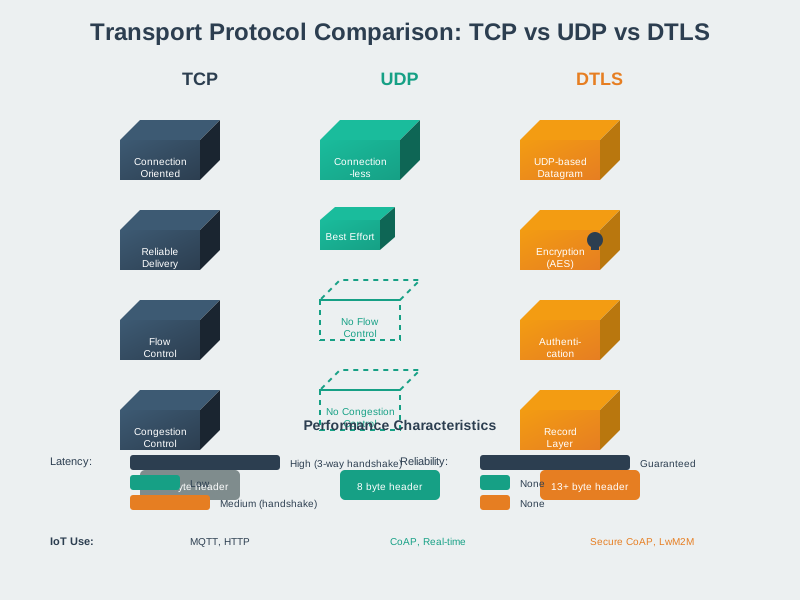
Transport protocols provide the foundation for IoT communication, with TCP offering reliability and UDP offering efficiency for different use cases.
NoteTCP vs UDP Comparison
Choosing between TCP and UDP depends on reliability requirements, latency constraints, and power consumption considerations for IoT devices.
NoteTCP Three-Way Handshake
The TCP three-way handshake establishes reliable connections but adds latency and overhead, making it less suitable for frequent short transmissions.