%%{init: {'theme': 'base', 'themeVariables': {'primaryColor': '#2C3E50', 'primaryTextColor': '#fff', 'primaryBorderColor': '#16A085', 'lineColor': '#16A085', 'secondaryColor': '#E67E22', 'tertiaryColor': '#7F8C8D', 'background': '#ffffff', 'mainBkg': '#2C3E50', 'secondBkg': '#16A085', 'tertiaryBkg': '#E67E22'}}}%%
graph TB
    subgraph Star["Star Topology"]
        S1[Central Hub]
        D1[Device 1]
        D2[Device 2]
        D3[Device 3]
        D4[Device 4]
        S1 --- D1
        S1 --- D2
        S1 --- D3
        S1 --- D4
    end

    subgraph Bus["Bus Topology"]
        B[Main Backbone]
        B1[Device A] -.-> B
        B2[Device B] -.-> B
        B3[Device C] -.-> B
        B4[Device D] -.-> B
    end

    subgraph Ring["Ring Topology"]
        R1[Node 1] --> R2[Node 2]
        R2 --> R3[Node 3]
        R3 --> R4[Node 4]
        R4 --> R1
    end

    subgraph Mesh["Mesh Topology"]
        M1[Sensor 1] --- M2[Sensor 2]
        M1 --- M3[Sensor 3]
        M1 --- M4[Sensor 4]
        M2 --- M3
        M2 --- M4
        M3 --- M4
    end

    classDef starStyle fill:#2C3E50,stroke:#16A085,stroke-width:3px,color:#fff
    classDef busStyle fill:#16A085,stroke:#2C3E50,stroke-width:2px,color:#fff
    classDef ringStyle fill:#E67E22,stroke:#2C3E50,stroke-width:2px,color:#fff
    classDef meshStyle fill:#7F8C8D,stroke:#2C3E50,stroke-width:2px,color:#fff

    class S1,D1,D2,D3,D4 starStyle
    class B,B1,B2,B3,B4 busStyle
    class R1,R2,R3,R4 ringStyle
    class M1,M2,M3,M4 meshStyle
775 Network Topologies: Basic Types
775.1 Learning Objectives
By the end of this section, you will be able to:
- Understand Basic Topology Concepts: Define what network topology means and why it matters
- Identify the Four Fundamental Topologies: Recognize star, bus, ring, and mesh configurations
- Compare Topology Characteristics: Understand the trade-offs between different topology types
- Read Network Diagrams: Interpret topology symbols and conventions
- Select Appropriate Topology: Choose topology based on basic IoT requirements
NoteRelated Chapters
Deep Dives: - Network Topologies Overview - Chapter index and navigation - Topology Analysis - Graph theory and failure analysis - Communication Patterns - Data flow patterns - Hybrid Design - Real-world hybrid topologies
Routing: - Routing Fundamentals - How routing works in topologies
IoT Protocols: - Zigbee Mesh - Mesh topology implementation - LoRaWAN - Star topology for wide area
775.2 Prerequisites
Before diving into this chapter, you should be familiar with:
- Networking Basics: Understanding fundamental networking concepts including switches, routers, hubs, and basic network design principles
775.3 What is a Network Topology?
TipSimple Explanation
Analogy: Network topology is like how desks are arranged in a classroom. You can arrange desks in rows, circles, groups, or a mix. Each arrangement affects how easily students can communicate, who can see whom, and what happens if one desk is removed.
In everyday terms: - Star = Everyone talks to one central person (like a teacher in the middle) - Bus = Everyone sits along one hallway and passes messages down the line - Ring = Everyone sits in a circle, messages go around - Mesh = Everyone can talk directly to everyone else
ImportantWhy Network Topologies Matter for IoT
Understanding network topologies is essential for designing scalable IoT systems. Whether deploying smart home sensors, industrial monitoring, or smart city infrastructure, the topology determines reliability, scalability, and performance. Physical placement of sensors and logical communication patterns directly impact system effectiveness.
NoteKey Takeaway
In one sentence: Your network topology determines fault tolerance, latency, and scalability—star is simple but has a single point of failure, mesh is resilient but complex.
Remember this: Start with star topology for simple deployments (easy to manage), but plan for mesh when reliability matters more than simplicity—a failed hub in star topology takes down everything.
775.4 The Four Fundamental Topologies
775.4.1 Star Topology
In a star topology, all devices connect to a central hub or switch. All communication passes through this central point.
Characteristics: - Structure: Central hub with radial connections to all devices - Connections: n-1 connections for n devices - Path Length: Maximum 2 hops (device → hub → device) - Management: Easy to add/remove devices without affecting others
Advantages: - Simple to install and manage - Easy troubleshooting (isolate faulty device) - Adding devices doesn’t affect existing connections - High bandwidth per connection (dedicated link to hub)
Disadvantages: - Single point of failure at the hub - Hub bandwidth can become bottleneck - More cabling required than bus topology - Hub failure disconnects all devices
IoT Examples: Wi-Fi networks (devices → access point), LoRaWAN (sensors → gateway)
775.4.2 Bus Topology
In a bus topology, all devices connect to a single shared communication line (backbone).
Characteristics: - Structure: Linear backbone with device taps - Connections: Single shared medium - Path Length: Direct access to backbone - Medium Access: Contention-based (CSMA/CD or similar)
Advantages: - Simple and inexpensive to implement - Minimal cabling required - Easy to extend by adding devices - Works well for small networks
Disadvantages: - Single cable failure disconnects all devices - Collisions reduce performance as devices increase - Difficult to troubleshoot - Limited scalability
IoT Examples: Industrial fieldbus (CAN, Modbus), legacy coaxial Ethernet
775.4.3 Ring Topology
In a ring topology, devices connect in a circular chain where data travels in one direction (or both in dual-ring).
Characteristics: - Structure: Circular chain of devices - Connections: n connections for n devices - Path Length: Average n/4 hops - Medium Access: Token passing (deterministic)
Advantages: - Deterministic latency (predictable timing) - No collisions (token-based access) - Equal access for all devices - Performs well under heavy load
Disadvantages: - Single break disrupts entire network - Adding/removing devices interrupts network - Requires careful configuration - Higher latency for distant nodes
IoT Examples: Industrial control systems (PROFINET, BACnet MS/TP), FDDI networks
775.4.4 Mesh Topology
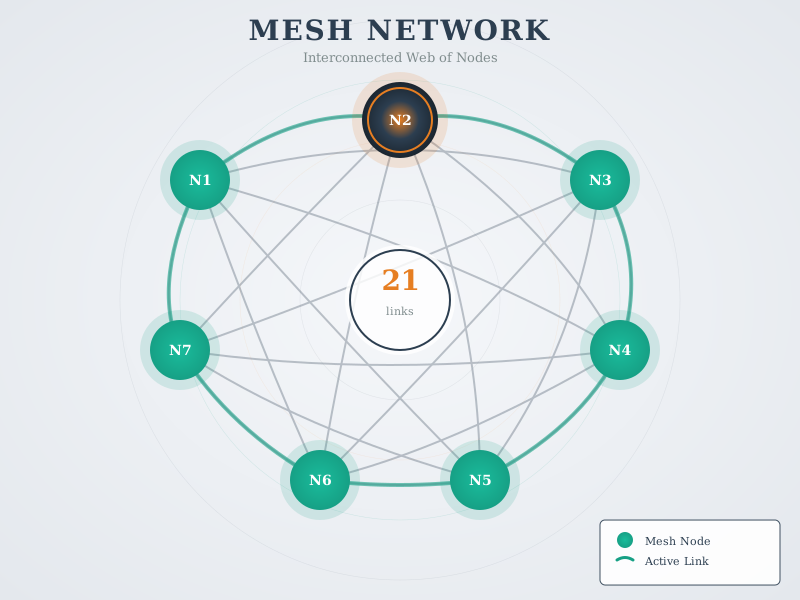
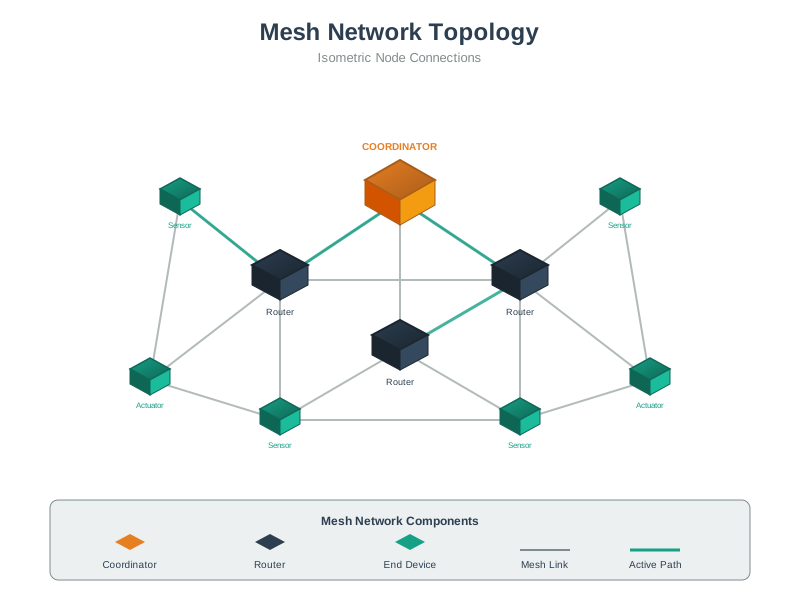
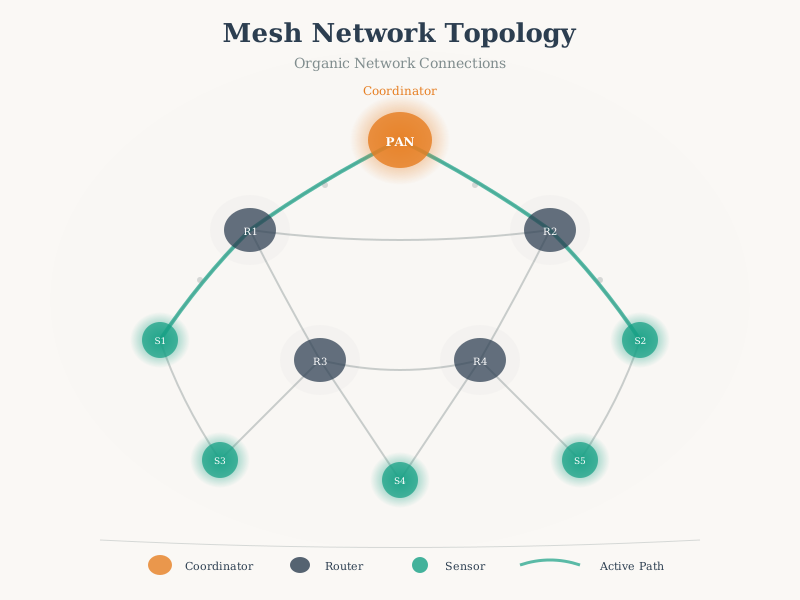
In a mesh topology, devices have multiple connections to other devices, providing redundant paths.
Characteristics: - Full Mesh: Every device connects to every other device (n(n-1)/2 connections) - Partial Mesh: Selected redundant connections (compromise) - Path Length: Typically 1-4 hops - Self-Healing: Routes around failures automatically
Advantages: - Highly fault-tolerant (multiple paths) - Self-healing when nodes fail - Scales well for coverage area - No single point of failure
Disadvantages: - Complex routing and configuration - Higher cost (more connections) - Routing overhead consumes bandwidth - More difficult to manage
IoT Examples: Zigbee mesh, Thread/Matter, BLE Mesh, Z-Wave
775.5 Topology Comparison
| Topology | Connections (n nodes) | Max Hops | Fault Tolerance | Complexity | Best For |
|---|---|---|---|---|---|
| Star | n - 1 | 2 | Low (SPOF) | Low | Simple deployments |
| Bus | 1 backbone | 1 | Low (SPOF) | Low | Small networks |
| Ring | n | n/2 | Medium | Medium | Deterministic timing |
| Mesh | n(n-1)/2 (full) | 1 | High | High | Critical systems |
775.6 Topology Selection Decision Tree
NoteAlternative View: Topology Selection Decision Tree
This decision tree helps select the optimal network topology based on IoT deployment requirements.
%% fig-alt: Decision tree for selecting network topology based on reliability requirements, device count, bandwidth needs, and cost constraints
%%{init: {'theme': 'base', 'themeVariables': {'primaryColor': '#2C3E50', 'primaryTextColor': '#fff', 'primaryBorderColor': '#16A085', 'lineColor': '#E67E22'}}}%%
flowchart TD
    START([IoT Network<br/>Topology Selection]) --> Q1{Reliability<br/>requirement?}

    Q1 -->|Mission critical| Q2{Device<br/>count?}
    Q1 -->|Standard| Q3{Bandwidth<br/>needs?}
    Q1 -->|Best effort| BUS[/Bus Topology/]

    Q2 -->|Many 50+| MESH[/Mesh Topology/]
    Q2 -->|Few < 20| Q4{Redundancy<br/>budget?}

    Q3 -->|High video/data| STAR[/Star Topology/]
    Q3 -->|Low sensors| Q5{Self-healing<br/>needed?}

    Q4 -->|High| RING[/Ring Topology/]
    Q4 -->|Limited| STAR

    Q5 -->|Yes| MESH
    Q5 -->|No| STAR

    MESH --> M_USE["Zigbee, Thread, Wi-Fi Mesh<br/>Self-healing, scalable"]
    STAR --> S_USE["Wi-Fi, Ethernet<br/>Central management"]
    RING --> R_USE["BACnet, Industrial<br/>Deterministic"]
    BUS --> B_USE["Legacy, simple<br/>Low cost"]

    style START fill:#2C3E50,color:#fff
    style MESH fill:#7F8C8D,color:#fff,stroke:#2C3E50,stroke-width:3px
    style STAR fill:#2C3E50,color:#fff,stroke:#16A085,stroke-width:3px
    style RING fill:#E67E22,color:#fff,stroke:#2C3E50,stroke-width:2px
    style BUS fill:#16A085,color:#fff
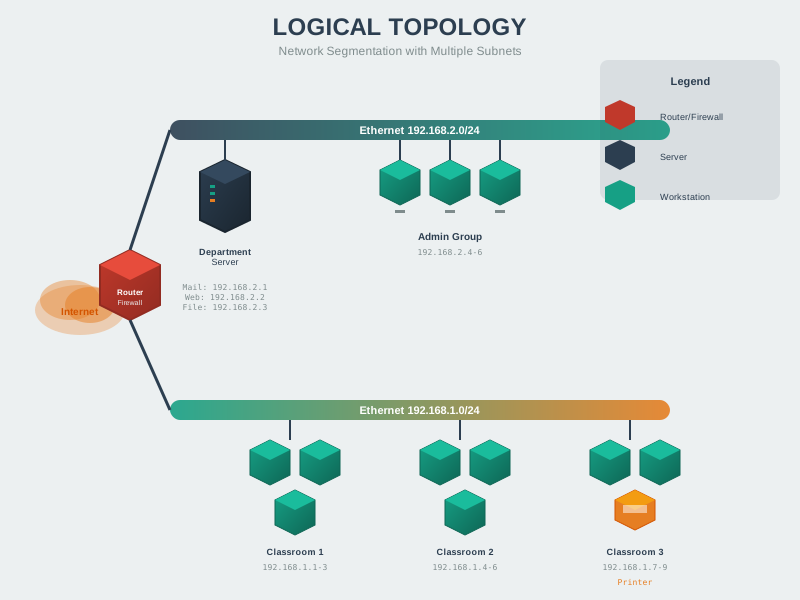
775.7 Visual Reference: Logical vs Physical Topologies
NoteAlternative Views: Network Topology Visualizations
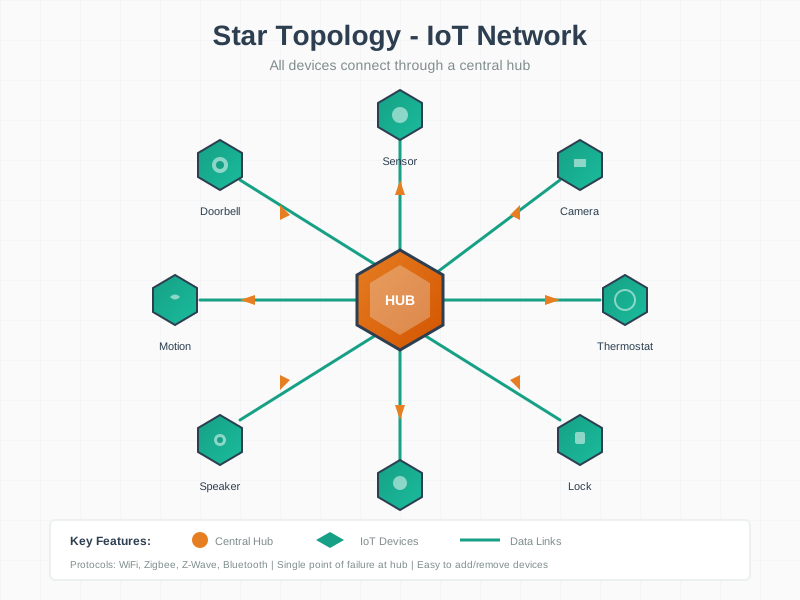
The star topology is the most common in modern networks, including home Wi-Fi and enterprise Ethernet. All traffic flows through the central hub, making it easy to manage and troubleshoot but creating a single point of failure if the hub fails.
Star topology is common in LPWAN protocols like LoRaWAN and Sigfox, where battery-powered sensors communicate directly with a gateway. This minimizes power consumption since devices don’t need to route traffic for other devices.
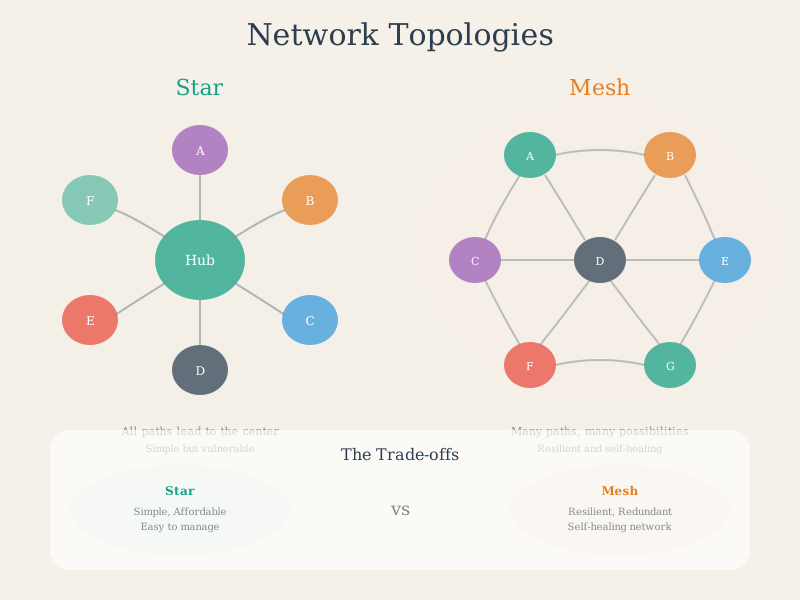
Choosing between star and mesh depends on requirements. Star offers simplicity and low latency (single hop) but limited range and single point of failure. Mesh provides extended range and redundancy through multi-hop routing but adds complexity and latency.
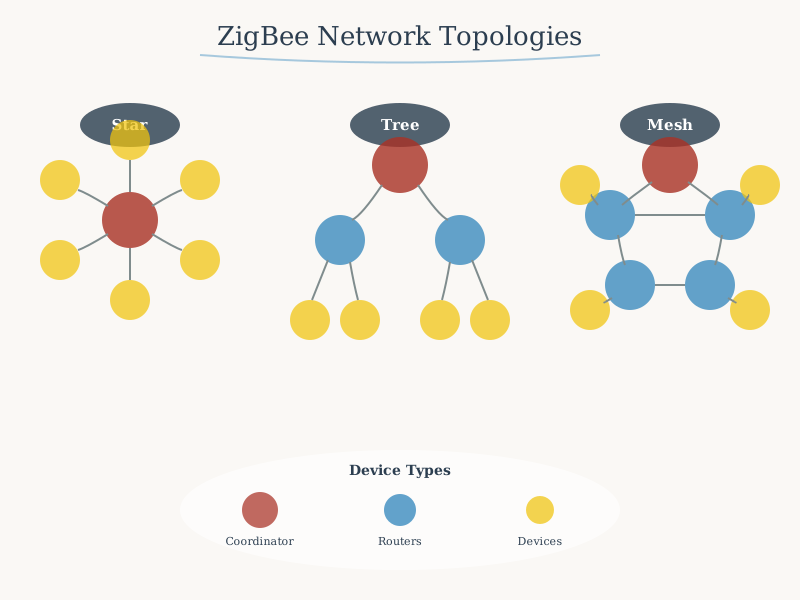
Tree (hierarchical) topology combines star topologies in a parent-child structure. Common in campus networks and Zigbee cluster-tree deployments, it provides scalable organization but relies on parent nodes being available.
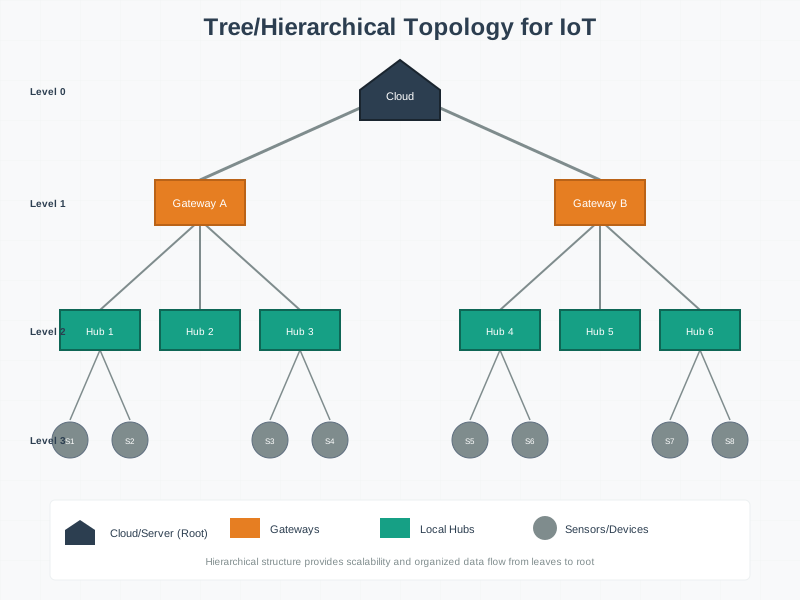
Tree topology is natural for building automation where floor controllers connect to wing controllers, which connect to room sensors. The hierarchy matches the physical building structure and simplifies addressing schemes.
775.8 Understanding Check: Smart Building Network Design
TipUnderstanding Check: Smart Building Network Design
Scenario: You’re designing networking for a 50,000 sq ft office building with 200 IoT devices: 120 LED lights, 40 HVAC sensors, 20 security cameras, 20 door locks. Requirements: lights must stay functional even if one fails, cameras need high bandwidth (2 Mbps each), HVAC sensors need ultra-reliability, door locks need redundant paths for safety. Budget: $80K for networking infrastructure.
Think about: 1. Would you use the same topology for all four device types? Why or why not? 2. What happens if your central switch fails in a star topology?
Key Insight: Use hybrid topology: Mesh for lights (Zigbee mesh, $10/device, survives individual node failure), Star for cameras (PoE switch, $3K, high bandwidth), Ring for HVAC (BACnet/MSTP, $500, redundant), Dual-star for locks (two star controllers, $8K, failover).
Cost breakdown: - Lights: 120 x $10 Zigbee modules = $1,200 (mesh self-heals when fixtures fail) - Cameras: 20 x $200 PoE cameras + $3,000 switch (8 ports @ 2Mbps = 16Mbps < 1Gbps) = $7,000 - HVAC: 40 x $50 sensors + $500 BACnet controller = $2,500 (ring provides redundancy) - Locks: 20 x $300 locks + 2 x $4,000 controllers (primary + backup) = $14,000 - Total: $24,700 vs $120K for full mesh or single-point-of-failure star
Hybrid reasoning: Lights tolerate delay (mesh routing latency OK), cameras need bandwidth (star provides direct paths), HVAC needs reliability (ring provides two paths to each sensor), locks need failover (dual controllers eliminate single point of failure).
Verify Your Understanding: - Why would a pure mesh topology fail for 20x 2Mbps camera streams? - How does ring topology provide redundancy without mesh complexity?
775.9 Summary
Network topologies define how IoT devices are interconnected. The four fundamental topologies each have distinct characteristics:
Star Topology: - Central hub with radial connections - Easy management, single point of failure - Best for: Simple deployments, high-bandwidth devices (Wi-Fi cameras)
Bus Topology: - Shared backbone, all devices tap in - Simple and inexpensive, limited scalability - Best for: Small networks, industrial fieldbus
Ring Topology: - Circular chain, token-based access - Deterministic timing, single break disrupts network - Best for: Industrial control systems requiring predictable latency
Mesh Topology: - Multiple redundant paths between devices - Self-healing, complex routing - Best for: Critical systems, large coverage areas (Zigbee, Thread)
Key Design Principle: Real-world IoT deployments rarely use pure topologies. Hybrid designs combine multiple topology types to optimize for different requirements across device classes.
775.10 What’s Next
In the next chapter, Topology Analysis, we’ll explore the mathematical foundations of topology design using graph theory, analyze failure modes and fault tolerance quantitatively, and examine routing overhead trade-offs.