702 RPL Worked Example: Smart Lighting Network
702.1 Worked Example: DODAG Construction Step-by-Step
By the end of this section, you will be able to:
- Calculate RANK values using actual RPL parameters
- Perform parent selection with multiple candidate parents
- Apply objective function formulas to real network scenarios
- Interpret final DODAG structure for routing decisions
This worked example walks through the complete DODAG construction process for a realistic smart lighting deployment. We will calculate RANK values using actual RPL parameters and show how parent selection works with varying link qualities.
702.2 Problem Context
Scenario: You are deploying a smart lighting mesh network in a commercial building lobby. The network consists of:
- 1 Border Router (Root): Connected to the building management system
- 9 Smart Light Controllers: Need to report status and receive dimming commands
- Goal: Build an RPL DODAG for reliable many-to-one (sensor data) and one-to-many (commands) communication
702.3 Given Parameters
RPL Configuration (RFC 6550 defaults):
| Parameter | Value | Description |
|---|---|---|
| MinHopRankIncrease | 256 | Minimum RANK increase per hop |
| Objective Function | OF0 with ETX | Minimize Expected Transmission Count |
| ETX Calculation | ETX = 1 / (delivery_ratio) | Higher ETX = worse link |
| RANK Formula | RANK = Parent_RANK + (MinHopRankIncrease x ETX) | Cumulative path cost |
Network Topology and Link Quality:

{fig-alt=“10-node smart lighting network topology showing border router ROOT at top connected to first-hop nodes A B C, which connect to second-hop nodes D E F, which connect to third-hop leaf nodes G H I. Links labeled with ETX values ranging from 1.0 for good links to 2.0 for poor links, demonstrating varying wireless link quality in building environment”}
702.4 Solution: Step-by-Step DODAG Construction
702.4.1 Step 1: Root Advertisement (t = 0s)
Root Action: Border router initializes DODAG and broadcasts first DIO message.
DIO Message Contents:
DIO {
  DODAG_ID: fd00::1
  RANK: 0
  Version: 1
  MinHopRankIncrease: 256
  Objective Function: OF0 (ETX)
}Result: Root has RANK = 0. All nodes within radio range receive this DIO.
702.4.2 Step 2: First-Hop Nodes Calculate RANK (t = 2-5s)
Nodes A, B, and C receive the root’s DIO and calculate their RANK values:
Node A Calculation: \[\text{RANK}_A = \text{Parent\_RANK} + (\text{MinHopRankIncrease} \times \text{ETX})\] \[\text{RANK}_A = 0 + (256 \times 1.0) = \mathbf{256}\]
Node B Calculation: \[\text{RANK}_B = 0 + (256 \times 1.0) = \mathbf{256}\]
Node C Calculation: \[\text{RANK}_C = 0 + (256 \times 1.5) = \mathbf{384}\]
Parent Selection: All three nodes select ROOT as parent (only option).
| Node | Parent | ETX to Parent | Calculated RANK |
|---|---|---|---|
| A | ROOT | 1.0 | 256 |
| B | ROOT | 1.0 | 256 |
| C | ROOT | 1.5 | 384 |
Actions: 1. Each node sends DAO to ROOT announcing reachability 2. Each node broadcasts DIO with its new RANK to neighbors
702.4.3 Step 3: Second-Hop Nodes - Parent Selection Decision (t = 5-10s)
This is where RPL’s intelligence shines. Second-hop nodes may hear DIOs from multiple parents and must choose the best one.
Node D: Receives DIO only from Node A \[\text{RANK}_D = 256 + (256 \times 1.0) = \mathbf{512}\] - Parent: A (only option)
Node E: Receives DIOs from both A and B (key decision point!)
Option 1: Via Node A (ETX 1.5) \[\text{RANK}_E^{(A)} = 256 + (256 \times 1.5) = 640\]
Option 2: Via Node B (ETX 1.0) \[\text{RANK}_E^{(B)} = 256 + (256 \times 1.0) = \mathbf{512}\]
Decision: Node E selects B as primary parent (lower RANK = better path) - Node E also stores A as backup parent (RANK 640, valid alternate)
Node F: Receives DIOs from B and C
Option 1: Via Node B (ETX 1.0) \[\text{RANK}_F^{(B)} = 256 + (256 \times 1.0) = \mathbf{512}\]
Option 2: Via Node C (ETX 1.5) \[\text{RANK}_F^{(C)} = 384 + (256 \times 1.5) = 768\]
Decision: Node F selects B as primary parent (RANK 512 < 768)
| Node | Candidate Parents | Calculated RANKs | Selected Parent | Final RANK |
|---|---|---|---|---|
| D | A only | 512 | A | 512 |
| E | A (640), B (512) | 640, 512 | B | 512 |
| F | B (512), C (768) | 512, 768 | B | 512 |
Notice that Node F could reach ROOT via C in just 2 hops (F to C to ROOT), but the poor link quality (ETX 1.5 + 1.5) makes this path worse than going through B (ETX 1.0 + 1.0), even though both are 2 hops. RANK incorporates link quality, not just hop count.
702.4.4 Step 4: Third-Hop Nodes - Final RANK Calculation (t = 10-15s)
Node G: Receives DIOs from D and E
Option 1: Via Node D (ETX 1.0) \[\text{RANK}_G^{(D)} = 512 + (256 \times 1.0) = \mathbf{768}\]
Option 2: Via Node E (ETX 2.0 - poor link!) \[\text{RANK}_G^{(E)} = 512 + (256 \times 2.0) = 1024\]
Decision: Node G selects D as parent (768 < 1024)
Node H: Receives DIOs from E and F
Option 1: Via Node E (ETX 1.0) \[\text{RANK}_H^{(E)} = 512 + (256 \times 1.0) = \mathbf{768}\]
Option 2: Via Node F (ETX 1.5) \[\text{RANK}_H^{(F)} = 512 + (256 \times 1.5) = 896\]
Decision: Node H selects E as parent (768 < 896)
Node I: Receives DIO only from F \[\text{RANK}_I = 512 + (256 \times 1.0) = \mathbf{768}\] - Parent: F (only option)
| Node | Candidate Parents | Calculated RANKs | Selected Parent | Final RANK |
|---|---|---|---|---|
| G | D (768), E (1024) | 768, 1024 | D | 768 |
| H | E (768), F (896) | 768, 896 | E | 768 |
| I | F only | 768 | F | 768 |
702.4.5 Step 5: DAO Propagation - Building Downward Routes (t = 15-25s)
After DODAG formation, DAO messages flow upward to build downward routing tables:
{fig-alt=“DAO message propagation sequence showing Node G sending DAO to parent D announcing reachability, D aggregating and sending to A, A aggregating and sending to ROOT. Each intermediate node stores routing entries. ROOT confirms with DAO-ACK flowing back down through D and A to G, completing downward route establishment”}
702.4.6 Step 6: Final DODAG Structure (t = 25-30s)
{fig-alt=“Final DODAG structure for 10-node smart lighting network showing hierarchical tree rooted at border router with Rank 0. First hop has nodes A B C with Ranks 256 256 384. Second hop has D E F all with Rank 512, where B serves as parent for both E and F. Third hop has leaf nodes G H I all with Rank 768. Dotted lines show backup parent relationships from A to E and F to H for fault tolerance”}
702.5 Final Answer: Complete RANK Summary
| Node | Layer | Parent | ETX to Parent | RANK Calculation | Final RANK |
|---|---|---|---|---|---|
| ROOT | 0 | - | - | Root node | 0 |
| A | 1 | ROOT | 1.0 | 0 + 256x1.0 | 256 |
| B | 1 | ROOT | 1.0 | 0 + 256x1.0 | 256 |
| C | 1 | ROOT | 1.5 | 0 + 256x1.5 | 384 |
| D | 2 | A | 1.0 | 256 + 256x1.0 | 512 |
| E | 2 | B | 1.0 | 256 + 256x1.0 | 512 |
| F | 2 | B | 1.0 | 256 + 256x1.0 | 512 |
| G | 3 | D | 1.0 | 512 + 256x1.0 | 768 |
| H | 3 | E | 1.0 | 512 + 256x1.0 | 768 |
| I | 3 | F | 1.0 | 512 + 256x1.0 | 768 |
702.6 Interpretation: How RANK Determines Routing
Upward Routing (Sensor Data to Cloud): - Each node simply forwards to its parent (follows decreasing RANK) - Example: Light #9 (Node I) sends status: I to F (512) to B (256) to ROOT (0) to Cloud - Total path cost: 768 (Node I’s RANK represents cumulative ETX)
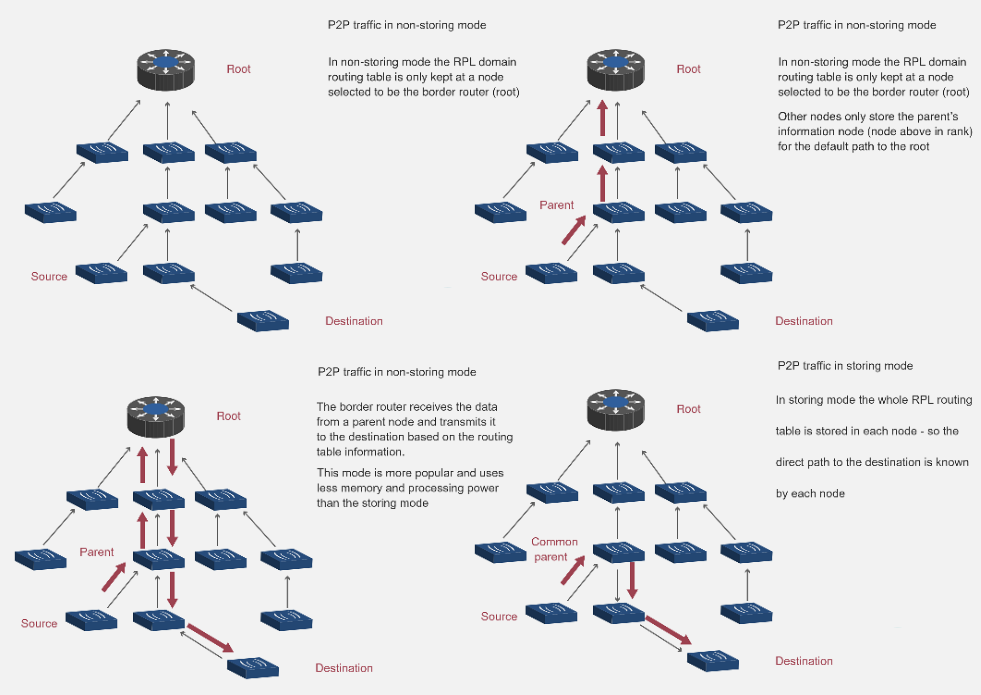
Downward Routing (Commands to Lights): - ROOT uses stored routing table from DAO messages - Example: Dim command to Light #7 (Node G): ROOT to A to D to G - Source routing header (Non-Storing) or hop-by-hop lookup (Storing)
Loop Prevention: - Data only flows toward lower RANK (upward) or via explicit routes (downward) - Node E (RANK 512) cannot send to Node F (RANK 512) directly - Point-to-point: E to B (256) to F (512) via common ancestor
Fault Tolerance: - If Node B fails, E has backup parent A (RANK 640 > 512, but functional) - E would recalculate: RANK_E = 256 + 384 = 640, network continues operating - Trickle timer detects failure within 3-4 DIO intervals
- RANK is cumulative: Each hop adds MinHopRankIncrease x ETX, not just +1
- Link quality matters: Node F chose B over C despite C being available, because B offered better cumulative path quality
- Multiple parents: Nodes can maintain backup parents for resilience (A as backup for E)
- Unbalanced trees are OK: Node B has 3 descendants (E, F, H, I indirectly), while C has none - this is optimal given link quality
- RANK inversion = loop: If Node H somehow got RANK < 512, it would create a loop with E - RPL prevents this
- MinHopRankIncrease = 256: This standard value allows for 16 sub-levels (256/16=16) of rank differentiation per hop for fine-grained path selection
702.7 Detailed Construction Steps
Root node (border router/gateway): 1. Creates DODAG: Assigns unique DODAG ID 2. Sets RANK = 0: Root has minimum RANK 3. Broadcasts DIO: Sends DODAG Information Object (multicast)
DIO Contents: - DODAG ID (IPv6 address) - RANK (0 for root) - Objective function (routing metric) - DODAG configuration (timers, etc.)
702.8 Step 2: Nodes Receive DIO and Join
Node receives DIO: 1. Decision: Join this DODAG or wait for others? - Compare DODAG rank, objective function - May receive DIOs from multiple DODAGs 2. Calculate RANK: RANK = parent_RANK + increase 3. Select parent: Choose sender of DIO (if acceptable) 4. Update state: Store DODAG ID, parent, RANK
Multiple DIO Sources: - Node may hear DIOs from multiple neighbors - Chooses best parent (lowest RANK, best link quality) - May maintain backup parents (loop-free)
702.9 Step 3: Nodes Propagate DIO
After joining DODAG: 1. Node becomes part of DODAG 2. Sends own DIO: Advertises DODAG to neighbors 3. DIO contents: Own RANK, DODAG ID, etc. 4. Trickle timer: Controls DIO frequency (adaptive)
Trickle Algorithm: - Stable network: Send DIOs infrequently (minutes) - Network changes: Send DIOs frequently (seconds) - Reduces overhead while maintaining responsiveness
Upward routes (towards root) established automatically: - Each node knows its parent (from DIO selection) - Default route: Send to parent (towards root) - No routing table needed for upward routes (just parent pointer)
Example:
Node 3 -> Node 1 -> Root
(N3 knows parent is N1, N1 knows parent is Root)Downward routes (from root to nodes) require DAO messages:
- Node sends DAO to parent:
- “I am reachable via you”
- Includes node’s address and prefixes
- Parent updates routing table:
- “Node X is reachable via this child”
- Parent propagates DAO towards root:
- Aggregates reachability information
- Root knows all nodes:
- Complete routing table for downward routes
DAO-ACK (optional): - Parent confirms DAO receipt - Reliability for critical networks
702.10 Summary
This worked example demonstrated:
- RANK Calculation: Using MinHopRankIncrease x ETX formula to compute cumulative path cost
- Parent Selection: Comparing multiple candidate parents and choosing the one offering lowest RANK
- Link Quality Impact: How poor links (high ETX) cause nodes to prefer longer paths with better quality
- Backup Parents: Maintaining alternate routes for fault tolerance
- Routing Interpretation: How RANK determines upward, downward, and point-to-point routing paths
702.11 What’s Next
Continue to RPL Trickle Algorithm and Routing Modes to learn how the Trickle timer minimizes control overhead and understand the trade-offs between Storing and Non-Storing modes.